
 . . .
. . . 
– in a perfect, Duanesburgian world, safe enough –
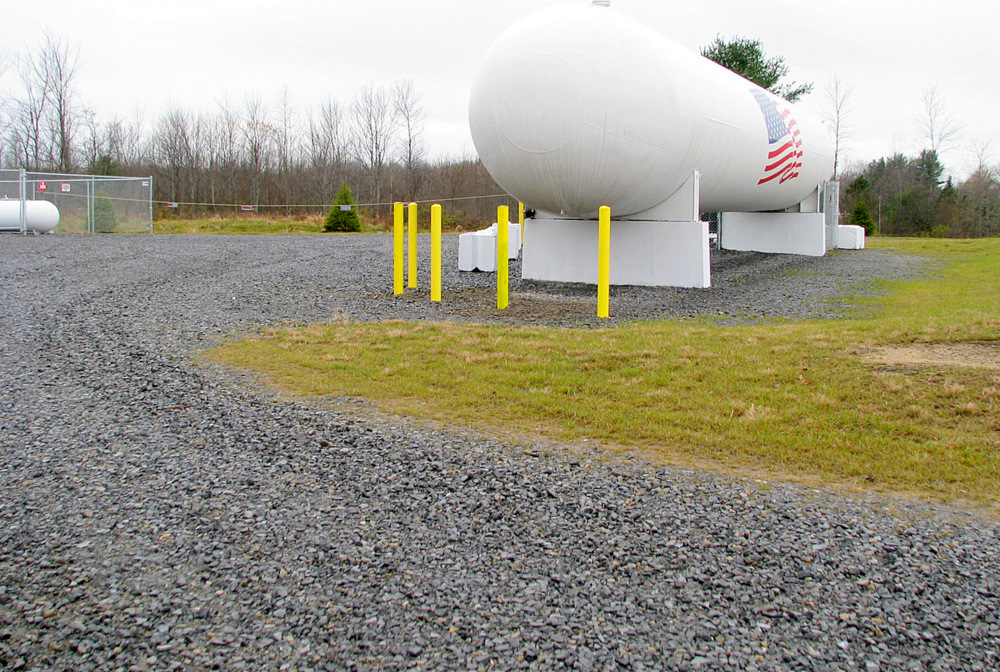
The Zoning Board of Appeals of the Town of Duanesburg voted last night, 4 to 2, to reject Bill and Cyndi’s appeal of the issuance of a Certificate of Occupancy to Long Energy for operation of its 30,000-gallon bulk propane tank facility, which sits 200 feet from their home on Western Turnpike (Rt. 20). The only question before it was whether the existing vehicle barriers are adequate under the NYS Fire Code. More specifically, the Board had to determine whether more and improved barriers were needed for all or portions of the tank, using the strict standards of Fire Code §312, because the tank was “exposed to vehicular damage” due to it being “in proximity” to the driveway and parking areas within the meaning of Fire Code §3807.4.
The lengthy Resolution passed by the Board repeatedly stated that the vehicles using the facility would be able to keep a “sufficient distance” from the tank and would not be able to reach a high enough speed to pose a risk to the tank. No mention was made of any accidents happening or unauthorized vehicles coming onto the ungated and unmanned facility and posing a danger for the tank, which is only 70 feet from Western Turnpike.
– To sum up the apparent reasoning behind the decision of the Duanesburg Zoning Board last night: Because we assume that everyone (including any unauthorized traffic) will drive safely, without driver error or equipment failure, the propane tank is safe from vehicular damage, despite its being only 70′ from the busiest road in town and being located on or very close to the semi-circular, gravel access driveway that must be used by all vehicles that enter or leave the unguarded and ungated facility. –

– part of our October 17 submission to ZBA –
Only ZBA members Russell Gage and Robert “Pat” Payst voted against the Resolution. Chair Wendy Graves and Members Patricia Wall, Evie Rudesheim and Kathleen Kosinski voted in favor. The entire “deliberation” by the members consisted of Member Payst saying the cement barriers on the south side of the tank seemed insubstantial. Long Energy must have assumed a positive outcome, because it had no lawyers or other representative present, despite being served in the matter by the Albany firm of Ganz Wolkenbreit & Siegfeld.
Here is a portion of my submission to the ZBA pointing out why the current barriers were insufficient
“Proximity” means nearness or closeness, according to countless dictionaries, including the Merriam-Webster online dictionary/thesaurus. Since the east and west ends of the tank, along with its entire south side, are actually contiguous/adjacent to the driveway, the tank is clearly in the proximity of the driveway.
Therefore, the Board must decide whether the tank is “exposed to vehicle damage” due to the expected traffic on that driveway. Such traffic includes the tanker trucks and bobtail tank trucks that are the primary facility visitors, plus company or contractor vehicles on-site for maintenance, repair or delivery of the customer-location tanks, as well as unauthorized traffic engaged in u-turns, repairs or mischief, or otherwise trespassing. As you know, the facility is located close to a busy road, with two roadside “curb-cuts” over 40’ wide, no entryway gate or guards to keep out unauthorized vehicles, and no personnel to help guide the movements of vehicles when maneuvering close to the tank. It is already being used as a turn-around and a spot to attend to vehicle repairs. In assessing the Long Energy tank’s exposure to vehicle damage, several additional factors should be considered:
- In common usage, “exposure to vehicle damage” means a tank is in jeopardy of sustaining such damage, not that the damage is inevitable.
- The exposure to damage does not mean only exposure that exists when all vehicles, drivers, and other personnel are operating in a completely correct and safe manner
- A meaningful exposure assessment must include situations where there has been driver error or misadventure, or a failure of one or more of a vehicle’s parts or systems (e.g., brakes), and it includes risk of impact created by unauthorized vehicles, and created by intentional as well as accidental impact.
- Such exposure is increased at the Duanesburg facility by weather conditions that regularly occur there — especially during the extensive heating season when the facility will be the busiest — such as fog, rain, snow, sleet, ice, etc.
- The difficulty of clearing down to its surface a gravel-covered driveway of snow and ice increases the exposure by reducing traction, even if the driveway were plowed and salted as soon and as often as needed
- Exposure is also increased by other facts: there is virtually no place for a vehicle to park other than the driveway; chains used to keep unauthorized vehicles from making a turn-around will force them to back down an incline to return to the road; the grassy portion in front of the tank is level and easy to access halfway up the driveway; and the fence surrounding the customer tank storage area behind the tank greatly limits the space at the top of the driveway through which all traffic must pass when coming and going.
Click here to see my submission to ZBA dated October 17, 2011, explaining further, with photos, why the barriers were inadequate (after we raised these issues Long Energy inserted two additional bollards at the east end of the tank to bring the distance between those barriers within the Code’s requirements); and click here for my December 1, 2011 letter to the Board responding to the ridiculous position taken by Jeff Siegel, attorney for the Town, that the Board must rely on the opinion of, William Smart, Long Energy’s hired engineer, because he is the only NYS certified engineer who has submitted an opinion on the adequacy of the barriers.
ZBA also concluded that the record was complete and it did not have to hear any testimony by the most important actor in this entire episode, Code Enforcement Officer Dale Warner, who issued the Certificate of Occupancy, nor allow the Miners or their attorney to question Mr. Warner about his decisions. Mr. Warner took a rare vacation on the night of the November public hearing and did not appear at that Board meeting. Click here for my Letter requesting that the public hearing be reopened to allow myself, and the Board, to question Mr. Warner.
At this time, we are expecting the inspector for the Code Enforcement office of the New York State Department of State to investigate this matter further and inform the Town of Duanesburg of what steps must be taken to comply with the vehicle barrier requirements of the NYS Fire Code relevant to propane tanks.
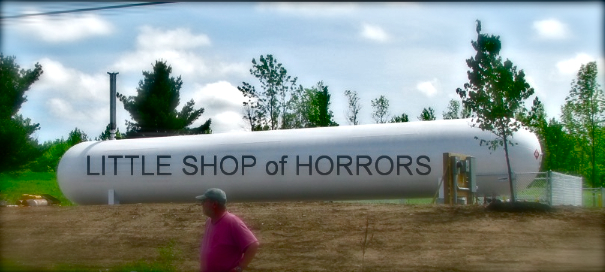 Don’t forget, the giant tank is located near homes and businesses and a church in a commercial zone because the Town Planning Board gave Long a Special Use Permit in the category of a Retail Store. This “store” has no building or personnel and makes no sales of any sort to customers. It is merely a bulk storage tank, where Long Energy’s bobtail propane tank trucks fill up before making deliveries to Long’s customers. See the full story, with facts and law explained, at “Duanesburg needs a dictionary“.
So, add “proximity” and “exposure” to the words the Town of Duanesburg can’t define correctly. And add one more example to the list of Duanesburg’s broken zoning promises.
. . . . . . . .

Just for the record, here is how I described this action before the Duanesburg ZBA at the original posting about the propane tank. [I’m moving the discussion here, to keep that posting focused on the overall facts and the challenge in the Supreme Court proceeding to what the Planning Board did issuing the special use permit]:
update (October 20, 2011): The Miners have asked the Town of Duanesburg Zoning Board of Appeals to rule that the fire code requirements have not been met (due to the failure to construct barriers of sufficient number and strength to protect the tank from vehicular impact and to install a perimeter fence around the facility to keep out unwanted people and vehicles), and that the Certificate of Occupancy issued for the site is therefore not valid. The ZBA’s public hearing on this matter will be held on November 15, 2011, at 7:30 PM, at Town Hall. Also, on September 27, 2011, Bill and Cyndi filed their Notice of Appeal to the appellate division from the Supreme Court decision by Judge Kramer, and served the Notice on the other parties.
update on the ZBA hearing (November 16, 2011): There was no decision last night (Nov. 15) at the Zoning Board of Appeals, which held its public hearing on the challenge by the Miners to the issuance by code enforcement officer Dale Warner of a Certificate of Occupancy for the propane facility. The appeal was based on the failure of the facility to comply with the Fire Code. I objected to having the hearing with Mr. Warner (whose decision is the focus of the challenge) absent and unavailable for our questions, but my objection was rejected. I also stated that I no longer believe that NFPA 58 and the Fire Code require a perimeter fence around the entire facility, but argued vigorously that the risk of vehicular impact required barriers around the entire tank, and they must meet Fire Code §312 standards, because the entire tank was “exposed to vehicular damage” due to it being “in proximity” to the driveway within the meaning of §3807.4. The Town’s attorney, Jeffrey Siegel argued that the street-side of the tank was not “in proximity to the driveway” and was not at risk of vehicular impact. [scroll down to our Appendix for more on this and other safety issues]
. . . “in proximity” to the driveway? . . . 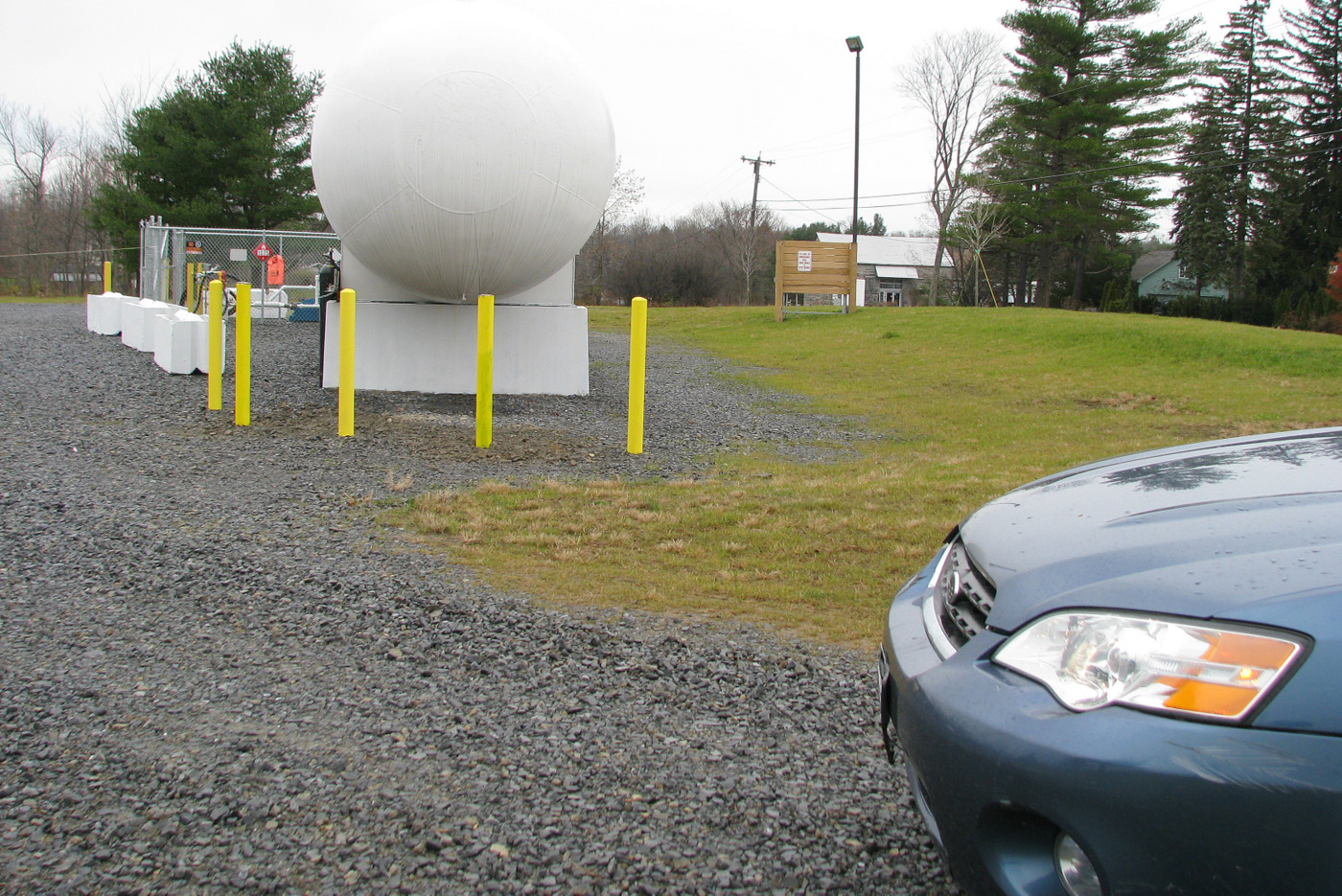
Many Duanesburg residents spoke out against the placement of that tank in the C-1 district and especially putting it so close to the road. The Board let the hearing continue for quite awhile, but closed the public hearing rather than adjourning it so Dale Warner could appear. Thankfully, ZBA did not decide on the appeal right then, as there are many things Members want to consider before voting; the item will be on the agenda for their next meeting, December 20. Unless the Board and the Miners agree to a longer period, ZBA must decide within 62 days of its public hearing.
A Personal Note on Homeland Security and the Tank: Robert E. Ganz, attorney for Long Energy, told the public hearing that I have wrongly stated for months that the Duanesburg tank is large enough to be considered a Chemical of Interest [COI] by the Department of Homeland Security’s Chemical Facility Anti-terrorist Standards [CFATS], due to its explosion potential as a target for a terrorist attack. Ganz produced a copy of an email from a DHS staffer saying the 30,000-gallon tank fell below the threshold to be considered a COI. That surprised me, as three different people at DHS told me last July that the threshold is 60,000 pounds, which amounts to around 15,000 to 18,000 gallons of propane. In addition, as a lawyer should, I further researched the issue at the time just to be certain and found the page in the Federal Register that officially sets forth the regulation and lists propane as a DHS Chemical of Interest when it has the Screening Threshold Quantity of 60,000 pounds. [click to see the Fed. Reg. DHS COI page] This morning, I wrote again to the DHS CFATS HelpDesk and they immediately wrote back confirming the 60,000 pounds number, saying that amount usually equates to about 18,000 gallons, which would include the Duanesburg tank, unless it is kept less than half full. I also emailed the DHS staffer quoted by Mr. Ganz, giving him my prior information from DHS, and he wrote back that he would research the issue and get back to me as soon as possible. I will follow up here as soon as I have more information from DHS.
follow-up (noon, Nov. 17, 2011): The DHS/CFATS enforcement officer who had written the email submitted by Lawyer Ganz phoned me this morning to say that my interpretation of the propane threshold is correct — it is 60,000 pounds, not 60,000 gallons — and that a facility with a 30,000-gallon propane tank does need to be registered by the owner and investigated by their office. He said his office would be letting Long Energy know that the advice given to them in July was incorrect.
 Naturally, I wish Mr. Ganz had contacted me last July when Long Energy got its response from DHS, so that we could have clarified the issue back then, rather than make the allegation four months later with great fanfare at a public hearing. I would never make blanket assertions about a law, especially one involving a specific quantity/number rather than requiring legal interpretation, without thorough research. And I would immediately correct any error.
Due to the Miners’ argument that the three bollards at the eastern end of the tank were out of compliance (as they were 84″ apart, rather than the maximum of 48″ required by the Fire Code), Long recently bridged the gap with two additional bollards. The lawyers for the Town and Long both said the Board should accept the opinion of the only engineer who has looked at the tank — Long’s engineer Bill Smart, who said three bollards was enough. Mr. Smart was clearly incorrect about the requirements for using bollards, and did not apply the standards of the Fire Code when erecting them. He also concluded that no barriers were needed across the entire south side of the tank, which is located directly along the driveway. Even Mr. Warner disagreed on that issue when Bill Miner pressed him about it in the summer; Warner made Long put cement blocks along the south side and around the appurtenances fence. (Those cement barriers are too short and too easily moved if hit by a large vehicle to comply with the Fire Code, which mandates more stringent specifications.)
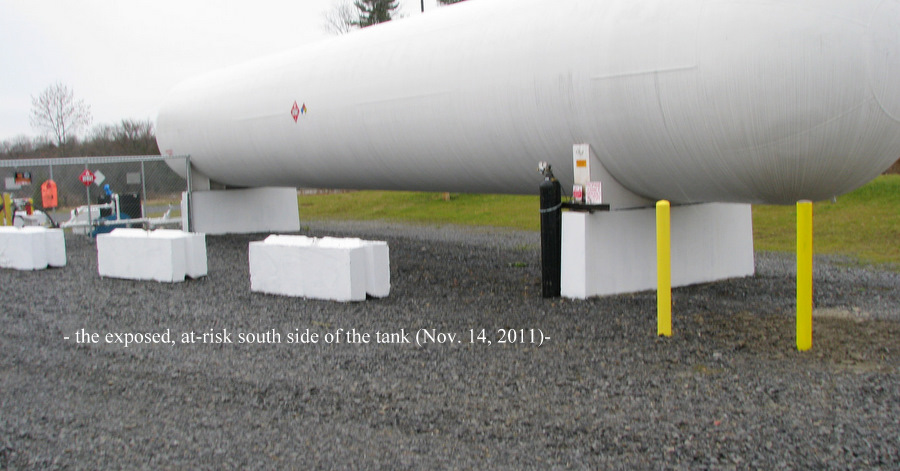 By any definition of risk of impact, barriers are clearly needed where the tank abuts the driveway: Even without taking into account intentional collision with the tank, it is at risk for accidental vehicle impact by the large trucks using the facility, or by unauthorized vehicles using the driveway or the grassy hill for a turn-around, out of curiosity, or for a prank (or romance). Long’s engineer was clearly not applying fire code requirements — or common sense – when deciding about protecting the tank from vehicle impact. His opinion should hold little weight when the Board is trying to decide this appeal.
 Risk of Impact cannot be gauged by asking what might happen if everything goes right. Drivers of large tanker trucks, bobtails, pick-ups and other vehicles on site make errors or take risks when they are tired or in a hurry, and vehicles malfunction. Fog is a constant problem limiting visibility at that location. In addition, the facility will be most frequently used in cold weather, when snow and ice, and severe cold can affect drivers and vehicles, and make the gravel surface of the driveway treacherous. Given its location on or so close to the driveway and the road, Long’s tank needs to be protected on all sides from vehicular impact.
Here’s the summary paragraph from my 7-page submission last night to the ZBA:
Due to the irresponsible and unlawful actions of the Planning Board and the Code Enforcement Officer, every person who lives, works, worships or shops along virtually all of Routes 20 and 7 in the Town of Duanesburg must now fear the placement of high-hazard and industrial uses in an area zoned C-1 commercial. We urge the Board to do all that it can to repair the damage that has been done to the trust and certainty that must exist in the zoning and planning process and to minimize the hazards created by this inappropriate use and occupancy by requiring the strict vehicle impact protection mandated under Duanesburg’s Zoning Ordinance and the Fire Code. As argued below, you have the full responsibility and all the authority necessary to do so.
. . status update (Nov. 24, 2011): As of November 22, I am serving as the lawyer for Bill & Cyndi Miner in the Zoning Board of Appeals proceeding. This should avoid the ambiguity created by trying to be their helpful friend. I’m still on retirement status as a member of the New York State Bar, so I am volunteering my services.
 snowmen at the gates