 Tomorrow, Dec. 17, 2014, the NYS Gaming Facility Location Board is expected to finally announce its selections for up to four Upstate gaming facility licenses. Before the winners and losers are chosen, however, we would like to set out our perspective on the coverage given to the casino selection process by the Schenectady Daily Gazette, which has editorially supported the Schenectady casino application.
Whether we “win” or “loose”, we believe it is important for the people of Schenectady to know how poorly the Gazette has performed the role of presenting the relevant casino news and helping the public (and our leaders) understand the issues and the likely impact of a casino on Schenectady and nearby communities. They are proud of being “locally owned” and “independent”, but we’re afraid that can translate into parochial, unaccountable coverage, far too susceptible to pressures from local government and business interests (including important current or potential advertisers), and from the social and personal demands on members of a small community of local leaders. In a way, “locally owned” can lead too readily to “locally bought”.
. . share this post with this short URL: http://tinyurl.com/GazetteTilt
Our posting this weekend (which we urge you to read), “the Gazette continues the ALCO tunnel coverup“, describes only one of the many ways in which the Schenectady Gazette appears to have skewed its coverage of the news of the casino application process, in order to present the Schenectady applicants and their proponents in a way that paints them in the best light, by avoiding tough questions, ignoring negative facts, and pretending that there is no organized, serious opposition locally to the casino. Any semblance of evenhanded news coverage ended June 9, 2014, the night the Schenectady City Council voted to support the application of Rush Street Gaming and the Galesi Group to operate a gaming facility at Mohawk Harbor, the former site of Schenectady’s ALCO plant. See the resulting Gazette editorial Casino would provide needed boost (June 10, 2014)
Meeting with Gazette Officials. Yesterday afternoon (Monday, Dec. 15, 2014), the Publisher of the Gazette, John DeAugustine, the Editor, Judy Patrick, and Miles Reed, the City Editor met with Stop the Schenectady Casino members Mohamed Hafez and myself (David Giacalone) to discuss our belief that the Gazette’s news coverage has favored the casino. They gave us a considerable amount of their time and made the valid points that they have a limited amount of resources to cover the wide world of local news and that they are bombarded by complaints they have not given enough coverage to particular issues or have not been impartial. The Gazette officials insisted they are proud of the wide coverage they have given the casino issue and seemed not to understand why we would want the Gazette to report the positions and arguments of Stop the Schenectady Casino, as opposed to merely vaguely mentioning concerns of those against a Schenectady casino.
We wanted (and needed) the public to know and the media to report there is a serious opposition campaign, because the Location Board wants to know the extent of local opposition, and because not mentioning our specific arguments and background information serves the interests of the casino applicant by default. To “write about” (usually, merely mentioning) crime, traffic, the proximity to Union College, and potential harm to the Stockade Historic neighborhood, etc., without mentioning our consistent focus on those issues, and our very specific research on the facts and research literature, not only has left the articles almost content-free, but fails to show the seriousness of the problems.
 The Gazette‘s editorial board endorsed the casino on June 9th, and — viewed from the outside as casino opponents, and also perhaps to the objective observer — its newsroom became a virtual public relations department for the Schenectady casino, with news editors seemingly reining in reporters who were initially curious and conscientious in covering casino issues. Despite the public’s desire to know more about the applicants and the pros and cons of locating a casino in Schenectady, the Gazette newsroom did little to counter the propaganda of local political leaders, the pie-in-the-sky predictions of Rush Street Gaming and Galesi Group CEO David Buicko, and the incessant cheerleading of Metroplex and the local Chamber of Commerce, with facts and investigatory reporting. It failed to look beyond the conclusions and soundbites of casino proponents and to present the facts and arguments behind the concerns of opponents.
Here are some examples:
- The Gazette‘s coverage of the City Council meeting of June 9th and its 5-2 vote approving the casino application failed to mention that a large group of local religious and community leaders submitted a Statement to the Council strongly opposing the casino; instead, the Gazette merely mentioned that the group asked the Council to delay its vote in order to hold a public hearing on the issues and consider public comments and the social effects of a casino on the City and its residents. Similarly, while reporting that the Council chambers were filled with blue signs and buttons saying Yes for the casino, the Gazette did not mention that virtually no hands went up when Rev. Sara Baron asked the audience who supported the casino and lived in Schenectady, while many hands were raised in answer to her asking who were against the casino and live in the City. See Schenectady City Council backs casino proposal (June 10, 2014)
 The Gazette also ignored a press release by many of the same religious leaders, dated September 30, 2014, telling of a campaign among various faith congregations in Schenectady to make their opposition known to the proposed Schenectady casino. [See our posting of Oct. 1, 2014; and click for a pdf. version of the Press Release] The campaign provided an information packet with documents to aid in writing the NYS Gaming Facility Location Board. I personally brought up the topic to a Gazette casino reporter, supplying the phone number of Rev. Phil Grigsby, who was a contact person for the group behind the Press Release and anti-casino campaign. Rev. Grigsby made several direct attempts to speak with the reporter and Gazette, but was never able to do so.
According to the ministers’ press release:
Of major concern is that “Rush Street Gaming invests in Ruby Seven Studios, which develops, markets, and distributes casino games such as slots and poker through social network and smart phone ‘app’ websites with terms of service that expressly allow children as young as 13 to play without any age or identity verification.”
 It is that “major concern” that might have kept the ministers’ news-worthy campaign out of the Gazette. The Press Release was referring to a study, Betting on Kids Online, released in early September by a major hospitality and casino worker union, stating that Rush Street Gaming is investing millions of dollars with the aim of becoming the industry leader in “building a bridge” between children playing casino-like games on social media and smartphones and their going to brick-n-mortar casinos to do real gaming once they are old enough. As we stated in our posting “Rush Street takes aim at adolescents” (Sept. 11, 2014): Knowing that the earlier you begin to gamble, the more likely you are to gamble often and obsessively, Schenectady’s proposed casino operator is sowing the seeds digitally to grow the next generation of problem gamblers.
I personally corresponded with a Gazette reporter a few times on Betting on Kids, sending a link to the study and related website. The Gazette chose to censor this important news about a casino operator who wants to locate a gaming facility a block away from a giant Union College residence hall filled with potential young gamblers. It also failed to report that Rush Street’s Philadelphia casino was specifically aiming at young potential gamblers by creating a simpler form of craps called “props and hops” and building a large poker hall. See this posting.
 The Gazette newsroom has also, by commission and omission, acted to erase the existence of the group Stop the Schenectady Casino from the minds of its readers. Indeed, when WAMC’s Dave Lucas first contacted me in November, he started the conversation by saying, “I didn’t even know there was a group in opposition to the Schenectady casino.” Also, at the September public presentations by the Applicants to the Location Board, one Board member told the East Greenbush applicant that they were the only casino with any public opposition. Mr. Lucas and the Location Board staff must have blinked and missed the initial coverage the Gazette gave to our group when we were first formed at the end of May, in our attempt to prevent the City Council from approving the Schenectady casino proposal. See “Neighbors rally against Schenectady casino plan” (Sunday Gazette, by Ned Campbell, June 8, 2014); and our posting on “our June 7 opposition meeting” at Arthur’s Market.
In fact, in the four months since the Gazette’s June 9th editorial supporting the casino, there has only been one mention of the existence of a group in Schenectady opposing the casino. That was in a piece on June 23 about my complaint to the NYS Attorney General, alleging that the efforts of the Fair Game theater coalition to force applicants to accept a list of their demands violate the antitrust laws. [see our post “arts venues want more than a Fair Game” June 28, 2014] The very next day, the Gazette printed an editorial praising Fair Game, and calling it good for the theaters, the City and the casinos. Despite the editorial staff’s usual CYA approach, in which it states “on one hand, on the other hand”, concerning most issues, it did not even acknowledge that Fair Game’s activities could increase entertainment prices and limit entertainment options available to Schenectady County residents, while also damaging non-favored entertainment and leisure establishments. Perhaps because I was attacking our biggest local sacred cow, Proctor’s and its director Philip Morris, I have subsequently been relegated to being called a Stockade resident and/or outspoken casino critic, not the leader of an opposition group.
 The worst example of the Gazette magicians making Stop the Schenectady Casino almost disappear is certainly our treatment relative to the all-important Location Board public comment event on September 22nd. On September 21, the Sunday Gazette published the article “Public to have its say on casinos: Supporters, foes to lobby board at Monday hearing” (by Haley Viccaro). In a section that begins “Here’s a sample of what to expect during the hearing at the Holiday Inn at 205 Wolf Road in Colonie”, the article has two sentences about an out-of-town labor group, Unite HERE, that was to appear to complain about labor complaints against Rush Street Gaming. The only other discussion of expected opposition at the public hearing to the Schenectady casino says:
“Also speaking against the proposed Schenectady casino are some residents of the Stockade Historic District. David Giacalone is set to speak at 10 a.m., while Mohamed Hafez has a reserved slot at 6:15 p.m.”
Reporter Viccaro had been in frequent touch with me the days before the Board’s public comment event. She knew that I was scheduled to appear on behalf of the group Stop the Schenectady Casino, and that the reserved spots were in fact meant for representatives of groups. I told her Mr. Hafez also had a time slot, and she sent me an email specifically asking if Hafez was a Stockade resident. I immediately wrote back, saying he lived in Mt. Pleasant, not the Stockade, with an insurance office on Guilderland Ave., and was appearing to present the perspective of a landlord on the negative impact of a casino.
To the typical Schenectadian reading the Gazette, the term “Stockade resident” often means “spoiled elitist opposed to anything new that might be an inconvenience.” It does not suggest serious opposition and a coalition of people with a wide range of reasons to fight against a casino. The impression is strengthened by failing to mention (as the article does for opponents of other Capital Region casinos) any actual issues and concerns of the Group.
 Worse than the relegating us to the issue-less category of Stockade resident prior to the Public Comment Event, the Gazette‘s multi-piece coverage of the 12-hour public hearing never mentions that there were local opponents of the Schenectady casino present at or making presentations to the Location Board, much less that a spokesperson appeared on behalf of Stop the Schenectady Casino and presented a 20-page Statement in Opposition to the Schenectady Casino to the Location Board, along with our signed Petitions against the casino. [Even Galesi CEO Dave Buicko and Metroplex Chairman Ray Gillen later congratulated us on the quality of the Statement.] Nor did the Gazette mention Mohamed Hafez’s presentation, and his attempt to share some of his five minutes with Rev. Philip Grigsby of the group of Schenectady religious leaders against the casino.
Did we just get lost in the overkill of a day-long hearing? Well, Gazette reporter Haley Viccaro watched my presentation and when I finished it, we talked, joked, and schmoozed on and off for well over 30 minutes; she even strongly advised me to check out the fancy room reserved by the Schenectady applicant for the comfort of its supporters. She was also very pleased when I handed her a flashdrive that held our Statement, its attachments, and copies of the petitions. Instead of mentioning our group in her pieces, Haley ended up marveling over a cake baked by one of the businesses that plans to partner with Rush Street Gaming at the Schenectady casino.
The worst example of blatant pro-casino “news” was surely the front-page article on Sunday August 4, 2014, entitled “Schenectady Casino Group Praised: Host communities say Rush Street lives up to its billing” (Sunday Gazette; by Haley Viccaro). As was stated in our posting that day, “a few things the Gazette forgot to mention“, the puff piece gave Rush Street a lot of free public relations propaganda. [update (Feb. 7, 2017): The Gazette is at it again, playing public relations patty-cake with Rush Street; see “Rush Street Gaming properties hint at what to expect in Schenectady“, by Brett Samuels.)
In addition:
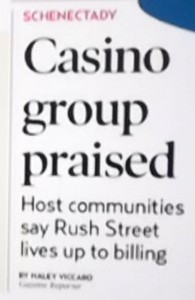 Haley’s article is filled with quotes from local development and business officials and Rush Street Gaming’s CEO Greg Carlin, without a word from their detractors, such as Casino-Free Philadelphia, or the Worchester MA citizens group that was successful in keeping RSG out of their city, nor even from the Stop the Schenectady Casino gang. We speculated in August that perhaps the article was the Gazette‘s penance and mea culpa to Casino proponents for an earlier article titled “Officials in other cities warn of pitfalls, failed promises by Rush Street“? (June 8, 2014, by Bethany Bump).
Indeed, Rush Street Gaming liked the August 3rd article so much, it included a Power Point image of the headline in the “final”, public presentation it made to the Location Board in September. (click the image at the head of this paragraph) In our posting on what the newspaper forgot to mention, we walk through a number of very important facts the Gazette should have mentioned as a matter of fairness, but also of journalistic duty and pride. For example, it failed to mention the many facts that refute the claim by a Philadelphia official that, rather than crime rising, it actually got safer near Rush Street’s Philadelphia casino. In addition, it allowed a company official to brag that they even help customers find other hotels for their stay in Philadelphia, without noting that the particular casino has no hotel of its own and must assist customers to find lodging if it wants to lure them to their facility.
Traffic & Crime Concerns. The Gazette also managed to write an article on the traffic problems in the Stockade, and to occasionally mention concerns over increased crime, without ever including mention of Stop the Schenectady Casino, which has focused on those issues, and researched and written on them in some detail.
For example, see the Gazette piece “Stockade group frets over potential traffic: Mohawk Harbor access a concern” (Sept. 30, 2014, by Haley Viccaro). Ms. Viccaro decided to only speak with Mary D’Allesdandro, Stockade Association president concerning the Stockade’s traffic worries. Not only is Ms. D’Allesandro a supporter of the casino, she never did anything about the traffic issue until a non-officer member of the Association asked at the September Stockade Association that they give comments to Metroplex as part of the environmental review. The Comment was hammered out at the end of the Meeting, and is filled with generalities. The Gazette article is so troublesome, that I left a lengthy comment at their website, and repeated it in a posting on October 1, titled “the Gazette gets stuck in Stockade traffic” (October 1, 2014). That posting has links to the work done by Stop the Schenectady Casino on the traffic issue, including discussion on our Statement in Opposition of September 22, 2o14.
 Crime. The Gazette has also failed to address in any meaningful way an issue of great concern to neighborhoods near the proposed casino: the likelihood that the casino will bring an increase in crime. We were told in the Gazette, with no explanations, that Stockade Association President, a casino booster (and mayor-appointed member of the City’s Board of Zoning Review), Mary D’Alessandro didn’t think there would be an increase in crime; that East Front Street Association officer Mary Ann Ruscitto, an “excited” casino booster, wasn’t worried, because we already have crime in the Stockade area; and that a Rush Street Gaming proponent stated that crime went down around its Philadelphia SugarHouse casino. As you can see in our posting “will a casino bring more crime,” and at pages 6 -8 or our Statement in Opposition to the Casino, there is much to say about crime and an urban casino that goes far beyond one-sentence gut feelings. The Gazette could have added to that debate, but I believe doing so would have made more of their readers and their allies supporting the casino nervous.
In addition, the Gazette newsroom:
- Never wrote about the County Legislators and town leaders ignoring the November 2013 vote on Proposition One, in which a majority of county residents opposed having any casinos upstate, with large majorities in opposition in Niskayuna and Glenville, which are the towns closest to Mohawk Harbor. In addition, it never wrote that, despite its claims, the County Legislature, had absolutely no power to approve the casino application if the City did not do so. My own presentation to the Gazette staff of the relevant provisions of the law and Request for Applications, which clearly state that only a city or town could give the necessary local approval, were ignored. [See our posting “Schenectady County ignores its voters and plain English” (June 2, 2014)]
 Often mentioned that the East Front Street Association supported the casino, but never reported on how few people were members nor how its leaders concluded the majority of neighborhood residents supported the casino. Every resident of that neighborhood asked by us said no one asked them their stance on the casino.
- Gave no coverage to the Statement of the Schenectady Heritage Foundation to Metroplex, asking Metroplex to act to protect the Stockade from the negative effects likely to be caused by having a casino a half mile away. See our post on October 2, 2014.
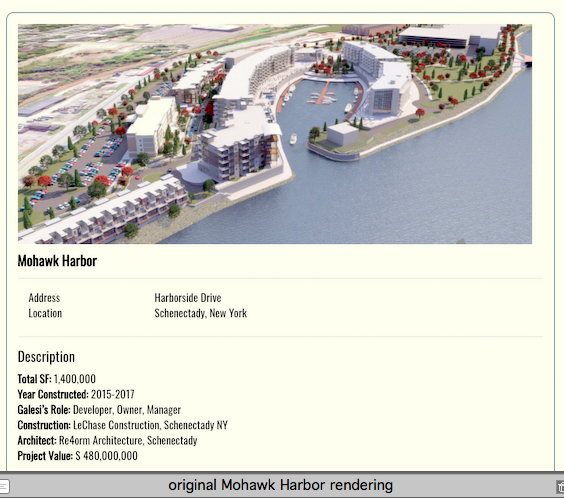
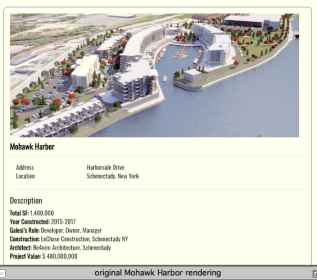 Gratuitously, with no source given, asserted in the piece”Automated Dynamics weighs relocation options” (Haley Viccaro, Nov. 27, 2014) that “If [the Alco site is not chosen for a casino], the portion of the site dedicated for the project would probably remain undeveloped.” I think Mssrs. Galesi, Buicko and Gillen would be trying hard to find a substitute use of that land, even if it is only the major amenity of a park setting with walking and bike trails along the Mohawk, next to the Mohawk Harbor hotel, condos, marina, office buildings, retail shops, etc. on the west end of the plot. [The image to the right is an original rendering of Mohawk Harbor released by the Galesi Group, showing the project filling the entire riverbank site, with much-needed green space, as well as trees and setbacks along Erie Blvd, and its first phase constructed in 2015.]
This is, we submit, not a record that should make the Gazette proud, unless its goal has been to give Rivers Casino at Mohawk Harbor a better shot at being selected by the Location Board.
update (Dec. 18, 2014): Well, at least they’re consistent. The following is apparently the only mention of an Opposition in the Gazette’s massive coverage of the casino selection in today’s newspaper: “Some Schenectady residents, including those in the nearby Stockade neighborhood, have voiced concerns about a potential increase in crime and traffic due to the casino.”
follow-up: Why No East-Greenbush Effect? (Dec. 22, 2014): The opponents of the East Greeenbush casino won a well-earned victory, and they show what was needed to attract the attention of the Gaming Facility Location Board. You need a large number of truly upset, directly-affected homeowners (especially middle-class ones), with organization skills and at least a modest war chest, and with lots of publicity that garners more publicity, and the kind of Town Council monkey-business to make a lawsuit at least colorable, and gives the media a hook for covering the topic repeatedly. See “Churchill: East Greenbush casino opponents win big” by Chris Churchill,” Albany Times Union, Dec. 18, 2014). With the Gazette ignoring us, and the Stockade Association hampered by a President who favored the casino and would not call a meeting on the casino nor put the issue on the agenda, the anti-casino crowd in Schenectady never got the nucleus of publicity that would let them grow into as thorny an opponent as those in East Greenbush. The Stockade had voted against Proposition One in the November 2013 election. Had the Stockade Association voted to oppose the casino and opened its treasury to the cause, the Gazette would not have been able to ignore us. Ifs, buts, regrets.
Irony Update: See “Gazette decries ‘fake news’” (Nov. 6, 2016)






 snowmen at the gates