
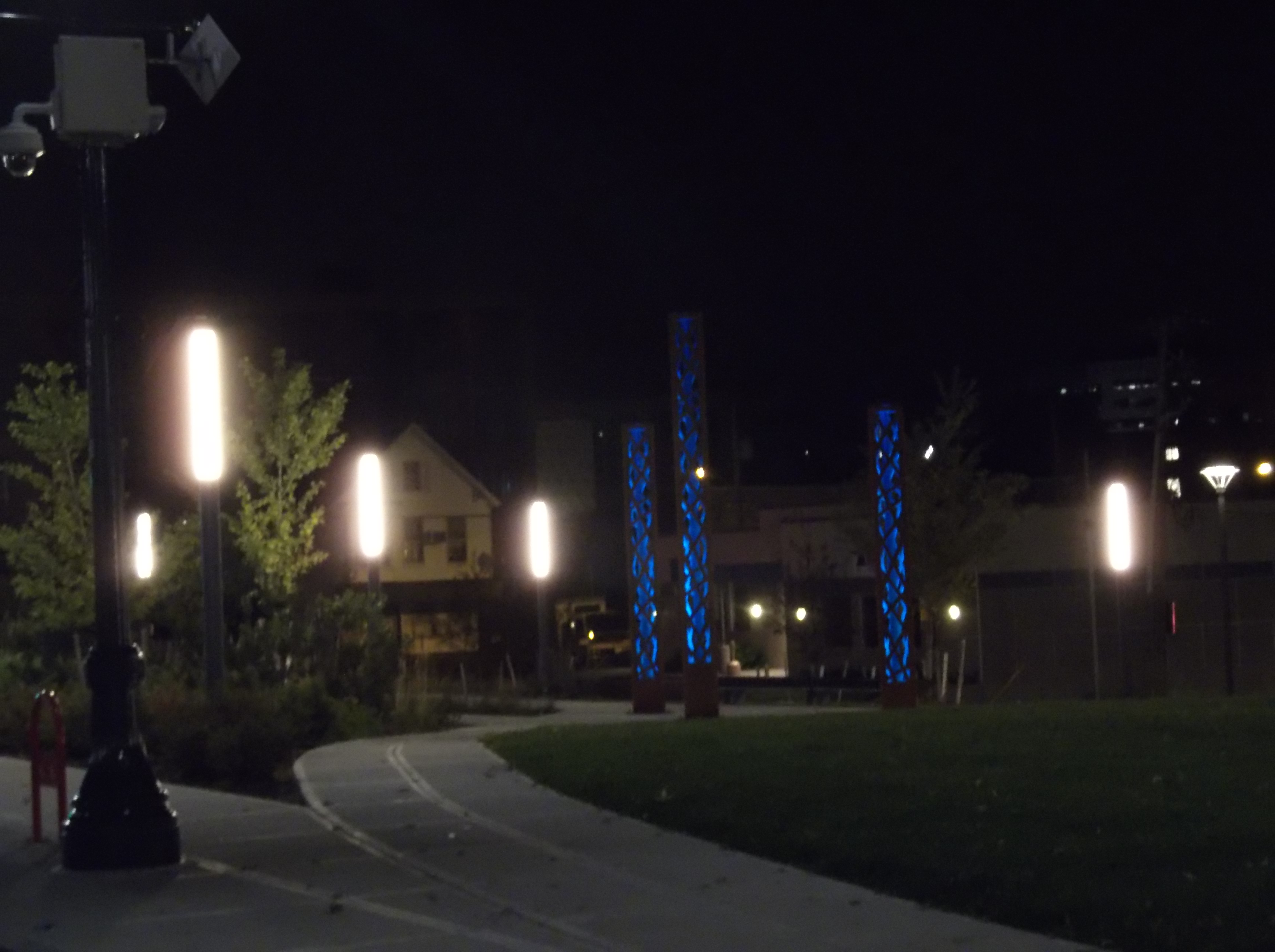
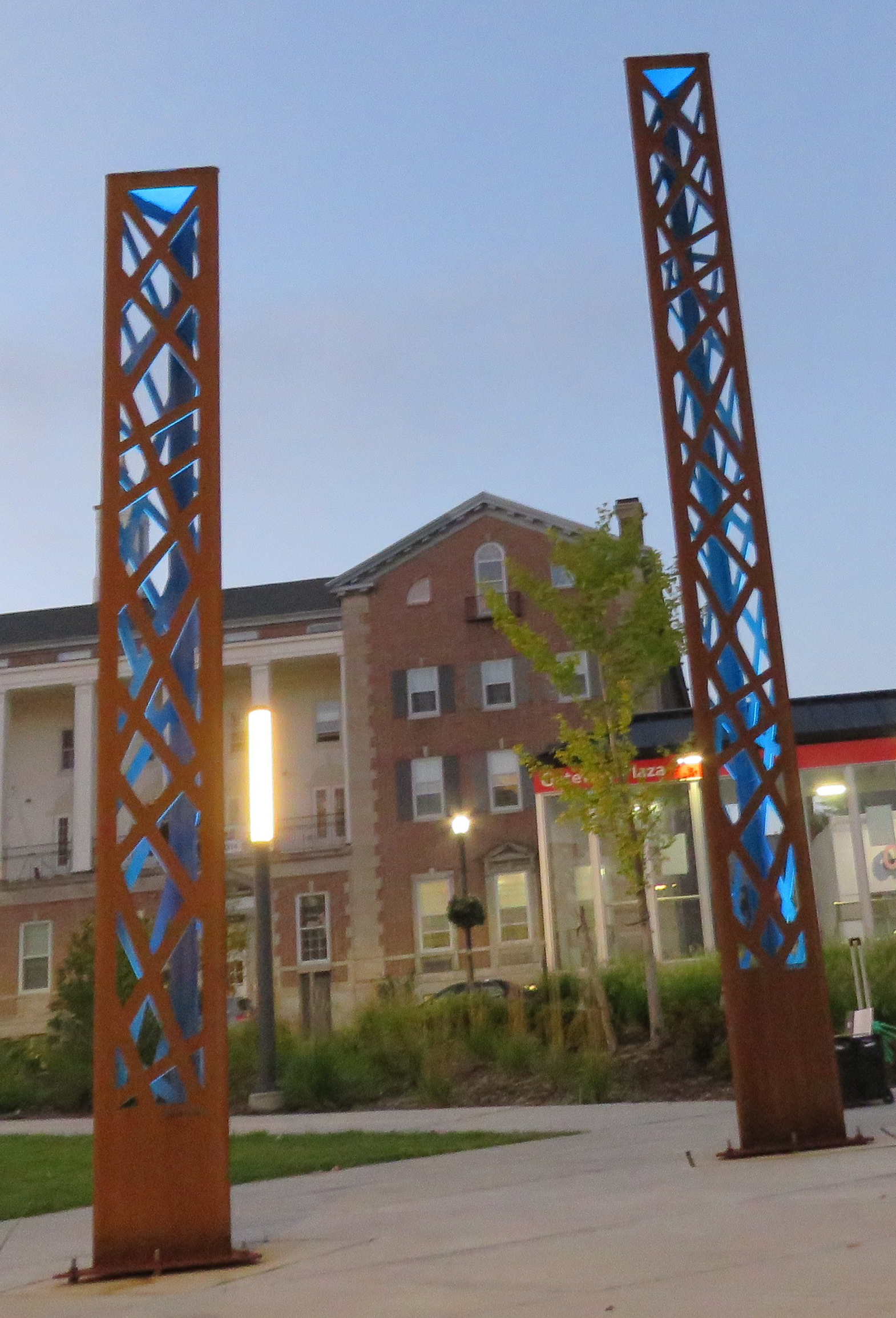
No, those “Rusty Girders” & “Light Sabers” are not there for Halloween. They are, however, more trick than treat for many of the people who live or work in Schenectady, or just visit the City and pass by or through “Gateway Plaza”, a/k/a Liberty Park. The Plaza designer and construction administrator, Mary Wallinger, has had them permanently installed, despite their never appearing in the Gateway Plaza Implementation Plan, which contained what most of us believe were better alternatives.
 . .
. . 
Of course, the Plaza fixtures aren’t officially called “Rusty Girders” & “Light Sabers”. They are the modern sculpture and lighting fixtures that have been permanently installed along Gateway Plaza’s [Liberty Park’s] Water Street Pedestrian Way. What do you think?
The makers of each refer to them as “pillars”:
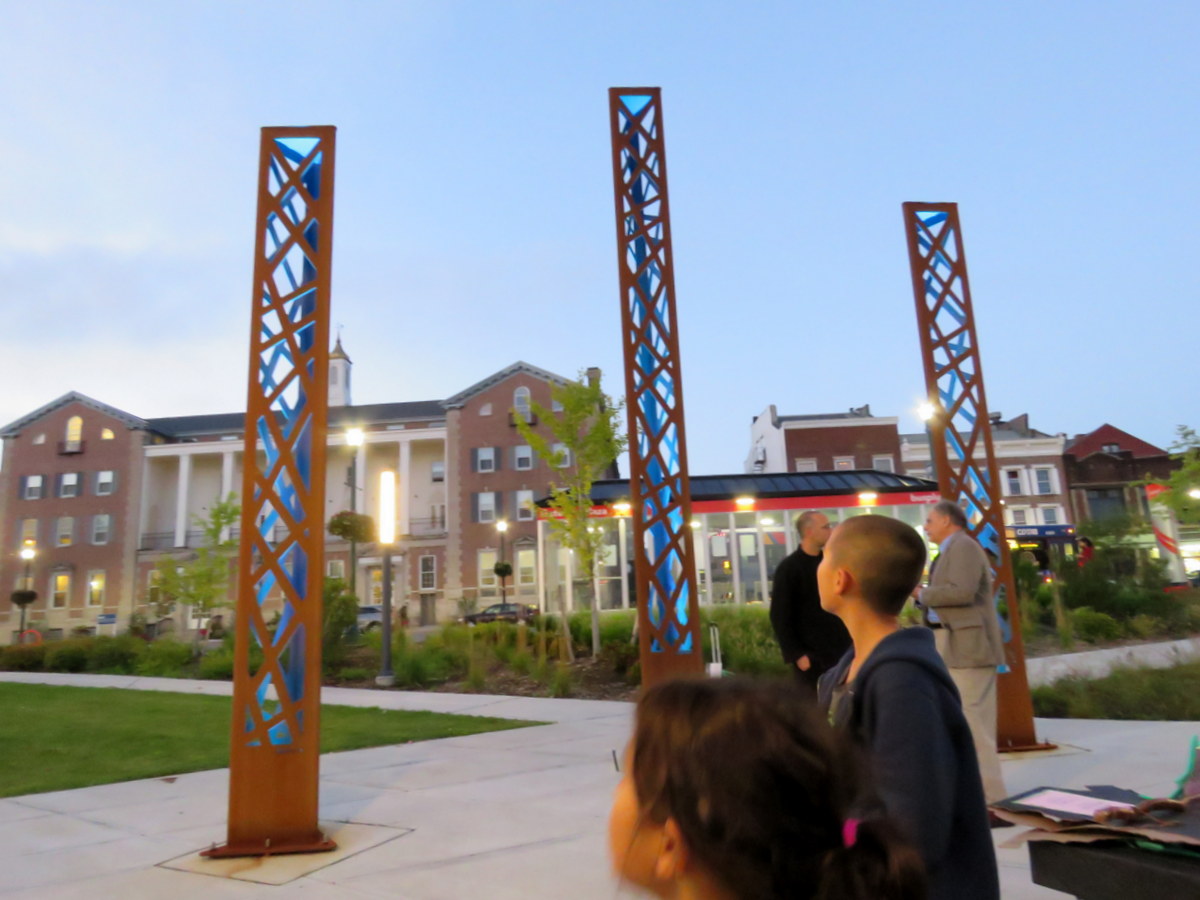
 The girders, which have been placed at the Central Focal Point of the Plaza as urban sculpture, are “Open Pillar Corten Steel Lighting Columns“, described as “triangular LED-ready lighting columns with a lattice-like graphic pattern.” Their attributes: They “break the horizon with a strong vertical expression. The abstract geometrical pattern can blend into almost any atmosphere. The distinctive open pattern allows vegetation to climb and grow, introducing vertical green in open spaces.” Ours have no vegetation, but do have blue LED lighting that can be seen starting around sunset and dusk.
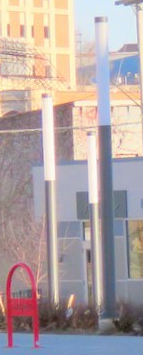
 The light poles are “Unilamp’s Contemporary Light Column / PMMA / LED / For Public Spaces: Pillar“. The sales copy for the light column states: “It is intentionally used for highlighting the surrounding structure works in modern architectural areas. Because of its eye-catching look, it is suitably applied in square, commercial areas and open spaces.”
The Plaza’s designer and construction administrator, landscape architect Mary Moore Wallinger, apparently chose them for the Plaza believing they signal to visitors that Schenectady is contemporary and future-oriented. On the other hand, she decided, belatedly and behind the scenes, to exile Lady Liberty from her Liberty Plaza home, for not being contemporary enough. [For that story, see our post “Lady Liberty is Timeless“]
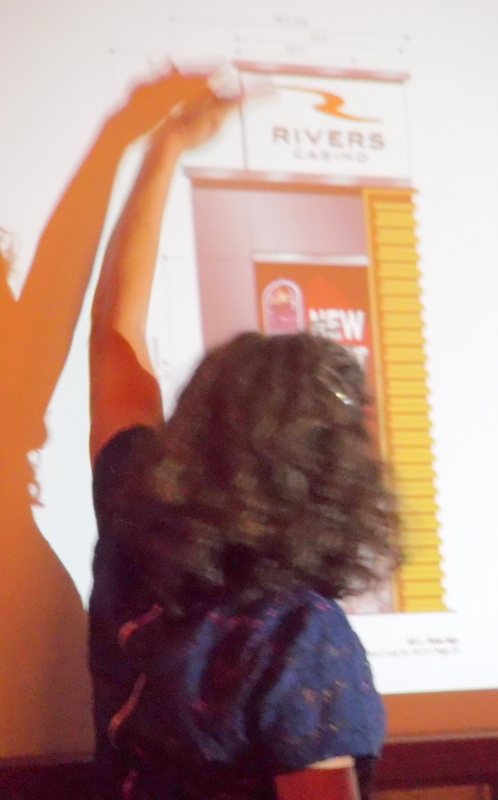
Chair Wallinger discussing Casino Pylon
Those changes from the approved Gateway Plaza Implementation Plan, in my opinion at least, really do seem like tricks, especially since the decisions were made out of the public view by the same person who authored and promoted the original Implementation Plan in 2013, and who incidentally wields power at City Hall as the Chair of the City’s Planning Commission. Moreover, because (as explained below), they were not shown in the approved Implementation Plan or even as alternatives during its creation and approval, they seem like a bait-n-switch.
SURPRISE: Why were so many of us surprised by the choice of these pillars for the Plaza? What did we expect the lighting and sculpture to look like in Gateway Plaza? The public, and their representatives who are asked to adopt or approve a plan, look to drawings or other images (renderings) presented by the Plan creators in order to conveny the intended/proposed appearance of a project when completed. Here are details from a rendering presented by Ms. Wallinger in drafts and in the Final Report of the City of Schenectady Gateway Plaza Implementation Plan, which was adopted by the City Council and signed by the Mayor in 2013:
 . . [L] detail from Plan rendering of a wind turbine (and sculpture) located at the Plaza’s Central Focal Point, on the “Water Street Pedestrian Way” portion of Gateway Plaza, as seen from State Street. And,
 [L] rendering detail showing decorative lamp poles along the Pedestrian Way (with a Venus de Milo replica and a modern red sculpture further down the path) . .
CENTRAL FOCAL POINT. The Implementation Plan’s Executive Summary has this to say about the Central Focal Point and Sculpture:
The central focal point is intended to be a large sculptural wind turbine that would cleanly and abstractly capture the City of Schenectady’s historic legacy as a City of innovation while also celebrating its more recent role in both the arts and green technologies.

 When asked at the Implementation Plan’s Design Public Workshop, “Why a wind turbine and not something solar?” [image at left shows text in the Report], the design team representative, Ms. Wallinger, gave the following response:
There is room for both technologies, but the wind turbine speaks to Schenectady’s past and present and would also say something about the environmental conditions in the park, adding another layer of interest. In addition to providing energy for the park, it would also serve as a piece of art that tells a story.
As actually implemented and constructed, of course, there is not a Wind Turbine in sight, just the “fast-rusting” Girders for focal point sculpture. Were there engineering or financial problems that made a working or purely artistic wind turbine impractical? When was the wind turbine concept abandoned and the search for a substitute made? When and why were the Cor-ten Girders selected? Who participated in the change and new selection process? If the public was asked to participate in the discussion, I am not aware of it. Same thing goes for City Council members.
 Which Budget Item in the Gateway Plaza Plan to the left accounts for the Cor-ten Girders? Is it the $100,000 lumpsum for a Primary Sculpture Piece? Or, the $70,000 “secondary sculpture elements”?
. . can window turbines be attractive? . . yes, of course. .
. . [R] sample of attractive wind turbine 
 LIGHTING: When asked “How would lighting work in the park?” at the Public Design Workshop for the Implementation Plan [image to the right], the design team representative responded (emphases added):
There would be perimeter lighting at levels similar to those along the 400 block of State Street and it would be in the form of street lights at a pedestrian scale. There would also be lighting along the central axes and likely some low level lighting as needed to ensure visibility and safety within the park, especially since it will likely be used in the evenings by students and others if restaurants move into the area. The internal fixtures would likely be more contemporary and should utilize low energy technologies.
What about using bollard lighting? Response: There are certainly opportunities for some creative lighting, but maintenance needs to be considered and whichever fixtures are chosen will need to be easy to maintain, inexpensive to replace parts, durable, and efficient.
 Having reviewed many proposals over the last several decades by government staffers and contractors, and by attorneys, the vague wording “The internal fixtures would likely be more contemporary” should have raised red flags for me and others even more familiar with the planning process. Including that phrase looks like an attempt by the designers to give themselves more than a little “wiggle room”, to later justify diverging from the light fixtures shown in the Plan rendering of the internal Pedestrian Way [image detail to the right]. When was the switch to the “light sabers” made, and who was included in that decision process?
 How did the cost of the Light Sabers compare with the Buget items on the Plan page to the right of $130,000 for 26 Decorative Light Poles ($5000 each) and $32,500 for 26 Light Bases ($1250 each)?
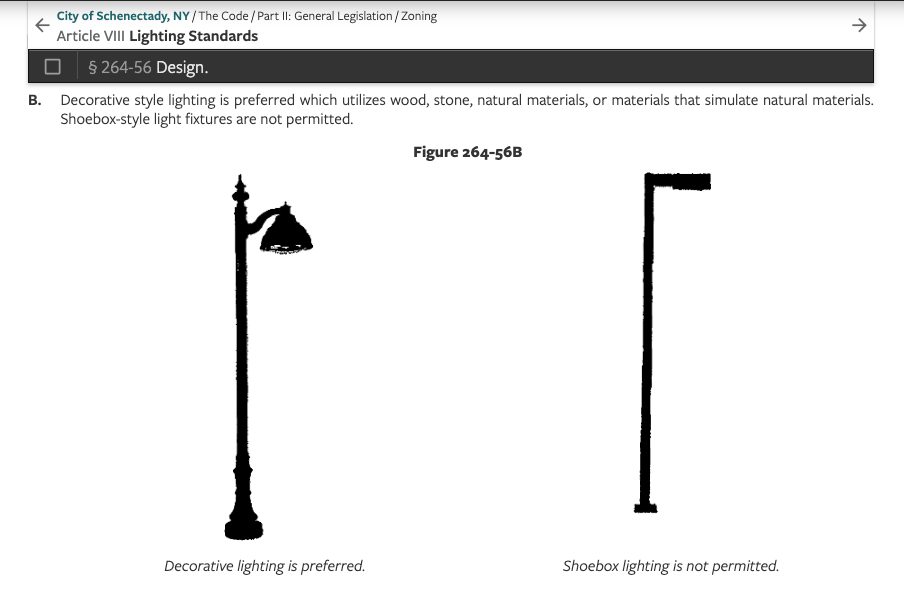
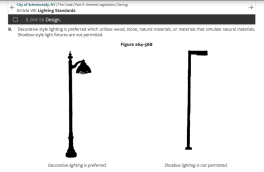 And, when was the decision made to ignore §264-56 Lighting Standards of our Zoning Code? It states that “Decorative style lighting is preferred, which utilizes wood, stone, natural materials, or materials that simulate natural materials”, and that “shoebox lighting is not permitted.”
How did we get something so different? You’ll have to ask Mary Moore Wallinger, whose LAndArt Studio is administering the construction of Gateway Plaza. She is Owner/Principal of LAndArt Studio and incidentally, as noted above, the Chair of the City of Schenectady Planning Commission. You might also ask her protectors-partners-sponsors, Metroplex Chair Ray Gillen and Mayor Gary McCarthy. [For more pictures of the finished Gateway Plaza, please see this posting at “suns along the Mohawk”].
- One wag has suggested that maybe Ms. Wallinger had the wrong definition of “execute” in mind, when given the task of executing the approved Plan for Metroplex and the City.
Should we care? How should our elected officials (City Council or the County Legislature) and the public react, as a matter of either public process or aesthetics, when a result is so different from a proffered and approved Plan, with no intervening input from our representatives or the public?

. . De gustibus non est disputandum . . . .
HOW MUCH DISCRETION? The cliché is that “There is no accounting for taste” — that there is no objective way to resolve disputes over a matter of taste. That is certainly true about private matters, although promises should matter and be taken into account. But, when one person’s taste is thrust upon the public, in a visually inescapable and financially significant way, what safeguards should be in place? Here, we add the important factor of expectations created when a plan is produced after broad participation and then officially approved.
 In Schenectady, approved plans have been changed on projects for preserving or replacing buildings at important locations — usually, with City Hall or the Planning Commission pointing to “engineering” reports that they say indicate a safety issue or unknown factors that make the approved plans impossible, impractical, or immensely more expensive, to achieve. No such reasons were available for the belated exiling of Lady Liberty from Liberty Park and its extension into Gateway Plaza. Instead, Mayor Gary McCarthy spoke of recommendations from “the Design Team,” giving no further details or explanation. The Design Team is, or is headed by, Mary Wallinger.
Similarly, as a member of the public who tries to keep abreast of such issues, I have heard of no reasons for the change in installed sculpture and lighting poles. I have no idea whether or not the changes were brought to the attention of the City Planning Office staff, Operations Bureau, the Mayor, or other City Hall officials or staffers, before the selections were made, purchased or installed.

Given the great emphasis the City and County have placed on creating this “gateway” to Schenectady, and supposed influence on the image presented by the City, shouldn’t we expect more monitoring and oversight of the final product, especially its appearance and appeal? And, shouldn’t we require that significantly more attention be paid to the likely reaction of the public to significant stylistic and design changes to major elements of an approved plan?
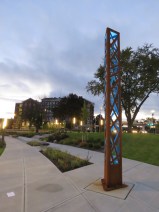 Public Reaction? The best review of the Lamp Pillars that I have heard is that they look really cool at night. Of course, ignoring their bland appearance all day so that relatively few people might see the lamp portion at night is not a great trade-off.
- Similarly, as to the girders, [1] Some passers-by think the off-the-shelf pillars must be remains from the 9/11 Tragedy at the World Trade Center or perhaps are an allusion to the City’s once-great industrial past. I do not know whether Ms. Wallinger was trying to make such references, despite her professed goal this year of honoring Schenectady’s future. [2] Close up, I find the blue light glowing in the Open-Pillar Lighting Columns fun to view and photograph. But, how many people will have that experience after sunset, especially when the glow is scarcely noticeable from State Street even in full darkness (perhaps because the light pillars are so bright)?
- Even if you like the Girders and Sabers and have no problem in the abstract of having them in the Plaza, the process that brought them there is troublesome.

When Ms. Wallinger addressed City Council at a public meeting to explain her exiling of Lady Liberty, she asserted that “plan’s change” (without differentiating among initial brainstorming, drafts and alternatives under consideration, reaction to public input at workshops, and municipally-adopted plans, much less those with post-approval emergencies), and she insisted Lady Liberty was only a “small part” of the overall Plaza Plan, seemingly talking about square footage, not emotional and historic value. Her breezy attitude about her authority over final design choices is especially worrisome to me, because she (through her alter ego landscape architecture studio or subcontractor roles with other firms) has been given design control over so many municipal projects, and because of her influence over the Planning Commission agenda and procedures, and its staff.
Thus, her LAndArt Studio website proclaims:
Principal and owner Mary Moore Wallinger has been working in the field of Landscape Architecture since 2000 – designing, managing and overseeing projects both large and small. Ms. Wallinger’s robust portfolio includes municipal parks and plazas, institutional and corporate campuses, site planning, master planning, urban design, sustainable site design, healing gardens, and streetscapes.
For example, in Schenectady City and County, Mary Wallinger has been the principal designer for:
- Gateway Park/Plaza
- And (update) the Rainbow Pride Memorial
- Schenectady County Community College School of Music
- recent additions to the Central Park Rose Garden, including the new pergola
- BTW: Robert Blood’s popular “Yuan” sculpture (meant as variations on the Chinese character for garden) was a favorite sight in the Rose Garden for many years. Like Lady Liberty, however, Blood’s sculpture apparently got in the way of Ms. Wallionger’s image of “her” project. As a result, Yuan was exiled to the outerlimits of the Rose Garden, and several years later still has no path leading vistors to it, and very little landscaping. Below are images of Blood’s sculpture [L] before and [R] after Wallinger’s pergola project.
 . .
. . 
- Center City Way, which is along the public parking lot behind Center City, between Franklin St. and Liberty St. [It sports a shorter version of the Light Sabers]
- the Central County Library Plaza, including the relocated bright orange modern sculpture “Ishmael” (photo on right)
 Steinmetz Park Master Plan and subsequent preservation projects
- the Rotterdam Brownfield Opportunity Area Land Use Master Plan
- Tribute Park (pocket-park with water pad at Eastern Avenue)
- Bike Schenectady, the Schenectady Bike Infrastructure Master Plan (2017)
How Much Discretion is Appropriate? Perhaps Schenectady City and County (and especially Metroplex) should take a close look at the various guidelines on the selection of public art that have been promulgated by interested professional and community groups (for example, the Standards and Guielines adopted by the College Art Association, CAAA), to renew their commitment to broad participation and respect for public input. The CAAA guidelines, for example, call for early public participation and reconsideration of a draft design after receiving public comments on the draft.
- With Gateway Plaza, the public’s desire for the return of Lady Liberty and keeping the name of Liberty Park has been ignored after approval, while being placated during the plan-making process. [see images just below this blurb] In addition, the public’s ability to influence the appearance of the Plaza/Park was greatly undermined by switching two of the most important elements, with choices that have been met, at most, with indifference.
 . .
. .
Public Workshop comments on [above] name of the Plaza; [below] location of Lady Liberty

It seems that the City and County of Schenectady are giving too much discretion on important and highly-visible municipal projects to too few people. And, even after official approval, too much leeway to the person entrusted with implementing plans. Especially when it comes to highly visible pieces of public art or important public spaces, the public’s role and opinion must be protected and honored.
 . .
. .
. . share this posting with this shorter URL: https://tinyurl.com/pillaried
. . hm: maybe a real pillory like one on display at Williamsburg VA would bring back a little history, at least for Halloween . .

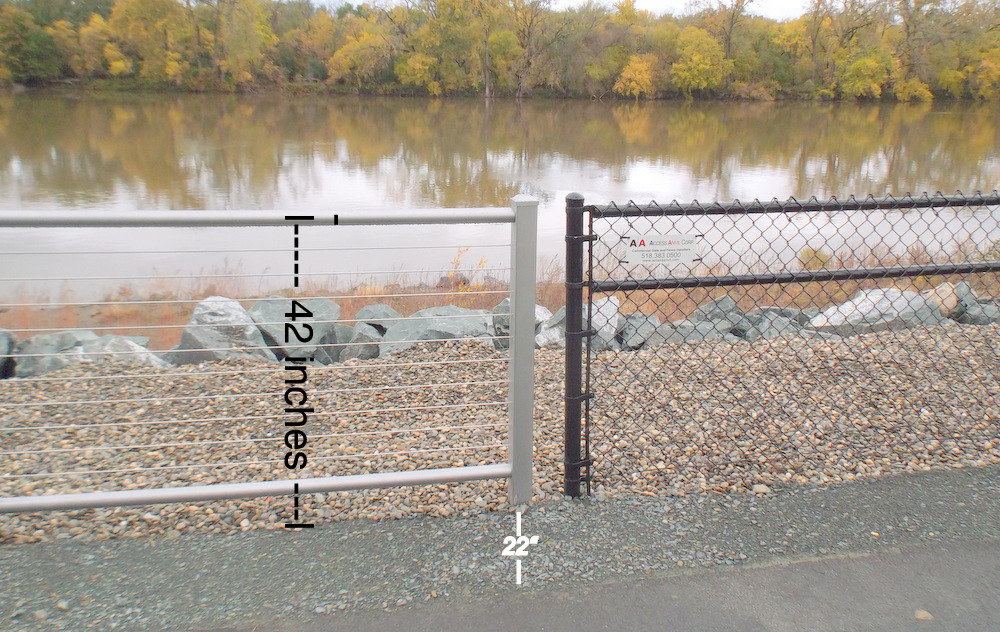


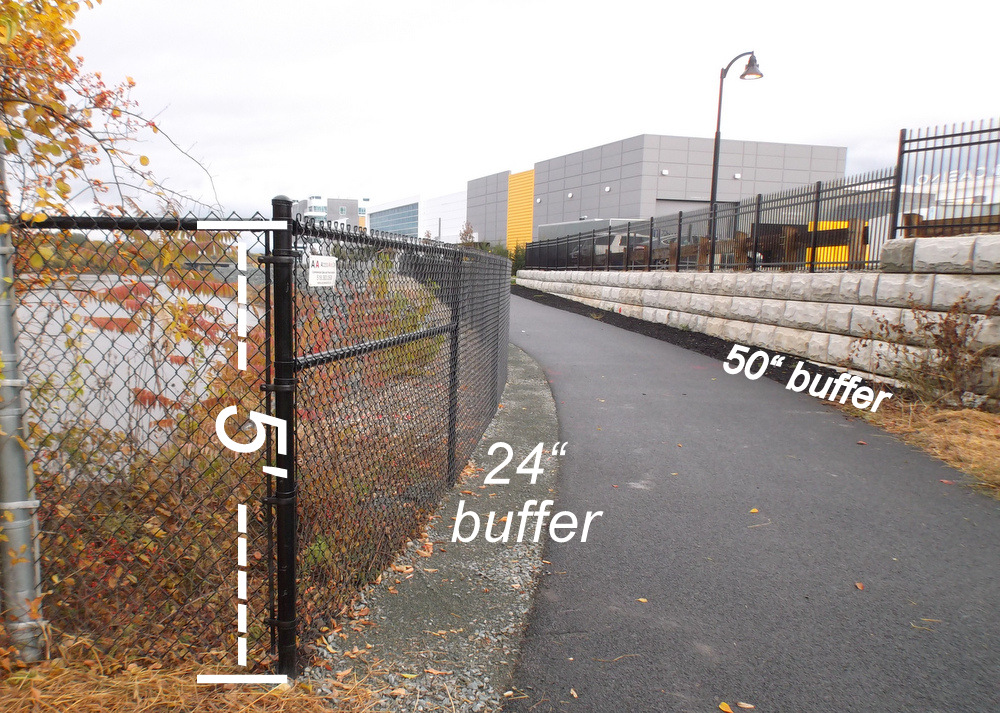
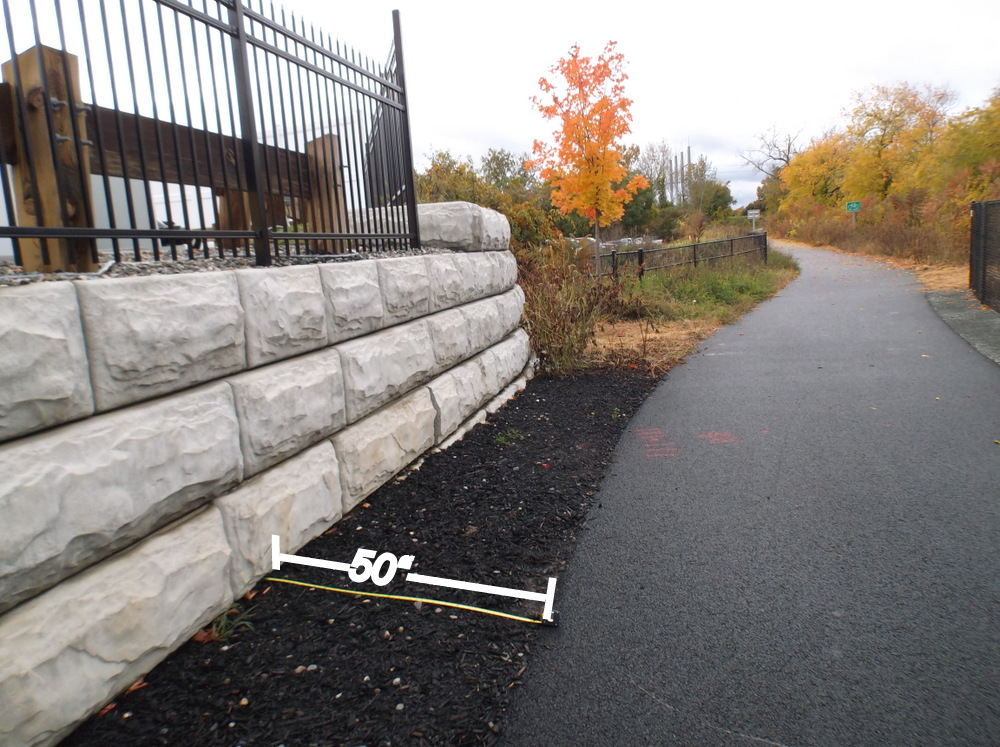

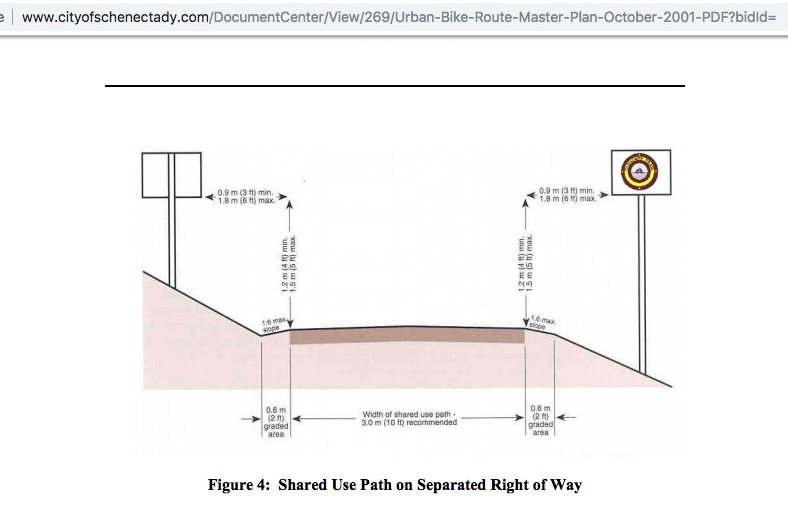
 Below is an email message that I sent today (October 15, 2018) to Christine Primiano, the City of Schenectady’s Chief Staff Planner. It outlines why I believe we must halt the installation of a railing/fence along the riverside of the ALCO Heritage Trail in Mohawk Harbor, and seek to achieve a better, safer guardrail. The 42″ high guardrail is being installed only two feet from the paved edge of the Hike-Bike Trail. Best practices for shared-use paths and relevant regulations call for a 3-foot buffer (including the Bike Schenectady Master Plan adopted just last year). A taller guardrail, with a rub rail, is also needed. Following the regulations and guidelines can help increase the likelihood that hikers, cyclists, tourists and other visitors will avoid injury along the Mohawk Harbor trail and guardrail, and reduce liability exposure by the City and County.
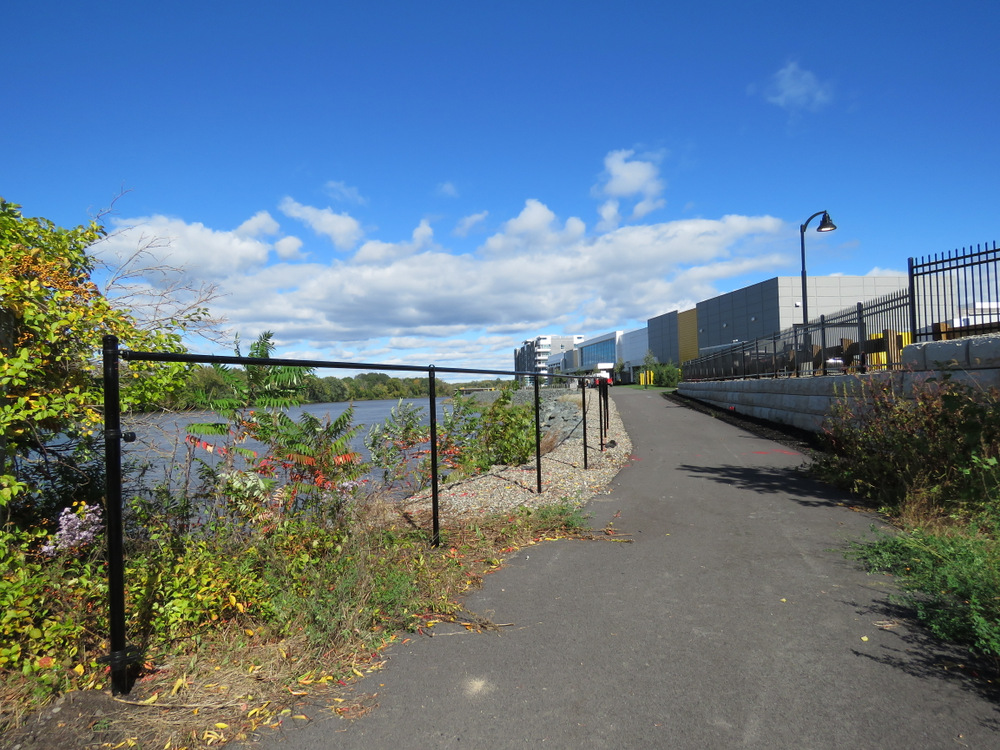


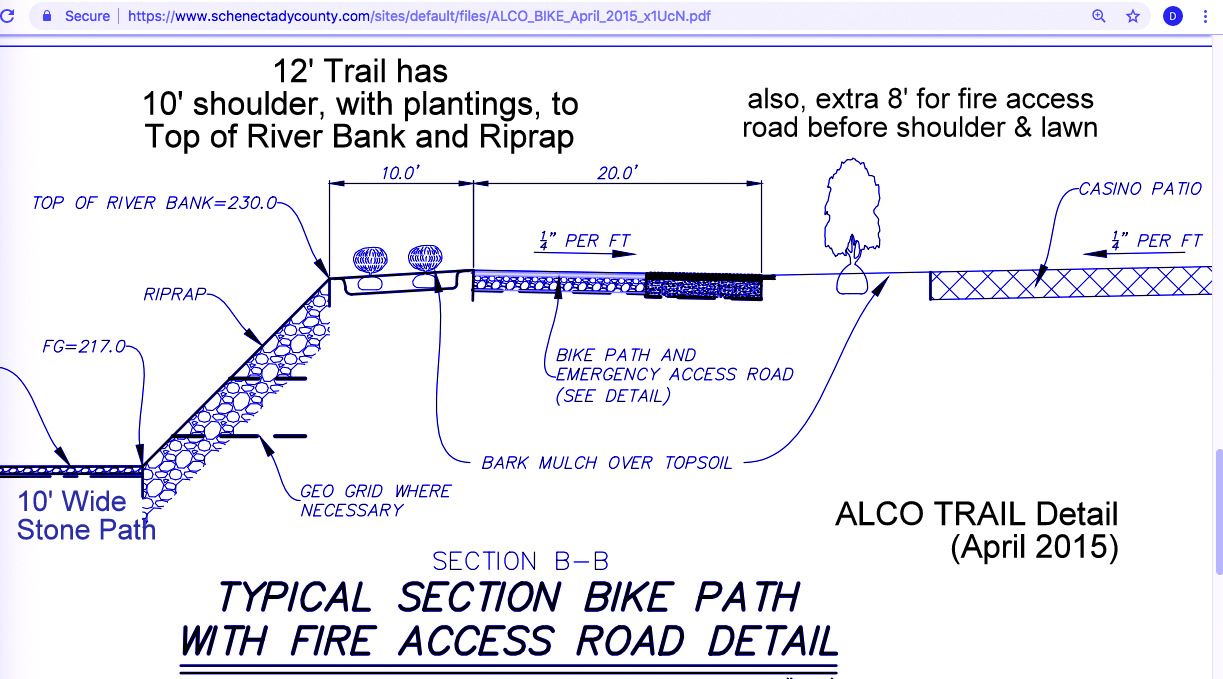


 In addition to the points made in the email to the Planning Office, I continue to wonder why taxpayers are paying 90% of the cost of constructing the bike-hike trail, and for the guardrail, when the Schenectady Zoning Code for the Harbor District [C-3, §264-14(1)E(4)] says that: “A single multi-use pedestrian and bicycle trail shall be constructed by the applicant.” “Applicant” refers to the developer or owner of the harbor property.


 Problem Gambling Prevention. The County and City are still not acting to help reduce the incidence of Problem Gambling through Education that prevents gambling disorders by helping to make gambling a safe, occasional leisure activity, not an obsession or addiction. If Rivers Casino and soon Sports Betting are here to stay, we must educate our youth, and help adults learn to recognize the signs of problem gambling in themselves, their friends and loved ones, their employees, and co-workers. [More information on
  snowmen at the gates