a voice from North Street for saving trees

NorthSt18May2016-001

. . “I remember many years ago when North Street had many beautiful large healthy trees that were cut down. The street has some small trees which will never replace the huge trees. The street looks naked without those gorgeous trees.”

I would rather ‘watch my step’ on uneven sidewalks than walk down a street without the shade and beauty of those large trees.

. . Jessie Malecki, Letter in the Sunday Gazette,”Stop the senseless cutting of trees, especially in historic districts” (May 15, 2016)

JessieM-facebook

from Jessie’s Facebook page

Jessie Malecki has lived in her Stockade house on North Street her entire life – more than 90 years. Earlier this month, the Gazette published another of her strong, insightful Letters to the Editor. Jessie’s topic this time was ending the unnecessary removal of our valuable street trees. At the top of this post are two salient quotes from the Letter, which is copied in full below and well worth your perusal.

Jessie mentioning the prior existence of large street trees on North Street sent me searching yesterday afternoon for old photos of the one-block, one-lane thoroughfare, which runs north from Front Street to Riverside Park, just east of Lawrence Circle. In my brief exploration, I was able to locate only one photo, at the Schenectady County Historical Society. It is shown immediately below, in a collage that features the March 1914 picture alongside a photo taken last week by me of the now “naked” North Street, looking north from mid-block. (Click on the collage for a larger version.)  As you can see, in 1914, flooding caused by ice jamming deposited ice floes and chunks well down the block. The angle is not optimal for viewing the curbside trees, but they clearly outnumber the current array, which is basically comprised of the species poleis-utilitus (utility poles).

I’m sorry I could not find more old photos from North Street. If you have one, especially with the tree fully foliated, please let me know.

StockadeBlocks6-001

. . above: 1914 photo courtesy of Schenectady County Historical Society . .

Jessie shared the March 1914 photo yesterday at her Facebook page, saying:

Thought people from my area would like to see North St. in 1914 (ten years earlier from my time – my house is the third down on the left) during the flooding, which in 8/28/2011 would be just about the 100 year flood.

In the 2016 photo, Jessie’s house is the 4th house on the left, with the orange awning. Please join Jessie voicing your well-reasoned opinions at the Gazette, or local news medium of your choice.

For more on our campaign to have a street tree preservation policy enacted in Schenectady, scroll down our web home page, and see our S.O.S. Trees portal.

Letters to the Editor (Schenectady Daily Gazette, Sunday, May 15, 2016)

Stop the senseless cutting of trees, especially in historic districts

Schenectady, and especially its historic districts, are fortunate to have so many large trees along our streets. Cutting them down when it is not necessary is a terrible waste that makes our city less beautiful, inviting and healthy.

Therefore, it is most important that a tree preservation policy be adopted and implemented for Schenectady so trees in the city’s right of way (between the curb and sidewalk, and in the medians) are preserved unless an individual tree is dead, dying or dangerous. That means alternatives to tree removal must be considered and employed, except where there is no viable alternative.

The Schenectady streets have many old beautiful trees which took years or centuries to grow. The city should not be able to remove them merely to repair a sidewalk and homeowners should not be able to have them removed for frivolous reasons.

There should be no excuse to cut down a healthy tree because it causes litter to the homeowner. Trees not only bring shade to our homes but beauty to our landscape.

NorthSt18May2016

“naked”

 I remember many years ago when North Street had many beautiful large healthy trees that were cut down. The street has some small trees which will never replace the huge trees. The street looks naked without those gorgeous trees.

North Ferry Street was so beautiful with their large trees but they were all cut down to replace the sidewalks. Fortunately, St. George’s Church property has some gorgeous, huge trees.

Walking on Washington Avenue, it is a delight that the large trees were not eliminated because of the outcry of the residents there. I would rather “watch my step” on uneven sidewalks than walk down a street without the shade and beauty of those large trees.

Both the Historic District Commission and the Planning Commission may initiate a study or make recommendations for new policy, laws or regulations and it should do so, even if not specifically requested by the mayor or City Council.

If you would like to preserve our Schenectady trees, email Chuck Thorne at Cthorne@schenectadyny.gov and he will distribute your letter to the mayor and City Council on your behalf. Or write: Chuck Thorne, City Clerk at City Hall, Jay Street, Schenectady, NY. 12305.

Jessie Malecki

Schenectady

the day after Arbor Day

ArthursMkt22Apr2016

Arthur’s Market, site of the First S.O.S. Trees meeting, had been well-shaded prior to the 2008 N. Ferry “streetscape improvements.”

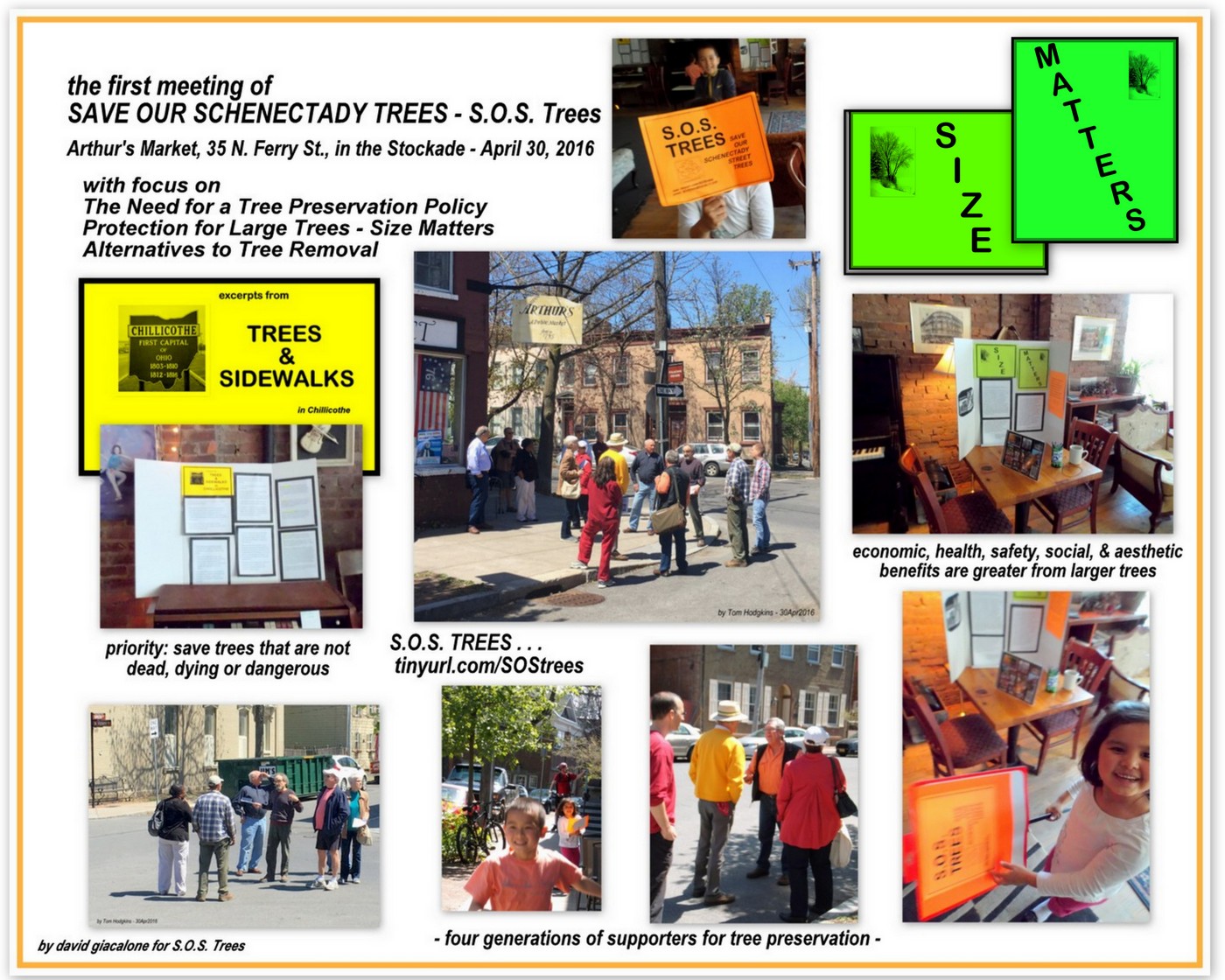
  Everyone loves trees on Arbor Day. But, what happens the day after Arbor Day? This year, on the literal Day After, Saturday, April 30, 2016, a group of Schenectady residents who appreciate the ways our urban forest can enhance the quality of our lives, came together at Arthur’s Market in the Stockade for the inaugural meeting of Save Our Schenectady Trees [S.O.S. Trees]. This posting contains many of the materials presented at that Meeting, provides analysis, shares a few pictures from the event, and asks what we should be doing all the Other Days After Arbor Day to help achieve a Street Tree Preservation Policy for Schenectady.

Here are images from the April 30th SOS Trees Meeting. The photo-collage shows most of the adult attendees, as well as the two major exhibits. (click on it for a larger version):

SOSTrees1stMtgCollage

. . Share this posting with this short URLhttp://tinyurl.com/AfterArborDay

The three primary topics at the Meeting were:

  • the Need for a Tree Preservation Policy in Schenectady, as shown by:
    • Ferry-WashCompare-Apr2016the City Engineer’s stated preference for the “N. Ferry St. process” of sidewalk repair, which resulted in the removal of every large street tree on the block in 2008, rather than the process used on Washington Ave. in 2014, which left the trees [click on image to right for a comparison of the results]
    • the many Benefits of our Urban Forest that will be lost through street tree deforestation
    • the omission from the City’s Tree Master Plan of the preservation concept, despite Schenectady’s status as a Tree City.
    • a real-life Show & Tell performed right outside the door of Arthur’s Market, as we stood in the shadeless noon sunlight and looked south up the once-shady N. Ferry St.
  • the Special Value of Large Trees: Size Matters. Replacing large trees with small ones is a waste of a precious resource and a poor investment, which cannot be reversed.
  • Alternatives to Tree Removal that are proven effective and efficient, and often less-expensive when repairing or replacing sidewalks.


WE MUST PRESERVE THE MANY BENEFITS OF OUR URBAN TREES 

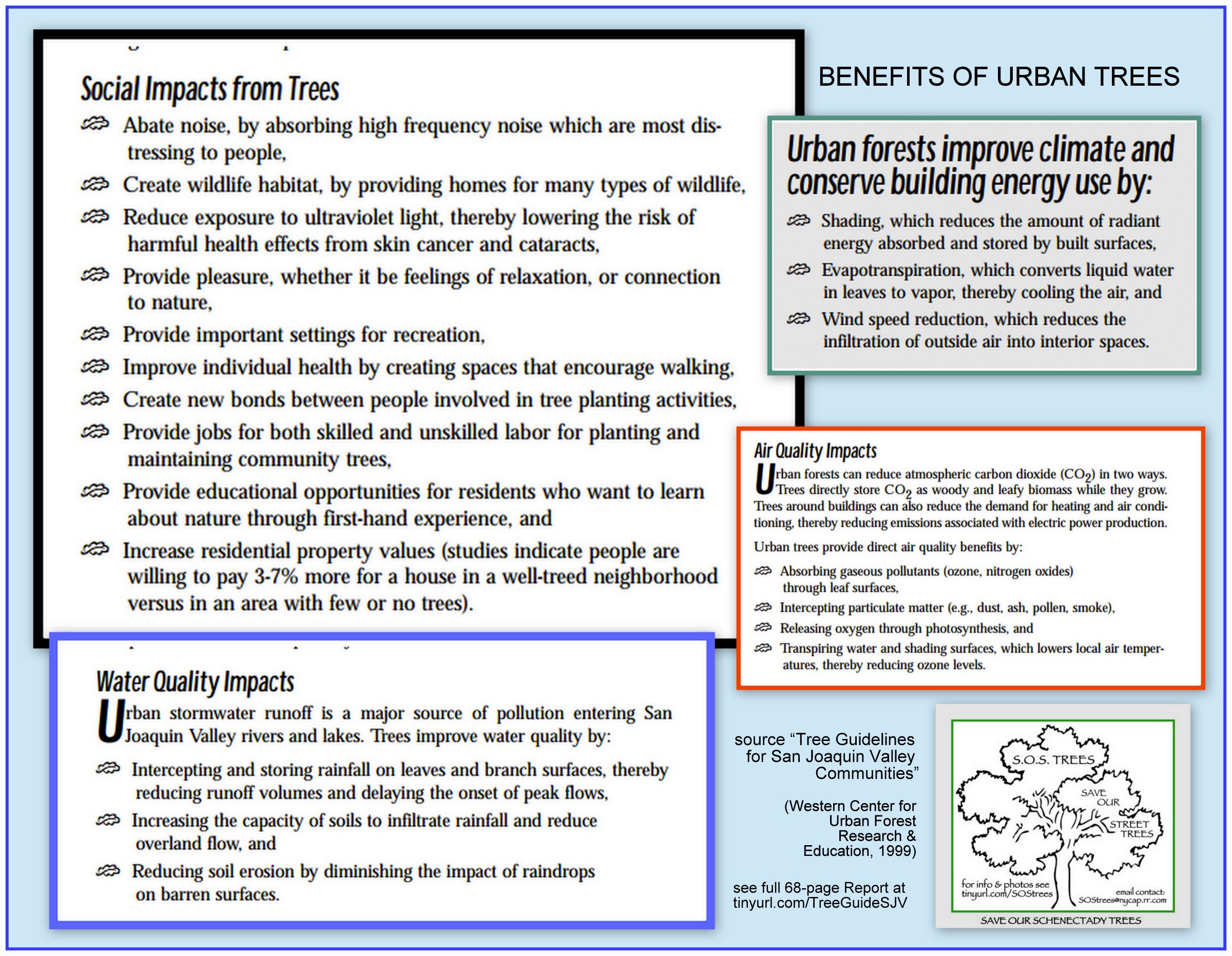
SJVCtreebenefits1 . . . TreeBenefitsSJV  ….

Click each of the above images to see or print both sides of a handout outlining the major benefits derived from urban trees (“from Tree Guidelines for San Joaquin Valley Communities”, Western Center for Urban Forest Research and Education,1999; “SJV Tree Guidelines Report”).  Avoidable streetside “deforestation” decimates those benefits, and cannot be justified by a general fear of liability or the convenience of property owners.

For additional discussion of the Benefits of Urban Trees, see our posting “why worry about our large street trees?“.  Also, the 17-page presentation on the Grand Pass [Oregon] website, “Benefits of Trees in Urban Areas” contains information and statistics, with charts, on topics such as the effects of trees on real estate values, traffic safety, asphalt savings, and (as excerpted in a 6-page pdf. file) on commercial businesses and consumer activity, sociological factors, and the adjacent homeowner. The Oregon study views trees as an important element of a city’s infrastructure, as major capital assets that must be cared for and maintained like any other valuable municipal property.

See “Schenectady needs a Tree Preservation Policy” for additional background and analysis, including Schenectady’s failure to include preservation in its Tree Master Plan, and discussion of cities choosing to give priority to retaining street trees.

An important moment in the April 30th Meeting came when Rich Unger, a retired planner who is chair of the Stockade Association’s Infrastructure Committee, and working on a neighborhood Sidewalk Survey for the Association, stated his support for a City-wide preservation policy, which would be adopted in a City Council resolution after research, drafting, and consensus-building. Mr. Unger is, however, more optimistic than  I that the City Engineer is willing to work to consider and permit alternative ways to repair sidewalks in order to save a tree. If true, that would make achieving a formal tree preservation requirement less urgent. 

NFerry-March1-DSCF1560

N. Ferry St., March 2016

Rich Unger’s optimism is only realistic, however, if the City Engineer has changed the criteria applied by the Office in 2008 on N. Ferry St., and again in its Washington Ave. plan in 2010. In both those instances, every large street tree was considered to pose too big a liability risk to leave in place, because root chopping during construction could damage the tree, making it more likely to topple in the future. It appears that no options other than removal were considered in 2008 and 2010 (such as rerouting or narrowing the sidewalk, ramping it, or leaving and monitoring healthy trees that had a sufficient portion of their root system intact), due to that fear of liability.  The continuing stress on liability by Assistant City Engineer Peter Knutson in recent correspondence (see our “why worry” posting), shows a reluctance to consider alternative repair options that continues to put large street trees greatly at risk.


Thus, with the City voicing its preference to work a block at a time, doing the sidewalk work at the same time as repaving the road, as on N. Ferry St., we can expect that virtually every mature street tree will be slated for removal when the City “does” a block, unless other options are fully considered, and greater leeway given to retain (and monitor) an otherwise healthy tree after its root system is reduced. The way to avoid such a result is to promulgate a Tree Preservation Policy that requires the City arborist to determine in good faith, for each tree that is not dead, dying or dangerous, whether there is a viable option other than removing the tree.

.

SIGNIFICANCE of LARGE TREES

SizeExh  Virtually all of the benefits we receive from trees growing in our “urban forests” are directly related to their size — from cleaning air and water, cooling pavement, shading homes and reducing utility bills, muffling noise, and dampening traffic speed, to luring tourists, shoppers, and residents, with their beauty and shelter. This is a core message for S.O.S. Trees.

NFerryTreeCollageThe handout sheet to the right shows a sampler of effects of removing all large street trees on N. Ferry St. in 2008. Planting the smaller replacement trees is simply a lose-lose situation, and not a defense that justifies removing healthy street trees.

SizeMattersCover1

. . . Size Matters. Click on the image to the left for a pdf. version of the Size Matters exhibit presented at our First Meeting. Each page has a large-font quotation from an expert concerning the relationship between the size of trees and the tree canopy and the resulting benefits to a community. For a fuller discussion of the issue, see the Size Matters section of our posting “why worry about our large street trees?“.

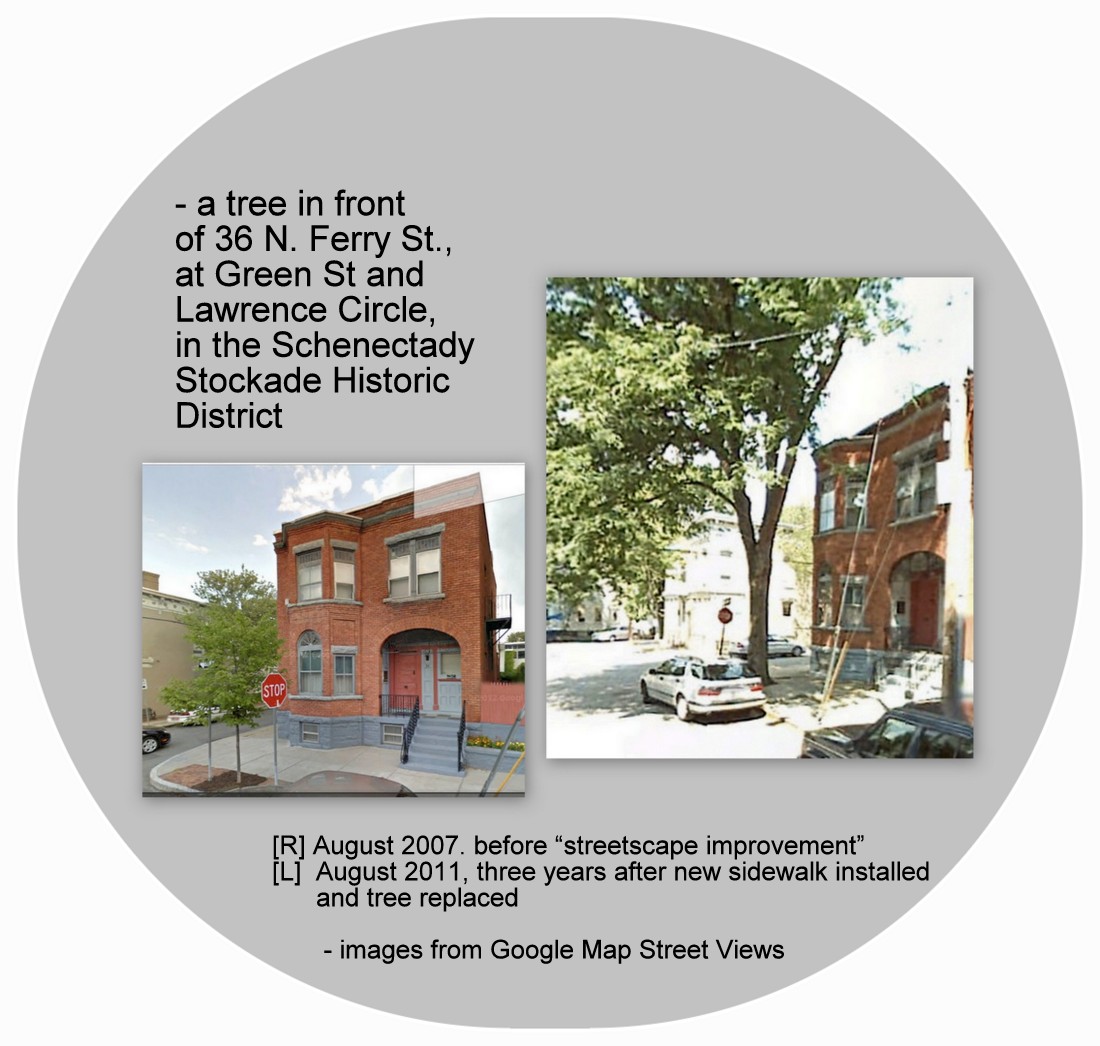
Example of a bad trade-off: 36 N. Ferry St.

36NFerryTreeCompare

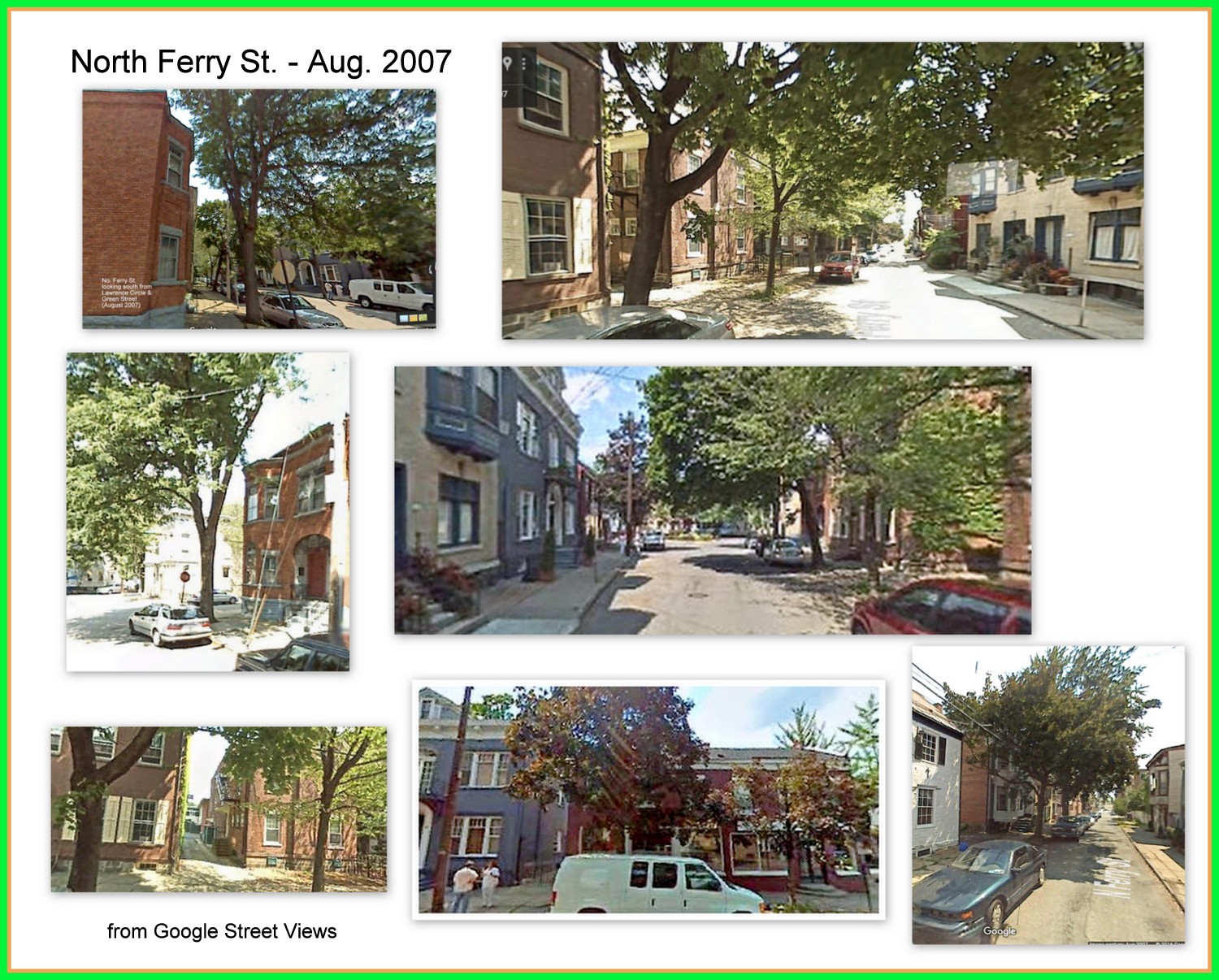
Meeting attendees were able to compare side-by-side, with photos taken from similar perspectives, 8″x10″ photo collages showing N. Ferry St. in 2007 (prior to the street 2008 tree removal), and in mid-April 2016. Click on the following images to see larger versions comparing N. Ferry St. in 2007 [L] and 2016:

. . 2007 . . NFerry1

.

.SOSTrees2 . . 2016

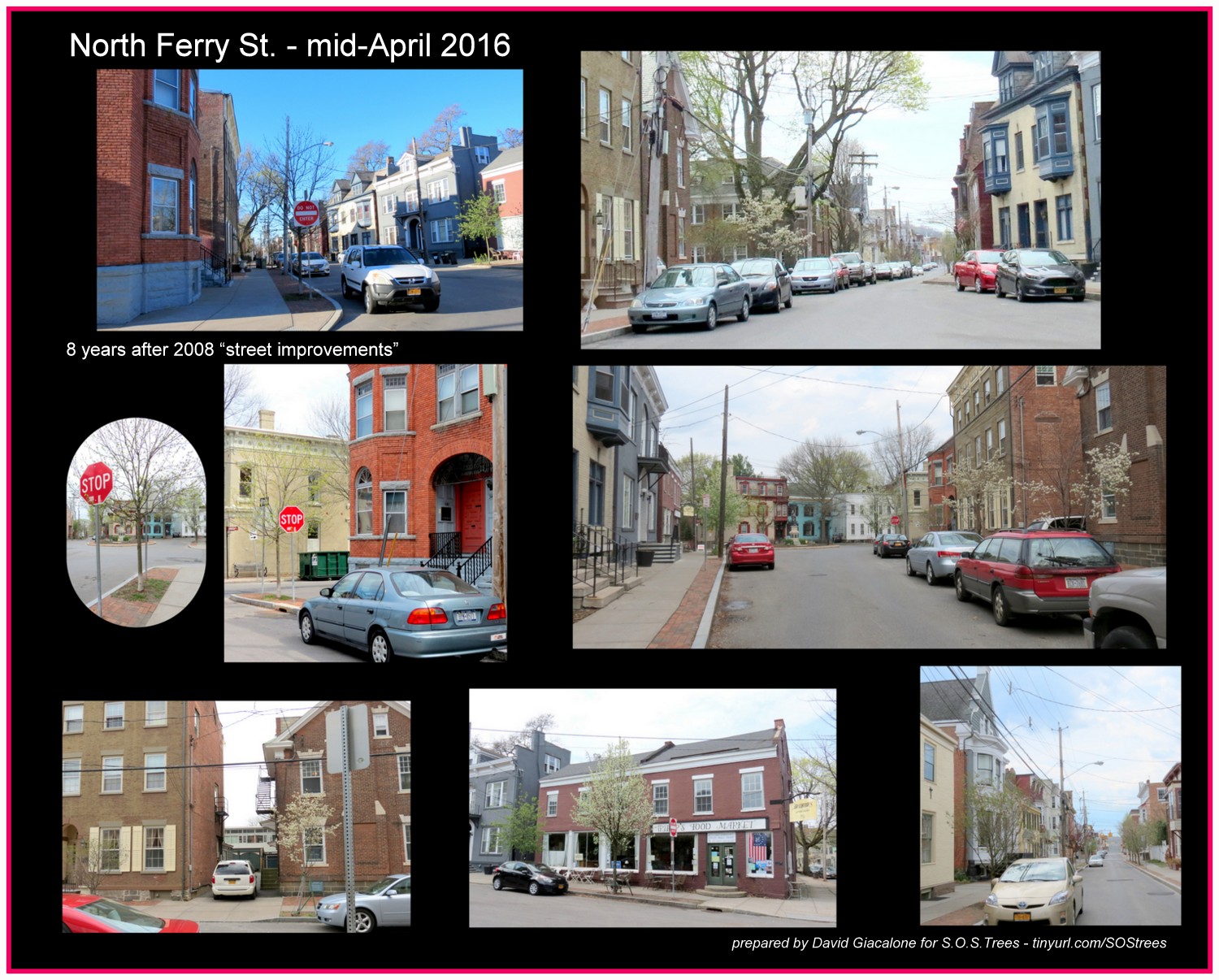
The 2016 photo collage above [lower, R], showing the streetscape 8 years after the “improvements” of 2008, belies the statement from an Assistant City Engineer that, ”[I]f you give the [the small replacement trees] 5-10 years, they will be mature and give the same feel as the larger trees with minimal burden of damage.” [The photos collages will be available to view at Arthur’s Market throughout the S.O.S. Trees campaign.]

During an outdoor session, those attending the Meeting were also able, by looking down the streets that intersect Lawrence Circle, to see several at-risk blocks of Stockade trees. Each block has significant numbers of healthy or treatable street trees that deserve to be saved, even if they are standing alongside uneven or damaged sidewalks.

Front&GreenSts05May2016

.. above: an eastward view up Front St. and Green Street at Lawrence Circle, May 5, 2016 . . 

ALTERNATIVES to TREE REMOVAL

ChillicotheExh An important exhibit at the April 30th Meeting centered on the publication “Trees and Sidewalks in Chillicothe”. Chillicothe is a small and historic municipality in Ohio. Its guide for residents having tree-sidewalk conflicts is a particularly thoughtful and easy-to-read resource for those wanting to learn about the benefits of preserving our urban street canopies and about practical options available to avoid the removal of trees that are not dead, dying or dangerous. The report begins its description of the problems and solutions by saying:

“Both sidewalks and trees are crucial in providing important services to our residents and visitors. When there are conflicts between trees and sidewalks, we must be thoughtful in our approach to effectively spend limited dollars and truly address the problem. Surprisingly, there are often efficient and inexpensive ways to repair walks and at the same time retain nearby trees.”

One point made in the Chillicothe Report that deserves special emphasis is: “When considering sidewalk repair, there are several well established and inexpensive techniques available. The typical approach of ripping out the old and re-constructing a new walk is the most expensive and this can damage the nearby trees.”

  . . If you click on the yellow exhibit sign on the left, you will see a printable version of the large-font quotations used in our Chillicothe Exhibit.

  • For other sources on Alternatives to Removing Trees when repairing sidewalks and repaving streets, see the discussion at the bottom of our posting “sidewalks vs. trees”. One helpful resource is the monograph “Sidewalks and Roots: Mitigating the Conflict—An Overview” by Gordon Mann of Auburn, California, which has descriptions of alternative and innovative solutions to tree removal, mentioning the advantages and disadvantages of each process or material.  Municipal Research and Services Center (MRSC), a nonprofit organization in Washington State, reproduced Mann’s helpful article on its website.

WHAT’s NEXT for S.O.S TREES?

Continue reading