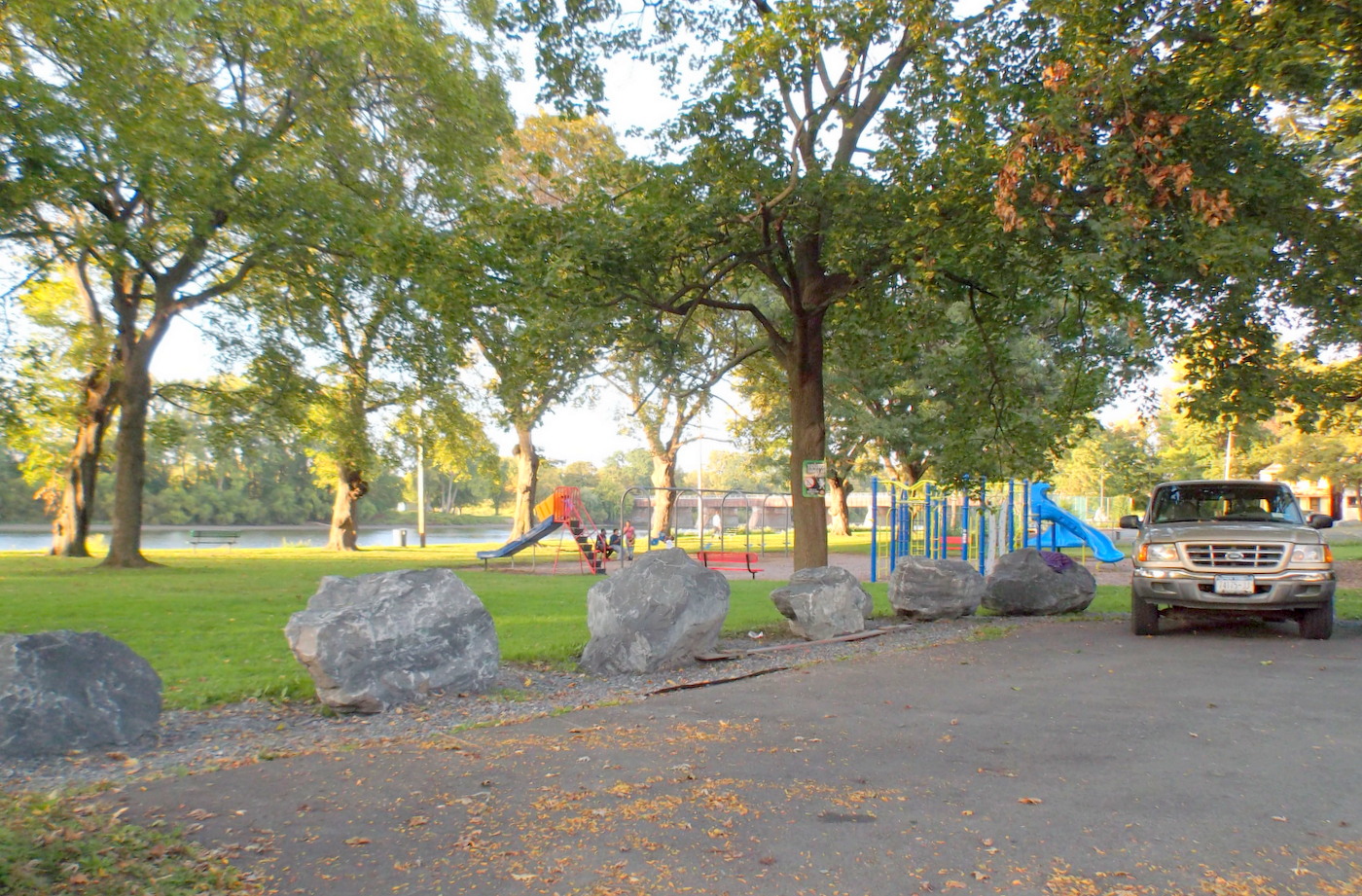
The Boulder Bunch Design Committee
BoulderGate! BoulderDash! Frankly, I’ve been virtually seething over the process used by the officers and board of the Stockade Association [SA] to achieve the replacement of old metal guardrails with boulders where Riverside Park meets the dead-end parking/turn-around areas of three Stockade streets. The deliberate decision* of SA leaders not to inform members and neighbors of the boulders-for-guardrails project, specifically because they expected strong opposition, shows a great disrespect for the Stockade community, and disregard for their obligations.
*follow-up clarification (Sept. 23, 2017):
 SA President Carol DeLaMater sent me an email yesterday morning (Sept. 22), saying “David, very disappointed in your assumption about Board behavior regarding support for a proposal to improve the area at the end of North St. It had none of the deliberate motivations you describe.” Please Note: My information on the reason the Board failed to inform the community comes from a person who attends SA Board Meetings, has no apparent axe to grind, and who I have always found to be most trustworthy and reluctant by nature to foment controversy. The account also rings true, because Board fear of opposition to the boulders is about the only reason that seems to explain the failure to request or allow “outside” input over perhaps a period of two years. I do not believe that responsible Board members and officers considered this major change in the appearance of the Park and streetscape to be too trivial to bring to the membership.
 In addition, SA Recording Secretary Suzy Unger wrote yesterday evening (Sept. 22) to myself and the 400+ members of the Stockade Yahoo email list, to point out that, in the September 2016 Stockade Spy, in the section with the minutes of an August 3, 2016 SA Board meeting : “The boulders and the letter to the city are referenced, clearly contradicting David’s assertions.” I, of course, checked out Suzy’s claim, and discovered that the Spy states, regarding the boulders: “Board approved . . . letter to City requesting replacing battered guardrails with decorative boulders at end of North St. and others ending at Riverside Park.” (screen shot of page at left) After considering that fact, I replied to Suzy and the Yahoo email list, thanking her for the clarification, and noting that:
 “(1) The Board acted to ask the City to replace the guardrails with boulders without first informing the membership or neighborhood about the issue. And, (2) Although the initial request to the Board by residents was only about North Street, the letter expands the request to other streets along the Park, without notifying residents of the other streets.”
back to Original Posting
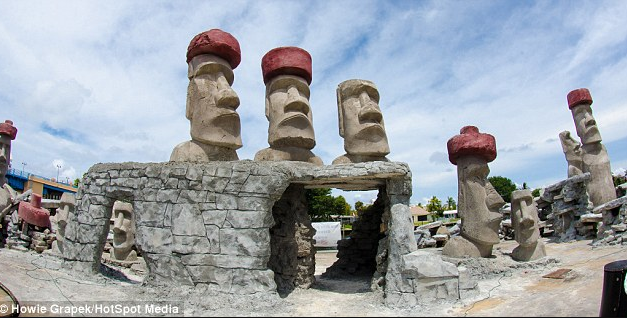
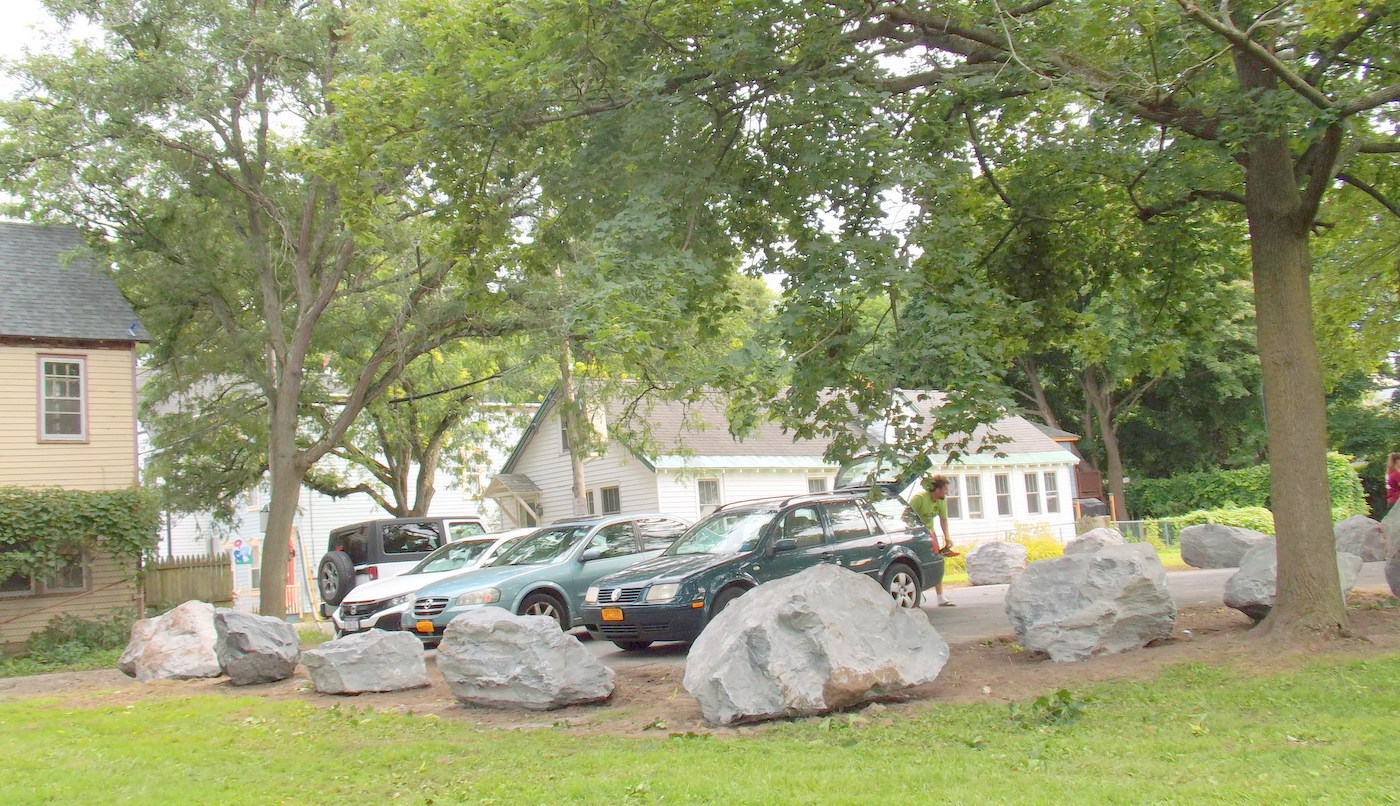
Perhaps more importantly, the failure to inform members and the community about the requested boulder project demonstrates why any substantial proposal needs the input of “outsiders” (people other than the proponents of a plan and their close friends) to assure that significant concerns are raised, unintended consequences pointed out, alternatives offered (and expensed), and the thoughtful wishes of the neighborhood heard. Nonetheless, I am attempting to write in a civil tone, and keep my sense of humor (see image of the Boulder Bunch Design Committee, above).
- There may be reasonable responses to the concerns discussed below, but we were never allowed to raise the issues or test the responses before 110 tons of rock were deposited in Riverside Park.
- Why am I so upset at the process? To better focus on facts, research, and common sense concerns relating to the use of the boulders, I expand on my reasons at the foot of this posting*. I also explain why even non-members of the Stockade Association have the right to be concerned and to point out failures in the process and outcome.
- Share this webpost with the short URL: http://tinyurl.com/BoulderGate
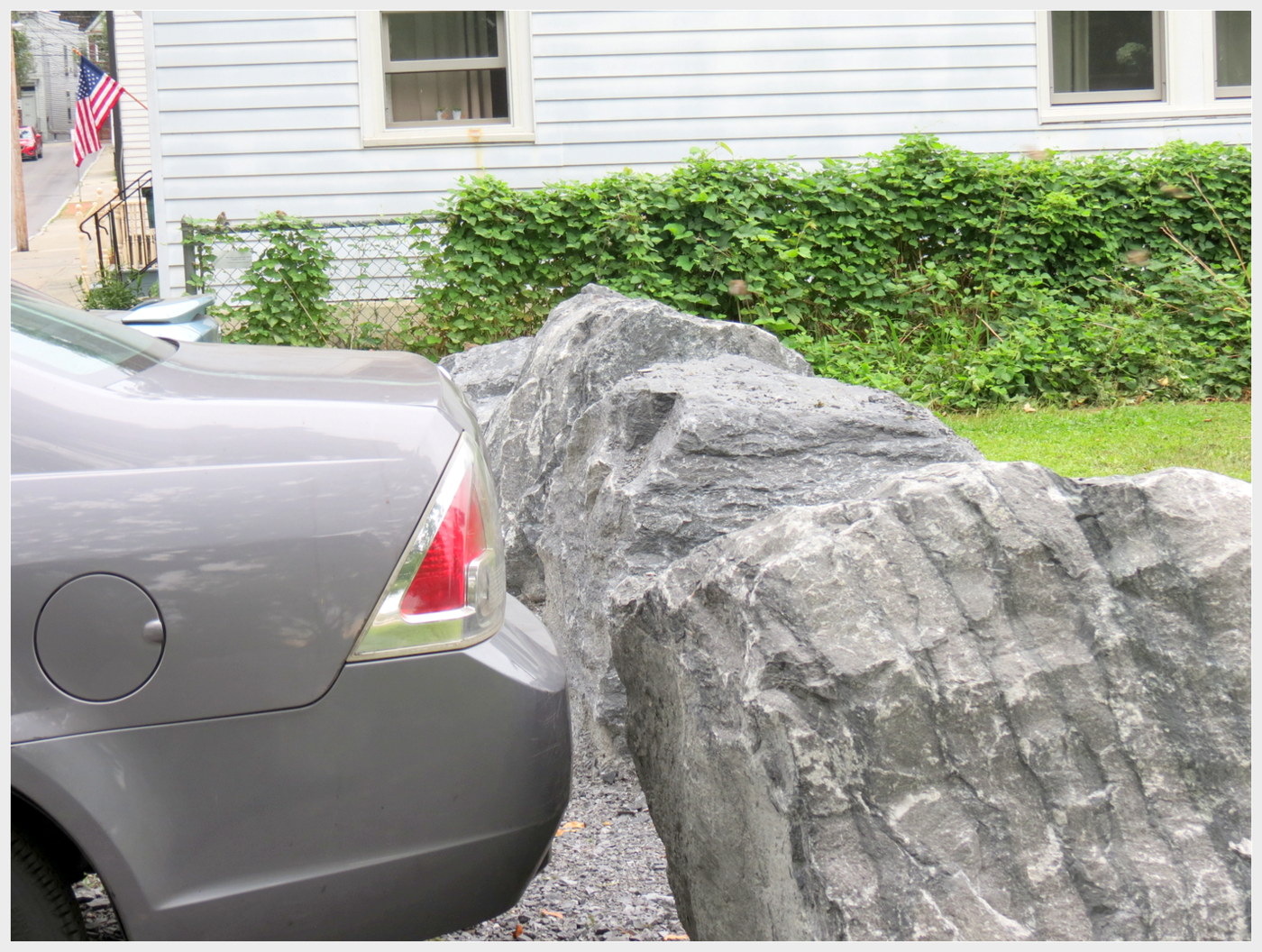
In case you are not aware of the situation at Riverside Park, here are some images (and, note, none of the photos has been staged; I found the situation and snapped the picture):
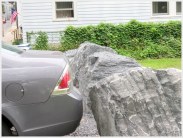 . .
. . 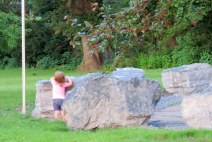
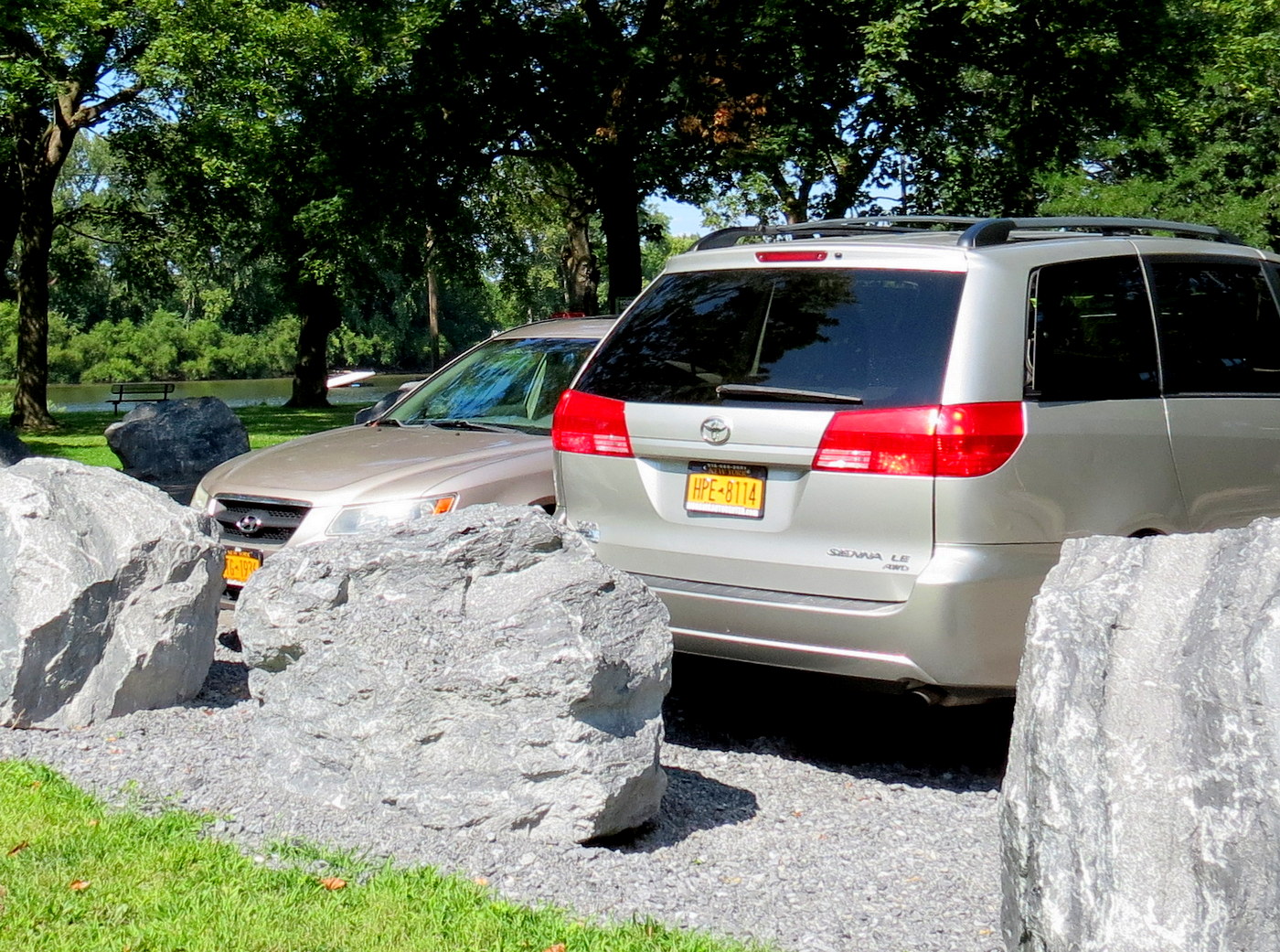
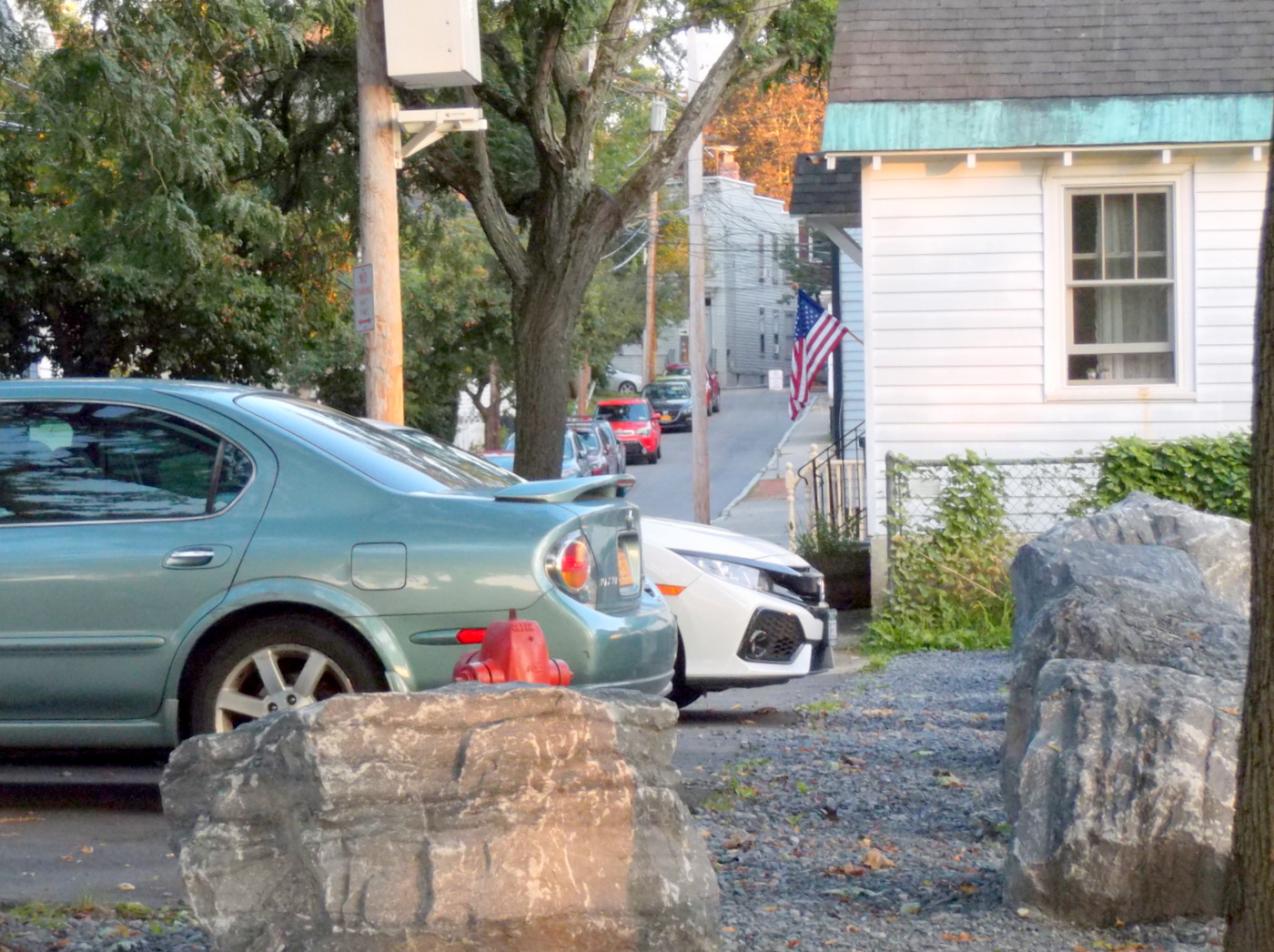
. . above: [L] a car parked at North St. boulders; [R] a toddler about to climb a boulder at the end of Governor’s Lane . .
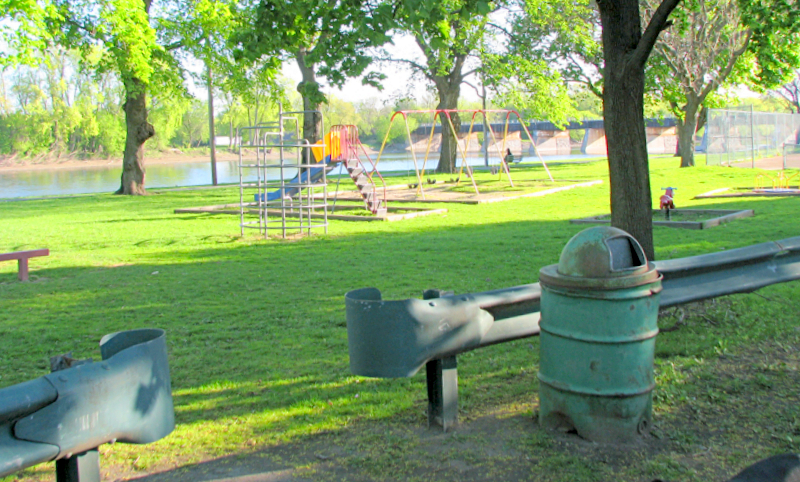
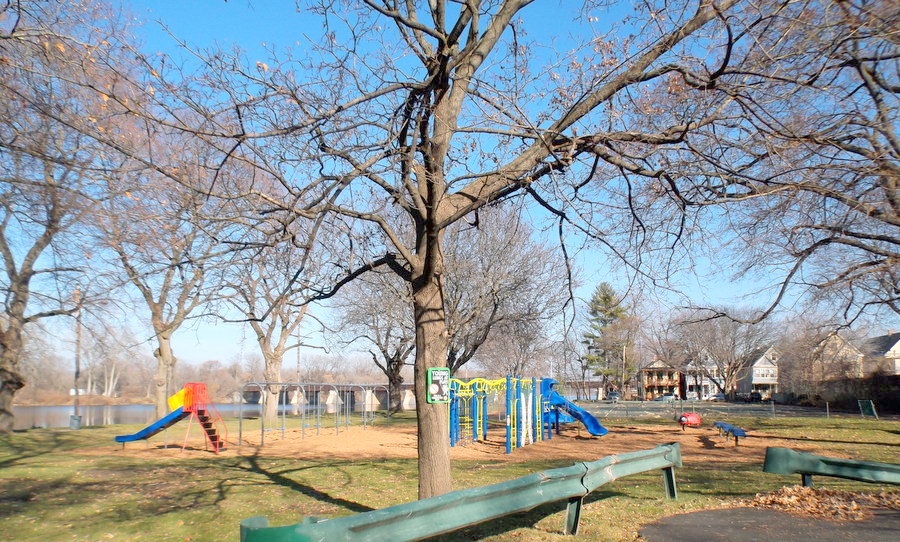
. .Also, a portion of the end of North Street near the playlot, showing the old guardrails:
 ..
.. 
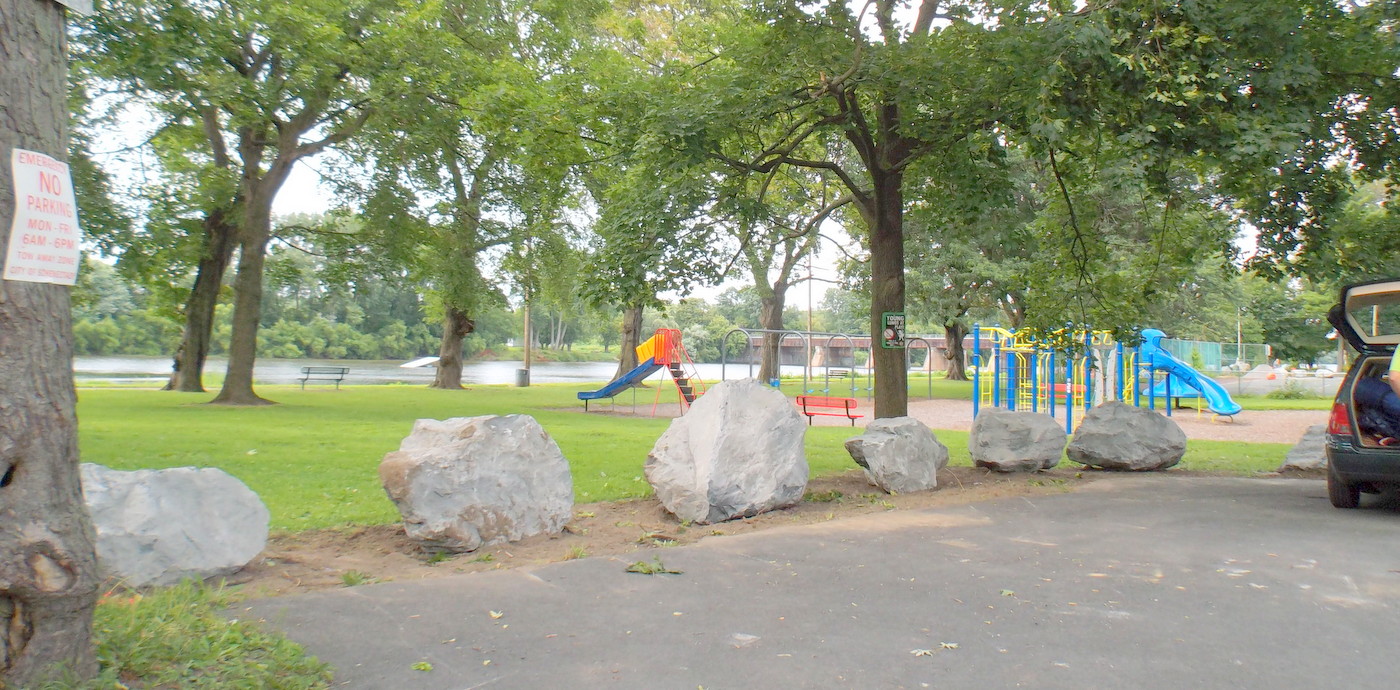
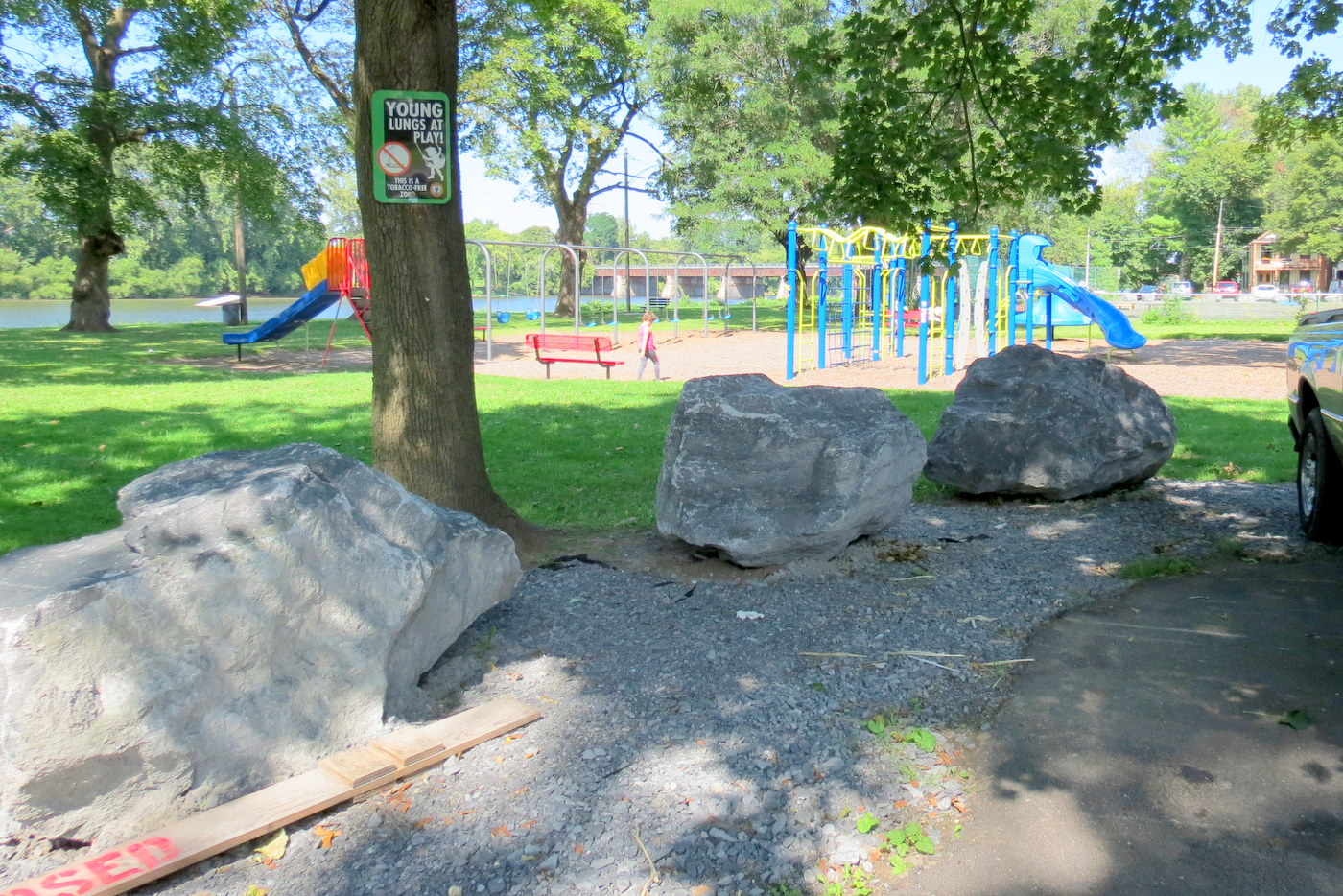
. . and, the same portion with the new boulders:

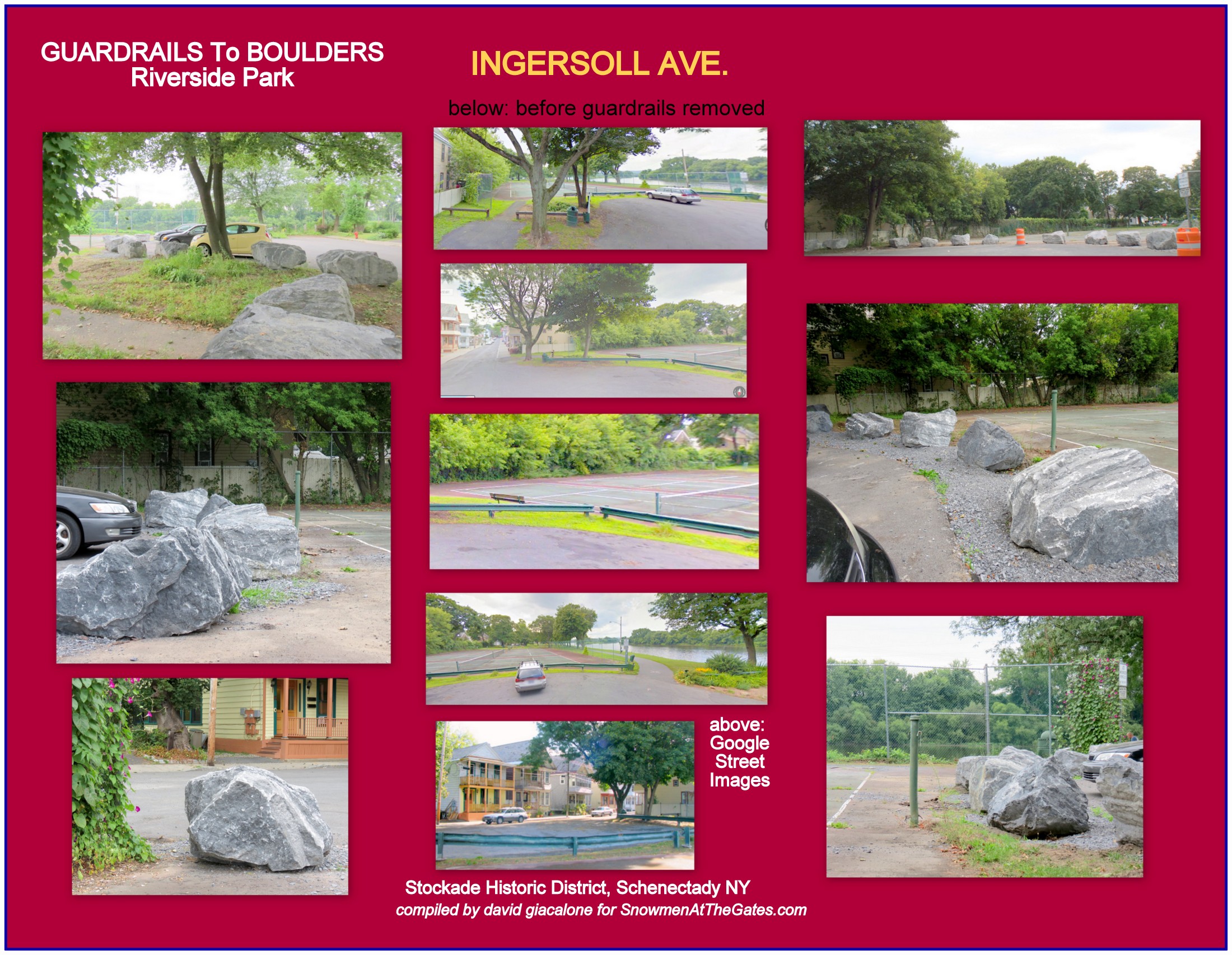
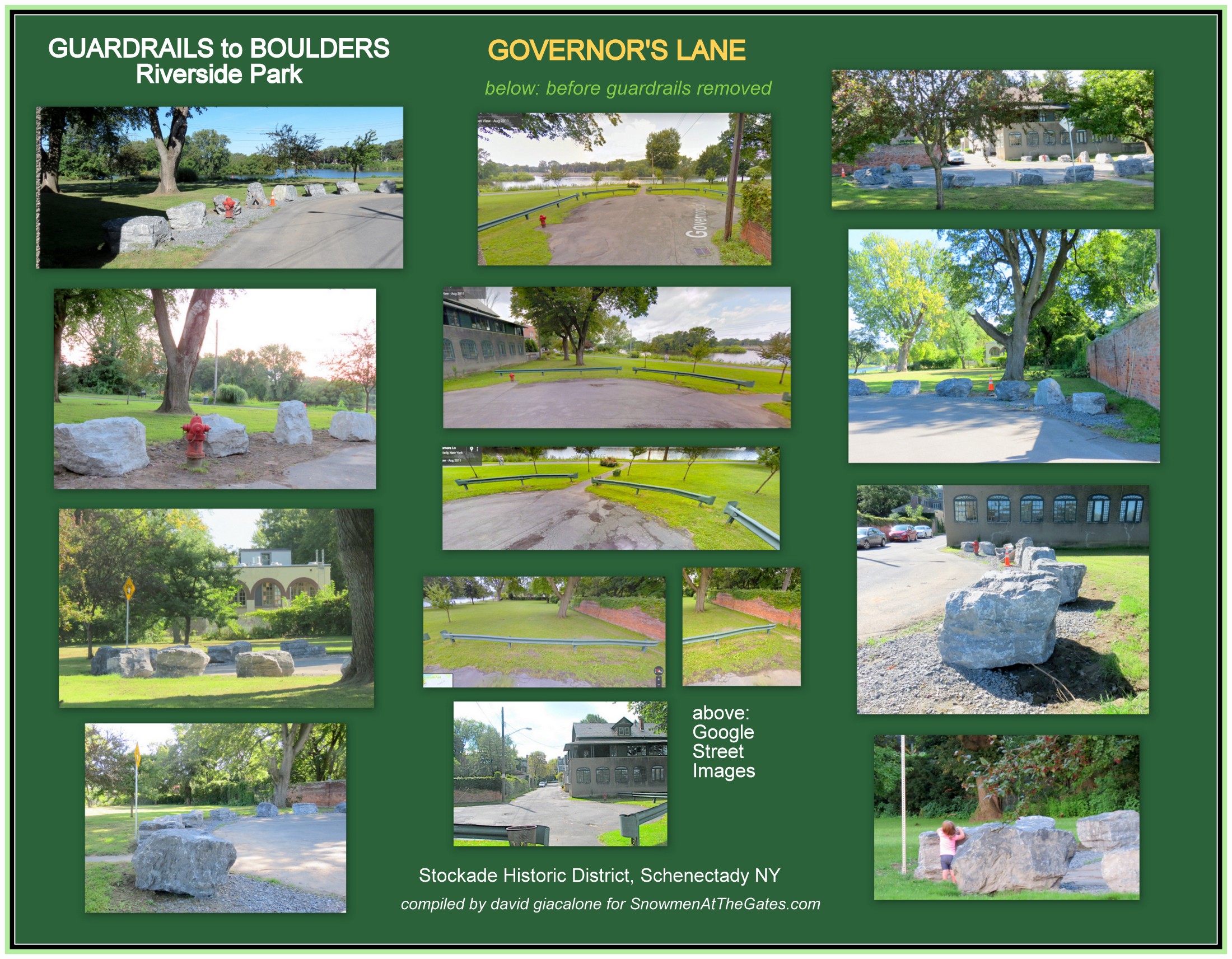
For a fuller picture at each location, click on the collage thumbnails below to see both the prior green guardrails and the new boulders at the end of Ingersoll Avenue, North Street and Governor’s Lane:
 . .North Street
 . . Ingersoll Avenue
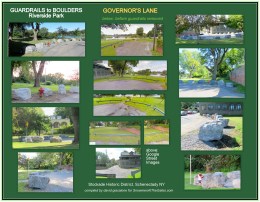 . . Governor’s Lane
 CONDITION of GUARDRAILS: I have no argument with the assertion that a sufficient number of the green metal guardrails are old, dented and rusted to warrant replacing all of them. The question, of course is “replacement with what?” (see below).City Engineer Chris Wallin told the Times Union last month that the price for removing the guardrails and purchasing the gray limestone boulders was $16,000. We have no idea what other options might have cost, because they were never pursued
-

Google Map North Street 2011
NORTH STREET Focus: To simplify the discussion, this posting will focus on the situation at the end of North Street. According to SA President Carol DeLaMater, it was North Street residents who first suggested replacing the old green, bumper-high metal guardrails with large rocks or boulders, where the street dead-ends at Riverside Park, in a small, circular, paved area used for parking and turn-arounds. The street is one block long starting at Front Street, north to the Mohawk River. There is only one travel lane, which must be used by two-way traffic, making turn-arounds important and requiring the accumulation of snow at the dead-end or the Park. The Park’s playlot, aimed at young children, and almost totally renovated by the City in November 2016 for safety reasons, is located about 25′ from the parking area.

North St. parking area seen from Playlot (Aug. 2106)
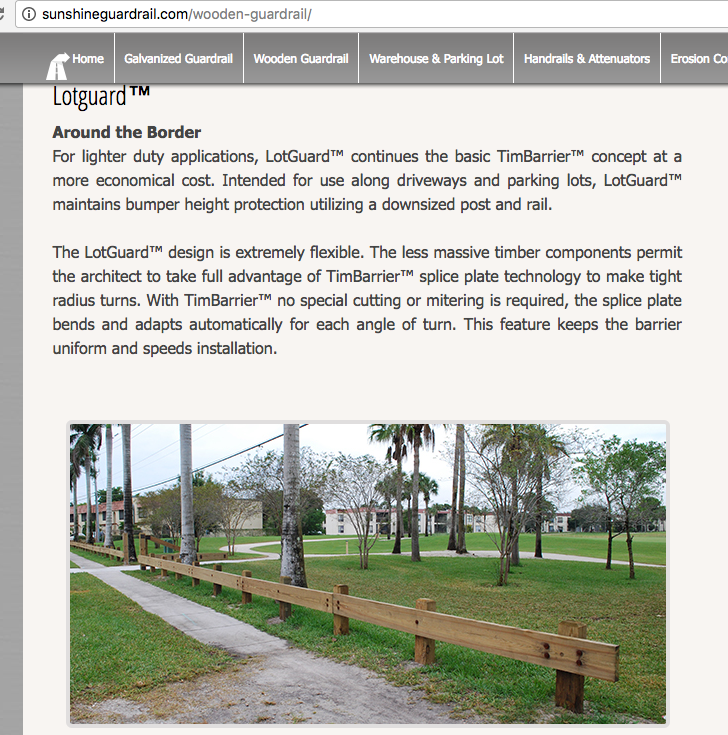
- Repair/Replace ASSUMPTIONS. We Stockade residents are used to the principle that you replace things in a historic area with something as close as possible to the original material and without a drastic change in appearance [e.g., Sch’dy Code. §264-76]; that more and bigger are not always better; and that maintaining longstanding streetscapes, park-scapes, and scenery are important goals that should only be circumvented or ignored for very good reasons. Such principles may not be a legal requirement in this instance, but they reflect important historic district values and expectations. Here, no alternatives were discussed (for example TimBarrier LotGard), and no reason given for the drastic change, other than “the old guardrails are ugly”, “the boulders are beautiful and natural”, and “the City has a grant.” Others boulder supporters have waffled a bit, “we only asked for lower, large rocks, wanting them to be smooth and useful for seating, too.”
REPLACEMENT WITH WHAT?
When replacing a utilitarian element like guardrails, we should probably start by asking what purposes the guardrails serve, whether they have been serving those purposes well, and whether some performance factor can be improved at a reasonable cost. We surely need to ensure the replacement situation is just as safe and effective, and hopefully adds no new maintenance worries or costs.
 Note, however, that in support of his boulder proposal for North Street, Dennis Meyer told the Times Union that “boulders would also satisfy the city’s 2020 comprehensive action plan to “remove guardrails from parking areas and install a more appropriate barrier”. That, of course, begs the question of what constitutes an appropriate barrier at the particular location.
GUARDRAILS vs. BOULDERS
As Parking Barriers: NEEDS of DRIVERS When PARKING
No driver that I know of has ever been intimidated by bumper-high metal or wooden guardrails. It seems, however that a significant number of drivers fear getting too close to the Riverside Park boulders when parking:
- boulders are unforgiving. they will beat your doors, fenders, bumpers and side-panels every time you engage them. also their non-uniform shape means you cannot always tell how far away the vehicle is from the boulder merely by seeing its top.
- the boulders are much higher than passenger car bumpers. drivers backing in have to worry about being able to open their rear doors.
- parallel parkers very much need to have full control of their doors when exiting and returning to the vehicle.
 . .
. . 
NEEDS of DRIVERS When TURNING AROUND
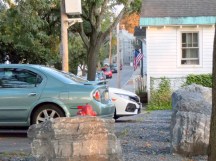 Because drivers often do not park as closely to the boulders, there is considerably less space to maneuver when pulling out of a parking space or turning around at the dead-end.
SNOW REMOVAL
We know how the guardrails serve snow removal needs, but we have to wonder how major snowfalls will be handled, and what major accumulations will mean. Guardrails permit some snow to be pushed under them and are low enough for plows to dump snow over them. Boulders seem to have neither characteristic. One SA officer wrote that snow can be pushed between the boulders. Maybe by hand, but the suggested process seems to be a great way to break a plow blade or push boulders onto the park lawn.
SAFETY
It seems highly likely that small children will be attracted by the boulders, which do not offer the foot and hand holds of artificial climbing boulders certified for playgrounds. Instead, these unpainted, rough limestone boulders have many sharp edges, and splinters chipping off, and those falling will not have the required surfacing found on playgrounds (which
mandate 6′ of such buffered ground around the entire climbing element).
Even with a parent readily at hand, small children will likely have mishaps, and older ones will challenge each other and themselves in hazardous ways. It seems clear that the City, especially where it has put boulders between parking and the playlot only 25 – 30 feet away, may be liable for creating an “attractive nuisance.” For example, see this
legal discussion:
An “attractive nuisance” is any condition on someone’s property that would attract children, who are fascinated by it but don’t understand its dangers. If a child is injured or killed by an attractive nuisance, the property owner could be held liable for damages in a personal injury case.
INSTALLATION
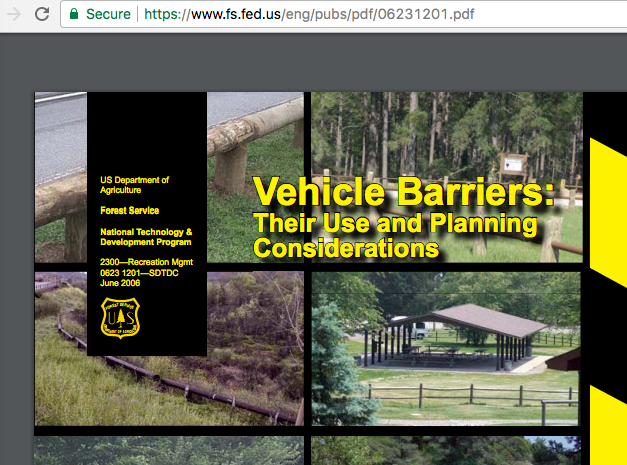
The Parks Department appear to have ignored basic elements for safe installation of boulder, making them dangerously unstable. For example, see Vehicle Barriers: Their Use and Planning Considerations (USDA Forest Service, June 2006):
 Construction techniques: Bury one-third of the rock for stability, anchoring, and a more natural look. [see sample sketch]
Similarly, a Best Management PracticesToolkit for the Tahoe Regional Planning Agency has a number of pointers related to Parking and Vehicle Barriers. Included are (emphases added):
-
DESIGN CONSIDERATIONS
Parking barriers shall be treated as potential visual features and shall have consistency with neighborhood and regional character and with other landscape elements such as lighting, adjacent building details, and street furniture.
Cluster and stagger boulders to mimic natural conditions.
-
INSTALLATION CONSIDERATIONS
 Boulders shall be greater than 3 feet in diameter and be keyed in to the soil a minimum of 6 inches. [see figure to the left, which suggest that one-half to one-third of the boulder should be below the surface]
Shrubs and vegetation can be used as parking barriers.
-
INSPECTION AND MAINTENANCE: Ensure parking barriers are sized and spaced correctly so they remain intact. Yearly maintenance may be necessary to repair damage from snow removal activities.
TAGGING-GRAFFITI
 According to Paul Nelson’s Times Union article, “The city engineer said he is not overly worried about the rocks being spray-painted because they can be power- or sand-blasted without being damaged.” (“Boulders make a big difference at Riverside park in Stockade neighborhood,” August 16, 2017) . That seems rather optimistic. The rocks are already flaking away; they are soft, limestone. Also, they are oddly-shaped, not smooth granite-type rocks, or already painted, and are not securely anchored. Because there are so many crevices, the idea of power cleaning, especially near parked vehicles and playing children, seems unrealistic.
FLOODING
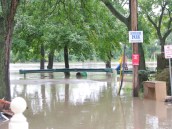 We know the guardrails stay put in a flood. Can we say the same for the poorly anchored boulders? Where might they end up if there is a flood? What about with ice-jam-related flooding? A FEMA training material states that flash flooding can move very large boulders, and then states (at 2-9).

North St. boulder
Flooding caused by ice jams is similar to flash flooding – the formation of a jam results in a rapid rise of water both at the point of the jam and upstream. Failure of the jam results in sudden flooding downstream.
AESTHETICS
Many in the Stockade community appear to disagree with the notion that the boulders are “beautiful” and look “natural”. Aesthetics are a matter of subjective evaluation, but the opinion of a significant, and perhaps majority, element of a neighborhood should not be ignored, and should at least be solicited. That is especially true when several years ago a similar boulder proposal for the Park inspired strong opposition when presented to an SA membership meeting.
When we are dealing with Riverside Park, which has been called “perhaps the finest thing of its kind” by the editor of Architect Forum, “nice”, “I’ll learn to live with it,” or “better than those old, dented guardrails”, is simply not good enough.
 . . beautiful and natural?
The Forest Service Vehicle Barrier Guide also states in its section on the use of Large Rocks and Boulders (emphasis added):
How to use: Mimic nature by planting rocks in clusters of one to five and varying space between the rocks and the clusters.
Where to use: Use where large rocks occur naturally. If large rocks are not common, do not use them; they will appear out of place.
- Furthermore, I have not been able to find even one example of analogous boulders of similar size being used as barriers along parking spaces — that is, none are in places where drivers must pull or back up to a boulder to park. The City Engineer told the Times Union last month that the rocks in the Stockade are similar to the ones in found in Collins Park in Scotia and Indian Meadows Park in Glenville. My investigation suggests the contrary.
 I could find only one “boulder” in all of Collins and Freedom Park, and it is nowhere near a road or parking space.
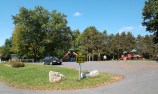
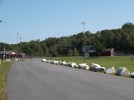
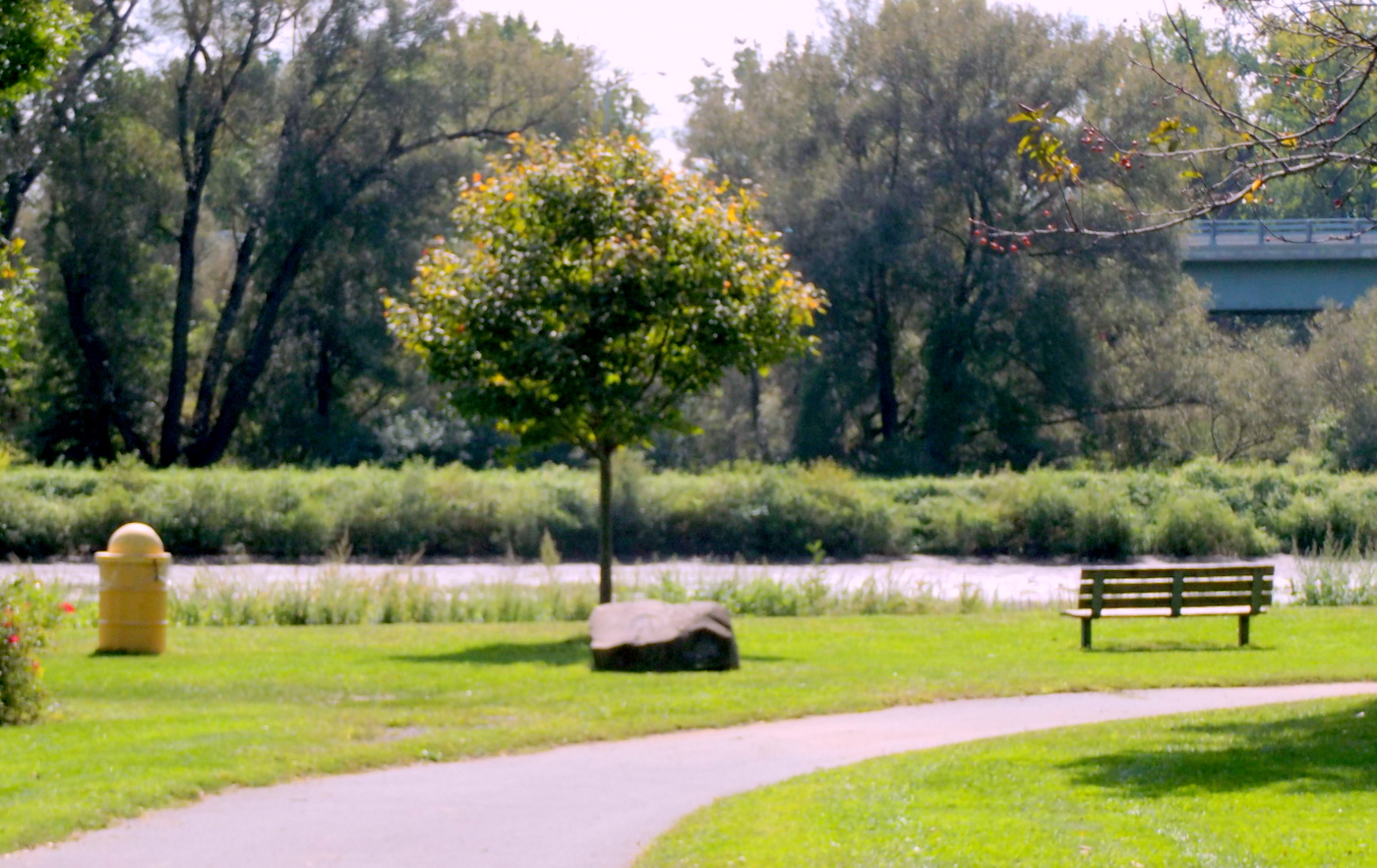
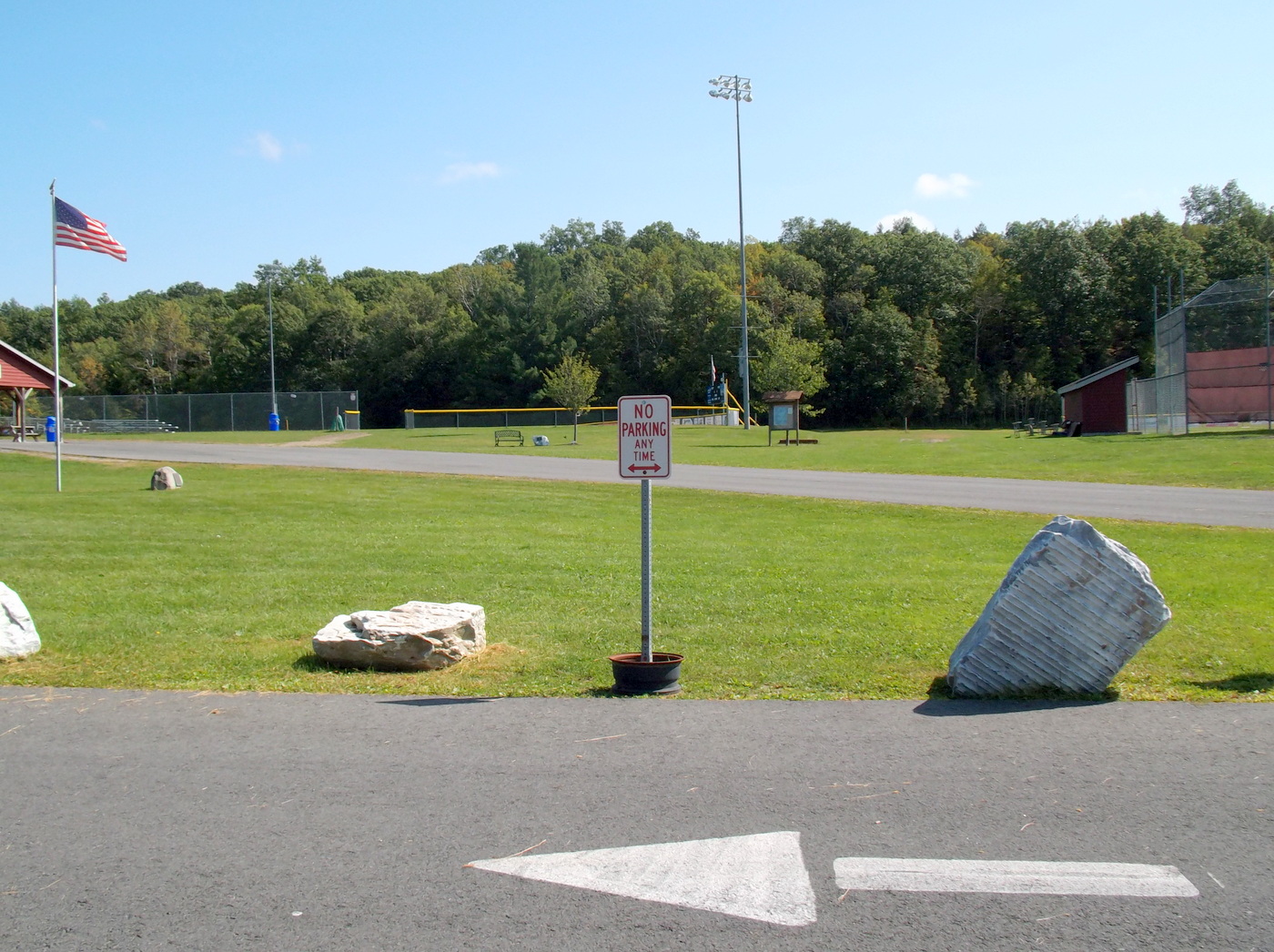
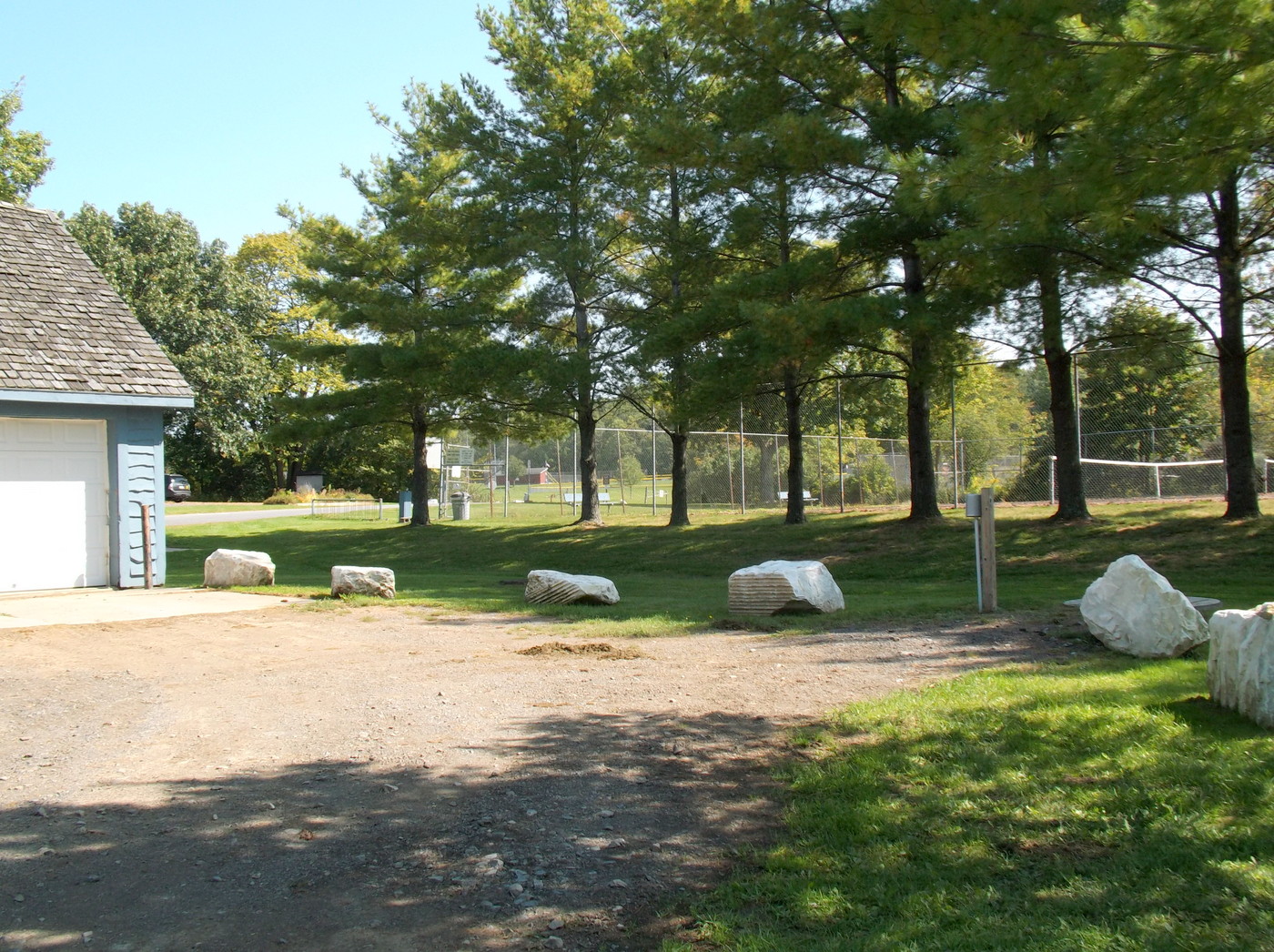
 There are many boulders at Indian Meadows Park in Glenville, but not one is next to a parking space and, especially, none are along the parking spots at the playground. Also, the Glenville boulders, which are really homely when in large groups, are there to keep vehicles off of the lawns, and have plenty of open space available nearby for depositing plowed snow.
 . .
. .  . .
. . 
above: Indian Meadows boulders: [L] none are near the parking spaces for the playground; [M] used along no-parking road to keep vehicles off lawn; [R] along driveway to Park Dept. garage to protect lawn. [click on an image for larger version]
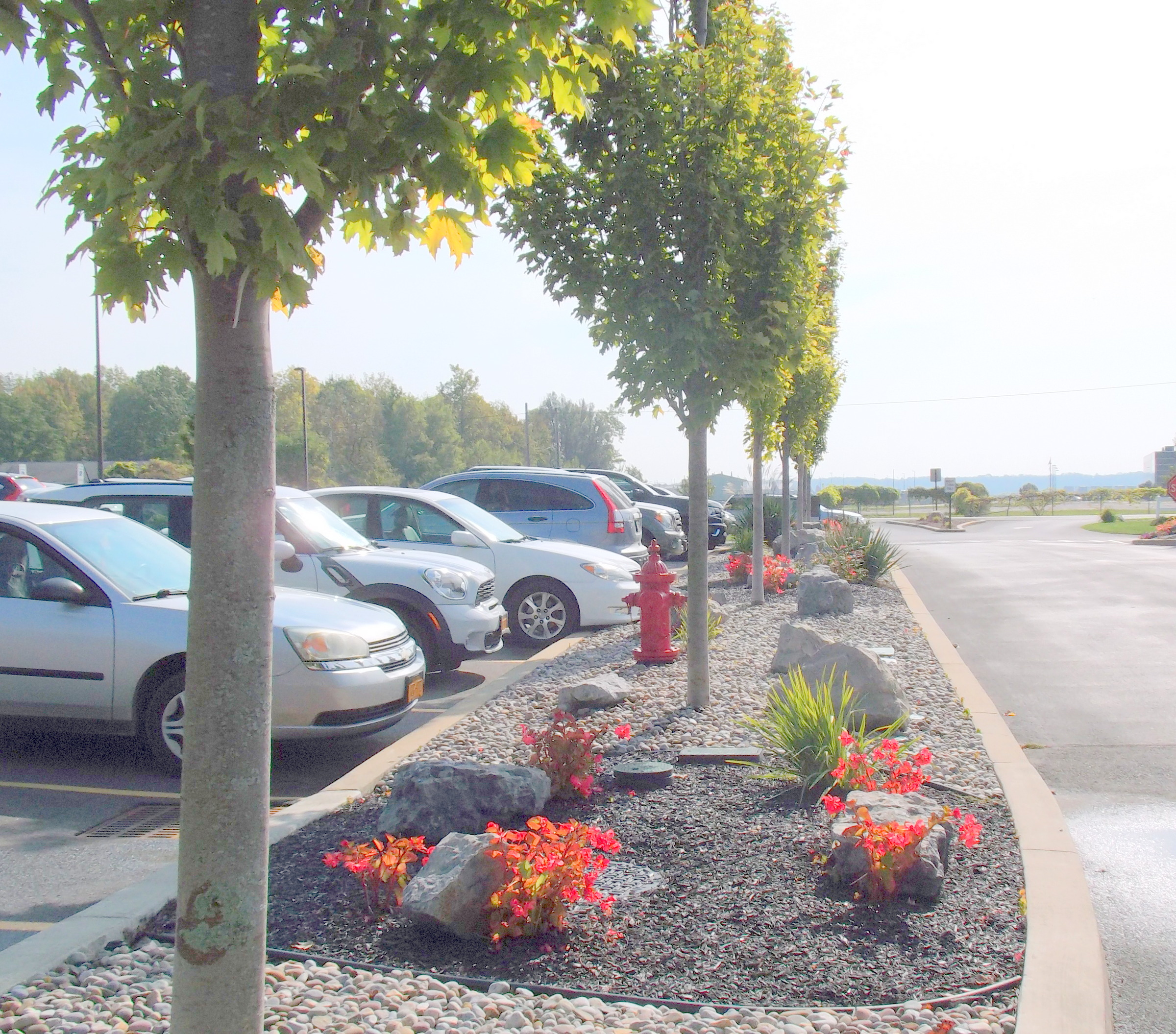
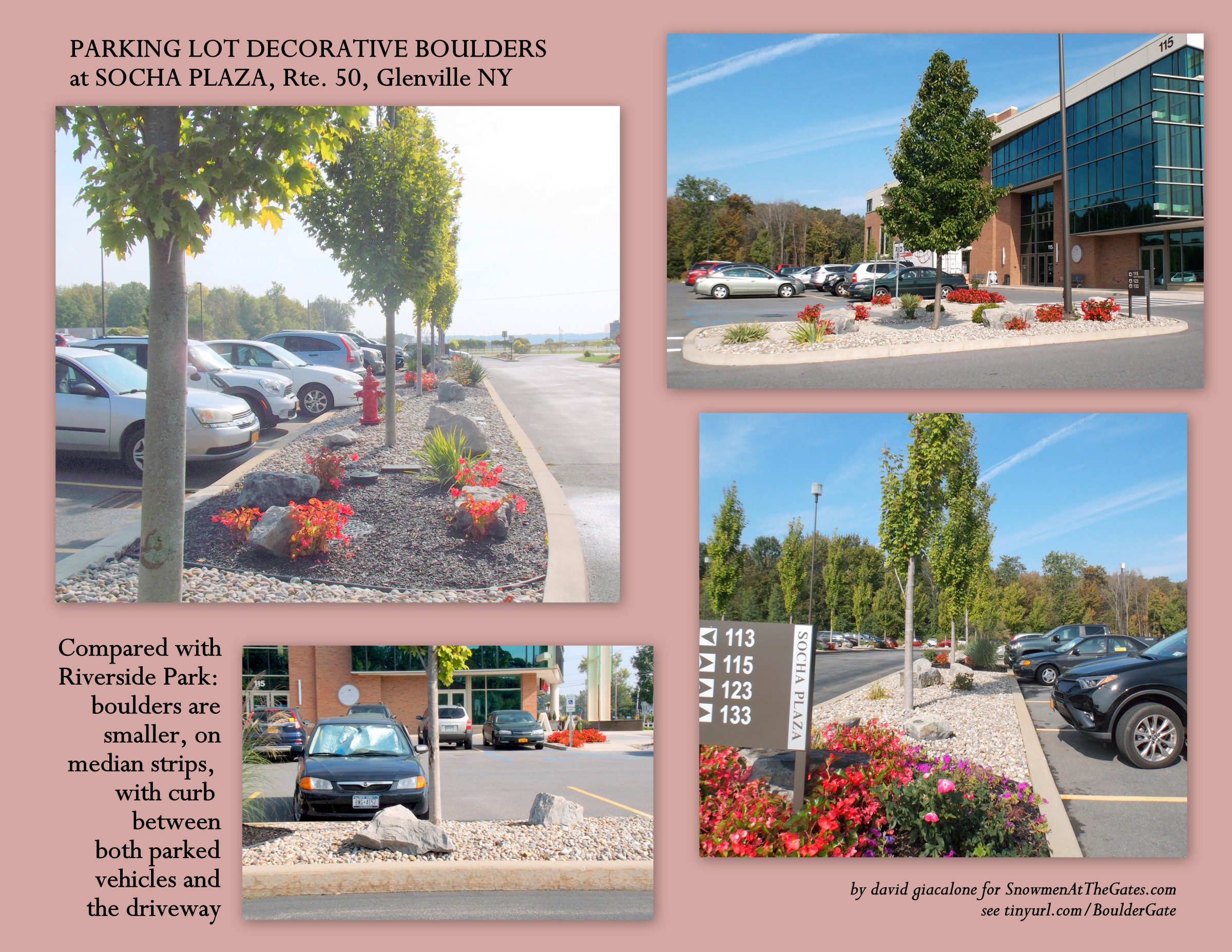
Glenville follow-up  (added Sept. 26, 2017): While leaving a medical appointment at Socha Plaza today, I noticed how they use boulders at that parking lot. The decorative boulders are quite a bit smaller than those at Riverside Park, preventing visual assault, and present none of the parking issues caused at our Park. With the boulders set on medians, there are curbs and additional space between vehicles being parked or driven in the parking lot and the boulders. (see photo at right and collage immediately below)

I hope the main points made above will help ensure a far more open process within the Stockade Association, and may help the City decide to find a better solution for the Park and a more appropriate home for the costly boulders.
Continue reading →
 . . .
. . . 

 Of course, Constant Vigilance is nonetheless a very helpful state of mind, and I am quite pleased we have that symbolic cannon to help protect the Old Pump House from future threats, whatever the source.
























 Update (September 15, 2017): Around noon today, I sent the following email message to Capital Region Media members and others interested in the topic, relaying the good news that Ellis and MVP were no longer listed as Sponsors of the Gaming Lessons project at Rivers Casino.
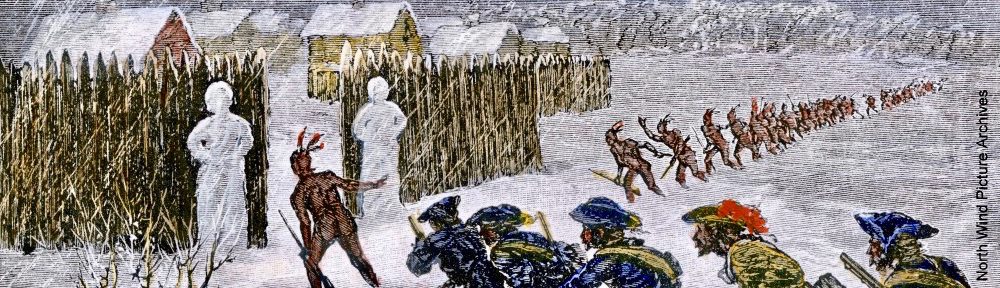
 snowmen at the gates