the Gazette gets stuck in Stockade traffic

The Schenectady Gazette wrote yesterday that “Stockade group frets over potential traffic: Mohawk Harbor access a concern” (by Haley Viccaro, September 30, 2014).  They decided to only speak with Mary D’Allesdandro, Stockade Association president, concerning the Stockade’s traffic worries, although this group has raised the traffic issue since created at the end of May and deals with it specifically in our Statement in Opposition to the Casino.  Mary would not say anything negative about the casino, which would greatly increase traffic, but did admit that “Anytime there is development there are concerns, like with traffic.”

The Gazette article quotes from the Stockade Association’s letter to Metroplex commenting on the environmental review of the Mohawk Harbor:

“Because of these concerns, the association requests that, at a minimum, there be no direct connection from the development to Front Street and other measures are taken to reduce the likelihood of drivers using the Stockade streets.”

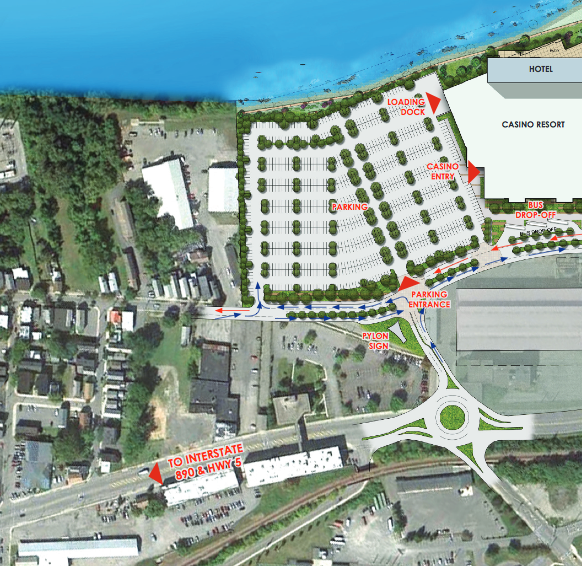
The article does not point out, as Stop the Schenectady Casino has done often, that the casino’s access plan shows traffic going directly east up Front Street from the casino parking lot, and that that the Mohawk Harbor traffic report insists there will be no harmful effects for traffic as it traverses Front St. and Green St. at Lawrence Circle.  Thus, the applicant recommends no changes along Front St. or at the Circle.

just-say-no-003 For a full account of the Stop the Schenectady Casino group’s position and conclusions on the traffic issues created by the casino in the Stockade, see pages 4 to 6 of our Statement in Opposition to the Schenectady Casino, and the related attachments.

The article has so many flaws, including confusing the extra traffic generated by the casino at the morning rush hour with the number for all daytime traffic, that I left the following comment at the webpage of the article:

COMMENTS
Sept. 30, 2014, 1:17 a.m.

dagiacalone says…

I’m concerned that the Gazette has again forgotten to mention the strong Stockade opposition to the casino, which has focused on the traffic issue for the past two months. Instead, you speak with the President of the Stockade Association, who has refused to have a meeting on the casino, which she supports, and talk about a traffic letter that received a few minutes of attention almost as an afterthought at an Association meeting.
.
Casino opponents collected 126 signatures by Stockade residents on their petition, as compared to the membership of the Association which is under 100, and compared to the 18 people who voted for the “neutrality position” at the September Association meeting.
.
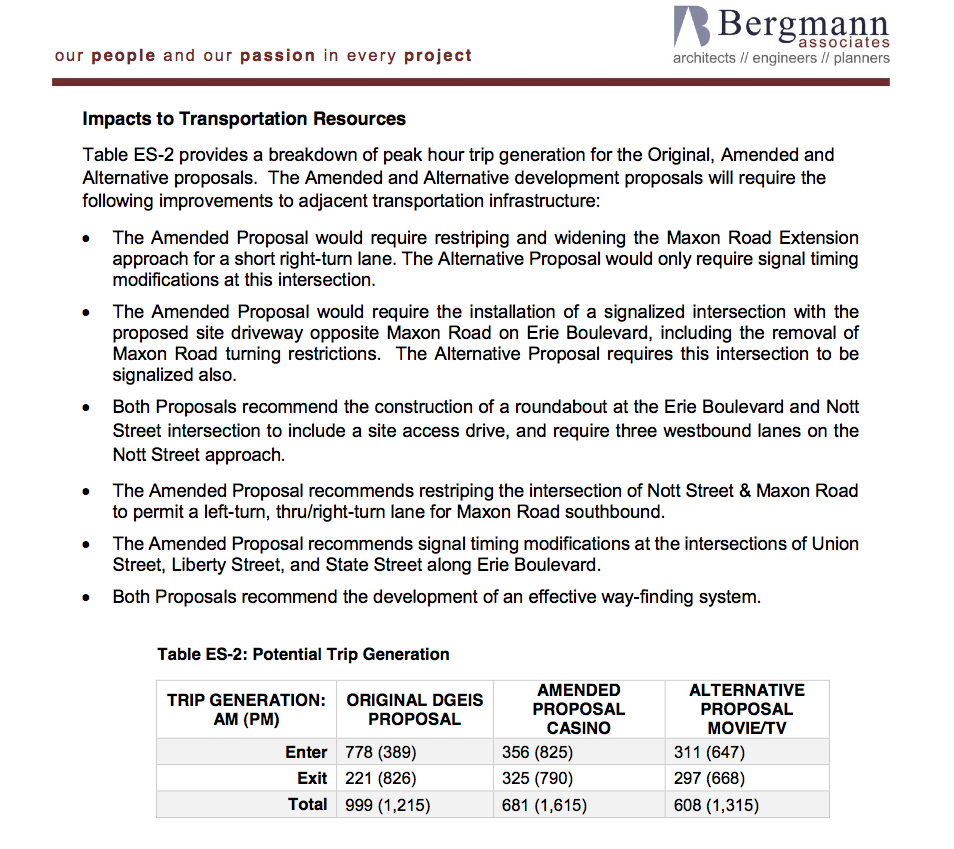
Had you spoken with us, we would have pointed out, as was stated on August 14 at StopTheSchenectadyCasino.com, that the Applicant’s traffic study predicted casino patrons would generate 681 new vehicular trips during morning peak rush hour and 1,615 new trips during evening peak rush hour, not 680 during the day and 1615 at night, as your article states. In fact, the traffic report states that the peak rush hour numbers are those at the peak of the nearby roads, and that the casino’s even higher peak numbers come at different hours (which are never discussed in the Report).
.
The Table from the Traffic Report with the trip generation numbers can be found at this webpage:
http://tinyurl.com/CasinoTripGen
.
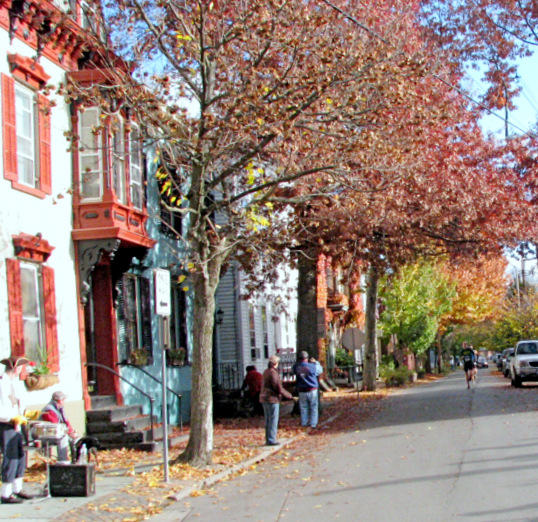
It is strange that after 40 years of constant worry about traffic from development, the “leaders” of the East Front Street Neighborhood Association “don’t mind the traffic” from the casino. Yes, Front St. will get the traffic, and two-thirds of Front Street is very narrow and runs through a very densely populated portion of the Stockade neighborhood. For photos and description of the traffic problem likely to be created by the casino, see
http://tinyurl.com/CasinoFrontStreet
.
Finally, the Casino’s access plan has an arrow directing exiting traffic west up Front St. If that is any indication of the good working relationship between the casino Applicant and the Stockade Association, perhaps we are lucky the Association has decided to disarm itself and abandon its role of protecting the residential nature of the Stockade.


Rush Street takes aim at adolescents

noslots

According to a report issued September 9th by a major hospitality and casino worker union, Rush Street Gaming is investing millions of dollars with the aim of becoming the industry leader in “building a bridge” between children playing casino-like games on social media and smartphones and their going to brick-n-mortar casinos to do real gaming once they are old enough.  Knowing that the earlier you begin to gamble, the more likely you are to gamble often and obsessively, Schenectady’s proposed casino operator is sowing the seeds digitally to grow the next generation of problem gamblers.

bettingonkidsonline-cover Go to the website No Slots for Tots, which is sponsored by the Unite HERE, to see their informative, easy-to-read, and well-illustrated, 12- page report, “Betting on Kids Online: How One US Casino Company Hopes to ‘Bridge the Space’ Between Real and Virtual Casinos While Making Apps Available to Children via Social Networks and Smartphones.”  The introduction states:

[O]ne US casino company [Rush Street Gaming] has quietly pursued an Internet strategy that has sidestepped gambling regulators while also explicitly allowing players as young as 13″ to play their virtual games.

Who is Unite HERE? In their words, “UNITE HERE is the hospitality workers union representing workers in the gaming industry in North America. UNITE HERE Gaming Research provides analysis of the gaming industry from the perspective of those who work in it.”

Note: The Albany Times Union reported last night that “A large casino workers union [Unite HERE] has written to the state Gaming Commission complaining about Rush Street Gaming, the company trying to obtain licenses to run gambling houses in Schenectady and Newburgh. . . . The letter asserts that workers at casinos run by the Chicago-based firm have reported ‘illegal harassment by casino managers including threats, surveillance and other intimidation’.” TU reporter Jim Odato explains further and gives a little background on Rush Street and unions.

If Rush Street Gaming is rushing to create the next generation of casino gamblers, can there be any doubt that they will make a full-court (full-rink?) press to lure Union College undergraduates across the street to the old ALCO site?  For more on the increased vulnerability of young gamblers, see our posting “what will the casino mean for Union College students” and the materials referenced there.

protocol for Location Board’s public comment events

The NYS Gaming Facility Location Board announced the Details and Protocol for Public Comment Events today (August 21).  The email message with the Announcement, from Communications Director Lee Park , is copied in below.  As we posted recently, the “Public Comment Event” — public hearing — for selecting the Capital Region casino will be on Sept. 22, from 8 AM to 8PM, at the Holiday Inn Turf , 205 Wolf Road. Attendance at the Event is on a first-come-first-seated basis, but you will be able to watch it streamed and archived at the Gaming Commission website (www.gaming.ny.gov). Information on sending in your written comments is also given below.

red check Reserved Time Slots.  Note that you may request a 5-minute time slot for making a presentation to the Board at the September 9th event, and there will be five slots reserved per hour, with the remaining slots filled on a first-come basis by signing up the day of the event.  As you can see from the directions, you should reserve a slot as soon as possible, as people will be commenting on all four Capital Region applicants and there are only a total of 60 reserved slots:

Comment Segment Reservations:  Five time slots per hour will be held for speaking time reservations.  To reserve a segment for a public comment event, members of the public should email their name, organization (if applicable) and desired time request to the following email addresses, respective to each location:

September 22, Capital Region Event:                          CapitalRegion@gaming.ny.gov

Organizations or groups are asked to designate a representative to make one 5-minute presentation, with other members speaking as time permits.  Because of limited seating, those not wishing to speak are urged to watch the streamed version online.

update: As representative of Stop the Schenectady Casino, I (David Giacalone) have been given the 10:00 to 10:05 A.M. time slot at the Capital Region public comment event. I hope there will be other Opponents more persuasive than I at the Event.

red check Written Comments. The Board will accept, and seems to prefer, written comments by email [info@gaming.ny.gov], or you may submit them at the Public Comment Event or within 7 days after the event:

Written Submissions: In addition to oral statements, the Board will accept written submissions at the event and up to seven (7) days following the event.  Statements received beyond seven (7) days will not be included in the formal record. 

All submissions should clearly identify the submitter’s name, and affiliation, if any.

Click for a one-page Opposition handout outlining our reasons for opposing the Schenectady Casino.

The full announcement from the Board follows:

Continue reading

Teachout says No to casinos

zephheader Zephyr Teachout, Governor Cuomo’s main opponent in the September 9th Democratic primary, spoke with Schenectady Gazette editors and reporters on Thursday (August 14, 2014), and had some very welcome words about casinos. See Education, business on Teachout’s mind“, (August 15, 2014, Daily Gazette, August 15, 2014).

As Haley Vicarro reports in today’s Gazette:

Teachout said she would also pursue new ways to spur economic development upstate — but betting on casinos is not the answer.

“With casinos, there is this initial promise that they will provide jobs,” she said. “But as we know, there might be saturation, and casinos are failing in Atlantic City. I don’t think casinos are the right direction for economic development.”

Teachout said she believes the Galesi Group’s plan to revitalize the former Alco site off Erie Boulevard is development that “makes sense.” Add in a casino, though, and it creates trouble.

“It’s my understanding Galesi was looking to make that investment before the casino,” she said. “Casinos are a gamble themselves. It’s riskier to bring in a casino. It’s not a priority for my campaign to pursue casinos.”

Those might be Teachout’s first public words on casinos, and they are most encouraging. As I asked in a Comment at the Gazette webpage: Why is it that Zephyr Teachout has figured out the casino scam, but our local politicians are still playing Hear-No-See-No-Speak-No Evil?

If the Teachout-Wu campaign addresses the casino issue in more detail, we will cover it here. E.g., our post “Teachout sees donations behind Cuomo’s casino stance” (Sept. 15, 2014).

Howie Hawkins, the Green Party candidate for Governor, weighed in at his weblog last month, with the posting “Cuomo’s bad casino bet fueled by campaign donations” (July 16, 2014). update: see the Newsday piece, “After snubs, Cuomo team rakes in big donations from gambling, developers and two unions” (Spin Cycle column, by Yancey Roy, Aug. 29, 2014).

Location Board schedules presentations and hearings

Yesterday, August 7, the NYS Gaming Facility Location Board announced its schedule for final applicant presentations to the Board and for its public hearings.  Click for the Press Release. The “public comment event” for the Capital Region applications is scheduled for September 22, from 8 a.m. to 5 p.m., at the Albany Holiday Inn Turf, 205 Wolf Road, in Colonie (see below for more information).

  • Presentations: The four remaining Applicants*, from Schenectady, East Greenbush, Rensselaer, and Howe’s Cave, will make their final presentations on September 8, 2014, from 8 a.m. to 5 p.m. in Meeting Room 6 at the Empire State Plaza in Albany. Each applicant will have 45 minutes for its presentation, with the Location Board taking 15 minutes for its questions. update (Aug. 13, 2014): 1) The presentations will be carried live and archived at www.gaming.ny.gov. The logistics, parameters and procedures for the applicant presentations may be found here; 2) Capital Region applications will be presented in the afternoon session, with the Schenectady casino applicant scheduled in the last spot, 4:30 to 5:30 p.m).

follow-up (Aug. 13, 2014): Is 15 minutes enough for the Board’s questing? At first, I was skeptical that 15 minutes would be adequate for a 5-member Board, but this explanation to me in an email from Lee Park, the Gaming Commission’s Director of Communication, has me believing that it could be enough:

The schedule for presentations allows for questions from the Board members at any time during the presentation. The guidance document issued today provides guidelines for the applicants to plan on a 45 minute presentation with 15 minutes for questions. Those question could be interspersed throughout an applicant’s presentation. Please note that the Gaming Facility Location Board members and staff have been actively reviewing the unredacted application materials since they were submitted on June 30 and that there are several ways in which the Board can seek clarification or explanation regarding a specific component of an application. The RFA states:

“The Board, through its designees, reserves the right to contact any Applicant  after the submission of its Application exclusively for the purpose of clarifying any item submitted in its Application to ensure mutual understanding. This contact may include written questions, interviews, site visits, or requests for corrective pages in the Application. Responses must be submitted to the Board within the time specified in the request. As applicable, clarifications will be treated as addenda to an Application….” (Section III.L., page 16-17)

“In addition to any authority set forth elsewhere in this RFA, the Board reserves the authority to: … 7. Seek clarifications and revisions to Applications; 8. Use information obtained through site visits, management interviews, the State’s investigation of an Applicant’s qualifications, experience, ability or financial standing, any material or information submitted by the Applicant in response to the request by the Board for clarifying information in the course of evaluation and/or selection under this RFA or otherwise;…” (Section III.M., page 17)

  • dontforgettack Capital Region Public Hearing: Public presentations to the Location Board regarding each of the four Capital Region applicants (described in the Press Release as “day-long public comment events”) will take place on September 22, from 8 a.m. to 5 p.m., at the Albany Holiday Inn Turf, 205 Wolf Road, in Colonie.  Click for Google Map Directions. The Board says that “Each public comment event will be open to the public, Web cast on the Commission’s site and recorded for Board’s use in its evaluation of applicants.” If you have more questions about either event, contact Lee.Park@gaming.ny.gov.
    • click for the Location Board’s Protocol for Public Comment Events
    • As representative of Stop the Schenectady Casino, I (David Giacalone) have been given the 10:00 to 10:05 A.M. time slot at the Capital Region public comment event.

Our Stop the Schenectady Casino group will, of course, make a submission to the Location Board prior to the September 22 public hearing.  We are not certain yet the form it will take, but are contemplating a relatively short Summary, followed by arguments and authorities for each point made, and an appendix with any charts or photos, or letters from individual opponents.  If you have ideas for organizing or drafting our Opposition Submission, use the Comment box or the Contact Tab above to let us know.  Individuals, groups and organizations may, of course, submit separate letters to the Location Board.  The Request for Applications [RFA] states that the Board would announce the form in which it will accept submissions from the public, but has not done so yet.

As we quoted in June, the RFA also states:

[at 22] Public Hearing

“The Board expects to convene public hearing in each Region to provide the Board with the opportunity to address question and concerns relative to the proposal of an applicant to build a Gaming Facility, including the scope and quality of the gaming area and amenities, the integration of the Gaming Facility into the Host Municipality and nearby municipalities and the extent of required mitigation plans and receive input from members of the public from an impacted community.

 “The Applicants for each Region and their agents and representatives are required to attend the public hearing(s) for that Region, may make a presentation and respond to questions of the Board or public comments as directed by the Board or the Board’s designee. Each Applicant must have at least one individual available who, based on actual knowledge, is prepared to respond on behalf of the Applicant to such questions or public comments that can reasonably be anticipated in regard to the contents of its Application, including the scope and quality of the proposed gaming area and amenities, the integration of the proposed Gaming Facility into the Host Municipality and nearby municipalities and the extent or  required mitigation plans.”

[at 23] “Representatives of the Host Municipalities, representatives of nearby municipalities and representatives of any impacted live entertainment venue may attend the public hearing, may make presentations and may respond to questions as directed by the Board or the Board’s designee.  Others may attend the public hearing and may make a presentation at the discretion of the Board. Before the hearing, the Board will prescribe the manner in which it will receive comments from members of the public, and may take the opportunity during the hearing to read into the record any letters of support, opposition or concern from members of the public in the vicinity of the proposed Gaming Facility.”

*_/ Yesterday, August 7, 2014, the Location Board voted unanimously to reject the application of the Amsterdam group, for failure to complete significant portions of the applications.  See TU coverage at Capitol Confidential.

first look at the Schenectady casino Application (with updates)

 At about 6 PM today (Thursday, July 31), I sent an email, in a rush, to my Stockade neighbors with information on the Schenectady casino application.  That email is copied below, supplemented by several more points of interest, and drawings from the Application.
 .
to: HistoricStockade@yahoogroups.con
 .
 I‘ve just taken a quick look at the full Application of Capital Region Gaming LLC, to operate Rivers Casino & Resort at Mohawk Harbor in Schenectady, which was put online today by the Gaming Facility Location Board.  The materials are presented online in pdf files, item by item from the Application form, making the items easier to handle and download. Note: It is a heavily “redacted version“, meaning that the Applicant has removed or covered over information that it believes would put it at a competitive disadvantage or would otherwise be exempted by federal or state law if sought in a Freedom of Information request.
 .
update (Aug. 14, 2014):  Naturally, the Applicant also submitted an unredacted version to the Location Board.  In an email yesterday responding to  my questions, Lee Park, the Commission’s Director of Communications explained that the redactions in the version of each application made public on July 31 were all made by the applicant, and had not been reviewed by the Commission.  However:
 .

With regards to applicants’ redactions to the published application materials: please note that our Counsel is actively reviewing all the submitted redactions to determine whether they are appropriate under the Freedom of Information Law (FOIL). Where discrepancies with redactions may be found, the FOIL outlines a specific legal procedure for reconciliation. If a redaction is ultimately deemed to be inappropriate, it will be removed.

Removing a redaction means “uncovering” the answer given by the Applicant, thus making it available for public inspection. Mr. Park assured me that the public will be notified of any removed redactions.
.

Here are items that seem to be important or particularly interesting, presented without commentary:

  • Casino-AccessPlan-FrontSt The [image at the front of this sentence] shows a detail from a traffic pattern rendering submitted with the Application (click on it for a larger version). That red arrow in the middle of the image, pointing down Front St. from the parking lot exit, is certainly of interest to those living in the Stockade, who are very concerned about a constant stream (or bumper-to-bumper traffic jam) of vehicles traveling down the narrow streets of the Stockade twenty-four hours of every day. update (Aug. 14, 2014):  The Applicant brags that the casino will bring 2.8 million visitors a year to Schenectady.  The Gazette tells us that: ” T.R. Johnson Engineer of Latham prepared a study in July that looked at traffic impacts from a full build-out of the site with a casino. Access to the site would differ from the original project, as casino patrons would generate 681 new vehicular trips during morning rush hour and 1,615 new trips during evening rush hour.” (Bergman Traffic Report, Table ES-2) (“Mohawk Harbor plan given new review“, Aug., 14, 2014, by Bethany Bump)
  • Immediately below is a rendering of the actual casino building:

Casino-RenderBldg

  • Hours of Operation: the Casino plans to be open 24 hrs a day, including its Marketplace; the entertainment/sports lounge will be open until 4 AM, and the Steakhouse until 2 AM
  • Other Proof of Local Support: this is a list of officials, organizations, retailers and other businesses supporting the casino.
  • red check Problem Gambling: funding for treatment programs, along with the prior existence of slots in Saratoga and casinos in Atlantic City and Connecticut means that “the addition of gaming at the Rivers Casino is not expected to lead to an increase in the prevalence rates in the local area.”
  • Housing. “The Rivers Casino is expected to have a positive though slight impact on Schenectady’s housing market.”  And, “The Rivers Casino is estimated to increase housing demand by 83 units in the high case or only 0.12% of the projected number of housing units in the county in 2019.”
  • Market Analysis: totally redacted, including answers to how the Casino would attract out-of-state visitors, compete with other gambling facilities nearby, and broaden the appeal of the Region and the Host Municipality
  • Jobs. Plan to Ensure Quality of Jobs and numbers of jobs.  totally redacted
  • Ownership of the Land for last 20 years and plan to acquire rights to use land under a lease of at least 60 years: totally redacted.
  • Consultants: so far, of 19 development consultants, only one is from Schenectady: Re4orm Architecture (hotel architecture), which was hired by the Galesi Group.  No Schenectady County law firm out of ten firms.
  • Floodplain: modeling demonstrates no adverse impact of Mohawk Harbor on the Flood plain nor a raise in the Base Flood Elevation above its current 229 feet.
  • scalesrichpoorLegal Actions within past 10 years or currently ongoing against Applicants: No information given, all redacted.
  • Substitution Effect (the loss of revenue by local businesses because customers spend their money at the casino instead)  “In summary, there is a wealth of evidence contradicting the proposition that gaming substitutes for other expenditures. The positive spillover effect on local hotels for one is unequivocally demonstrated in numerous jurisdictions, even in markets where casinos operate hotels for their gaming customers.” [however,]
  • Sales & Sales Tax: Food and Beverage Sales of $18.92 million, and Hotel sales of $7.52 million are projected, resulting in the payment of $2.42 million in sales taxes being paid.
  • Partnerships with Local Businesses: Names, types of business, dollar amounts, etc, are all redacted.

masks

  • Cultural Institutions:  “Rivers Casino is not anticipated to negatively impact any cultural institution in Schenectady.  Further, some may benefit by increased visitation to the downtown area, particularly Proctors Theater.”  Two case studies are given: The Franklin Institute in Philadelphia and the Andy Warhol Museum in Pittsburgh, both of which had higher attendance after casinos opened. [There is no mention of any Schenectady history nor of the Historic Stockade.]
  • Poker. There will be 12 Poker Tables, in a 3000 sq. ft. hall.
  • Crime: “[T]he perception that casinos breed crime is not supported by the evidence. While the number of reported crimes can increase, as in any commercial development that attracts visitors, such as a shopping mall, casino gaming has not been shown to lead to an increase in crime rates. . . Host communities should anticipate impacts similar in kind to other commercial development of similar scope and visitor potential.”
  • prayinghandsS Public Safety Services: “The introduction of a casino can lead to an increase in traffic patrol requirements and in the number of calls for police service.  Arrests or citations related to increased visitations to the local area will create increased caseloads for the local judiciary  Even calls not resulting in arrest or citation can result a need for increased police staffing. . . . The specific increase in police staffing varies from community to community. As shown in the examples from Indiana, many communities found no need to increase police staffing.”

– share this post with this short URL: http://tinyurl.com/casino1stLook

CasinoApplication-drawings

 – collage of drawings from the Application; click on it for larger version –

– click to see the individual renderings:

  • the Casino and Resort Casino-AttN

.

Casino-AttG-landscape . . . Casino-AttI-Landscape

  • landscape

.

  •   Access Plan: Casino-AccessPlan

.

  •  Casino-AccessDetail-FrontSt Access Detail showing traffic directed onto Front Street toward East Front and Stockade Historic District neighborhoods

TWC-Siena poll finds ambivalence

images-8 The Time Warner Cable News/Siena College poll that came out yesterday surveyed people from all three regions of the State where applicants are seeking casino licenses that are expected to be awarded this autumn.  See “Exclusive TWC News/Siena Poll Shows Ambivalent Attitude Toward Casinos” (July 28, 2014) Ambivalence is probably the right word, with the public showing an optimistic outlook on revenues and jobs that will be produced by casinos, but agreeing strongly with the statements:

  1. “We already have enough outlets for gambling in New York, we really don’t need new casinos.” [Capital Region results: 56% agree; 40% disagree] and,
  2. “New Casinos will only increase societal problems such as crime and compulsive gambling.” [Capital Region results: 60% agree; 38% disagree]

TWC’s coverage gives figures for the three areas combined, as well as tables showing the results for the various questions, broken down by regions, political parties, political leanings, religion, ages, and income.   At the Times Union, you can find a focus on the Capital Region results. “Poll: Voters divided on Capital Region casino development” (TU Capitol Confidential, by Matthew Hamilton, July 29, 2014)

newspaper update (July 30, 2014): In Part II of TWC-Siena casino poll, “19 percent of those surveyed would gamble more if they lived near a casino. A combined 64 percent said they would likely or very likely attend a concert. More than half said they would go out to dinner at a casino’s restaurant.”  In addition “26 percent overall said they expected either themselves or a member of their household to apply for a job at one of the resorts.”  In its coverage of the poll, the Times Union notes today that in the Capital Region 63 percent say they’re not likely to visit a regional casino.”

10 of 17 casino applicants accept FairGame’s terms

 The Albany Times Union reported this afternoon that: “The Upstate Theater Coalition for a Fairgame” said Tuesday that it has reached agreements with 10 of the 17 casino applicants seeking casino licenses in the three upstate regions eligible for commercial gambling halls.” (“Entertainment coalition nets majority of casino bidders“, Capitol Confidential Blog, by James M. Odato, July 1, 2014). The three Capital Region applicants that have partnered with “FairGame” are Schenectady’s Rush Street Gaming, the Hard Rock Café in Rensselaer, and the Howe Caverns Casino.

According to TU’s Capitol Confidential, Philip Morris, CEO of Proctors and chairman of Fairgame, said:

“While we were not able to come to accord with a number of other applicants, the agreements we have reached are significant. They clearly declare the size and scope of casino entertainment plans; they have joint booking agreements that will guarantee access for the casinos and for Fairgame members to touring performers; they support the Fairgame Fund for those same facilities; and they establish arts granting programs for smaller organizations in every region. Finally, should the plans the casinos propose be significantly changed, each applicant has agreed to mitigate those impacts with additional support.”

SlicingThePie By also reaching agreement with seven applicants in the two other Upstate regions that are eligible for casino licenses, the “FairGame” Coalition (a/k/a The Concert Cartel) may end up achieving joint booking and venue-size limitations, and a revenue-sharing agreement with each of the 3 or 4 winning casinos.  That could mean the equivalent of territorial exclusivity, and joint booking and ticket pricing, for all/each of FairGame members, across all of the eastern portion of Upstate New York, through midState locations such as Utica and Syracuse, and apparently stretching to their members in the Western end of the State.

Will the members of the FairGame Coalition be allowed to try to leverage the protection that the State meant to give local and regional entertainment venues from local casinos into a vast network of competition-killing promises among themselves and between each entertainment center and far-spread casinos covering several large regions, and perhaps all of Upstate New York?

NYg My “State Action” Analysis: To survive antitrust scrutiny, the FairGame group would need to justify such clearly anticompetitive joint action with a “state action” defense: the claim that their action is immunized from the antitrust laws because of the actions and policy of the State where the conduct takes place.  However, just last year, in its FTC v. Phoebe Putney Health Sys. Inc. (No. 11-1160, 2013) opinion, the U.S. Supreme Court reiterated that state-action immunity is a disfavored exception that will get careful examination before being accepted. The Phoebe Putney Court further stressed that to successfully invoke state-action immunity, state laws should be explicit in their intent to displace competition.  In addition, although the issue was not reached in Phoebe Putnam, prior cases have required that the state must “actively supervise” the conduct that would otherwise be deemed anticompetitive where — as here — the actors are private parties rather than governmental entities.

The FairGame Coalition may be able to show that New York State wanted to limit the competition that entertainment venues would normally face from a nearby casino, when it passed The Upstate New York Gaming Economic Development Act of 2013.  But they cannot show that the State wanted to greatly reduce competition among the major art and entertainment centers themselves, or even between the arts venues and casinos that would not normally be considered part of their local entertainment market.  The Act merely requires that the Siting Board evaluate whether the applicant has established:

“a fair and reasonable partnership with live entertainment venues that may be impacted by a gaming facility under which the gaming facility actively supports the mission and the operation of the impacted entertainment venues.” [§1320(3)(2)(D)]

As of COB today, I have not received any sort of reply from the State Attorney General’s office on the antitrust Complaint that I submitted last Friday. See our June 28th posting “arts venues want more than a fair game“.

– share this posting with this short URL: http://tinyurl.com/TenOfSeventeen

follow-up (March 8, 2017): An article in today’s Schenectady Daily Gazette, “Rivers Casino, Proctors team up for entertainment: ‘In no way, shape or form do I feel like we’re competitors” (by Brett Samuels, A1, March 8, 2017), suggests that my fears expressed above and in a prior post were warranted. See “a wicked concert cartel?” (March 8, 2017).

Schenectady Council approves casino 5 to 2

SlicingThePie Democrat Marion Porterfield and Independent Vince Riggi were the only Schenectady City Council members to vote against the Rivers at Mohawk Harbor casino proposed by  the Galesi-RSG partnership.  It took a strong backbone for Ms. Porterfield to resist the heavy pressure for unity among the Democrats, and she deserves thanks.

The same goes for Vince Riggi, who surely found it easier to resist the Mayor and Peggy King, but also felt that a significant part of his base wanted the casino.  Vince ended by saying that they simply did not have enough information to make a decision that could affect Schenectady significantly for decades to come.  He opened with words he said were by a man we all respected.  It was Rep. Paul Tonko, who had this to say about the competition for casino licenses (Rep. Tonko, With Several Possible Locations In District, Lukewarm On Casinos,” by Alan Chartok):

Rep. Tonko: “You know, I’ve seen these dividing communities along almost a 50-50 threshold. If there is going to be an issue that people decide, if there is going to be a casino in the area, I hope it’s going to be a situation where it’s not in a poor neighborhood because of the disproportional impact on the poor,” he said. “But in general, I’m concerned about us hinging our hopes for a better economy on casinos. I think there has got to be a better way, a more straightforward way. What we have is a dependency on perhaps someone to lose their retirement check or their week’s salary so that we can invest in children and their future through education. Somehow that doesn’t make sense to me.”

treasurehunter

 “I know people have been saying that it equals jobs and it provides for economic recovery. I don’t know if the soundness of that recovery is as great as we would like to think; you look at the economy in Las Vegas and Nevada, it has not been that great, the property values have dipped precipitously,” he added. “I talked to my colleagues from Nevada, they have had tough, tough times and you see this growing number of states in the Northeast that are delving into this concept of casinos. I have to believe there is a finite amount of money that people are able, not necessarily willing, but able to give.

 emptyPockets“After you have drained some of those paychecks and retirement accounts, what’s left?

“And of course the impact on the cultural industry in these towns: Proctors, SPAC, the track itself in Saratoga. This has to be done in a way that puts together a plan that can avoid however possible, the negative impact on some of the standing cultural entities or entertainment entities as they exist today and also just being conscious of just where we provide for the setting so that it is not going to make it so convenient for some of the poorest amongst us.”

Ed Kosiur, perhaps heeding Lincoln’s advice on remaining silent, merely said “Yes” when it came time for his vote [note: I learned much later that Mr. Kosiur had to leave due to a medical issue].  All the others gave several reasons for their decisions.  John Mooterveren, who was at one time thought to be leaning toward a No, said that Schenectady needs the jobs.  Carl Erikson no longer seemed like a likely No vote for the past few weeks, but he struggled to come up with convincing reasons for his Yes.  One weak notion was the attraction a casino would be for sought-after skilled workers looking for a place with diverse entertainment options.

sbaron9jun2014 The crowd was probably 65% Yes supporters, but we discovered that very few of them were Schenectady residents.  Rev. Sara Baron asked a telling question to each camp: How many of you are from Schenectady?  A much larger percentage of the casino opponents than of the supporters were Schenectady residents. Follow-up: See our posting, “Rev. Baron’s excellent questions” (April 7, 204).

checkedboxs We opponents plan to reflect a bit, continue to collect signatures on our Petitions, and give some thought on how to best bring our cause before the State Gaming Facility Siting Board. Making our presence and our concerns known was and will be an important part of the campaign to keep a casino out of Schenectady.

StopCasPet

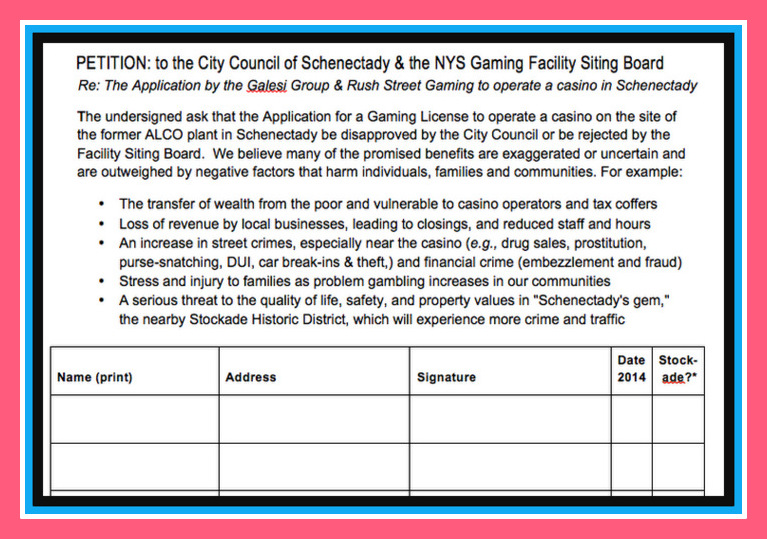
PETITION UPDATE:  We brought a packet with 187 signatures on 26 Petition forms to the City Council meeting, which were presented to the Council, saying it was just a downpayment on the signatures we would be submitting from people the Council has been ignoring. [click on the image at the head of this paragraph for a copy of the petition, and go here for instructions.]

While at City Hall, one avid worker handed me 30 additional signatures, and another 30 were obtained outside the meeting room during the session.  Many people sought out the opportunity to sign.

At this point, 77 Stockadians have signed the Petition.

 DSCF3061

Council ploy: all casino revenues will be used to reduce property taxes


Contrary to its custom, there are no materials attached to the Agenda for tonight’s Council Meeting, to allow the public to see the “exclusive use for tax reduction” proposal that the Council has been planning to vote on tonight.  That Resolution is clearly meant to back the possible No Votes into a corner, by daring them to vote “no” on a “tax reduction”.

The Exclusive Use resolution is officially named “RESOLUTION OF THE CITY OF SCHENECTADY IN SUPPORT OF USING HOST MUNICIPALITY REVENUES FROM A PROPOSED GAMING FACILITY FOR PROPERTY TAX RELIEF.”  Click here for a pdf. file of the Resolution.

 It states that the Schenectady Casino is the best site of all in the Capital Region, says that the Council expects to receive $5.7 annually as its 5% share of the casino tax revenues, and that a $5.7 million Host Municipality payment to the City of Schenectady would result in a reduction in real estate taxes of approximately 18%.”. The proposal then states that:

RESOLVED, that the Host Municipality payment received by the City of Schenectady will be used exclusively for the reduction of real property taxes in the City of Schenectady.

Of course, the Council cannot bind other Councils, dollars are interchangeable in a budget, and there will surely be normal increases in the budget, along with many casino-related expenses, that make a 18% cut in real property taxes an unlikely event.  To my knowledge, neither the Mayor nor the City Council has released any estimates of the additional expenses the City will incur “hosting”  construction process or operation of the Casino.

Petition update

StopCasPet

As of Saturday afternoon (June 7), we have collected at least 146 signatures on our “NO Casino in Schenectady” Petition.  That’s a good start, as the petitions were first available for signing on Tuesday, June 3rd, and we’ve done only a small amount of door-to-door canvassing.

You can still find and sign a Petition:

  • at Arthur’s Market & Historic Coffee House (35 N. Ferry St.) and Moon and River Cafe (115 S. Ferry St.).
  • Monday, at City Hall during the 6 PM Rally on the front steps and the City Council meeting.
  • by downloading and printing a Petition from this site  ( Click this Petition link), and then dropping them off at Arthur’s Market or bringing them to us at City Hall on Monday
  • by looking for someone in Riverside Park with a clipboard and a No Casino in Schenectady sign this afternoon, Sunday, June 8.

You can help even more by taking a blank Petition and circulating it at home, in the neighborhood, near schools and churches, etc.

Stockade Petition Report

As of Saturday afternoon, at least 66 “Stockadians” (persons who currently live in the Stockade or own property or a business there), signed our Petition — in stark contrast to the “neutrality” of the Stockade Association Board, with its unfathomable assumption that a nearby casino is not a topic worthy of a meeting of the Association’s membership.

It should not be surprising that there are scores of Stockadians against the proposed casino at the old ALCO site.  At November 2013 general election, 138 voters, 55.8% of those who voted on the Casino Proposal in election District 2, said No to any casinos in upstate New York. (District 2 is comprised solely of the Stockade and East Stockade; see map image below; click on it for a larger version)

. SchdyElectionDist2

– If you need convincing, or want to remind yourself, about how special the Stockade neighborhood is:

  • read about it at Wikipedia
  • see my own attempts to capture its beauty and community spirit, with thousands of photographs, at “suns along the Mohawk
  • peruse Jean Zegger’s brief description of the uniqueness and importance of the Stockade Historic District

PLEASE SIGN the NO-CASINO PETITION, and help circulate it, if you can.

.

our June 7 Opposition Meeting

 DSCF3041  . . .  DSCF3036

An article in the Sunday Times Union article captured the tone of our June 7th Meeting for Casino Opponents at Arthur’s Market:

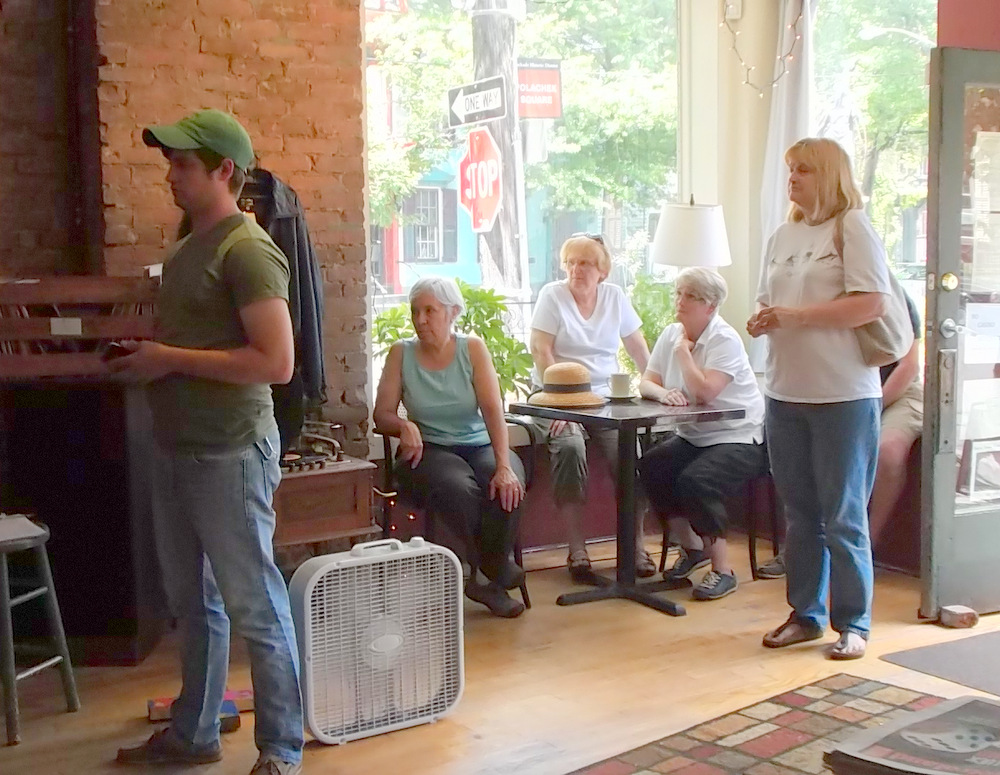
“Some 30 residents were willing to bypass Saturday’s glorious sunshine to gather on couches and around tables at the corner meeting place to join him. They shared concerns about the proposed casino and urged each other to speak against it at a City Council meeting Monday, when a resolution to support the project is on the agenda.” Stockade residents rally against Schenectady casino plan (by Claire Hughes, June 8, 2014)

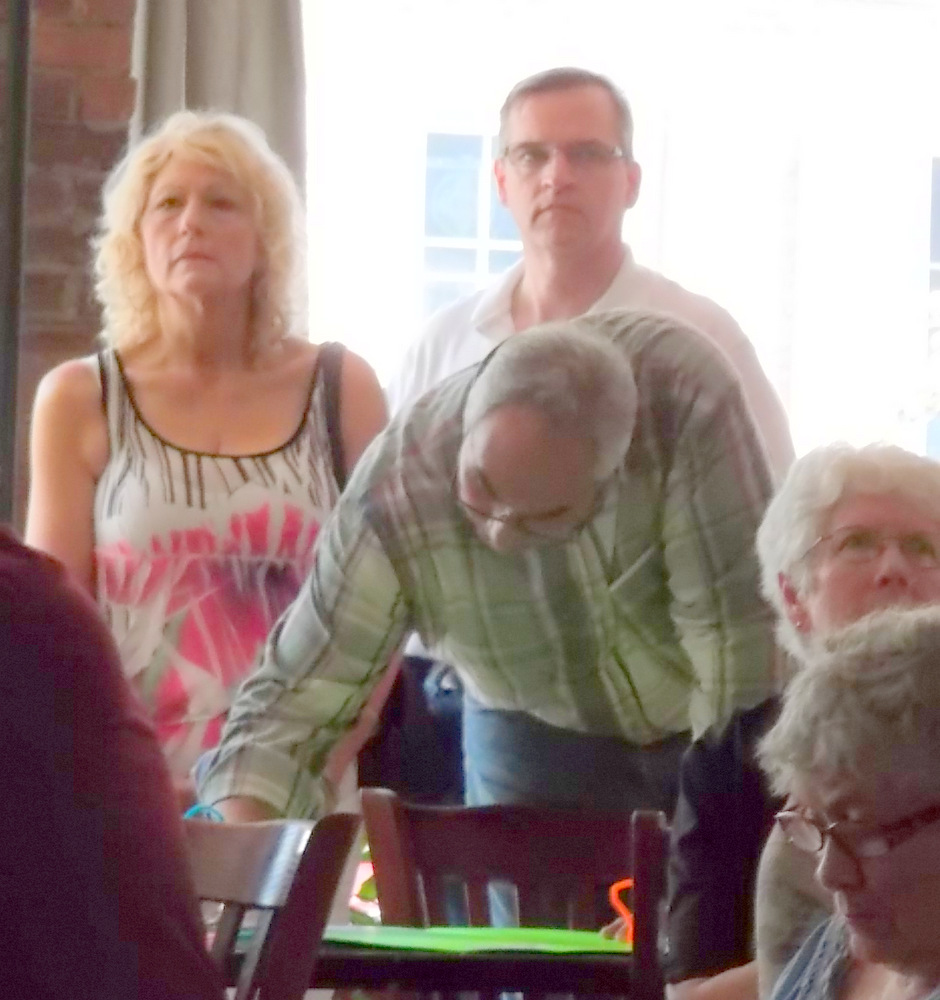
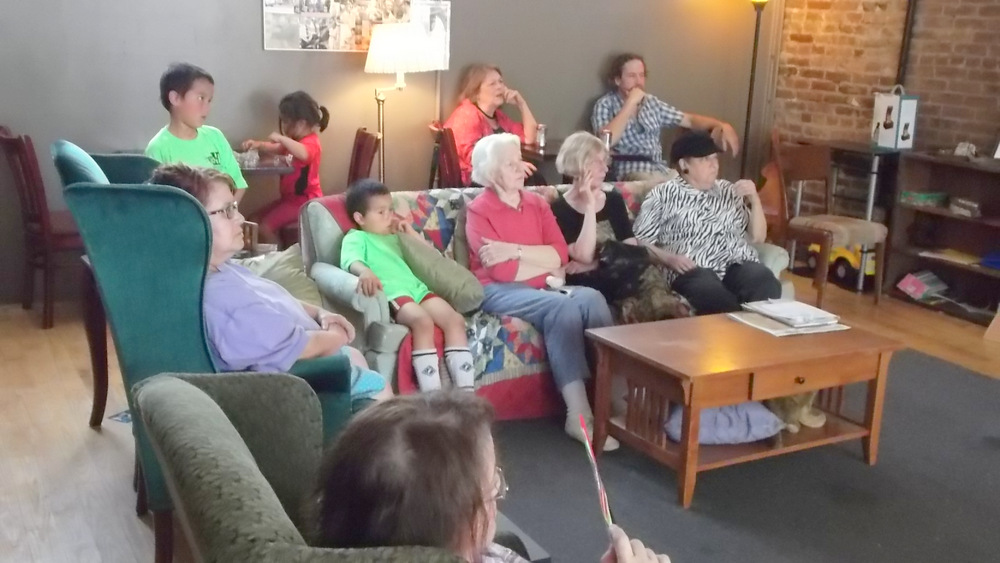
   DSCF3061    About three dozen Casino Opponents  created an atmosphere of urgency and caring, in the comfortable surroundings of the redesigned Arthur’s Market.  The subtitle of the TU article is “Stockade-area residents stress ‘people’ as council vote on gaming site nears” .  And, although “people” were/are our first priority, the Meeting stressed the many ways a casino would harm our people, community, businesses and future — using studies, literature, experience elsewhere and common sense. Many also stressed how the sneaky and cliquey process used by the applicant and by City Hall (Mayor and Council leadership) to push this proposal through tars the project and the Administration, insults the public and democratic principles, and creates suspicion and anger.

 DSCF3050-001 . . . OppoMtg07Jun2014MHafez

– Donna Lagone [L] and Mohamed Hafez –

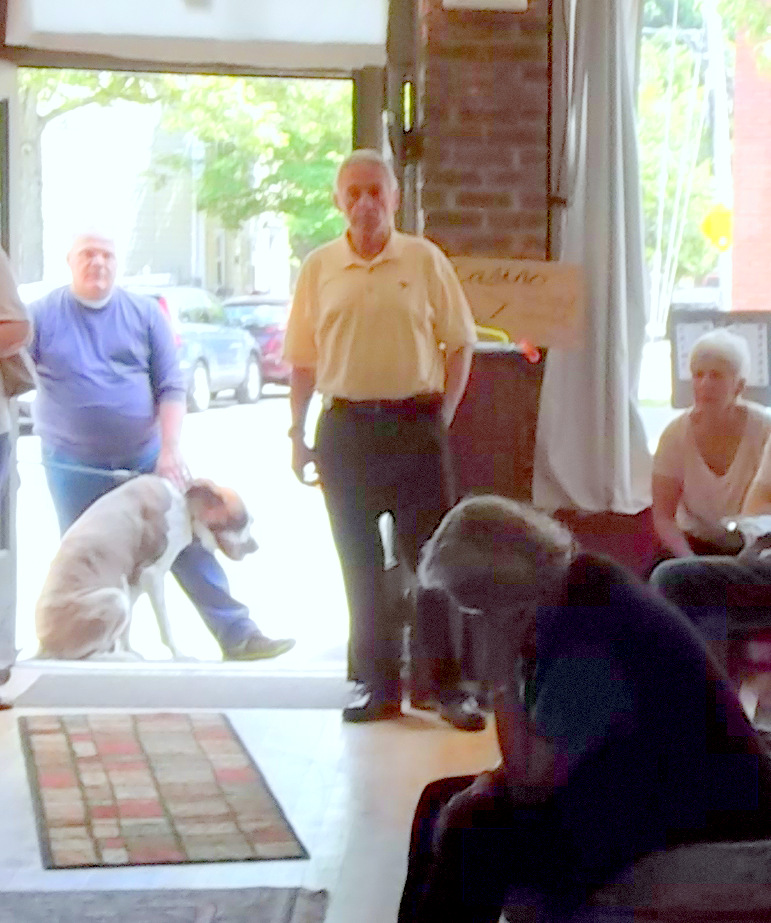
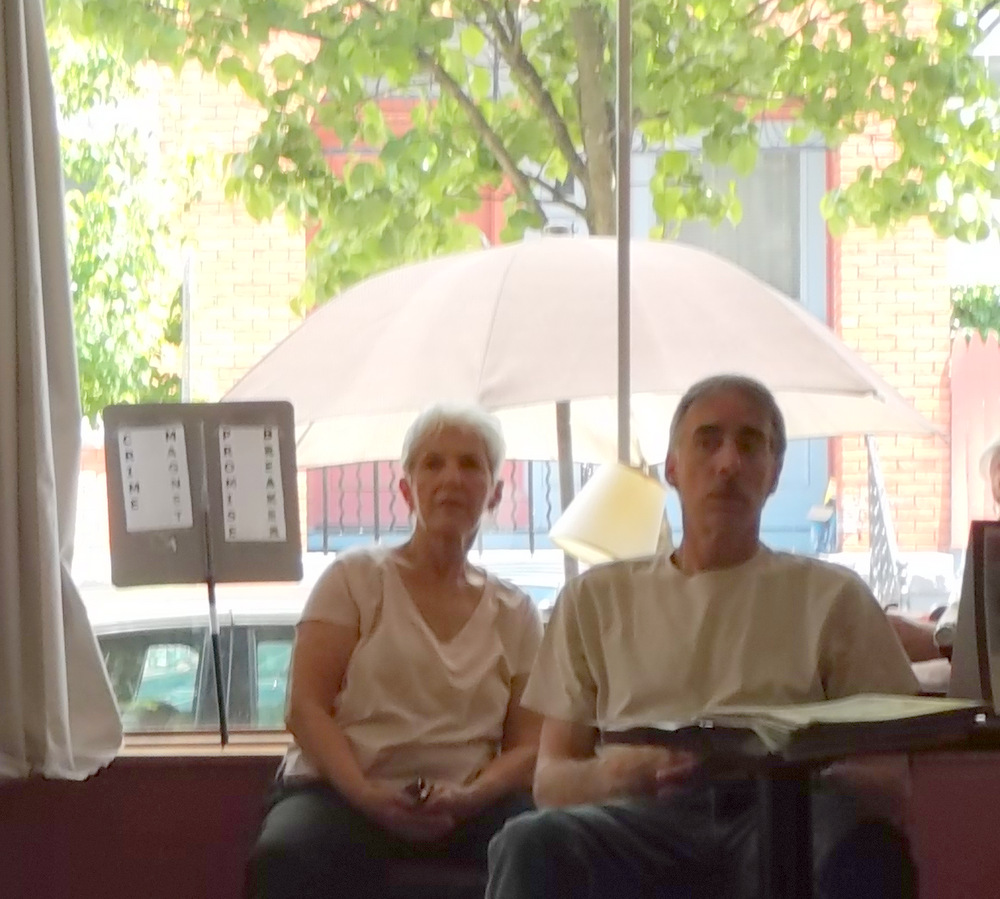
Organizers Richard Genest, Mohamed Hafez, Tom Hodgkins and myself (David Giacalone), each told why we felt the need to show that a serious opposition existed.  We then asked those present (our opposition partners) to come up and tell us their most important reasons for opposing the casino.  Many did, including Lydia Eis, Jean Zegger, Vince Riggi, Joe Kelleher, Mary McClain, Donna Lagone, and Gloria Kishton.  I apologize for not recalling, or knowing the names of, others who contributed with their thoughts and emotions.  Mr. Riggi was the only elected official at the event.

   DSCF3058 Grade-schoolers Tianning and Hainuo Hodgkins, plus little Concetta, added energy inside Arthur’s, and made their beliefs known with chalk on the sidewalk, proclaiming “no casino.”

The front page of the Regional section of today’s Sunday Gazette, C1, has a lengthy article with a summary of the casino approval situation in Schenectady, as well as good coverage of yesterday’s Meeting of Opponents, and a description of the Statement of Schenectady Clergy calling for a public hearing (discussed here). “Neighbors rally against Schenectady casino plan” (by Ned Campbell, June 8, 2014; available online only by subscription)  On the lack of a public hearing, the Gazette writes:

 While the Schenectady County Legislature hosted a public hearing on the issue Monday, [Councilman Vince] Riggi criticized the City Council for not setting its own public hearing before the vote on what he considers “the most important issue” since he started attending council meetings 28 years ago.

“If I want to make it illegal to spit on the sidewalk, that requires a public hearing. By law, according to our corporation counsel, this doesn’t require a public hearing. Maybe legally, but morally?” he said to applause.

Vince Riggi (in yellow shirt) listens to opponents of the Schenectady Casino - 07Jun2014

 Two tv news reporters also covered the Meeting. Channel 13, WNYT, has a short, informative piece on the Meeting, with Dan Basile reporting after spending quite a bit of time with us at Arthur’s Market.  Take a look: Protestors in Schenectady speak out against casino proposal.  (WNYT News, June 8, 2014). YNN/TWC’s Madeleine Rivera was also at the Meeting with camera. The Time-Warner News website states “They held a rally Saturday, which several opposers attended.”  There may have been three opposers, but there also were another 30 or more opponents.  See Residents Voice Opposition Toward Schenectady Casino.

StopCasPet

WANT TO HELP STOP THE CASINO? You can demonstrate to City Council and (if needed) the Gaming Facility Siting Board the strength and sense of the casino’s opponents, by attending Monday night’s City Hall Rally (June 9, 6 PM on the entry steps), and the Council Meeting thereafter.  And, by signing our Petition. See “petition update” to learn its status and how to find it.

DSCF3037

checkedboxs Many thanks to all who came to show their support of the No Casino campaign, and to those helped organizing and putting on the Meeting: Richard Genest, our host at Arthur’s Market; Donna Lagone and Jessie Malecki, who did most of the work of circulating the petition in the Stockade; Mohamed Hafez, who physically got the petition to churches and businesses on his side of town, and spurred on the No Casino campaign with his energy and writing skills; and Tom Hodgkins, who made signs and decorations, but also crunched numbers to show us the strength of the opposition in Schenectady County, and brought along his best reasons for wanting to preserve and improve Schenectady, his three great kids.

DSCF3043

Thanks also to Vince Riggi, for his advice, and for having the spunk to resist the pressures at City Hall, and the courage to stand his ground and state his reasons for opposing a casino.

p.s.  Preparing for this meeting kept me from my hobby of photographing Stockade events and its beauty.  So, I missed Friday’s Garden Tour, and I was bouncing around too much during the Meeting yesterday to “focus” on photos.  Nonetheless, here’s a brief Slideshow with images from the event.  Sun and shadows created beauty and photographic challenges.  Please forgive the caffeine-busy-shaky fuzziness of the images.

.

This slideshow requires JavaScript.


the problem with urban casinos

checkedboxsINTRODUCTION to This Website:  This website will soon have information, materials, and links to documents and articles, that are relevant to efforts to keep a casino from being sited at the location of the old ALCO plant, on Erie Boulevard near Freeman’s Bridge, along the Mohawk River, in Schenectady, New York.  We believe that urban casinos bring more problems than benefits.  See Reference Materials below.

As I wrote in “Don’t accept rosy predictions for downtown casino“, a Letter to the Editor in the Schenectady Daily Gazette of May 13, 2014:

CasinoRosyDAG

Urban casinos are risky endeavors, requiring serious analysis. The New York State Gaming Task Force Report to the governor (1996), which favored upstate casinos, said: 1) Stand-alone casinos draw far fewer people from outside the area than a resort-style casino, meaning relatively few overnight stays and a 150-mile market area impacted by nearby casinos; and 2) Most regular casino customers come from within a 25-mile radius, making the casino simply part of the local leisure marketplace (draining dollars from others offering entertainment, dining, sports, and other leisure activities of all kinds).

SharkGF The report also warned of potential crime problems at and near urban casinos, including “prostitution, panhandling, pick-pocketing and purse snatching”; economic crimes by pathological gamblers; and vehicle-related crimes like DUI and automobile break-ins. Such crime is especially worrisome for the nearby Stockade, which was granted historic district protection specifically to preserve its residential characteristics. Street crime and constant drive-through traffic will hurt quality of life in the Stockade, where 55.6 percent of voters said “no” last November to any upstate casinos.

update: What About SugarHouse in Philadelphia? A study that came out in July 2014 purported to show that there was no significant increase in crime in the neighborhood of the SugarHouse Casino since its opening in 2010.  We think that claim is misleading. See our response in  .

The Applicant for a license to operate the casino in Schenectady is a team consisting of a local  construction and development company, the Galesi Group, and an experienced casino developer and manager from Chicago, Rush Street Gaming, which is critiqued negatively here, by a Worcester Citizens Group.

StopCasinoPet  Petition: Go to our posting “Petition to Stop the Schenectady Casino” to see the text of our Petition, for a link to a printable version of the Petition, and for instructions on returning Petitions to us this week. Please excuse our haste, but we want to present the Petitions to the Schenectady City Council as soon as possible, as they must vote on a proposed resolution to approve the casino no later than June 30, 2014.

Casino-SAMmast

.

.

noalcocasino-mastB

– feel free to download and use our NO ALCO CASINO logos (photos by David Giacalone) –

REFERENCE MATERIALS  (more to come)

  •  No Downtown Casino: an informative website created by citizens fighting (successfully) to stop a casino from being built in Hamilton, Ontario, Canada. The group was not against all casinos, but felt there were locations far preferable than their Downtown . A Position Statement explains their opposition to a downtown casino.  Here are a few important paragraphs:


Our focus.

NO! Downtown Hamilton Casino is a group of Hamiltonians that, as a result of doing an extensive review of the available research, is opposed to building a casino in our downtown.The research shows clearly that the closer you are to a casino, and the easier it is to get to, the greater the social costs to all citizens and the greater the negative financial impact on nearby businesses and property values.

logoclip_0

Higher social costs for citizens – the bad numbers go up.

Studies show that proximity to a casino doubles the levels of problem gambling, which in turn results in increased spousal abuse, depression, child developmental issues, personal debt, addiction and cross-dependency, personal bankruptcies, attempted suicides, suicides, social service costs. We know that problem gambling has a profound impact on a gambler’s friends and families, which substantially increases the number of people affected by problem gambling. Individuals living in disadvantaged neighbourhoods, some of whom would be within walking distance of a casino in downtown Hamilton, have a 90% increase in the odds of becoming problem gamblers.

Greater negative financial impact on nearby businesses – the good numbers go down.

Studies show that property values near a casino decrease by 10% or more once the casino opens. Part of the reason for that is because the casino never closes. It operates 24/7. Commercial buildings, apartment buildings, condominiums, etc. decrease in value which means over time they pay lower property taxes. Research also shows that 60% of businesses that existed before the casino opens, go out of business within 2 years of the casino opening. Lost jobs. Lost taxes. Failed entrepreneurs. Empty storefronts.

Plywood%20Business

– there are several dozen instructive and often entertaining posters at NoDowntownCasino.coz

.

  • The Durand Neighborhood Association also fought to stop the proposed downtown casino in Hamilton, Ontario.  Their campaign was strong, articulate, and well-researched.  The neighborhood has many heritage sites and beautiful architecture and would have been within walking distance of the proposed casino.  (In contrast, our Stockade Association has refused to even call a meeting about the casino proposed for the ALCO site, which is several blocks from the residential historic district the Stockade Association was created to protect and preserve, and to represent before government bodies.) The Hamilton casino question was on the ballot in last year’s City election and opponents won by almost a two-to-one margin.  As part of its comprehensive website, DurandNA has a busy weblog, where you can find quite a bit of information under the tag “casino.”  See http://www.durandna.com/tags/casino/

.

SharkGF “Based on his experiences as a representative and resident of southern Connecticut, home of two of the earliest and largest casinos in the country, Steele cautioned that those expectations are considerably less beneficial than the outlooks presented by the various developers and operators vying for a chance to open similar casinos in Albany, East Greenbush, Rensselaer, or Schenectady. Steele described casinos as a predatory industry that depends on problem gamblers for its huge revenues, and that its effects cause a range of social ills, from pathological gambling addiction to bankruptcies among local businesses and increases in crime.”

.

Layout 1 . . . logo used in the campaign to stop a proposed Foxwoods Casino in Milford, Mass.

At EducateHopkinton.com you will find information used in a successful campaign to defeat a proposed casino in Milford, MA.  On Nov. 19, 2013, the casino was voted down by almost a 2 to-1 margin, with 57% of the electorate participating.

  • You have to envy cities and towns with organized, active, well-educated and researched campaigns by residents to stop casinos. Perhaps this is because the electorate gets to vote on a specific proposal, in contrast to our New York siting system, where developer-applicants need to merely woo a handful of politicians, and a few “neighborhood leaders” and businessmen hoping to partner with the resulting casino.  Sketchy proposals are then announced to the public, with a very short period available in which to somehow convert the already-convinced local legislative body. For a look at the application and selection process, see the current RFA for Gaming Facilities for choosing among applicants for several upstate New York casino licenses.

more over-trimming by National Grid

  An article in today’s Schenectady Gazette discusses the issues raised by National Grid’s aggressive trimming of trees in the Stockade and Union Triangle neighborhoods the past two weeks. See “Residents upset after trees trimmed,” by Kathleen Moore, B3, January 18, 2013, online by subscription).  This is, of course, not a new issue, and Stockade residents have complained about the ugly over-amputation of tree limbs and topping of trees, and the resulting loss of shade and beauty, for many years.  The “trimming” is done, of course, in an attempt to prevent power outages and other damage from falling limbs.

In the Gazette piece, National Grid forester Michael Freed is quoted saying he could not cut back trees any less, and that they often trim less than the company’s guidelines, which are to cut back 10 feet away from the primary wire and 18 inches from secondary wires.  They often leave behind lopsided trees, and National Grid spokesman Patrick Stella suggests that homeowners could request that their trees be “rounded out” after safety cuts are made.  Gillespie St. resident Jackie Craven complained about the over-cutting of flowering pear trees on her street.  ReTree Schenectady, which planted those trees, now attempts to put shorter trees under power lines.

Earlier this week, I wrote to the Stockade neighborhood Yahoo email list, complaining about the over-trimming that occurred again last week, when a Lewis Tree Service crew came through the Stockade on behalf of National Grid.  As an example, I gave the treatment of a healthy tree in front of 101 Front St., behind the statue of Lawrence the Indian; see the image at the head of this posting.  The following collage was attached to my email message, comparing that tree on the day when Lawrence was removed for cleaning last May with its current sad state (L):

tree in front of 101 Front St.  - Schenectady NY Stockade - comparison after being trimmed by National Grid

– 101 Front St. –  comparison before and after trimming –

– click on an image for a larger version –

The damage from the amputations will be even more apparent when the leaves return this Spring.  Imagine, for example, the view behind Lawrence with all the leaves above his biceps gone.

I understand that trimming is required for safety reasons, but our trees are too valuable to be treated with so little care.  The City of Schenectady needs to let National Grid know that the company must be far more discerning when trimming our trees.  Unfortunately, the City does not seem to appreciate the importance of trees to our cityscape and ecology.  You may recall, for instance, that this weblog — which was originally named “Preserve Our Stockade Trees” — was created in April 2010 to fight the City’s plan to cut down all the mature trees on Washington Avenue when it repaved the road and replaced sidewalks.  See our first posting.  When we protested that foolish plan, the City purportedly decided to punish the Stockade by not repaving. [follow-up (May 19, 2014): more than four years later, there has been no repaving.]

– 101 Front St.: autumn colors during the 2010 Stockade-athon –

One possible solution to this problem is contained in a bill proposed again this year in the New York Assembly by District 92 Assemblyman, Thomas J. Abinanti. Assembly Bill A02300 would add an Article 3 to the NYS Public Service Code in order to regulate the cutting, topping and removal of trees upon rights of way by providers of electric service, setting up a commission that would make and enforce regulations meant to assure that tree maintenance is done in a manner that has a less destructive impact on our trees.

In addition to requiring that a State arborist certify the need for trimming or removal of a tree, and requiring notice to a municipality and homeowners, the Bill states that:

  • “An electric corporation or municipality may prune a tree within a right of way only when an arborist,  designated  by  the  department  of agriculture  and  markets,  certifies  that  the  part of the tree to be pruned is dead, diseased, a broken branch, resting against a service  or distribution  line,  or  poses or could reasonably be expected to pose a danger to a service or distribution line.
  • “No electric  corporation  or  municipality  shall  engage  in  the topping  of  a  tree in a right of way so as to remove more than twenty-five percent of the foliage within an annual growing season.”
  • An electric corporation or municipality may  remove  a tree  from  a  right  of  way  only  when [a designated arborist] . . . certifies that  the  tree  to  be removed  is  dead,  diseased, broken, that its branches are so entangled with a service or distribution line that pruning  cannot  be  reasonably expected  to  prevent interference with such line, its trunk is touching such a line, or otherwise poses a danger to a  service  or  distribution line if not removed.”

Mr. Abinanti needs co-sponsors and public support to move his Bill through the Assembly.  Please let your Assemblyman know that you support the goals and requirements of Bill A02300.  You can reach 110th Assembly District representative Phil Steck, by clicking here.

– use the short URL http://tinyurl.com/OverTrim to share this posting.

appellate court says neighbors waited too long to challenge the giant Duanesburg propane tank

  update (November 29, 2012):  Today, the New York State Court of Appeals, the highest court in the State, denied the Miners’ motion for “leave to appeal” the decision of the Appellate Division. (Motion No. 2012-1042) The Court states at its website that denial of leave to appeal should not be construed as an opinion on the merits of the case. There are no further steps that Bill and Cyndi Miner can take, and the lawsuit is over.

  The Third Department appellate division issued its decision today (Aug. 23, 2012) affirming the lower court’s dismissal of Bill and Cyndi Miner’s lawsuit, which challenged the placement of Long Energy’s 30,000-gallon propane storage tank less than 200 feet from their living room in Duanesburg under the category of a “retail store”.  The decision states that “The entire petition is properly dismissed based on the doctrine of laches, which respondents pleaded and proved.”  Basically, the court said that because the Miners waited until the facility was almost completed to bring their lawsuit, it would be unfair to Long Energy to let them challenge the issuance of the special use permit.

The Appellate Court did not say that it was proper to put a propane storage facility at that location, but merely said the Miners filed too late, even though they filed within the statute of limitations.  No issues were dealt with “on the merits,” so the Court did not decide whether a bulk storage facility can be considered a “retail store” when there are no personnel, no buildings, and no sales or customers on the premises, nor whether the danger from putting a high-hazard facility so close to homes (and a church and a welding operation) was adequately considered by the Planning Board .

 Click for the Appellate Division’s decision in Miner v. Town of Duanesburg Planning Board (NYS Supreme Court 3rd Department App. Div., Case No. 513780, 2012 NY Slip Op 06043, August 23, 2012).  Our arguments against the tank can be found in our posting “Duanesburg needs a dictionary” and in our subsequent discussion of the appeal.  Also, read the Statement of Facts from the Miners’ Appellate Brief.

    LACHES: The doctrine of laches is based on equitable principles and states that a court may refuse to hear a complaint, even when as here the petitioners filed within the statute of limitations, if the relief they request would cause undue hardship to the respondents because of an inexcusable delay in bringing the lawsuit.  Here, the Third Department notes that the Miners were at the public hearing in March 2011 but did not file until June 2011 (they actually filed May 26, 2011).  The Appellate Division concluded:

“Thus, although petitioners’ effort to resolve their concerns through negotiations directly with Long Energy is commendable, their failure to pursue any legal remedy while construction of the facility proceeded to near completion right before their eyes must result in dismissal of this proceeding.”

Naturally, Bill and Cyndi Miner, and I as their good friend and appellate lawyer, are disappointed in the 3rd Department’s decision, and respectfully disagree.  Laches is about equities — fairness and justice — and we believe there were/are many reasons why it was unfair to deny the Miners a chance to show that it was unlawful for Duanesburg to allow a giant propane storage tank at that location.  The result is placement of a high-hazard industrial use in a restricted commercial zone and a neighborhood populated by single-family homes and small farms.  Here are a few of the facts and issues the appellate court never mentions that show the Miners had sufficient equities on their side to allow them to be heard:

  •  the Miners did not bring the lawsuit solely for their own sake; a giant tank situated near a road with open access by people and vehicles creates a serious safety hazard for all who live, work, or worship near there
  •  the Planning Board granted the special use permit under the category of “retail shop or store,” although — as the Court states — “Long Energy sought to construct a propane storage facility featuring a 30,000 gallon tank.” Not only is a storage tank not a store, the Town’s Zoning Ordinance specifically defines the storage of explosive materials as a heavy industrial use, and the Town has no heavy industrial zoning. The Town’s Zoning Enforcement Officer himself issued the facility an occupancy certificate as a High-Hazard use.
  • allowing a dangerous use that is so inappropriate for this zone and neighborhood undermines the entire Town’s faith in the Zoning Covenant  — the promise that zoning restrictions will be enforced and their lives and property protected
  •   Long took a calculated risk that it could avoid a legal challenge to the permit despite not operating a store on the premises; not supplying any form of visual or audio buffer; installing no restrictions on access, and no protection in front of the tank from accidental or intentional vehicle collision
  • the Miners were interested in far more than what the Court called their “viewshed”.  They delayed their lawsuit thinking Long had agreed to construct a large berm in front of the tank that was tall enough (and topped with sufficient evergreen trees) that it would be a visual and sound buffer, protect the tank from vehicle damage, and help protect the neighbors from an explosion.
  • Long knew that the Miners had strongly opposed the tank at the public hearing, saying it was not a store, and dangerous, and thus not an allowed use.  Long therefore did not prove an important element of laches, because it could not show that it had no prior knowledge that the Miners might sue to stop their project.
  • This is not a case where a significant building would have to be destroyed if neighbors who had seen the ongoing construction won their lawsuit.  There was no building, merely a storage tank that could readily be moved on a flatbed truck to an appropriate location.  That greatly reduces any hardship, which the respondents brought on themselves, if the Miners won.
  • If there were any factual disputes about fairness and equities and hardships, the Supreme Court was required to give the benefit of the doubt to petitioners, or else to hold a fact-finding hearing on important questions.  The appellate division could have allowed a better balancing of equities by remanding the case to the Supreme Court for a quick trial.

  The Miners are considering whether they will ask the Court of Appeals (the highest court in the State) for leave to appeal the appellate court’s decision.  They have 30 days after being served with the decision to do so.

Finally, here are a few musings about the aftermath of this case:

  • Members of the Duanesburg Planning Board (including Ms. Novak and Mr. Wiederman) specifically noted that this was not a store or that no retail sales would be going on at the property — it is just bulk storage for distribution by Company trucks to customers.  But, no Board member was responsible or courageous enough to try to block this project.  A reversal might have been an important reminder of their duties, and a motivation to ask the Board’s counsel for an objective legal opinion.
  • State law specifically allows “an officer, department, board or Bureau of the town” to appeal any decision of the code enforcement officer to the Zoning Board of Appeal.  [Town Law.Sec. 267-a(4)] That means that the Town Supervisor, the Planning Board or its members, or even the Town Counsel could have asked the Zoning Board of Appeal to interpret whether a propane storage tank could be allowed under the “retail store” category in the C-1 district, and whether it was a banned heavy industrial use.  They could have gone to the ZBA as soon as the CEO Dale Warner made his decision in February 2011 that the tank was an appropriate special use, or gone after the permit was granted. No one did so.  Indeed, when Bill Miner went to the Town Supervisor right after the permit was granted and asked if she could do anything to stop the permit, she told him there was nothing she could do and the only thing Bill could do was to bring a lawsuit or try to reach a settlement with Mr. Long.
  • Allowing this permit to stand sets a very bad example for the Planning Board and Enforcement Officer.  For example, I hope that Town officials do not conclude they can ignore the plain meaning of everyday words such as “retail store”. What will they decide is a place of worship or an office building, if they can ignore a word as explicit and ordinary as “store”? 
  • The Duanesburg zoning ordinance allows “retail stores” in its quaint Hamlet District, with only a 40-foot setback.  I hope that doesn’t give other propane companies any ideas for placing their tanks.
  • An actual retail store would have been acceptable and probably desired by the neighbors.  A store tries to offer needed or desired products or services, creates jobs in the Town, and attracts people to the neighborhood and Duanesburg.  This propane facility does none of those things.

    Besides putting people at risk, the Town has spent over $38,000 defending a permit that on the very face of the Ordinance should never have been granted.   Despite this “victory,” I hope some important lessons were learned that might somehow avoid similar conduct in the future and help justify that expenditure.  Public-minded tax-payers like Bill and Cyndi Miner should not have to rush to court and suffer the aggravation and expense of an Article 78 lawsuit in order to undo the work of appointed or elected scofflaws and protect their peace of mind and property values.   Of course, this case again underscores the need for constant vigilance — and a litigious spirit — on the part of the public.

  Share this posting with the short URL: http://tinyurl.com/tankstays

challenge to Duanesburg propane tank goes to the Appellate Court

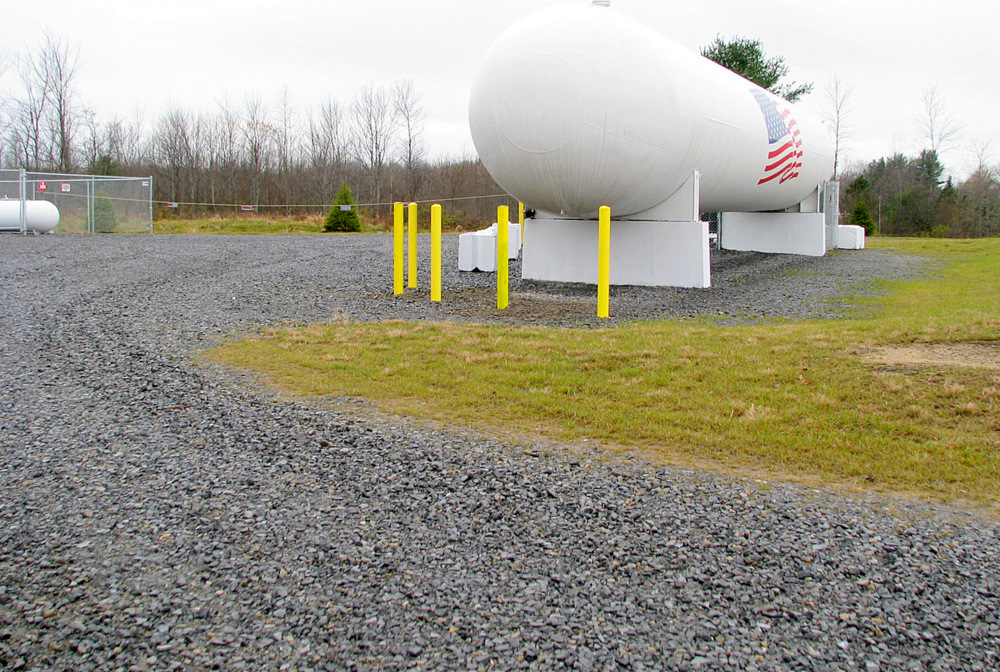
– the 30,000-gallon propane tank that Duanesburg permitted in the category of  “retail shop or store” is seen from near the Miners’ front door; click on the image for a larger version –

    By filing their Appellants’ Brief with the 3rd Judicial Department Appellate Division on Monday, March 19, 2012, Bill and Cyndi Miner continued their fight against a giant, 30,000-gallon propane storage tank that the Town of Duanesburg allowed Long Energy to place within 200′ of their home last year, in its restrictive C-1 commercial zone, under the special use category of a “retail store”.  [The story of their court battle is told at our weblog post “Duanesburg needs a dictionary,” July 14, 2011, with many photos, linked resources and updates.] Click for the Statement of Facts from the Miners’ Brief, dated March 19, 2012, Miner v. Town of Duanesburg Planning Board et al, NYS Supreme Court, Third Department Appellate Division, Case No. 513780.

note: The author of this weblog is a close friend of Bill and Cyndi Miner and, after over a decade on retirement status with the Bar, offered to serve as attorney for the Miners in their Appellate Division proceeding.

–  Share this post with the short URL: http://tinyurl.com/tankappeal

update (May 30, 2012): Oral argument was held yesterday, May 29, at the 3rd Department Appellate Division at the Empire State Plaza in Albany.  It will be a month or more before the judges release their decision.  Stay tuned.

The Miners’ Appellants’ Brief makes the following major points, appealing the July 22, 2011 decision of Justice Barry D. Kramer of the Supreme Court in Schenectady County, which dismissed the lawsuit:

  • Laches. Judge Kramer should not have applied the doctrine of laches (that inexcusable delay bringing the lawsuit was unfair to Long Energy, although the Miners filed within the statute of limitations), because: (1) the Miners had delayed suing because they thought they had reached a compromise with Long that would prevent litigation (if Long would build a large berm in front of the tank, topped by evergreen trees, that would protect the tank from vehicle impact and provide a sound and visual buffer); (2) Long Energy had notice that the Miners were contemplating a lawsuit and therefore, under controlling court opinions, may not raise a laches defense; (3) the harm to Long if they were forced to stop operations at the site would not be “undue”, because Long took a calculated risk (knowing their tank was not a retail store) and because the tank can readily be removed and reused elsewhere.
  •  Exhaustion of Remedies.  The court below erroneously dismissed their claims after finding that before coming to court the Miners should have first appealed to Duanesburg’s Zoning Board of Appeals the “determination” of the Town’s Code Enforcement Officer, Dale Warner, in which he decided the application for the bulk propane facility fit into §11.2.3 of Duanesburg’s Zoning Ordinance, the “retail store” special use category).  By not going first to ZBA, the court concluded, the Miners “failed to exhaust their administrative remedies”.  The Miners claim they were not “aggrieved” by Mr. Warner merely referring the application to the Planning Board for action, and therefore were not required nor allowed to go to ZBA, and instead must appeal to the Supreme Court the grant of the special use permit, under New York State Town Law §274-b(9).  They also point out that Duanesburg’s zoning ordinance is unique, requiring the Planning Board to ensure that the proposed use is in compliance with all standards and requirements in the entire Ordinance before granting a special use permit.  That obligation distinguishes this case from those in which the courts have said a planning board may not interpret a zoning ordinance and decide a proposed use is not permitted.
  • Retail Store“:  On the merits, the Planning Board and the Supreme Court were wrong to conclude that a bulk propane facility was allowed in the C-1 zone under the retail store category. The plain, ordinary meaning of the words “retail store” must be applied by the Board, which instead decided to follow the interpretation of the Code Enforcement Officer that it was a permitted “retail establishment” because Long’s bobtail trucks took propane from the facility and delivered it to Long’s customers’ homes and businesses.  The Miners pointed out that the propane facility, which has no personnel, no buildings and no sales or public access on the premises, was neither a store nor a retail use of the parcel.

– notice the lush landscaping and sturdy “buffer” between the tank and the road –

  • Neighborhood Impact.  The Board was wrong to conclude simplistically there could be no adverse impact on the neighborhood because it was already zoned commercial, and therefore the Board did not adequately protect the character of the neighborhood and its property values.  One example: the Board did not fulfill its obligation to assure an adequate visual and noise buffer between the facility and nearby lands, when it allowed Long Energy to merely plant 4 deciduous trees across the 250′ frontage along Western Turnpike, with nothing else between the tank and the road, including no vehicle barriers such as bollards. See the discussion about The Neighborhood below.  Also, the Board allowed Long Energy to renege on its promise to put a perimeter fence and entry gate on the facility in order to control access.
  •  SEQRA: The Board failed to fulfill its obligation under the State’s Environmental Quality Review Act, because it did not take a “hard look” at potential significant harm to the public health and the character of the neighborhood — especially the failure to look at ways to lessen the likelihood and effects of a catastrophic explosion of the tank.

The Neighborhood:

     When Bill and Cyndi Miner bought their home in 1999, their parcel and all the lands across the street were zoned “Agricultural-Residential”.  In 2001, Duanesburg superimosed a C-1 Commercial zone 500-feet deep along both sides of Western Turnpike.  Patrick Barnes, the Planning Board Member who chaired the public hearing on Long’s special use permit and rushed through the unanimous vote a few minutes after the hearing ended, swore in his affidavit to the court that the neighborhood is already “predominantly commercial.”  In fact, there are mostly residences and agricultural or vacant lands in the immediate neighborhood of the propane tank and the Miners’ home, plus a church.

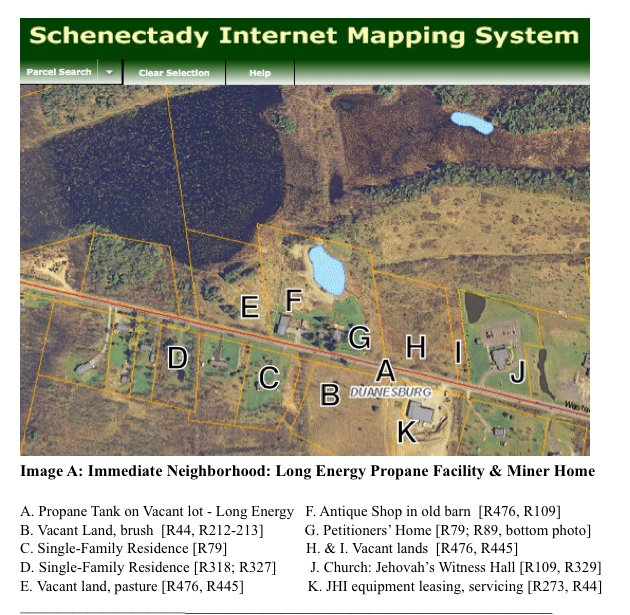
The Record that is going up to the appellate court doesn’t show the neighborhood in great detail: For example, it does not show that on the tank’s side of the road, heading west, there is a row of at least five single-family residences next to the vacant field that borders the propane facility, nor that heading east there is another row of single-family homes starting next to the equipment leasing firm that borders the propane storage facility.  The heavy equipment firm is, in fact, the only parcel with a commercial use (except for farmland) that is visible heading east along that side of the road for a mile or more.

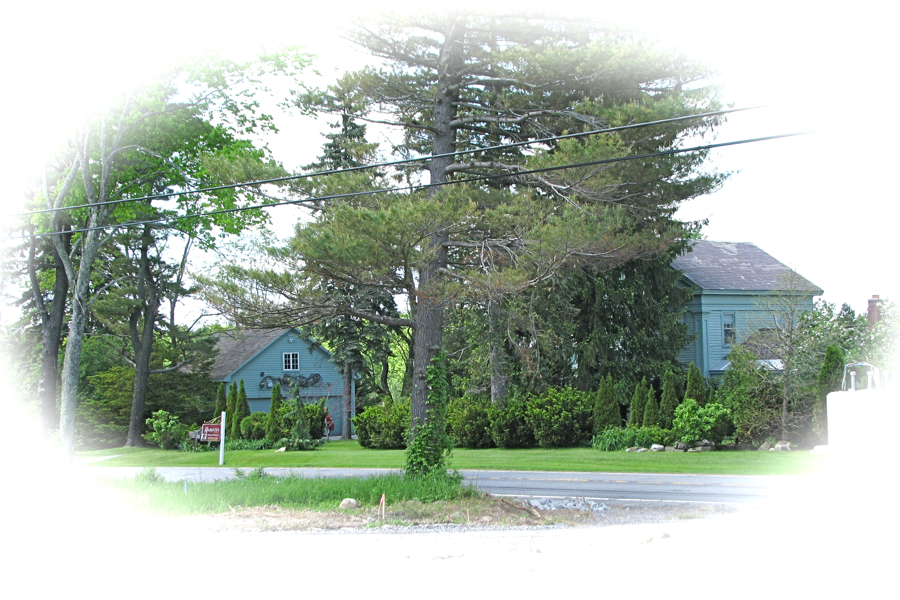
Here is a map showing only the parcels that we know about from the Record that was before Justice Barry Kramer in the Article 78 proceeding, which the Miners are appealing.  [The only facts that can be argued to an appellate court are those in the Record from the proceedings below.] After the map, I’ve indicated each parcel and how it is used (with references to the Record on Appeal).  Clearly, I think, this is not a “predominantly commercial” neighborhood:

. . .

As you can see, there is a lot of land that is still covered in green, and lots of lots with homes that have been there from before there was a C-1 zone along Western Turnpike.  Also, the dark area in the top left-hand side of the map is a bog that straddles both sides of the road.   Although Duanesburg has no Heavy Industrial Zone, the Planning Board let a dangerous, looming, industrial facility be placed in this pleasant rural neighborhood.

– map submitted by Long of the same stretch of road . . . click on map to enlarge –

An applicant such as Long Energy is required under the Duanesburg Zoning Ordinance to provide the Planning Board with “a map showing the important existing natural and man-made features in and around the site” [§14.6.2.2], and to submit “a sketch or map of the area which clearly shows the location of the site with respect to nearby . . . properties . . . and other pertinent features.” [§14.6.1, Sketch Plan review (b)] Nevertheless, the dismally low-resolution image above this paragraph is the better of the two images/maps of the area submitted to the Planning Board by Long Energy. It fails to indicate that any of the row of buildings to the west (left) of the tank, which you can see if your squint hard enough, are homes; in fact, each of them is a single-family residence.   The Board did not ask for a better map.

 Note re Lawyers: The Miners started their Art. 78 proceeding challenging the special use permit with a pro se Petition, meaning they had no lawyer.  Before the hearing was held in front of Justice Kramer, my brother Art Giacalone, of East Aurora, NY, was retained to represent the Miners in Supreme Court; Art is an expert in challenges to zoning actions.  In December 2011, I took over as the attorney of record for my good friends Bill and Cyndi Miner to handle this appeal.  Nonetheless, as this is a volunteer effort on my part, I continue to maintain my status as a retired member of the NYS Bar.

– the Miners’ antique shop in their barn near their home along Western Turnpike –

Above is the old barn that Bill and Cyndi restored for their weekend, seasonal antique shop.  It’s located west of their house, about 500 feet from the Long Energy propane tank.  Long and the Town have argued that because the antique shop is “commercial” and the tank facility is also “commercial” there won’t be any effect on the neighborhood having the propane tank located there. (Note as you look west toward the sunset that there are no other “commercial” entities in sight.)

p.s. Here are a few more facts that we wish were on the Record and could be taken into consideration by the appellate court:

  • There have been judicial decisions that mention that a town planning board or town board had informed a neighbor that the town’s zoning board of appeals is the correct place to bring a complaint that a proposed use was not permitted.  (For example, Swantz v. Planning Board if the Village of Cobleskill, 34 A.D.3d 1159; Cowger v. Mongin [ZBA of Niskayuna], 87 A.D.2d 932).  That did not happen here.  Instead, before the public hearing, Bill Miner was told by the planning office that the tank was clearly permitted and he could not stop it.  When Bill met with the Town Supervisor and the Town Code Enforcement Officer the day after the special use permit was granted for the propane facility, he was told by the Town Supervisor that the only thing he could do to stop the project was to go to court.   Moreover, she urged him instead to “reach out” to Mr. Long to try to reach a settlement, which Bill did.
  • Bill Miner not only offered to avoid a lawsuit if Long built a large berm to act as a visual and noise screen/buffer and barrier to protect against damage to the tank, Bill also offered to build the berm for Long, with the help of other neighbors with the equipment and know-how to do so.  And, Bill also offered to plant the row of evergreen trees on top of the berm for Long.
  •  Not only does the Department of State local government office indicate in its Guidelines for Applicants to the Zoning Board of Appeals that a neighbor is not “aggrieved” (negatively affected) until a Code Enforcement Officer actually issues a permit or certificate to the subject landowner, so do the BZA Guidelines for Applicants of the City of Schenectady, and the Zoning Board of Appeals primer of the Westchester County Planning Federation.  If not aggrieved, a neighbor is not required or allowed to go to the Town zoning board.
  • Duanesburg’s Comprehensive Plan  describes neighborhoods such as that of the Miners and the Propane facility in the following statement (at 45):
    • “Much of the Commercial District is currently vacant or in agricultural use providing ample acreage to accommodate business development. Certain areas are predominantly occupied by single family dwellings since they are a permitted use by special use permit. In areas of Commercial Districts dominated by single family dwellings, consideration should be given to rezoning the property to accurately reflect existing land use.”
  • Table 7.1 of the NFPA/NPA Fire Safety Manual, which was used by Long Energy to evaluate their bulk propane facility, shows — as one example — that the release of the inventory of transfer piping as small as  2″ x 30 ft. long at 80 GPM for ten minutes can result in an Explosion Hazard Distance of over 250 ft.  [The Miners’ home is less than 200 feet away.] Imagine what any significant rupture of the tank itself could do.  Long’s Fire Safety Analysis, upon which the Planning Board relied in saying there was no risk of explosion or fireball to neighboring properties, only dealt with brief releases from shorter lengths of 1″ and 2″-diameter piping and hoses. See Table 7.1 in Long’s FSA . [If interested, click here for the full 2011 edition of the NFPA/NPA Fire Safety Manual]

– Long indicated to the Planning Board that the tank would not be illuminated at night, but it is in fact brightly lighted every night, all night –

Duanesburg ZBA says vehicles no threat to propane tank

 .  .  .

– in a perfect, Duanesburgian world, safe enough –

The Zoning Board of Appeals of the Town of Duanesburg voted last night, 4 to 2, to reject Bill and Cyndi’s appeal of the issuance of a Certificate of Occupancy to Long Energy for operation of its 30,000-gallon bulk propane tank facility, which sits 200 feet from their home on Western Turnpike (Rt. 20).  The only question before it was whether the existing vehicle barriers are adequate under the NYS Fire Code.  More specifically, the Board had to determine whether more and improved barriers were needed for all or portions of the tank, using the strict standards of Fire Code §312, because the tank was “exposed to vehicular damage” due to it being “in proximity” to the driveway and parking areas within the meaning of Fire Code §3807.4.

The lengthy Resolution passed by the Board repeatedly stated that the vehicles using the facility would be able to keep a “sufficient distance” from the tank and would not be able to reach a high enough speed to pose a risk to the tank.  No mention was made of any accidents happening or unauthorized vehicles coming onto the ungated and unmanned facility and posing a danger for the tank, which is only 70 feet from Western Turnpike.

– To sum up the apparent reasoning behind the decision of the Duanesburg Zoning Board last night:  Because we assume that everyone (including any unauthorized traffic) will drive safely, without driver error or equipment failure, the propane tank is safe from vehicular damage, despite its being only 70′ from the busiest road in town and being located on or very close to the semi-circular, gravel access driveway that must be used by all vehicles that enter or leave the unguarded and ungated facility.

– part of our October 17 submission to ZBA –

Only ZBA members Russell Gage and Robert “Pat” Payst voted against the Resolution.  Chair Wendy Graves and Members Patricia Wall, Evie Rudesheim and Kathleen Kosinski voted in favor.  The entire “deliberation” by the members consisted of Member Payst saying the cement barriers on the south side of the tank seemed insubstantial.  Long Energy must have assumed a positive outcome, because it had no lawyers or other representative present, despite being served in the matter by the Albany firm of Ganz Wolkenbreit & Siegfeld.

Here is a portion of my submission to the ZBA pointing out why the current barriers were insufficient

    “Proximity” means nearness or closeness, according to countless dictionaries, including the Merriam-Webster online dictionary/thesaurus.  Since the east and west ends of the tank, along with its entire south side, are actually contiguous/adjacent to the driveway, the tank is clearly in the proximity of the driveway.

Therefore, the Board must decide whether the tank is “exposed to vehicle damage” due to the expected traffic on that driveway.  Such traffic includes the tanker trucks and bobtail tank trucks that are the primary facility visitors, plus company or contractor vehicles on-site for maintenance, repair or delivery of the customer-location tanks, as well as unauthorized traffic engaged in u-turns, repairs or mischief, or otherwise trespassing. As you know, the facility is located close to a busy road, with two roadside “curb-cuts” over 40’ wide, no entryway gate or guards to keep out unauthorized vehicles, and no personnel to help guide the movements of vehicles when maneuvering close to the tank.  It is already being used as a turn-around and a spot to attend to vehicle repairs.  In assessing the Long Energy tank’s exposure to vehicle damage, several additional factors should be considered:

  • In common usage, “exposure to vehicle damage” means a tank is in jeopardy of sustaining such damage, not that the damage is inevitable.
  • The exposure to damage does not mean only exposure that exists when all vehicles, drivers, and other personnel are operating in a completely correct and safe manner
  • A meaningful exposure assessment must include situations where there has been driver error or misadventure, or a failure of one or more of a vehicle’s parts or systems (e.g., brakes), and it includes risk of impact created by unauthorized vehicles, and created by intentional as well as accidental impact.
  • Such exposure is increased at the Duanesburg facility by weather conditions that regularly occur there — especially during the extensive heating season when the facility will be the busiest — such as fog, rain, snow, sleet, ice, etc.
  • The difficulty of clearing down to its surface a gravel-covered driveway of snow and ice increases the exposure by reducing traction, even if the driveway were plowed and salted as soon and as often as needed
  • Exposure is also increased by other facts: there is virtually no place for a vehicle to park other than the driveway; chains used to keep unauthorized vehicles from making a turn-around will force them to back down an incline to return to the road; the grassy portion in front of the tank is level and easy to access halfway up the driveway; and the fence surrounding the customer tank storage area behind the tank greatly limits the space at the top of the driveway through which all traffic must pass when coming and going.

Click here to see my submission to ZBA dated October 17, 2011, explaining further, with photos, why the barriers were inadequate (after we raised these issues Long Energy inserted two additional bollards at the east end of the tank to bring the distance between those barriers within the Code’s requirements); and click here for my December 1, 2011 letter to the Board responding to the ridiculous position taken by Jeff Siegel, attorney for the Town, that the Board must rely on the opinion of, William Smart, Long Energy’s hired engineer, because he is the only NYS certified engineer who has submitted an opinion on the adequacy of the barriers.

ZBA also concluded that the record was complete and it did not have to hear any testimony by the most important actor in this entire episode, Code Enforcement Officer Dale Warner, who issued the Certificate of Occupancy, nor allow the Miners or their attorney to question Mr. Warner about his decisions.  Mr. Warner took a rare vacation on the night of the November public hearing and did not appear at that Board meeting.  Click here for my Letter requesting that the public hearing be reopened to allow myself, and the Board, to question Mr. Warner.

At this time, we are expecting the inspector for the Code Enforcement office of the New York State Department of State to investigate this matter further and inform the Town of Duanesburg of what steps must be taken to comply with the vehicle barrier requirements of the NYS Fire Code relevant to propane tanks.

 Don’t forget, the giant tank is located near homes and businesses and a church in a commercial zone because the Town Planning Board gave Long a Special Use Permit in the category of a Retail Store.  This “store” has no building or personnel and makes no sales of any sort to customers.  It is merely a bulk storage tank, where Long Energy’s bobtail propane tank trucks fill up before making deliveries to Long’s customers.  See the full story, with facts and law explained, at “Duanesburg needs a dictionary“.

So, add “proximity” and “exposure” to the words the Town of Duanesburg can’t define correctly. And add one more example to the list of Duanesburg’s broken zoning promises.

. . . . . . . .

Just for the record, here is how I described this action before the Duanesburg ZBA at the original posting about the propane tank. [I’m moving the discussion here, to keep that posting focused on the overall facts and the challenge in the Supreme Court proceeding to what the Planning Board did issuing the special use permit]:

Continue reading

appreciating and mourning IOOF’s Temple of St. Paul (with demolition update)

follow-up: . .   . October 2012: another bait-n-switch?  Click on collage to see the story . .

and, see Nicholaus Building demolished (April 8, 2017)

.

. . . RenderTransfinderOOF

  . . . [L] IOOF Building (2017); [R] Transfinder 2011 rendering preserving façade . . 

above: demolition of a graceful and “strong little structure” (Gazette, A1, Jan. 31, 2012) –

. . below: the finished, modern Transfinder Building (April 2020):

IMG_1398

  update (Jan. 31, 2012): Today’s the fifth day of the physical demolition by Jackson Builders of the Odd Fellows Hall at 440 State St.   The terra cotta façade is gone and the entire building will be removed over the next few weeks.   This slideshow includes photos taken about 7:30 on this gloomy-gray morning at the site plus shots taken on November 20, 2011, when Tom Hodgkins and his children held an Architecture Appreciation Party for the building.  That story is below in the original posting. At the bottom of this posting you will find a Gallery with each of the photos; clicking on a Gallery image will bring you to a larger version; scroll over a Gallery image for a description.

This slideshow requires JavaScript.


. . below: the Transfinder Building: [L] Nov. 2019; l[R]  April 2020 . .

TransfinderNov2020 . . IMG_1397

ORIGINAL POSTING

  .  .  .

– condemned façade of St. Paul’s Temple – IOOF Hall – during the Hodgkins Family Appreciation Party and Protest (20Nov2011) –

 Tom Hodgkins and his three kids had an Architectural Appreciation Party in front of 440 State Street the past two mornings.  As Tom explained in a message to our Stockade neighborhood email list Saturday night:

“We had fun today at our architectural appreciation party.  The kids played music, carted around the wagon, ate candy and fruit, while I discussed the fate of the building with pedestrians.”

. . click on a photo for a larger version; scroll over it for a description . .

Tom told the Gazette in the Sunday paper today: “We’re just appreciating this building and the values it embodies before it’s gone.  It’s already been done.  The city’s been bought out.  It’s done. We’re just here to appreciate it before it’s gone.” See “Man stands alone in protest of plan to raze historic Schenectady hall” (Sunday Gazette, by Bethany Bump, November 20, 2011, at B5; online by subscription) More of the story can be found in Thursday’s Gazette, in “Planners approve demolition of historic Odd Fellows hall” (Daily Gazette, by Justin Mason, November 17, 2011, at B1; online), which explained:

“Wreckers await the former International Order of Odd Fellows hall in the very near future.

“Members of the city Planning Commission narrowly approved drastic changes to a plan they approved in July, allowing building owner Tony Civitella to demolish the entire structure at 440 State St. . . .

“The approval will allow Civitella, the president and founder of Transfinder, to immediately move forward on demolishing the entire building. His original plans called for the leveling of the rear of the structure, but to retain the ornate terra-cotta facade and about 20 feet of the building’s front.”

.

The Planning Board majority, with virtually no time for the public to weigh in, rushed to impose the death penalty on the Temple after Civitella came up with an engineering report saying the façade cannot be saved, and pressed for immediate action on his new plan due to imminent winter weather.  We’re supposed to believe that no one at Metroplex, no one in Civitella’s organization, and none of his architects or engineers thought to ask the obvious question last Spring, when Metroplex promised grants — including a $60,000 façade grant — and the project was announced with great fanfare and applause for Mr. Civitella and Metroplex: “Can the façade be saved and can we afford to do it?” In July 2011, the purchase was finalized.

  • If there was no engineering report prior to the first approval, lots of heads should roll. Ditto, if there was an engineer’s report that endorsed the façade-saving plan.

  For me, it’s much too much like the sorry Gillette House bagel shop story from January, 2011, leaving the same bad taste in my mouth.   Shortly after much hoopla and back-slapping over a plan to “save” an important historical building, the shrewd businessman-buyer discovers his original plan is simply no longer viable, and civil servants with the obligation to look hard at the situation and to preserve and protect our architectural heritage give in without demanding lots of facts and taking time for appropriate consideration. It is outlandish that a decision could be made when Civitella only submitted his drastically altered plans two days before the Planning Commission hearing.

There should never have been such a rush. The Gazette tells “In mid-August, Transfinder paid the state Office of Parks, Recreation and Historic Preservation $150,000 to lift a covenant placed on the building that would prevent him from demolishing it.” Transfinder knew it wanted to demolish the building soon enough to negotiate the covenant buy-out in August. And, yet, this big rush to beat winter was delayed until filing for the drastic change and demolition permission in mid-November. It seems far too convenient that it happened so far into winter that the Commission could hide behind weather as a reason for its hasty action.

You can bet there will be a great rush to knock that building down, especially the troublesome façade.  A lawsuit will be complicated and expensive, and have only a slight chance of finding a sympathetic judge who could act in time to save this fine old building. [Followup: As reported by the Gazette, demolition started the last week of January, 2012.]

Thanks go to Planning Commission member Matthew Cuevas for trying to slow down the process by tabling the measure.  And, thanks to Schenectady Heritage Foundation Chairwoman Gloria Kishton, for frantically piecing together public opposition over such a short timeframe.  Especially, thank you, Tom Hodgkins and kids, for reminding us what we’re losing.  As Tom told our email group yesterday:

  “Spending time in that location really gives one some perspective on how few historic buildings remain downtown, and the loss of a building built by the people for the people in the name of love is a crime.  It’s not the loss of a bank, or some industrialist’s residence, it is the loss of a temple. “

The Hodgkins kids always make me grin (often due to their photogenic charms).  But, seeing them at this Party-Protest had me smiling even more, hoping some of their dad’s zeal will rub off, so they’ll never simply take for granted the old buildings they see every day around their Stockade home.  At the rate they’re coming down despite laws meant to protect them, there soon won’t be any historic buildings left to preserve in downtown Schenectady.  The only, slight consolation will be that Tom and Gloria and I, and other lovers of our architectural heritage won’t have to have our Thanksgiving meal ruined with a holiday case of Demolition Agita.  This year, however, I’m heading to my medicine cabinet for a second helping of architectural-size antacid.

    . . 

– share this post with the short URL http://tinyurl.com/AppreciateIOOF


Duanesburg needs a dictionary

 update (Aug. 23, 2012): The Third Department affirmed the lower court’s decision, saying the Miner’s waited too long to bring the case and it would be unfair to Long Energy to make it remove its tank.  See our posting today.

update (March 23, 2012): See our posting “challenge to Duanesburg propane tank goes to the appellate Court“. Bill and Cyndi have filed their brief with the NYS Supreme Court Third Department appellate division.  Answer briefs are due by May 4th. Oral argument is scheduled for May 29, 2012. (Miner v. Duanesburg Planning Board, Case No. 513780). The posting includes, among other things, a summary of the Petitioners’ arguments, and a listing of additional facts we wish were on the Record and could therefore be considered by the appellate court.


  . .  Summary:  Bill and Cyndi Miner’s battle with the Town of Duanesburg, over placement of a giant propane tank less than 200′ from their home, is a tale that could happen to any of us. It shows how much we have to lose if those in charge of interpreting and enforcing zoning and safety laws break the Zoning Covenant by making arbitrary decisions or simply ignoring the law and the promises it contains.

The Town’s Planning Board allowed Long Energy to install a 30,000-gallon bulk storage propane tank on a parcel zoned commercial, under the use category of “retail store or shop.”  This “store” has no building, no personnel, no sales to customers nor parking spaces for them; instead, Long Energy’s “bobtail” trucks fuel-up there before making delivery to homes, farms, and business customers, and smaller storage tanks (100- and 200-gallon) are kept there before being delivered and installed at customer locations.
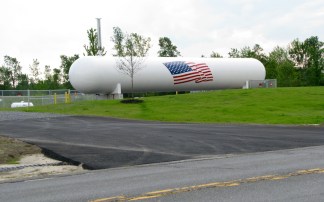
– Long Energy’s Propane Facility, 2321 Western Turnpike, Duanesburg  NY –

Ignoring the key words “shop or store”, Duanesburg’s planners focused on the term “retail” and insisted that the huge tank is a “retail establishment” because the propane is stored there “for retail distribution” by Long’s tank trucks.  Of course, every facility owned by a retailer is not a retail facility, and a location that offers no sales to customers on the premises is simply not a retail use.  As Long stated many times in its submission and testimony, the facility is a bulk storage plant.  The planning office and Board also completely ignored the provision in the local zoning ordinance that includes the storage of explosive or flammable materials in the definition of an “Industrial, Heavy” use.  Heavy Industrial uses are not permitted anywhere in Duanesburg, which has only “light” industrial zoning, and they certainly are not permitted in the more-restrictive C-1 commercial zone.

In considering environmental and fire and safety questions, the Planning Board in effect acted as if the Long Energy facility were no more of a hazard than having a conventional retail store on the parcel.  The propane storage facility, which is near many homes, a church, and other businesses, is classified as a High Hazardous use and occupancy under the NYS Building and Fire Codes and by the Town’s own zoning enforcement officer; and the quantity of propane stored there is large enough to be considered a Chemical of Interest as a potential terrorist risk by the U.S. Homeland Security Department.  Ironically, were this facility merely a retail or wholesale store, the Fire Code might have required significantly more safety protection systems than exist at this bulk propane plant. [The discussion of the subsequent proceeding by the Miners in front of the Duanesburg Zoning Board of Appeals, regarding the failure to comply with the NYS Fire Code, has been moved to the bottom of the post “Duanesburg ZBA says vehicles no threat to propane tank.”]
  Under its Zoning Ordinance, the Town Planning Board can only grant a special use permit when the proposed use fits into one of the specifically permitted categories (§5.1.1), and after many other conditions are met that ensure neighbors will not be adversely affected.  For a brief summary of how the Planning Board ignored the law and broke their covenant of trust in allowing the propane tank, see my Sunday Gazette Viewpoint OpEd column, “Propane tank ruling creates nightmare for Duanesburg couple” (July 31, 2011, p. D1; also available by subscription online here).

If the creators of the Hangover films ever dreamed up the plot played out at the Duanesburg Town Hall this year and called it Tanked, the scenario might seem a bit outlandish for even a Bradley Cooper summer farce.  The nightmare script is, however, all too real for the Miners.  Not only did the Town call a propane tank a retail store, but Supreme Court Justice Barry Kramer has refused to reverse the action, saying the Miners should have acted sooner (although they were within the statute of limitations) and should have gone first to the Town’s zoning board, and that it was not “arbitrary and capricious” to put the tank in a commercial zone in the retail store category.

This posting has photos and links to important court documents (such as the Article 78 petition and court decision), and to materials describing the law and facts, the arguments raised by the Miners,  and their continuing efforts to overturn the granting of the special permit.  In addition, detailed analysis can be found at the bottom of this posting on important safety and legal issues, along with the text of relevant local laws, in our Appendix: Safety and Legal Issues.  You can share this webpost using the short URL:

http://tinyurl.com/propanetanked

  Note re Lawyers: The Miners started their Art. 78 proceeding challenging the special use permit with a pro se Petition, meaning they had no lawyer.  Before the hearing was held in front of Justice Kramer, my brother Art Giacalone, of East Aurora, NY, was retained to represent the Miners in Supreme Court.  In December 2011, I took over as the attorney of record for Bill and Cyndi Miner to handle this appeal.  Nonetheless, as this is a volunteer effort on my part, I continue to maintain my status as a retired member of the NYS Bar.

[original posting, with updates, Appendix]

With a whimsical message superimposed on the 30,000 gallon propane tank, Bill Miner stands roadside in front of the “retail store” allowed 200′ from his house by the Duanesburg Town Planning Board –

.

My former Schenectady Stockade neighbors Bill and Cyndi Miner recently got a vocabulary lesson from the Town of Duanesburg Planning Board: they learned that the term “retail or wholesale shop or store” can mean a giant propane bulk storage tank.  They also had a civics lesson: they learned that vigilance is not enough to ensure that the covenant of trust created by a town with its residents through zoning and planning is fulfilled.  [A related article can be found in the Sunday Gazette, B2, June 12, 2011; the Gazette also reported on the case in an article on Oct. 3, 2011; subscription required] Bill and Cyndi have lived at the Duanesburg location, and raised their youngest child there, for over a dozen years.

The Town re-zoned their parcel and a 500′ deep strip of land on both sides of Western Turnpike “C-1 Commercial” a few years after the Miners moved in.  Because of the clear provisions in the Town zoning law, Bill and Cyndi thought that meant only certain types of businesses would be allowed there, but no light or heavy industrial activities. For the past several years, the Miners have planned to sell the house and front portion of their land and build a smaller “empty nest” home on a ridge further back on the property, which has woods, marsh land, ponds and a creek.  The Town allowed them to subdivide the lot in order to do just that.  Bill and Cyndi had placed the house on the market for sale prior to any indication that a propane tank would be situated closeby.   Given the current real estate climate, and the added burden of the tank’s proximity, they recently decided to take the house off the market for the time being, thus postponing their planned move to a more idyllic part of their land.

 . .

– northeast (L) and southeast views of Long Energy’s under-protected Duanesburg Propane tank –

The Miners filed an Art. 78 lawsuit against the Town and Long Energy, owner of the propane distribution facility, at the end of May, in the Supreme Court in Schenectady County (Miner v. Town of Duanesburg Planning Board et al., Index # 2011-1014).  Their claims against issuance of the special use permit were rejected by Judge Barry D. Kramer on July 22, 2011.  Although they filed within the short (30-day) statute of limitations, the Judge said that the Miners should have acted sooner, making it unfair to order the tank to be removed; and that the Board could leave the interpretation to the Town’s code enforcement officer as to whether the tank fit into the retail shop category, even though §14.6.2 the Zoning Ordinance explicitly states that “No special use permit shall be granted until the Board shall find and determine that . . . d) Such use will comply with all other terms, conditions, requirements and standards imposed by this Ordinance.” Judge Kramer also said the Board had taken the “hard look” required under the State’s environmental review laws.  He failed to address crucial question whether the tank is a retail store and simply concluded that it was not arbitrary and capricious for the Planning Board to approve a propane tank for that commercial location.  See the Appendix: Safety and Legal Issues below for detailed discussion of the safety and legal issues ignored by the Town and the Court.

checked box Here are links to important documents and materials:

  • the Miners’ Art. 78 Notice & Petition challenging the grant of the special use permit to Long Energy, which quotes relevant portions of state and local laws
  • a transcript of Judge Kramer’s Decision from the Bench on July 22, 2011
  • The extensive Statement of Facts from the Miners’ Brief to the Appellate Division, dated March 19, 2012.
  • recent 3rd Department appellate decision in Erin Estates, Inc. v. McCracken, 2011 NY Slip Op 03707, requiring the use of the “plain meaning” when interpreting a clear and unambiguous word or phrase in a zoning ordinance if it is not otherwise defined with a special meaning in the applicable law.

 Note: Bill and Cyndi Miner lived next-door to me on Union St. when I first moved into the Stockade in 1989 and are longtime friends of mine.  Although they started their lawsuit pro se, they soon decided it was too complicated to handle without a lawyer, and they retained zoning law expert Art Giacalone of East Aurora, my brother, to represent them in their lawsuit.  Although I’m a retired lawyer, I have tried to write this post with a lay audience in mind.

The photos in this slideshow help suggest what it feels like to have a looming — and possibly kabooming — bulk propane tank right across the street from your home:

This slideshow requires JavaScript.

. The Miners must now hope that the appellate court will help Duanesburg and other towns and cities, along with Judge Kramer, understand that:

Zoning is a covenant between a town and its residents — a promise that a homeowner’s important financial and emotional investments will not be devalued by unexpected and undesirable changes in a community or neighborhood.  Zoning limits what Board and owners can do, and creates important expectations about which activities are appropriate in particular locations and which are not.  Zoning laws also empower the town to add conditions and requirements to permits to ensure that a new use does not negatively affect nearby properties; with that power comes the responsibility to act to protect the community and its property values.

 It is difficult to understand why the Planning Board would go along with Long Energy and its Code Enforcement Officer, and break their zoning covenant to grant Long’s request.  Doing so will not bring one additional job to Duanesburg; it creates the threat of catastrophic explosion; and is very likely to lower the value of nearby homes and businesses, offsetting any increase in the tax base from Long’s parcel.  Worst of all, of course, it leaves the residents of Duanesburg unsure whether they can trust their leaders or the words written in their Zoning Ordinance and Comprehensive Plan.

checked box some important facts relevant to the equities, “clean hands” and timing:  There are a few “facts” mentioned by Judge Kramer at court that I would like to clarify. While explaining why he felt the Miners had waited too long to bring their lawsuit and were therefore guilty of “laches”, the Judge insisted in a mocking tone that the Miners were “taking photos” of the construction all Spring while the facility was being constructed, rather than bringing their lawsuit.  In fact, Bill and Cyndi took no photos.  The very first photos were taken on May 25, the day before their Petition was filed in court, for use with the Petition.  I took the photos used for their Petition and in other court documents, because Bill and Cyndi did not have any photos of the tank.

Far more important, Bill and Cyndi had a good reason for not immediately filing their Art. 78 lawsuit.  On the day after the Planning Board granted the special use permit, Bill Miner met with Town Supervisor Rene´ Merrihew and Dale Warner, the Code Enforcement Officer, and asked whether she could do anything to prevent the propane facility from being constructed.  The Town Supervisor said she could do nothing and that bringing a lawsuit was Bill’s only option.

  • Didn’t Ms. Merrihew know that State law allows any town official or board to challenge the action of the Code Enforcement Officer by appealing to the Zoning Board of Appeals [Town Law §267-a(4)], or to challenge in court the decision of a Planning Board on a special use permit application [§274-b(9)]?

Moreover, Ms. Merrihew asked Bill to instead “reach out” directly to Bob Long to come up with a compromise to avoid a legal challenge. Bill did just that, and within a few days, Bill thought they had reached an agreement that Long would build a large, protective berm in front of the tank topped with a thick visual buffer of evergreen trees; he therefore took no steps to sue Long and the Town in late March and April.

Only when it became clear in May that landscaping was nearly complete and Mr. Long was not going to build the expected berm, did Bill and Cyndi check to see whether the statute of limitations had expired, and rush to get their lawsuit filed within the statute of limitations.

   Judge Kramer also said the Miners could not complain so late about the propane tank, when they had themselves tried to have the tank located on a lot they owned adjacent to their residence.  In fact, before Bill Miner knew Long’s application was under the retail store category of uses, or had studied the Duanesburg Zoning Ordinance to learn whether a propane storage tank could be allowed in the C-1 district, and before he had learned more about the precautions needed to reduce the risks of tampering and hazardous impact with the tank, he had been told by the Duanesburg Planning Office that Long’s tank was absolutely allowed at the location and he could not prevent it.  Feeling helpless to stop the tank, and hoping to have more control over where the tank was placed in relation to their home, and over whether visual and safety barriers were constructed, Bill left one short phone message at Bob Long’s office, suggesting that Long might place the facility on one of the two vacant parcels the Miners owned along Western Turnpike, which are located on either side of their homestead.  That phone call was never returned and the idea was immediately dropped by Bill.

 By the way, despite the claims of the respondents that the tank would be closer to the Miners’ home if placed if the tank were placed on either of the Miners’ two (500 ft. deep) side-lots, it would have been farther from their house (and the road) than it is on its current lot.   Also, a large barn that would act as a buffer and screen is located between their house and the side parcel on the west side of their property.

Nonetheless, the court used that panicked, spontaneous and aborted offer as proof the Miners did not really mind having the tank nearby and as a reason to blame Bill for not knowing the law and not appealing the Town’s actions sooner.   The Miners are not developers or lawyers, and had no experience selling commercial property in Duanesburg.  Judge Kramer nevertheless said the Miners could not argue that the experienced business people at Long Energy Co. and their lawyers should have researched the permitted activities in the Duanesburg commercial district before asking for a special use permit as a retail shop, because Bill himself did not know what the restrictions were when offering his parcels for sale to Long.  Of course, an applicant must choose an allowed category when filing an application for a special use permit, and Long Energy — along with their lawyers and the Duanesburg planning officer who suggested the category — knew very well that a bulk propane storage facility is not a retail shop or store.  Judge Kramer might be willing to overlook Long’s inappropriate request, but other courts have made it clear that an applicant for a permit is expected to know the zoning law by the time it makes its application; as one court put it, “The burden of locating the business in an appropriately zoned site must fall on the business person.”

As soon as Bill Miner learned the tank was being proposed under the retail store special use category and realized he might be able to stop it, he turned his attention to opposing Long’s application.  Although his single, panicked phone message was never returned by anyone at Long Energy, its CEO Robert Long swore in his affidavit to the court that there had been “negotiations” in which Bill Miner was trying to get the propane tank placed on his own parcel for his personal profit and without any safety concerns, making Bill a hypocrite.  Although Bob Long never denied there was only the single unanswered phone message, Judge Kramer concluded there had been discussions in which Bill actively tried to sell his parcels to Long, and the Judge therefore acted as if the Miners, not the Longs, were acting in bad faith.

Exhaustion of Remedies? Judge Kramer also rejected the Miners’ appeal because he concluded that they had not “exhausted their administrative remedies.”   The judge said that, before going to court, the Miners should have appealed to the Zoning Board of Appeals the Determination made on February 8th by Dale Warner, Duanesburg’s code enforcement officer, that Long was allowed under the Ordinance to ask for a permit under the use subsection for retail shops.  But, that was not a public action that Bill and Cyndi could have known about, and the Determination form never even mentions a bulk storage tank, but merely describes the project as “retail distribution of propane,” simply referring to the subsection number of the Ordinance that includes retail shops.

Indeed, the Miners argue that they could not have appealed to the ZBA because they were not “aggrieved” at that point by the enforcement officer’s decision.   Dale Warner did not issue a permit or otherwise authorize Long to start doing anything at that site, all he did was refer the matter to the Planning Board.  At that point, even if they had known (which they did not) that the project was a bulk storage tank and not a retail store for selling propane, the Miners would have expected the Planning Board to do the only lawful thing and to reject the request for a special use permit. Once the Planning Board granted the permit, the correct place to appeal their action was in court in an Article 78 proceeding.

Throwing the Miners out of court because they rather than Long and the Town purportedly acted in bad faith is bad law and bad policy.  It in effect leaves all those affected by the placement of  this highly hazardous facility in the C-1 zone without a voice in fighting a boldly unlawful action by the Town.  This is not a fight over a garage or shed placed too close to a family’s property line.  This is a major precedent that violates the Zoning Covenant, endangers life and property, and sets a dangerous precedent.  When an aggrieved person properly files its court challenge about a matter so important to the entire Town within the statute of limitations, it is inexplicable that a judge would toss them out the courthouse door on flimsy laches and mootness arguments.  That is especially true when the tank would not have to be destroyed, as a building would be, if the Miners won the lawsuit and Long lost on the calculated risk it took when it called a bulk storage tank a store.  The tank can simply be placed on a flatbed truck and moved to an appropriate location.

checked box  APPENDIX: SAFETY & LEGAL ISSUES:  The Planning Board and the Supreme Court missed or misconstrued a lot of the important facts, and ignored the controlling law and safety implications, in their faulty assessment of the appropriateness and impact of locating the huge Long Energy propane tank near residences and businesses.  For example: Continue reading