Mohawk Harbor Site Plan released

Mohawk Harbor/Casino SitePlan03Mar2015

 – click on the above image for a larger version –

Above is the Site Plan submitted by The Galesi Group to the City Planning Commission yesterday, March 10, 2015.

red check Review of the Site Plan is slated to begin before the Commission on Tuesday, March 31, in a meeting to be held at 6:30 PM in Room 110 of the Schenectady City Hall. There is very little seating available, so plan to be there early, if you want to attend.

The above Site Plan is dated March 3, 2015, just 22 days after the City Council voted amendments to the C-3 waterfront zoning district, giving the Casino Gang everything they wanted (and more).  Galesi CEO and spokesman David Buicko said they could not let the public or the Council see a site plan until they knew how tall their buildings could be. Nonetheless, the Site Plan they have submitted does not does tell us how tall the casino facility or its 6-level associated hotel will be.  Over at the marina complex, we are told no specific height or even number of  floors, only “3-5” floors or “+/- 3 floors”.

As Applicants to the Siting Location Board, Galesi and Rush Street Gaming said they would be operating their casino 23 months after receiving a gaming license from the NYS Gaming Commission.  The gaming license has not yet been issued, and we must again ask just what all the rush was to force through the C-3 changes without first demanding more information from the Applicants and a lot more thoughtful evaluation by the Planning Commission and the City Council. See Schenectady’s waterfront zoning: a rubber stamp in a Company Town? and zoning vote hands Casino Gang a blank check. . ..

the Planning Commission can’t tame the C-3 Amendments

As discussed below, my several hours of legal research this weekend reaffirm the conclusion in our earlier post,”City Hall is giving bad legal advice to get Council votes” (Jan. 24, 2015) that:

 diceOnce put into law in a new version of C-3 standards, the signage, height and setback numbers will be virtually untouchable by the Planning Commission (unless, perhaps, it does a new environmental impact statement under SEQRA that justifies the changes as necessary “mitigation” of environmental harm).

Mayor Gary McCarthy and Corporation Counsel Carl Falotico have continued to argue that the Planning Commission will be able to reduce the allowable square footage of aggregate signage and the maximum height of buildings in the C-3 district during the Site Plan review process.  A Site Plan submitted by the Mohawk Harbor Developer and Casino Operator would be a detailed depiction and description of their proposed Casino Compound (the location and design of the gaming facility, its ancillary uses, parking garage and lots, and the casino hotel, and its traffic circulation plans and full signage plans), with plats, architectural drawings and more.

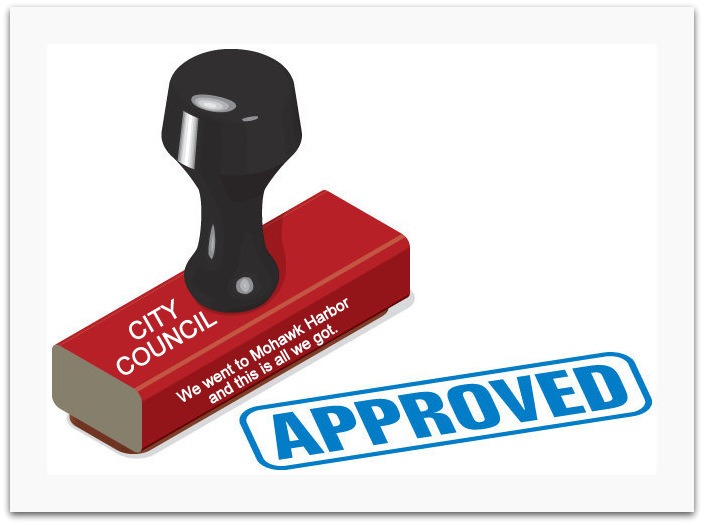
approved-CityCouncil At the February 3, 2015 Committee Meeting of City Council, Councilman Vince Riggi, an independent and the only non-Democrat on City Council, asked that a provision be added to the C-3 Amendments specifying that the Planning Commission has the authority to make such modifications, before asking the Council to vote on extreme changes to the C-3 ordinance with no idea of what the results would be in the real world. Riggi was voted down, and the Amendments were place on the Council Meeting Agenda for Monday, February 9, 2015.  The City Council is, therefore, poised to vote to approve the C-3 Amendments, despite their many flaws, and without having a fraction of the information needed to make an intelligent and responsible decision. So, they are dragging out all those rubber stamps again to please their Casino Cronies.

Councilman Ed Kosiur was adamantly against such a provision and Councilman John Ferrari stated it would be redundant. See the Schenectady Gazette article “Schenectady City Council mulls zoning for Mohawk Harbor: Riggi wants city to reiterate Planning Commission’s authority,” by Haley Vicarro, Feb. 3, 2015.  According to the Gazette:

“Corporation Council Carl Falotico stressed that the commission has the ability to evaluate the aesthetic visual impact of the project even if the plans satisfy zoning requirements.”

While Falotico’s assertion is true, it is quite vague and seems to suggest more than he has actually stated. Planning Boards or Commissions, of course, very often do modify or set conditions for a Site Plan, usually after the applicant has agreed to the changes out of indifference or to avoid the Site Plan being disapproved.  Those conditions tend to state detailed landscaping or buffering requirements; specify allowed color schemes for buildings and signs; limit illumination, and similar “aesthetic” improvement or safety requirements.  Leaving such details to the Planning Commission not only makes sense, it is a necessity, since such details could not possibly be included in a zoning code for a district that has hundreds of parcels in many different settings (and some of the criteria may appear to be in conflict).  Of necessity, the criteria given to a planning board often speak in general terms, such as not having a “substantial impact” on the nature of the neighborhood; or ensuring the “adequacy” of landscaping or buffering between the project and adjacent lands, or of traffic or pedestrian access and circulation.

In the case Moriarity v. Planning Board of Village of Sloatsburg, 119 A.D.2d 188 (1986), the N.Y. appellate court for the 2nd Department pointed out that zoning codes establish specific standards that are applicable to all parcels in a zoning classification, but then have to be applied from lot to lot, by a planning board. The Moriarity court noted that: “there is no escape from the fact that most of the cases dealing with land use regulation indicate a fairly restrictive interpretation of delegated powers. Thus it has been consistently held that each local agency involved in the zoning and planning process [including planning boards], may not exceed the bounds of the power specifically delegated to it.”

The court went on to find that the Sloatsburg Planning Board could not, under its general power to protect the health, safety and general welfare of the community, deny site plan approval based on the lack of nearby public water for fire protection purposes.

Planning Commission conditions are said to be “more onerous” than the zoning code, because they take a code provision stated in general or broad terms and make particular demands of the applicant for fulfilling the code provisions (e.g., the number and height of evergreen trees, or the width and length of a landscaped buffer zone).

Continue reading

Peggy King’s chronic TDE (Tight Deadline Excuse)

  Peggy King, President of the Schenectady City Council, has done it again: Used a “tight deadline” as an excuse for rushing the vote on important legislation, without allowing time for the Council or the public to gather important facts, consider alternatives, and evaluate the likely effects.

.
approved-CityCouncil The legislation this time is the [choose the most appropriate adjectives] novel, complex, radical, extreme, capitulating, over-generous, risky, under-researched, fawning, naive proposal to amend the provisions governing the Schenectady “C-3″ Waterfront Mixed-Use Residential Zoning District”.  The deadline is the two years that the New York State Gaming Commission gives a gaming facility licensee to be operating its casino after it is chosen by the Location Board.

The Tight Deadline Excuse [TDE] is a very weak justification even when the deadline could be met on an important action with only a bit more hard work by all involved. But TDE is not even a flimsy excuse when, as here, there is no deadline yet, much less a tight one that could justify rushing to pass such important and radical changes without knowing key facts.  For example, before voting, Council members should want to know what the Casino Group plans to do with permission:

  • To build 110′ buildings (i.e., how many buildings, where, effects on the view of the river? on future development nearby);
  • to use 19,000 sq. ft. of signage on the casino portion of Mohawk Harbor (what sizes, how bright, what content, and how they use signage at their other casinos), when it stated in its application to the Location Board it would need no more than 15,000 sq. ft.
  • to erect a 90′ pylon (what line of sight profile will it have, placed where, what content)
  • to construct a bike-ped path without the current provision requiring permanent public access to the waterfront, or a similar guarantee
hourglassAlmostFull

lots of sand left

The two-year deadline for completion of the project starts when the actual gaming license is granted, and no one knows how long the “vetting” process will take and the license be granted. Meanwhile, the developer still brags about how far along the site is (they had already spent $100 million there over a year ago and much more since), and how they already have their approved Environmental Impact Statement, with brownfield mitigation near to conclusion.

Furthermore, Rush Street was chosen (and touted by the Mayor and Ms. King) because it has significant experience operating casinos, and has already designed casino facilities that are much like the one they will put in Schenectady.  It goes without saying that the Galesi Group, the Capital Region’s largest developer and manager of commercial property, has the experience to get the job done as quickly as possible.  In addition, if any hotel chain can get a hotel designed, constructed and launched within a two-year window, Sheraton can. Moreover, Mohawk Harbor faces none of the sort of local opposition that can tie the project up in court or administrative proceedings for long periods.

Ms. King told the Times Union that “I’m putting my trust in the developer that they are going to do what’s right.” (“Public supports Schenectady casino at hearing,” by Paul Nelson, Feb. 28, 2015) Trust them why? Because their renderings of the casino hotel and gaming facility buildings are much smaller in scale than the 110′ they now want? Because they want the permanent easement for public access to the riverfront removed from C-3? Because they’ve told us the old factory buildings at ALCO were so high that people never really had a view anyway; which is a silly argument when developing scarce waterfront, but also untrue, as the vast majority of the buildings were very long and about 50′ high, with an occasional tall, narrow section that did little to block the overall view. Because they have asked for much more in the amendments than they told Metroplex they would need or do? (such as pylon size, square footage of signage, setback from the river, and more).

. . share this post with this short URL: https://tinyurl.com/PeggyTakesDictation

Why would Peggy King risk looking gullible or irresponsible, or like the godmother of a gaudy, permanent circus along the River and Erie Blvd.?  Just who does she want to please so much?  We’ll let the reader speculate.

One possibility: Tight Deadline Excuse has become a chronic and infectious disease at City Hall.

Here is our concise list of amendment changes:

Continue reading

the House is already winning: giving away the shore

CasinoHotel9floors  – a hotel 110′ tall; Trump’s along the Mohawk? 

–  click this link for Comments to the Planning Commission on the Waterfront C-3 Amendments by David Giacalone (editor of this website), on Wednesday, January 14, 2015.

red check update: Over half a dozen Schenectady residents pleaded that the Planning Commission not recommend such provisions as 110′ buildings, 40′ setbacks, giant pylons, and 20,000 sq. ft. of signage, and take more time to research materials, and have staff and the developer submit more specific plans, before making its recommendations.  Such comments made no difference at all in the final results.

    Is there anything Schenectady’s Mayor and City Council won’t do for their Casino Cronies? The gifts to the future Casino Owners in the proposed amendments to the City’s waterfront zoning regulations could scarcely fit on a river barge, much less under a Christmas Tree.  In changing the C-3 Waterfront Mixed-Use ordinance, City Hall proposes to give the Rivers Casino group significantly more leeway in designing their facilities than the Applicant ever asked for, or said was needed, in its public statements.  As a result, the Mohawk Harbor Riverfront and Erie Boulevard “front yard” could be more crowded, gaudy and tacky than the proponents of this “modest” project have ever given us to believe.  In reviewing the proposed changes, you might want to ask yourself just when the Mayor, Council President, and Metroplex Chairman knew of these changes.

Thanks to the Daily Gazette, we have online access to the proposed amendments to the City’s C-3 Waterfront Mixed-Use District; click for the Proposed “C-3/Casino” Amendments. Neither the City Council agenda for Monday January 12, 2015, nor the Planning Commission’s agenda for its meeting on Wednesday, Jan. 14, included the proposed casino zoning amendments, despite the topic being on the agenda of each body.  Click the following link for the Current C-3 Zoning Ordinance, which was last amended in 2009.

More Crowded and Tacky?

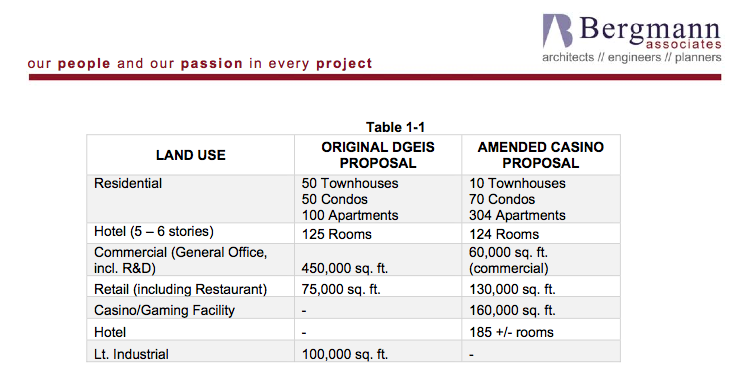
Bigger Hotel – Closer to the Shore: One proposed amendment to the Casino District Zoning rules would allow its hotel to be 110′ tall.  Yes, the Applicant did mention an 110′ height limit in its environmental impact statement, but it never warned us that the omni-present rendering of its casino hotel (the one with all the cherry blossoms) was not representative of its actual goal.  The rendering shows a casino hotel of about 5 floors, which might be 65′ high.   A hotel 110′ high would probably have about 9 floors above the ground.  For your comparison, here is the Applicant’s widely-used hotel rendering on the Left, with my best estimate on the Right of how high a 110′ version might be:

Comparison

– visual bait and switch? –

.

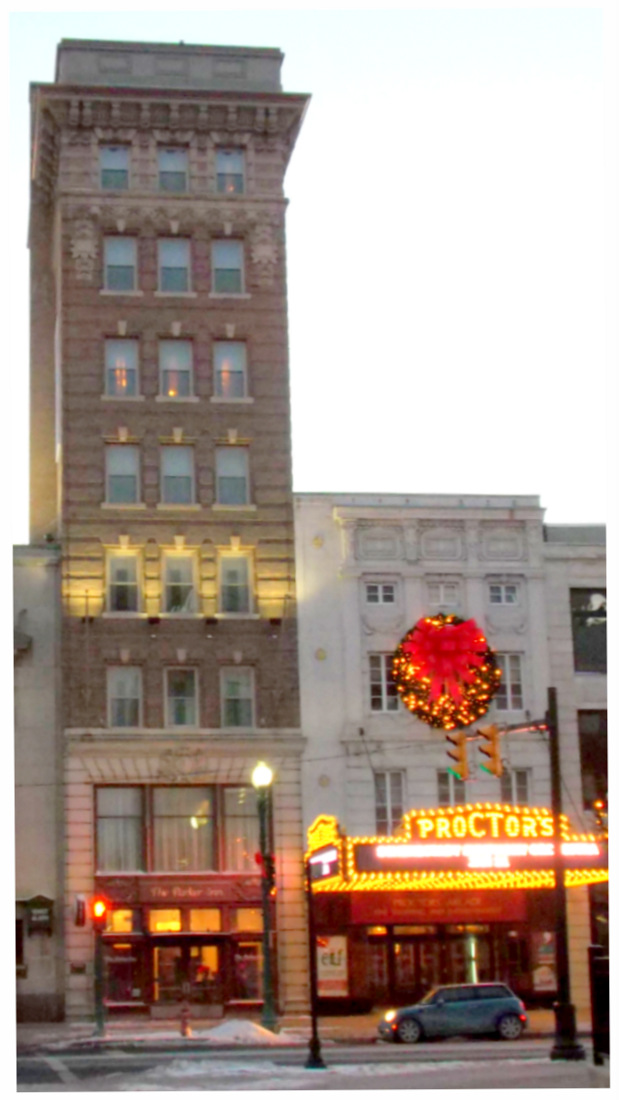
Parker-Proctor  How tall is 110 feet?  Proctor’s nextdoor neighbor, the Parker Inn was historically Schenectady’s tallest building. (see photo to the right of this paragraph) The Parker Inn is 98.56 ft. with 8 floors.  The former St. Clare’s Hospital, now called Ellis Hospital McClellan Campus, is a mere 69 ft. tall, with  5 floors above ground. Even the Wedgeway Building at State and Erie is only 72 feet, with 6 floors.   (Those three “tall” Schenectady buildings average about 12’5″ per floor.)  Imagine a building many times larger in bulk and 11 feet higher than the Parker Inn, with far less grace, enhancing our scarce Schenectady River frontage.

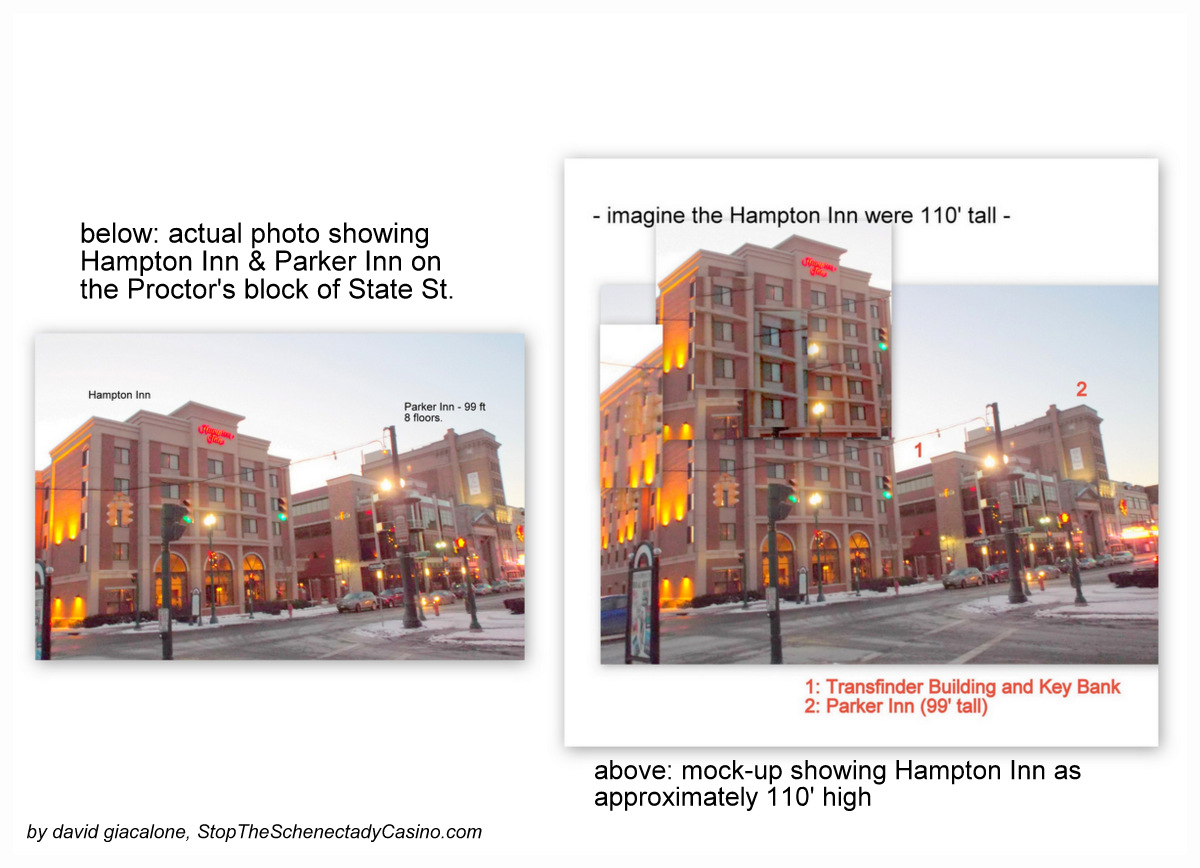
The Hampton Inn, at State and Clinton Streets, is right down the block from the Parker Inn. The Hampton Inn is 4 floors and appears to be a bit more than half the height of the Parker Inn; it has 93 rooms, which is half the 185-room figure the Casino has given in its impact statements. If you stacked another Hampton Inn on top of the current one, you would probably come fairly close to 110′. The following collage compares the Hampton-Parker end of the State Street block, with both the actual Hampton Inn and a bulked-up-casino-style version:

Hampton-ParkerCompareCollage

Important economic question: If Rivers Casino wants a hotel this big, how much will its promotions to fill the Casino Hotel cannibalize other quality hotels in Schenectady?  The sly Applicant never stated how many floors its hotel was likely to be, while indicating consistently that the separate, Galesi marina hotel would be 5-6 floors, and that the casino hotel would have 50% more rooms: 185  “+/-“, compared to 124 rooms.

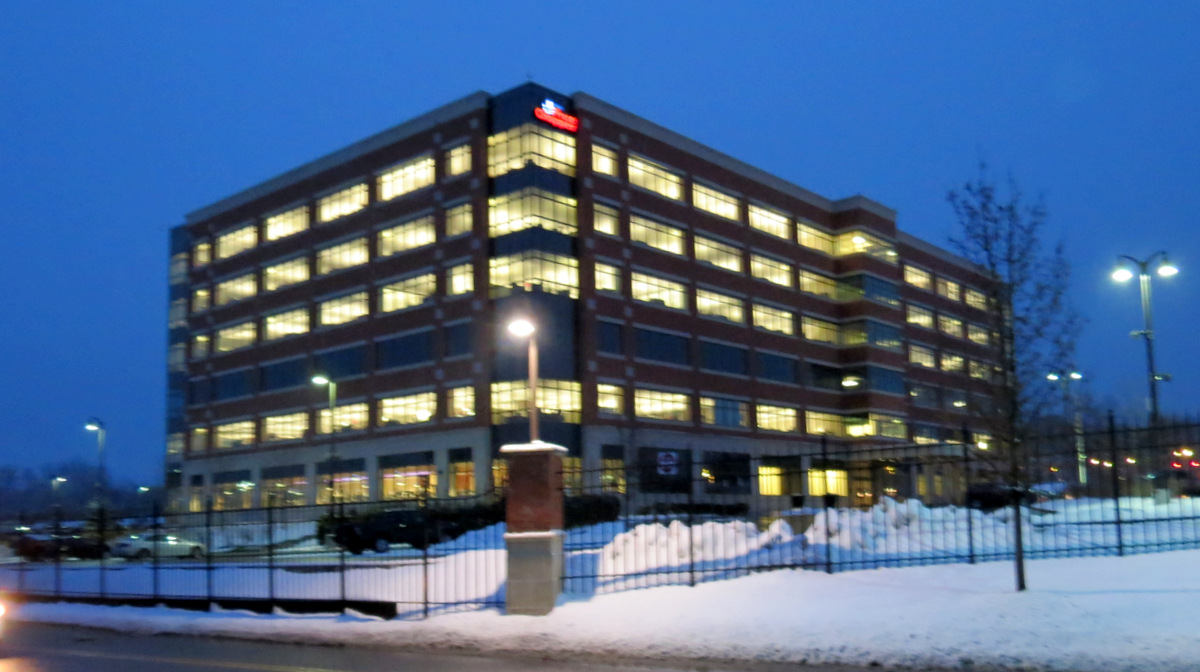
One more height comparison: The Schenectady Casino Applicants’ environmental impact Statement compares its proposed 110′ hotel with the 103-foot Golub/Price Chopper Building, stating that it is less than a quarter-mile from the casino location.  Of course, the Price Chopper headquarters is situated alongside the rather unlovely Maxon Rd. and Nott Street, not our scarce waterfront. [Note: it is not clear that the building is in fact 103′ tall; it appears to be shorter than that. update: Dave Buicko, Galesi Group CEO, continued to state at the Jan. 14, 2015 Planning Commission Meeting, that the Golub building, which is owned by Galesi, is 103′ tall. On Jan. 15, 2015, I received a response from a Price Chopper staffer to a question on the height of the building that I asked on Jan. 13; she phoned to say that the Golub Corp. Headquarters is 86′ high.]

Here is a photo of the building at dusk on January 12, 2015, to help you decide whether a building that tall should be located along the riverfront (as opposed to further back on the large parcel) at Mohawk Harbor:

Golub1

the “103-foot tall” Golub Corporate Headaquarters – actually 86′ tall

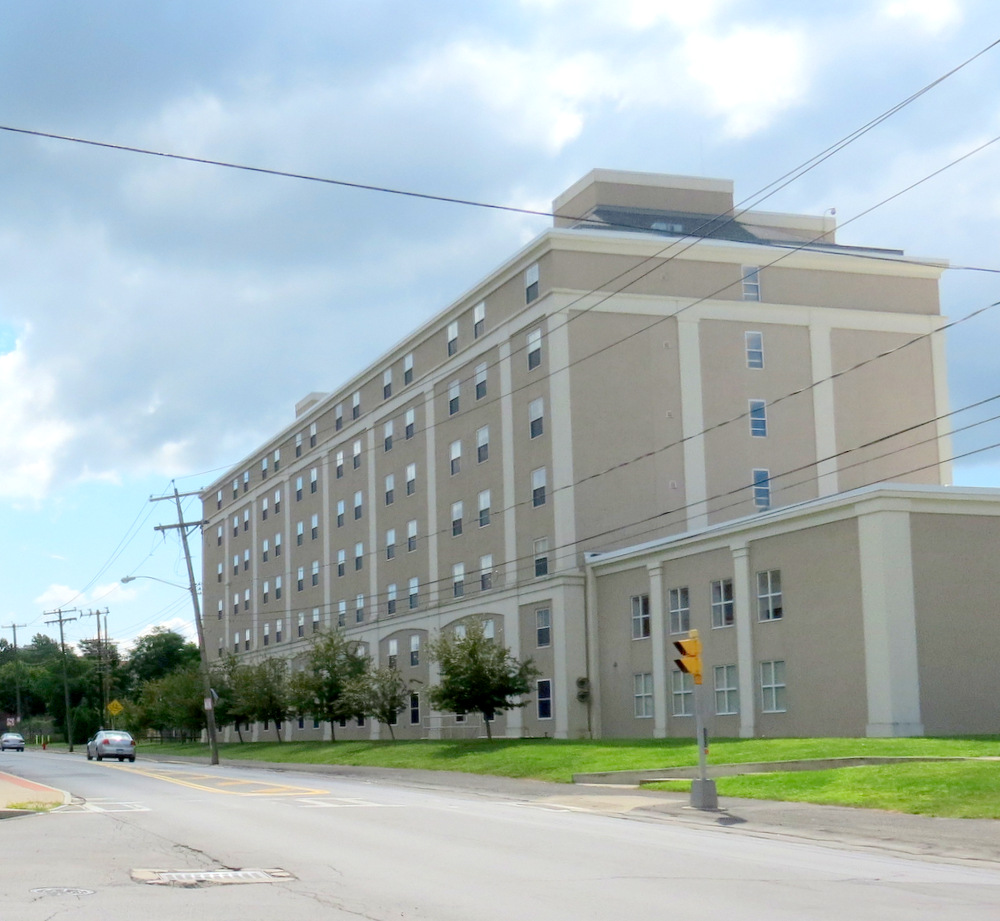
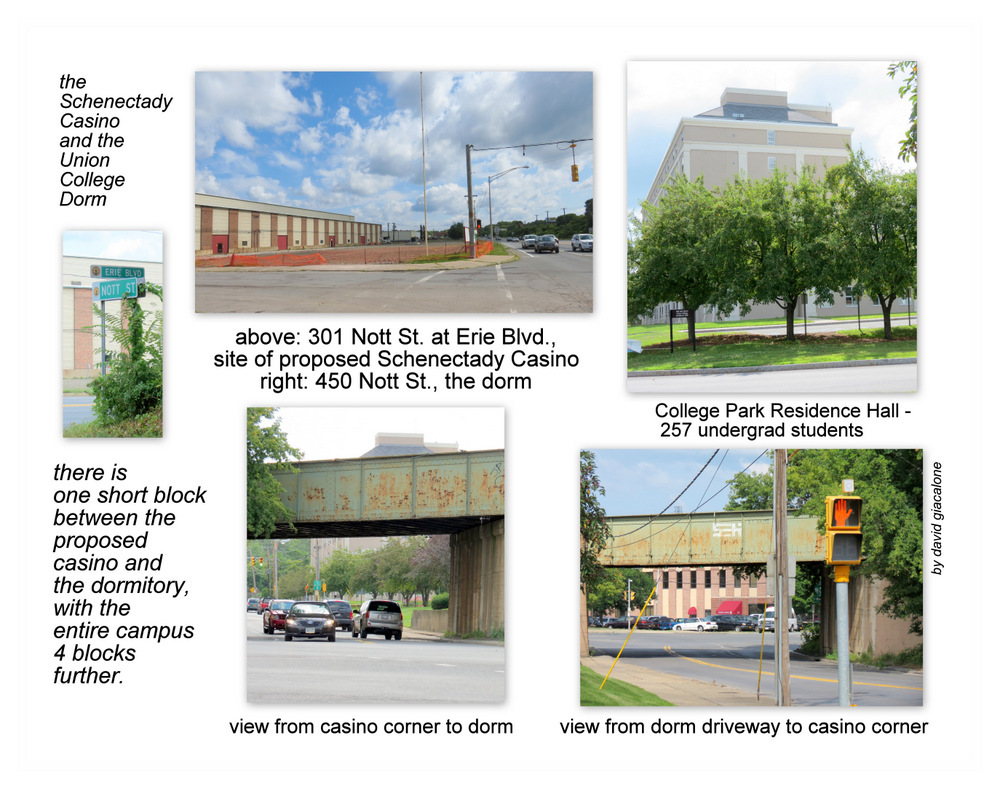
  • By the way, directly across the street from the Price Chopper headquarters is the largest Union College residency hall, which was once a hotel.  It is merely 7 floors, but not exactly river-bank svelte:
CollegeParkResHall

Union College Residence Hall, 450 Nott St.

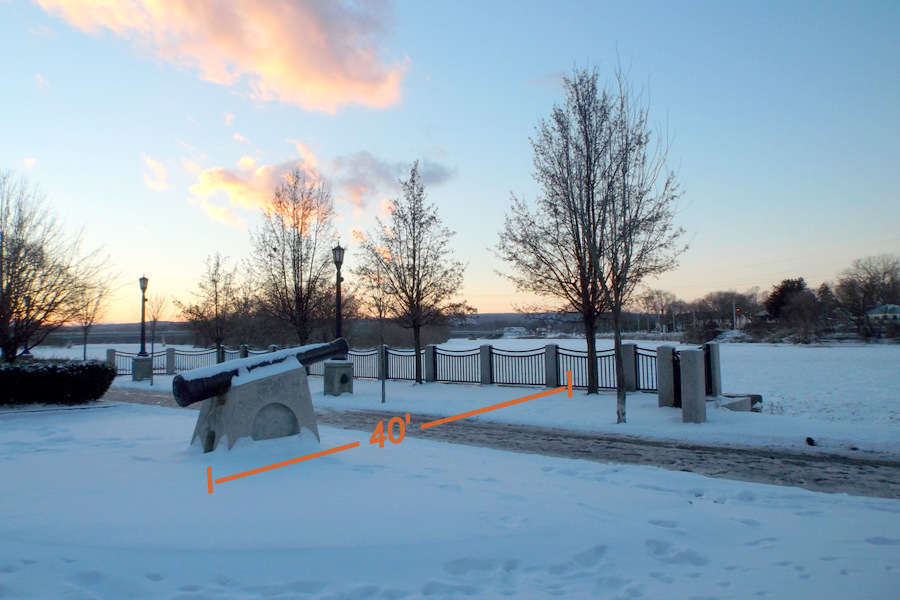
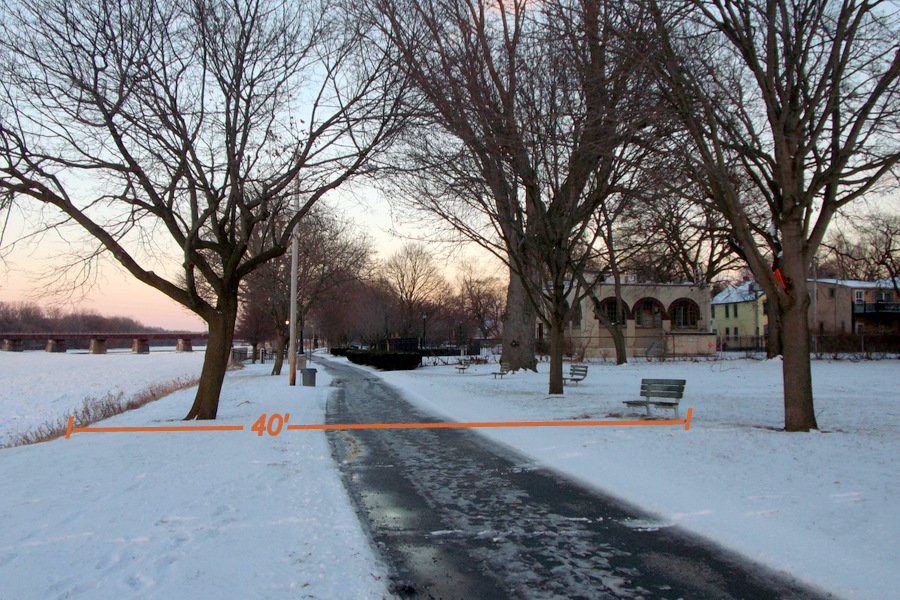
A Setback Setback.  Another City Hall concession would make the Casino Hotel loom even more ominously along the shore:  The Casino Applicant said all waterfront setbacks would be at least 50 feet; nonetheless, the amendments reduce the setback along the River to an even slimmer 40 feet.  Forty feet is awfully close to the river bank. [approximately the length of two Ford Expedition SUVs bumper to bumper]  Here are two 40-foot examples from Riverside Park:

casino40feet1  . . . casino40feet2

– click on a picture for a much larger version –

Note: The bike-hike trail could be 18 feet from the hotel.

Even Gaudier than Expected?

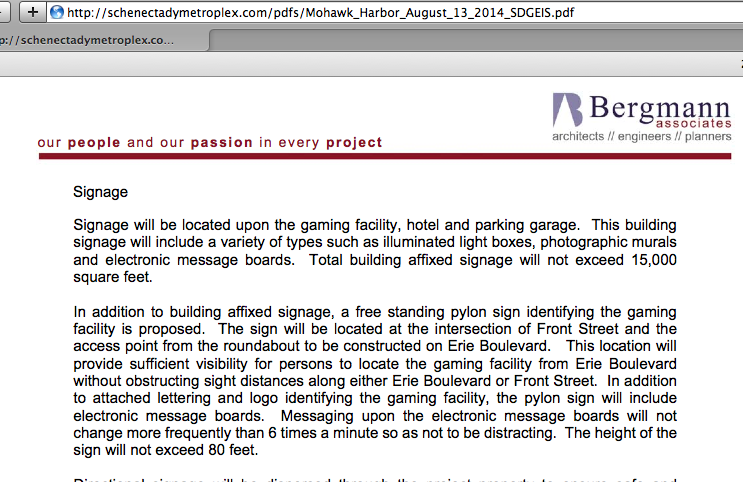
A Signage Tsunami.  No one can call the Galesi Group or Rush Street Gambling shy about asking for special rules.  The Amendments to C-3 state specifically that signage rules applicable to all other zoning districts [Article IX-Signs, §264-61(k)] do not apply at the C-3 casino compound.  So, the Casino Guys modestly said they would use no more than aggregate of 15,000 square feet of advertising.  [click for their statement on signage] That is 100 times more (not a mere 100% more) than permitted under Article IX.  Nonetheless, the Mayor et al. never said, “Now you guys are pushing it a bit.”  They said, “How about one-third more, 20,000 sq. ft.”

Freestanding at 80 feet.  The maximum height of a free-standign sign in any other zoning district is 10 feet.  The amendments do not state a maximum, only that Art. IX does not apply [update: the final version released for the Public Hearing before City Council calls for a 90′ limit on pylon signs.].  The Casino has told us it wants a free-standing pylon sign at the intersection of Front Street and the access point to the casino from the anticipated roundabout (near Front and Nott Sts.), to allow persons to easily locate the facility from Erie Boulevard.  But, don’t worry, “The height of the sign will not exceed 80 feet.” (Recall that the Wedgeway Building down at Erie Blvd. and State St. is only 72 feet high; also, GE’s giant, famous lighted logo has a diameter of only 36 feet; so stack one on top of another and you’re still 8 feet lower than the Casino Pylon’s apex.)

Pylon signage in the 80-foot-range is traditionally used by a business near a highway in order to give drivers traveling at 70 mph information about the service offered in time to allow them to safely get off at the next exit.  The sign industry calls such structures “freeway pylons.” For reasons too numerous to list, there is no analogous need in the situation of the Schenectady Casino.  By merely suggesting the possibility of an 80-foot pylon, Rush Street and Galesi Group demonstrate a brutish lack of sensitivity to aesthetics, safety, neighborhood traditions, and the image and reputation of the City of Schenectady — not to  mention the truth.

Wedgeway72

– the 72-foot-high Wedgeway Building, Erie at State –

A few months ago, the Applicant based its claim of having no negative impact on cultural resources and sensitivities (and fuddy-duddies worried about their viewscape) on the fact that you could not see their facility from the Stockade. They even said the RR underpass trestle on Front St. would block our view.  Back then, we did not agree, and a casino facility with a much taller hotel and a monster pylon, is most probably even easier to see.

Also, those who have long sought attractive entryways into the Stockade might not be pleased with that pylon, even if it had a Stockade sign with directional arrow.

Corner-Store-Pylon-Cometsigns  [sample pylon] Changing Electronic Messages. It is the giant pylon that will have, in addition to lettering and a logo for Rivers Casino, “electronic message boards.”  The safety-minded Casino assured us in its impact statement that “Messaging upon the electronic message boards will not change more frequently than 6 times a minute so as not to be distracting.”  Once again, rather than point out in amazement that current law only allows messages to change once per minute, and not even Proctor’s new marquee exceeds that pace, City Hall apparently said, “Heck, why wait 10 seconds to change a message, we’ll let you do it every 8 seconds,” which is 7.5 times a minute.

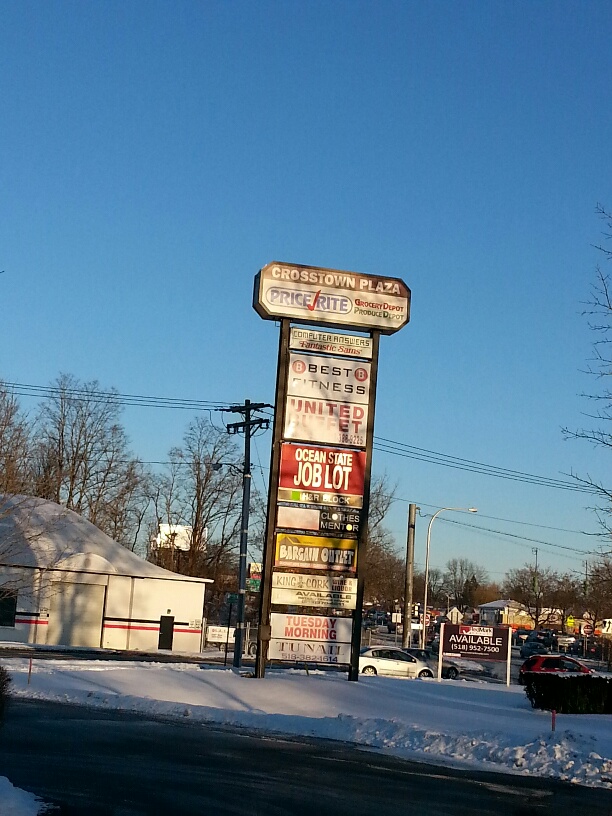
CrosstownPlazaSign

update: “grandfathered -in” pylon at Crosstown Plaza [shown above] is 50′ high; the Planning Commission voted to recommend a maximum of 90 feet on Jan. 14, 2015, but limited the portion of the pylon that could be signage to 70%  –

Good highway safety practice does not allow giant pylons with changing messages at places where drivers need to be paying close attention and have other distractions.  Our search online has produced no images of Rush Street having such giant pylons at its other, successful casinos — not even in Pittsburgh, where it might be a bit more difficult to find a low-rise casino than in Schenectady.  It will be interesting to see if City Hall changes its practice of Never Explaining, to justify such a drastic change in policy for electronic signs (other than, “it makes the Casino Cash-Cow content”). [followup: See the NYS DOT’s “Criteria for Regulating CEVM signs“, which set a  minimum interval of 8 seconds for changing electronic signs, but allows municipalities to be more stringent and suggests circumstances that might call for longer intervals.]

More Crowded?

In addition to having narrower setbacks along the River, which will surely increase the sense of being less spacious, the proposed amendments have a stealth provision that will increase the allowable footprint, and thus the width and length of buildings in the casino compound.  The Casino appeared to be content with the allowable footprint for buildings; however, the amendments in effect increase the footprint size permitted by counting the embayment area in calculating the size of the project lot.  Building footprints may not exceed 50% of the project site, but “the project site is defined to include any embayment.”

Hairy Arm Proposals?

Finally, it is difficult not to be suspicious of the statements and tactics of the Casino Collaborators after seeing them in action since the Spring.  The generous give-aways to the Casino owners and developer are perhaps part of a version of a  “hairy arm” ruse:  That is, City Hall is making outlandish proposals, so that it or the Planning Commission can look magnanimous and reasonable when they pull back a bit on an outrageous proposal or two. That may make it harder for dissenters to vote no, allowing the members to pass pared-down but still extreme concessions to their Casino Cronies.

We have not had a chance to study the proposals in depth, to see how other municipalities and planners have dealt with problems presented, and to uncover — much less examine — the reasoning behind each major proposal in the C-3 zoning ordinance.  Now that they have their casino victory, it is time for our local leaders to start asking tough questions and doing their homework before passing major zoning changes.

a New Year reminder of the job ahead

 Happy New Year to everyone who hopes the future Rivers Casino at Mohawk Harbor will somehow live up to its promises, while minimizing damage to the social, moral, legal, and financial fabric of our community.  Thanks again to all who worked in 2014 to avoid such damage by keeping a casino from being located in Schenectady. We haven’t stopped the casino, but we can’t give up the mission or the hope of stopping or reducing casino-made problems.

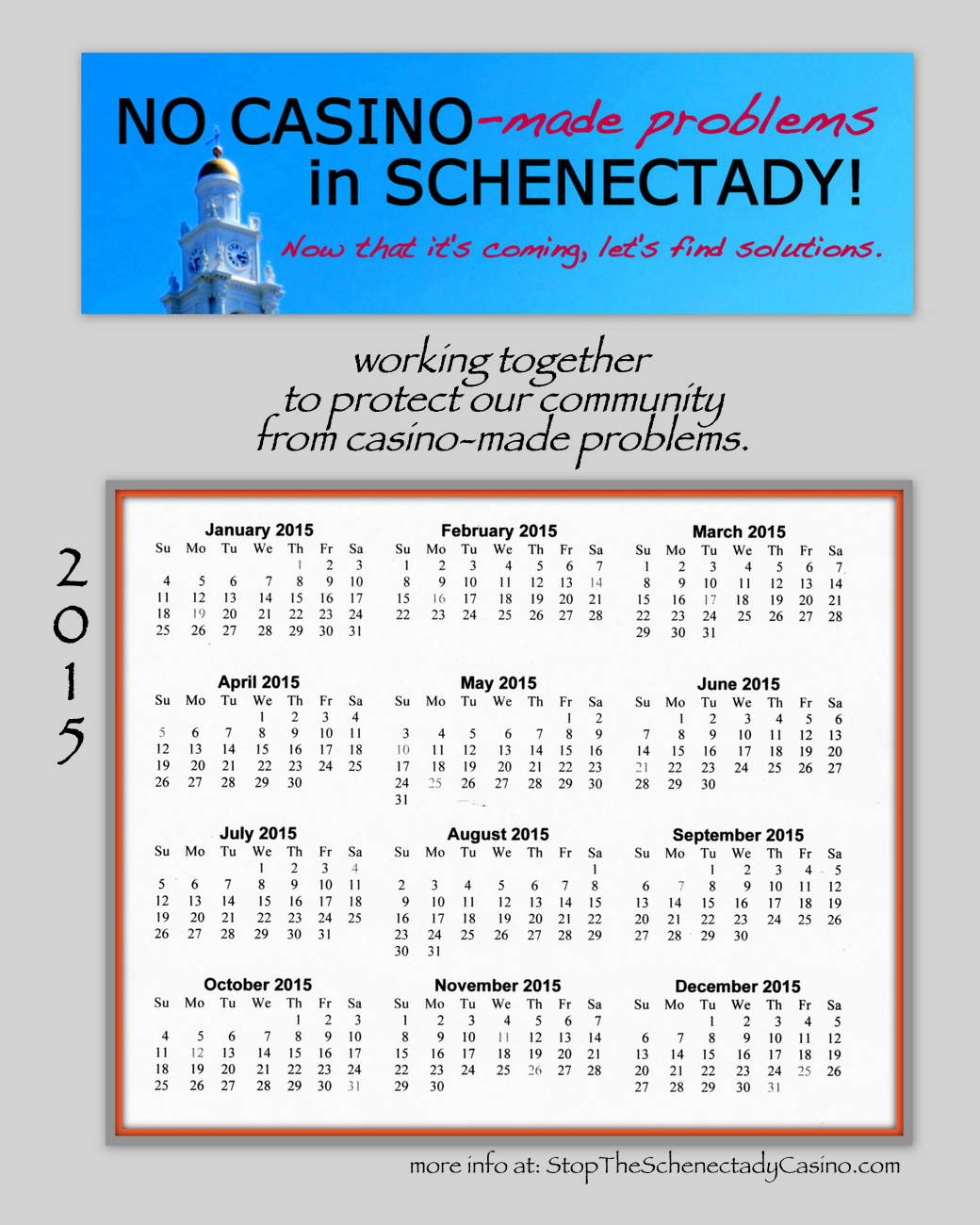
CasinoProblems2015Calendar It’s probably too early for public meetings on the best approaches for avoiding casino-made problems.  But, as the New Year unfolds, we hope the issues will be simmering on all our mental back-burners — whether opponents or proponents of the Schenectady application, in all sectors of our community: commercial, nonprofit, religious, political, academic, law enforcement, neighborhood advocates, and all people of good will.  Individuals and groups need to evaluate problems they feel are especially important and likely to occur in urban casino locations, such as an increase in certain kinds of crime and domestic violence, problem gambling (especially by the poor, elderly, young, and other vulnerable individuals), DUI and traffic problems, personal and business bankruptcy, evictions and foreclosures, etc., and a reduction in the quality of life and property values in nearby neighborhoods, including the Stockade Historic District. (See a possible list, with references, on our Issues page, and a more particular one centered on the Schenectady casino, in our Statement to the Location Board).

Because we are two years away from an operating casino facility, we have time to study experiences and experiments elsewhere and consult experts, to consider alternative approaches, to gauge the likelihood of nurturing community and political support for particular ideas and strategies, and to find individual and groups that have the commitment, ability, temperament, and energy to pursue and achieve our goals.  This need not, and probably should not, be a centrally-organized campaign, but it will hopefully be one where people and groups who share in the mission will also share a spirit of cooperation and mutual assistance in achieving our goals.

NoCasinoMadeProblemsB  You can click on the following link for a large jpg. file suitable for printing the one-page 2015 Calendar shown above as an 8″ x 10″ print. (you may reproduce it for any non-commercial purpose) We hope the calendar will be a reminder all year of the important task ahead.  Contact us with your ideas and/or your desire to be informed of our actions and meetings, or your willingness to be a volunteer in our efforts.

RIGGING THE NEWS: the Gazette and the Schenectady Casino

images  Tomorrow, Dec. 17, 2014, the NYS Gaming Facility Location Board is expected to finally announce its selections for up to four Upstate gaming facility licenses. Before the winners and losers are chosen, however, we would like to set out our perspective on the coverage given to the casino selection process by the Schenectady Daily Gazette, which has editorially supported the Schenectady casino application.

  Whether we “win” or “loose”, we believe it is important for the people of Schenectady to know how poorly the Gazette has performed the role of presenting the relevant casino news and helping the public (and our leaders) understand the issues and the likely impact of a casino on Schenectady and nearby communities. They are proud of being “locally owned” and “independent”, but we’re afraid that can translate into parochial, unaccountable coverage, far too susceptible to pressures from local government and business interests (including important current or potential advertisers), and from the social and personal demands on members of a small community of local leaders. In a way, “locally owned” can lead too readily to “locally bought”.

. . share this post with this short URL: http://tinyurl.com/GazetteTilt

Our posting this weekend (which we urge you to read), “the Gazette continues the ALCO tunnel coverup“, describes only one of the many ways in which the Schenectady Gazette appears to have skewed its coverage of the news of the casino application process, in order to present the Schenectady applicants and their proponents in a way that paints them in the best light, by avoiding tough questions, ignoring negative facts, and pretending that there is no organized, serious opposition locally to the casino.  Any semblance of evenhanded news coverage ended June 9, 2014, the night the Schenectady City Council voted to support the application of Rush Street Gaming and the Galesi Group to operate a gaming facility at Mohawk Harbor, the former site of Schenectady’s ALCO plant.  See the resulting Gazette editorial Casino would provide needed boost (June 10, 2014)

Meeting with Gazette Officials. Yesterday afternoon (Monday, Dec. 15, 2014), the Publisher of the Gazette, John DeAugustine, the Editor, Judy Patrick, and Miles Reed, the City Editor met with Stop the Schenectady Casino members Mohamed Hafez and myself (David Giacalone) to discuss our belief that the Gazette’s news coverage has favored the casino.  They gave us a considerable amount of their time and made the valid points that they have a limited amount of resources to cover the wide world of local news and that they are bombarded by complaints they have not given enough coverage to particular issues or have not been impartial. The Gazette officials insisted they are proud of the wide coverage they have given the casino issue and seemed not to understand why we would want the Gazette to report the positions and arguments of Stop the Schenectady Casino, as opposed to merely vaguely mentioning concerns of those against a Schenectady casino.

We wanted (and needed) the public to know and the media to report there is a serious opposition campaign, because the Location Board wants to know the extent of local opposition, and because not mentioning our specific arguments and background information serves the interests of the casino applicant by default.  To “write about” (usually, merely mentioning) crime, traffic, the proximity to Union College, and potential harm to the Stockade Historic neighborhood, etc., without mentioning our consistent focus on those issues, and our very specific research on the facts and research literature, not only has left the articles almost content-free, but fails to show the seriousness of the problems.

newspaper  The Gazette‘s editorial board endorsed the casino on June 9th, and — viewed from the outside as casino opponents, and also perhaps to the objective observer — its newsroom became a virtual public relations department for the Schenectady casino, with news editors seemingly reining in reporters who were initially curious and conscientious in covering casino issues. Despite the public’s desire to know more about the applicants and the pros and cons of locating a casino in Schenectady, the Gazette newsroom did little to counter the propaganda of local political leaders, the pie-in-the-sky predictions of Rush Street Gaming and Galesi Group CEO David Buicko, and the incessant cheerleading of Metroplex and the local Chamber of Commerce, with facts and investigatory reporting.  It failed to look beyond the conclusions and soundbites of casino proponents and to present the facts and arguments behind the concerns of opponents.

Here are some examples:

  • The Gazette‘s coverage of the City Council meeting of June 9th and its 5-2 vote approving the casino application failed to mention that a large group of local religious and community leaders submitted a Statement to the Council strongly opposing the casino; instead, the Gazette merely mentioned that the group asked the Council to delay its vote in order to hold a public hearing on the issues and consider public comments and the social effects of a casino on the City and its residents.  Similarly, while reporting that the Council chambers were filled with blue signs and buttons saying Yes for the casino, the Gazette did not mention that virtually no hands went up when Rev. Sara Baron asked the audience who supported the casino and lived in Schenectady, while many hands were raised in answer to her asking who were against the casino and live in the City. See Schenectady City Council backs casino proposal (June 10, 2014)
  • checkedboxs The Gazette also ignored a press release by many of the same religious leaders, dated September 30, 2014, telling of a campaign among various faith congregations in Schenectady to make their opposition known to the proposed Schenectady casino.  [See our posting of Oct. 1, 2014; and click for a pdf. version of the Press Release]  The campaign provided an information packet with documents to aid in writing the NYS Gaming Facility Location Board.  I personally brought up the topic to a Gazette casino reporter, supplying the phone number of Rev. Phil Grigsby, who was a contact person for the group behind the Press Release and anti-casino campaign.  Rev. Grigsby made several direct attempts to speak with the reporter and Gazette, but was never able to do so.

 According to the ministers’ press release:

Of major concern is that “Rush Street Gaming invests in Ruby Seven Studios, which develops, markets, and distributes casino games such as slots and poker through social network and smart phone ‘app’ websites with terms of service that expressly allow children as young as 13 to play without any age or identity verification.”

   It is that “major concern” that might have kept the ministers’ news-worthy campaign out of the Gazette. The Press Release was referring to a study, Betting on Kids Online, released in early September by a major hospitality and casino worker union, stating that Rush Street Gaming is investing millions of dollars with the aim of becoming the industry leader in “building a bridge” between children playing casino-like games on social media and smartphones and their going to brick-n-mortar casinos to do real gaming once they are old enough.  As we stated in our posting “Rush Street takes aim at adolescents” (Sept. 11, 2014): Knowing that the earlier you begin to gamble, the more likely you are to gamble often and obsessively, Schenectady’s proposed casino operator is sowing the seeds digitally to grow the next generation of problem gamblers.

I personally corresponded with a Gazette reporter a few times on Betting on Kids, sending a link to the study and related website.  The Gazette chose to censor this important news about a casino operator who wants to locate a gaming facility a block away from a giant Union College residence hall filled with potential young gamblers.  It also failed to report that Rush Street’s Philadelphia casino was specifically aiming at young potential gamblers by creating a simpler form of craps called “props and hops” and building a large poker hall.  See this posting.
Captured Videos1 The Gazette newsroom has also, by commission and omission, acted to erase the existence of the group Stop the Schenectady Casino from the minds of its readers.  Indeed, when WAMC’s Dave Lucas first contacted me in November, he started the conversation by saying, “I didn’t even know there was a group in opposition to the Schenectady casino.”  Also, at the September public presentations by the Applicants to the Location Board, one Board member told the East Greenbush applicant that they were the only casino with any public opposition.  Mr. Lucas and the Location Board staff  must have blinked and missed the initial coverage the Gazette gave to our group when we were first formed at the end of May, in our attempt to prevent the City Council from approving the Schenectady casino proposal.  See “Neighbors rally against Schenectady casino plan” (Sunday Gazette, by Ned Campbell, June 8, 2014); and our posting on “our June 7 opposition meeting” at Arthur’s Market.

In fact, in the four months since the Gazette’s June 9th editorial supporting the casino, there has only been one mention of the existence of a group in Schenectady opposing the casino.  That was in a piece on June 23 about my complaint to the NYS Attorney General, alleging that the efforts of the Fair Game theater coalition to force applicants to accept a list of their demands violate the antitrust laws.  [see our post “arts venues want more than a Fair Game” June 28, 2014] The very next day, the Gazette printed an editorial praising Fair Game, and calling it good for the theaters, the City and the casinos.  Despite the editorial staff’s usual CYA approach, in which it states “on one hand, on the other hand”, concerning most issues, it did not even acknowledge that Fair Game’s activities could increase entertainment prices and limit entertainment options available to Schenectady County residents, while also damaging non-favored entertainment and leisure establishments.  Perhaps because I was attacking our biggest local sacred cow, Proctor’s and its director Philip Morris, I have subsequently been relegated to being called a Stockade resident and/or outspoken casino critic, not the leader of an opposition group.

erasingF  The worst example of the Gazette magicians making Stop the Schenectady Casino almost disappear is certainly our treatment relative to the all-important Location Board public comment event on September 22nd.  On September 21, the Sunday Gazette published the article “Public to have its say on casinos: Supporters, foes to lobby board at Monday hearing” (by Haley Viccaro). In a section that begins “Here’s a sample of what to expect during the hearing at the Holiday Inn at 205 Wolf Road in Colonie”, the article has two sentences about an out-of-town labor group, Unite HERE, that was to appear to complain about labor complaints against Rush Street Gaming.  The only other discussion of expected opposition at the public hearing to the Schenectady casino says:

“Also speaking against the proposed Schenectady casino are some residents of the Stockade Historic District. David Giacalone is set to speak at 10 a.m., while Mohamed Hafez has a reserved slot at 6:15 p.m.”

Reporter Viccaro had been in frequent touch with me the days before the Board’s public comment event.  She knew that I was scheduled to appear on behalf of the group Stop the Schenectady Casino, and that the reserved spots were in fact meant for representatives of groups.  I told her Mr. Hafez also had a time slot, and she sent me an email specifically asking if Hafez was a Stockade resident. I immediately wrote back, saying he lived in Mt. Pleasant, not the Stockade, with an insurance office on Guilderland Ave., and was appearing to present the perspective of a landlord on the negative impact of a casino.

To the typical Schenectadian reading the Gazette, the term “Stockade resident” often means “spoiled elitist opposed to anything new that might be an inconvenience.”  It does not suggest serious opposition and a coalition of people with a wide range of reasons to fight against a casino.  The impression is strengthened by failing to mention (as the article does for opponents of other Capital Region casinos) any actual issues and concerns of the Group.

threemonkeys Worse than the relegating us to the issue-less category of Stockade resident prior to the Public Comment Event, the Gazette‘s multi-piece coverage of the 12-hour public hearing never mentions that there were local opponents of the Schenectady casino present at or making presentations to the Location Board, much less that a spokesperson appeared on behalf of Stop the Schenectady Casino and presented a 20-page Statement in Opposition to the Schenectady Casino to the Location Board, along with our signed Petitions against the casino.  [Even Galesi CEO Dave Buicko and Metroplex Chairman Ray Gillen later congratulated us on the quality of the Statement.] Nor did the Gazette mention Mohamed Hafez’s presentation, and his attempt to share some of his five minutes with Rev. Philip Grigsby of the group of Schenectady religious leaders against the casino.

Captured Videos1 Did we just get lost in the overkill of a day-long hearing?  Well, Gazette reporter Haley Viccaro watched my presentation and when I finished it, we talked, joked, and schmoozed on and off for well over 30 minutes; she even strongly advised me to check out the fancy room reserved by the Schenectady applicant for the comfort of its supporters.  She was also very pleased when I handed her a flashdrive that held our Statement, its attachments, and copies of the petitions.  Instead of mentioning our group in her pieces, Haley ended up marveling over a cake baked by one of the businesses that plans to partner with Rush Street Gaming at the Schenectady casino.

  The worst example of blatant pro-casino “news” was surely the front-page article on Sunday August 4, 2014, entitled “Schenectady Casino Group Praised: Host communities say Rush Street lives up to its billing” (Sunday Gazette; by Haley Viccaro).   As was stated in our posting that day, “a few things the Gazette forgot to mention“, the puff piece gave Rush Street a lot of free public relations propaganda. [update (Feb. 7, 2017): The Gazette is at it again, playing public relations patty-cake with Rush Street; see “Rush Street Gaming properties hint at what to expect in Schenectady“, by Brett Samuels.)

In addition:
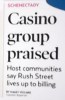
 DSCF3276-001 Haley’s article is filled with quotes from local development and business officials and Rush Street Gaming’s CEO Greg Carlin, without a word from their detractors, such as Casino-Free Philadelphia, or the Worchester MA citizens group  that was successful in keeping RSG out of their city, nor even from the Stop the Schenectady Casino gang.  We speculated in August that perhaps the article was the Gazette‘s penance and mea culpa to Casino proponents for an earlier article titled “Officials in other cities warn of pitfalls, failed promises by Rush Street“? (June 8, 2014, by Bethany Bump).

Indeed, Rush Street Gaming liked the August 3rd article so much, it included a Power Point image of the headline in the “final”, public presentation it made to the Location Board in September. (click the image at the head of this paragraph)  In our posting on what the newspaper forgot to mention, we walk through a number of very important facts the Gazette should have mentioned as a matter of fairness, but also of journalistic duty and pride.  For example, it failed to mention the many facts that refute the claim by a Philadelphia official that, rather than crime rising, it actually got safer near Rush Street’s Philadelphia casino.  In addition, it allowed a company official to brag that they even help customers find other hotels for their stay in Philadelphia, without noting that the particular casino has no hotel of its own and must assist customers to find lodging if it wants to lure them to their facility.

Traffic & Crime Concerns. The Gazette also managed to write an article on the traffic problems in the Stockade, and to occasionally mention concerns over increased crime, without ever including mention of Stop the Schenectady Casino, which has focused on those issues, and researched and written on them in some detail.

For example, see the Gazette piece “Stockade group frets over potential traffic: Mohawk Harbor access a concern” (Sept. 30, 2014, by Haley Viccaro). Ms. Viccaro decided to only speak with Mary D’Allesdandro, Stockade Association president concerning the Stockade’s traffic worries.  Not only is Ms. D’Allesandro a supporter of the casino, she never did anything about the traffic issue until a non-officer member of the Association asked at the September Stockade Association that they give comments to Metroplex as part of the environmental review.  The Comment was hammered out at the end of the Meeting, and is filled with generalities.   The Gazette article is so troublesome, that I left a lengthy comment at their website, and repeated it in a posting on October 1, titled “the Gazette gets stuck in Stockade traffic” (October 1, 2014).  That posting has links to the work done by Stop the Schenectady Casino on the traffic issue, including discussion on our Statement in Opposition of September 22, 2o14.

checkedboxs Crime. The Gazette has also failed to address in any meaningful way an issue of great concern to neighborhoods near the proposed casino: the likelihood that the casino will bring an increase in crime.  We were told in the Gazette, with no explanations, that Stockade Association President, a casino booster (and mayor-appointed member of the City’s Board of Zoning Review), Mary D’Alessandro didn’t think there would be an increase in crime; that East Front Street Association officer Mary Ann Ruscitto, an “excited” casino booster, wasn’t worried, because we already have crime in the Stockade area; and that a Rush Street Gaming proponent stated that crime went down around its Philadelphia SugarHouse casino. As you can see in our posting “will a casino bring more crime,” and at pages 6 -8 or our Statement in Opposition to the Casino, there is much to say about crime and an urban casino that goes far beyond one-sentence gut feelings.  The Gazette could have added to that debate, but I believe doing so would have made more of their readers and their allies supporting the casino nervous.

In addition, the Gazette newsroom:

  •  Never wrote about the County Legislators and town leaders ignoring the November 2013 vote on Proposition One, in which a majority of county residents opposed having any casinos upstate, with large majorities in opposition in Niskayuna and Glenville, which are the towns closest to Mohawk Harbor.  In addition, it never wrote that, despite its claims, the County Legislature, had absolutely no power to approve the casino application if the City did not do so.  My own presentation to the Gazette staff of the relevant provisions of the law and Request for Applications, which clearly state that only a city or town could give the necessary local approval, were ignored. [See our posting “Schenectady County ignores its voters and plain English” (June 2, 2014)]
  • threemonkeys Often mentioned that the East Front Street Association supported the casino, but never reported on how few people were members nor how its leaders concluded the majority of neighborhood residents supported the casino.  Every resident of that neighborhood asked by us said no one asked them their stance on the casino.
  • Gave no coverage to the Statement of the Schenectady Heritage Foundation to Metroplex, asking Metroplex to act to protect the Stockade from the negative effects likely to be caused by having a casino a half mile away. See our post on October 2, 2014.
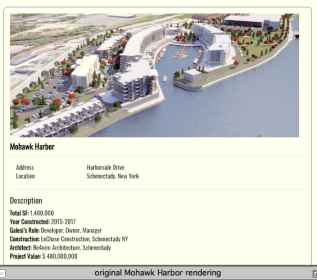
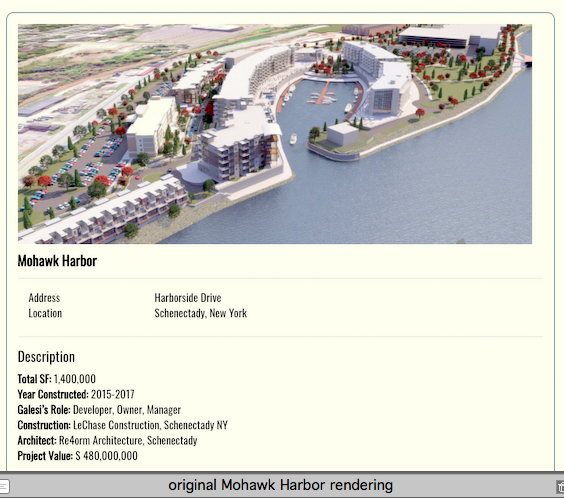
  • OriginalMohawkHarbor Gratuitously, with no source given, asserted  in the piece”Automated Dynamics weighs relocation options” (Haley Viccaro, Nov. 27, 2014) that “If [the Alco site is not chosen for a casino], the portion of the site dedicated for the project would probably remain undeveloped.”  I think Mssrs. Galesi, Buicko and Gillen would be trying hard to find a substitute use of that land, even if it is only the major amenity of a park setting with walking and bike trails along the Mohawk, next to the Mohawk Harbor hotel, condos, marina, office buildings, retail shops, etc. on the west end of the plot. [The image to the right is an original rendering of Mohawk Harbor released by the Galesi Group, showing the project filling the entire riverbank site, with much-needed green space, as well as trees and setbacks along Erie Blvd, and its first phase constructed in 2015.]

This is, we submit, not a record that should make the Gazette proud, unless its goal has been to give Rivers Casino at Mohawk Harbor a better shot at being selected by the Location Board.

update (Dec. 18, 2014): Well, at least they’re consistent.  The following is apparently the only mention of an Opposition in the Gazette’s massive coverage of the casino selection in today’s newspaper: “Some Schenectady residents, including those in the nearby Stockade neighborhood, have voiced concerns about a potential increase in crime and traffic due to the casino.”  

follow-up: Why No East-Greenbush Effect? (Dec. 22, 2014):  The opponents of the East Greeenbush casino won a well-earned victory, and they show what was needed to attract the attention of the Gaming Facility Location Board. You need a large number of truly upset, directly-affected homeowners (especially middle-class ones), with organization skills and at least a modest war chest, and with lots of publicity that garners more publicity, and the kind of Town Council monkey-business to make a lawsuit at least colorable, and gives the  media a hook for covering the topic repeatedly. See “Churchill: East Greenbush casino opponents win big” by Chris Churchill,” Albany Times Union, Dec. 18, 2014). With the Gazette ignoring us, and the Stockade Association hampered by a President who favored the casino and would not call a meeting on the casino nor put the issue on the agenda, the anti-casino crowd in Schenectady never got the nucleus of publicity that would let them grow into as thorny an opponent as those in East Greenbush.  The Stockade had voted against Proposition One in the November 2013 election. Had the Stockade Association voted to oppose the casino and opened its treasury to the cause, the Gazette would not have been able to ignore us. Ifs, buts, regrets.

Irony Update: See “Gazette decries ‘fake news’” (Nov. 6, 2016)

no matter the outcome

No matter the results on December 17th at the Location Board meeting, we are proud to have made this campaign to help protect the heart, soul and future of our community.  We believe Schenectady is strong, creative and capable enough to continue our revitalization, without the problems created by reliance on a casino for jobs and revenues.

update: Click here to see our reaction to the selection of Schenectady’s Casino.

StopSchenectadyCasino2015Calendar For a memento of the Stop the Schenectady Casino campaign, we’ve put together a one-page 2015 Stop the Schenectady Casino calendar.  It is formatted to be printed as an 8″ x 10″ photo. You can click on the above image or find the jpg. file at http://tinyurl.com/StopSchdyCasino2015 .

 ———————————————–

ALCOtunnel6 If you are coming here after hearing or reading the WAMC story about the ALCO Tunnel Coverup, please click this link to find out why we call it a coverup, and how theGazette buried the issue in the one article where it did mention the tunnels: See “the Gazette continues the ALCO tunnel coverup” (Dec. 13, 2014). (The photo above was taken August 8, 2014 by DEC engineer John Strang.)

the Gazette continues the ALCO TUNNEL COVERUP

controversial

photo of ALCO tunnel taken by DEC engineer 08Aug2014


About eight weeks ago, “Stop the Schenectady Casino” learned that the Applicant/Developer of the proposed Schenectady casino at the Old ALCO Plant site failed to disclose to Metroplex in its environmental statements its discovery of “tunnels” under historic ALCO Building 332, and that the Schenectady Gazette helped in the coverup.

For the bigger story of how the Gazette has served the interests of the casino and ignored the opposition and the needs of the City and people of Schenectady, see rigging the news: the Gazette and the Schenectady Casino” (Dec. 16, 2014)

The Rotterdam-based Galesi Group is the owner of the Mohawk Harbor site and the developer of a planned marina and mixed-use complex there, and hopes to include a casino on the 60-acre site.  As the owner-developer, Galesi is responsible for submitting an environmental impact statement [“EIS”] to the Metroplex Authority, which is the lead agency for purposes of the State Environmental Quality Review Act.  As such, in attempting to obtain approval of a final EIS, Galesi has an ongoing responsibility to report any new facts that raise a significant question of potential harm to relevant aspects of the environment, including elements of historical or archeological importance.

galesiwelcomecasino31jan2017Galesi CEO David Buicko has taken the lead as spokesman for the proposed Mohawk Harbor projects before local government bodies as well as the NYS Gaming Facility Location Board, and is well known in the business, development, political and educational sectors of Schenectady County and the region. Rush Street Gaming, which is headquartered in Chicago, is the primary Applicant for a casino license and would operate the Schenectady casino, called Rivers Casino at Mohawk Harbor, if granted a license by the Gaming Commission.

Because the Gazette has failed to clarify what happened on the site, at Metroplex, and in its newsroom and editorial enclave concerning the uncovered utility tunnels, I sent the following proposed opEd piece or guest column Letter to the Gazette on November 14, 2014. There has been no response of any kind from the Opinion Staff.  Here is the piece the Gazette refuses to publish, followed by additional explanation and discussion, including communications between myself and both the Gazette reporter who admitted she was asked not to report on the tunnels and the one purportedly assigned to find out what really happened.

To the Editor:

Three weeks ago, I was told by a Gazette reporter that the paper would be following up on its incomplete and one-sided article “Metroplex OKs Alco site environmental review” (Oct. 22, 2014), concerning the failure of the ALCO/Mohawk Harbor developer (Galesi Group) to disclose in its environmental impact statement its discovery of tunnels under Building 332, and its request (honored by the newspaper) that the Gazette not report on the discovery. [the portions of the Oct. 22 article relevant to the tunnel issue are quoted below] So far, not a word has been printed about an issue that draws into question the credibility of the Applicant for a Schenectady casino license, Metroplex’s environmental review, and the Gazette‘s coverage of the casino selection process.  Is the Gazette waiting until the NYS Casino Facility Location Board makes its decision awarding a Capital Region casino license, so that the credibility of the Schenectady Applicant won’t be undermined prior to the selection?

The Oct. 22 article correctly points out that I and Mohamed Hafez had written to Metroplex chair Ray Gillen just prior to its Board meeting that day, asking for a postponement of its approval of the environmental review, because we had just learned that the ALCO contractor had uncovered tunnels under the century-old ALCO Building 332 while demolishing its foundation.  The discovery was in early August, prior to the approval of the draft environmental impact statement, but Galesi Group never brought in an archeologist nor reported the discovery to Metroplex.

The article then fails to mention any of my supporting information, although it was supplied to the reporter along with the Memorandum to Metroplex. Instead, the rest of the article debunks my Tunnel Coverup claims, by quoting Mr. Gillen and Galesi CEO Buicko denying that there were any tunnels and that there was any historical significance to the “utility corridors” they did find and demolish.  It then quotes from three Galesi consultants denying the existence of tunnels or saying that what was found was expected.  In addition, the letters by the consultants were described as having been “written this week,” although the reporter knew that they had been written that very evening specifically in response to our Memorandum to Metroplex.

The article also fails to mention that our Memo to Metroplex specifically alleged, using information verified by another Gazette reporter, that “When a reporter from the Gazette attempted to learn about the tunnels [in early August], the Applicant refused to give an interview on the record and would not allow photos to be taken; it also appears that the Applicant specifically requested that the Gazette not report on the discovery of the tunnels.” Not having mentioned our coverup claim, the article does not tell us whether Mssrs. Gillen and Buicko denied the request for a coverup or somehow justified it.

At the very minimum, your readers show have been told in the original article, or by now in a follow-up article, that:

  • Contrary to the letters of the Galesi consultants, the DEC engineer stated twice that it would have been virtually impossible for the contractor to know the tunnels existed prior to demolishing the building’s foundation.
  •  In addition to the original Gazette reporter calling the so-called “utility corridors” tunnels and not questioning our using that word, the Department of Environmental Conservation engineer heading up the remediation project at the ALCO site spoke with me at length by telephone, and said that the “pipe chases” were indeed large enough to be more appropriately called tunnels, and he thereafter referred to them as tunnels.
  • The Gazette reporter, Haley Viccaro, wrote to me on October 20 in an email that: “Yes there are tunnels and they are working to get rid of them. I was asked not to report on that fact,” and complied after discussing the issue with Gazette editors.
  • On October 21, I emailed the six photos sent to me by the DEC engineer to Don Rittner, the former Historian of Schenectady County and the City of Schenectady, and an archeologist.  Dr. Rittner wrote back: “[A] professional archeologist should have been hired to document the site before destruction.  This was such an important part of Schenectady history [but] we may never know what those tunnels were for.” Dr. Rittner also concluded that the discovery should have been disclosed as part of the Environmental Impact review process.
  • photo of Bldg. 332 - by H. OhlhouseAccording to information at the Historic Marker Data Base website, “Building 332 was one of the longest structures in the world at nearly 1000 feet when it was completed in 1905.” (see photo to the right, taken and with commentary by Howard C. Ohlhous, Historian of the Town of Duanesburg, NY; click on the image for a larger version) Furthermore, according to DEC engineer Strang, the buildings on the ALCO site often were built over the foundations of prior buildings dating from the mid-19th Century, and “cells” found during its demolition suggest that was the case with Building 332.
  • Construction of ALCO Building 332 was completed in 1905, but its foundation was very likely to have been erected on the foundation of buildings dating back to before the Civil War, increasing the chance that the tunnels could have some important stories to tell us.

Whatever they are called, the uncovered hollow structures were part of or beneath the foundation of a building which played an important part in the history of ALCO, of Schenectady, and of our nation’s war efforts in the 20th Century.  A professional archeologist could have quickly examined and documented the tunnels, assessing whether they were standard, mundane utility corridors, or were indeed of archeological and historical significance.  We will never know, because the Applicant concealed their existence from all but DEC’s remediation engineer, demolished them and filled them over.

The goal of receiving environmental approval by Metroplex as soon as possible to gain an advantage in the casino licensing process is understandable, but in no way justifies the Applicant’s covering the tunnels over without archeological examination, nor asking the Gazette to cover up the story.  To the extent the Gazette allowed itself to be part of the Applicant’s concealment efforts, it has also failed to serve its public.

Readers can learn more on this topic, and see the photographs and documents mentioned, at
http://tinyurl.com/ALCOCoverup

David Giacalone
Editor, Stop the Schenectady Casino, http://stoptheschenectadycasino.com/

_____

Instead of reporting our supporting information to its readers, the article dismisses me as “an outspoken critic of the casino,” and tried to make me look unreliable.  See “Metroplex OKs Alco site environmental review” (Oct. 22, 2014, by Bethany Bump). Here is the Gazette’s total discussion of our tunnel coverup claim:

Continue reading

decision time: 2 PM Wednesday, December 17

The NYS Gaming Facility Location Board issued a Public Notice this morning stating it will meet at 2 PM, Wednesday, December 17, in Rm. 6 of the Empire State Plaza, for “Consideration of Selection of Applicants to Apply to the Gaming Commission for Gaming Facility Licenses.”   In addition:

• The meeting is open to the public. Seating is first-come, first-served.
• The meeting will be Web streamed on the New York State Gaming Commission’s Web site (www.gaming.ny.gov).
• Immediately following the meeting, there will be a media briefing for credentialed press only in Meeting Room 7 of the Empire State Plaza.

In reporting this news, the Capitol Confidential blog at the Times Union has again pointed to its July 7th piece “handicapping” the casino race, where the Schenectady casino application is said to be the Capital Region favorite, with 5-2 odds of being selected.  We believe the five members of the Location Board have fully considered our 20-page Statement in Opposition to the Schenectady Casino, and will decide that one of the three other Capital Region applications better fulfills the standards and goals they are to apply in  making their selection.

You can use this short URL to see our full Statement in Opposition, including its Twelve Attachments, and decide for yourselves:  http://tinyurl.com/NotSchenectady

A brief summary of our five major points, along with thumbnails and links to the twelve attachments, can be found at this posting.

cropped-nocasinoschdy.jpg OUR FIVE MAIN REASONS for OPPOSING the SCHENECTADY CASINO, as fully explained in our Statement in Opposition:

  1. Unlike the other Capital Region locations proposed to the Board, the Schenectady Casino is the only Location Well on its Way to Being Fully Developed without a Casino, and Schenectady already has a Vibrant and Successful Development Process.  In addition, the Applicant claims that the casino would remove the largest brownfield in New York State, but the site remediation process is almost complete and will be completed without the casino, as it is an integral part of the developer’s $200 million Mohawk Harbor mixed-use project.  The Board should choose a location that is more in need of casino investment to spur development.
  1. The Schenectady Casino is the only proposal that directly threatens the welfare of a treasured Historic District – the Schenectady Stockade Historic District
  1. The Schenectady Casino is the only proposed location and Applicant that directly threaten the welfare of a full campus of potential young gamblers living no more than a few blocks away.
  1. Mohawk Harbor’s Urban Location has More Disadvantages than Advantages –e.g., increased probability of social ills due to problem gambling, more crime, a more regressive tax structure. It is not a likely “destination casino” and cannot be expected to produce the most revenue and tax benefits for the State and its municipalities.
  1. The Applicant’s Local Support is Less Significant than It Claims and Weaker than in Competing Communities.


Bravo and Best Wishes to Howe Caverns Casino!

 The folks from Howe Caverns Casino and Resort did a great job before the Location Board and the media yesterday at the Capital Region public comment event. Chris Churchill at the Times Union said “if you had to pick a winner based solely on Monday’s hearing, you’d go with Howe Caverns.”

The TU’s Jim Odato reported that:

[Location Board Chair Kevin Law] told the crowd during a day of 145 speakers and 11 hours of testimony that “we have no doubt that Schoharie County wants a casino,” drawing hurrahs from the crowd of Howes Cave backers.

media attention for the Howe CAverns casino at the Location Board event - 09/22/2014

the yellow shirts got a lot of attention

Haley Viccaro at the Schenectady Gazette even wrote a separate article during the hearing yesterday that had the headline “Proposed Howe Caverns casino has most local support.”

Many of us at Stop the Schenectady Casino don’t think New York State should be in the business of using casinos as engines of economic growth and revenue generation.  But, if there’s going to be a casino license granted in the Capital Region, it is clear to us that Howe Caverns is the best choice:

  • the people as a whole [no hole pun intended] sincerely and fervently seem to want this casino, unlike places where there is — at the very least — a  large portion of the population strongly against one
  • the bang for the development buck is very much likely to be biggest in Schoharie County
  • its location should mitigate against many of the social problems we believe are especially dangerous when you place a casino at an urban location
  • we can actually imagine it as a “destination casino”

yinyang Yes, we think our  STATEMENT in OPPOSITION to the Schenectady Casino does a good job of explaining why Schenectady should not be chosen.  But, we also believe that the good people of Howe Caverns and Schoharie County have done Schenectady a very good deed by making such a strong case that they be selected.  So, Bravo!, Best Wishes and Big Thanks to the Howe Caverns Casino and Resort.  We like your odds.

poor-mouthing Schenectady won’t work

emptyPockets Hats in hand and tin cups raised, Schenectady’s leaders did not exactly do us proud at yesterday’s Public Comment Event.  As we’ve said before, Schenectady’s economic and financial plight is simply not desperate enough for the City to take the Casino Gamble with its future, its social fabric, its reputation, and its soul.  Casino supporters might like to call casino opponents “nay-sayers,” but we seem to have a lot more faith in Schenectady’s revival than they do.  Of course, when running for election, these same leaders trip over their own tongues telling us how successful they have been reviving and transforming Schenectady.

Giving Rush Street Gaming and The Galesi Group the gaming license will not meet the development and job-creation goals of the Upstate New York State gaming law. The first Point in our  Statement in Opposition to the Schenectady Casino explains why.

POINT ONE. Unlike the other Capital Region locations proposed to the Board, the Schenectady Casino is the only Location Well on its Way to Being Fully Developed without a Casino, and Schenectady already has a Vibrant and Successful Development Process.

Continue reading

five major reasons for opposing the Schenectady Casino

noALCOlogo On Monday,   September 22, 2014, two representatives of Stop the Schenectady Casino spoke before the casino Location Board at the Capital Region Public Comment Event. Mohamed Hafez made a rousing presentation of why a casino would harm the people and City of Schenectady, from the perspective of a landlord and businessman and of a resident trying to make a better Schenectady.

In addition, our STATEMENT in OPPOSITION to the Schenectady Casino (20 pages, plus twelve Attachments) was submitted that day to the Location Board, with a signed Cover Letter. A brief summary of the five major points made and explained in the Statement, along with thumbnails and links to the attachments, can be found below.

– Use this short URL to share this posting: http://tinyurl.com/NotSchdy

OUR FIVE MAIN REASONS for OPPOSING the SCHENECTADY CASINO:

  1. Unlike the other Capital Region locations proposed to the Board, the Schenectady Casino is the only Location Well on its Way to Being Fully Developed without a Casino, and Schenectady already has a Vibrant and Successful Development Process.  The Applicant claims that the casino would remove the largest brownfield in New York State, but the site remediation process is almost complete and would have been done without the casino, as required for the $200 million Mohawk Harbor development.
  1. The Schenectady Casino is the only proposal that directly threatens the welfare of a treasured Historic District – the Schenectady Stockade Historic District
  1. The Schenectady Casino is the only proposed location and Applicant that directly threaten the welfare of a full campus of potential young gamblers living no more than a few blocks away.
  1. Mohawk Harbor’s Urban Location has More Disadvantages than Advantages – e.g., increased probability of social ills due to problem gambling, more crime, a more regressive tax structure.
  1. The Applicant’s Local Support is Less Significant than It Claims and Weaker than in Competing Communities

Here are thumbnails and links to the Twelve Attachments we used to illustrate and supplement our Statement to the Location Board:

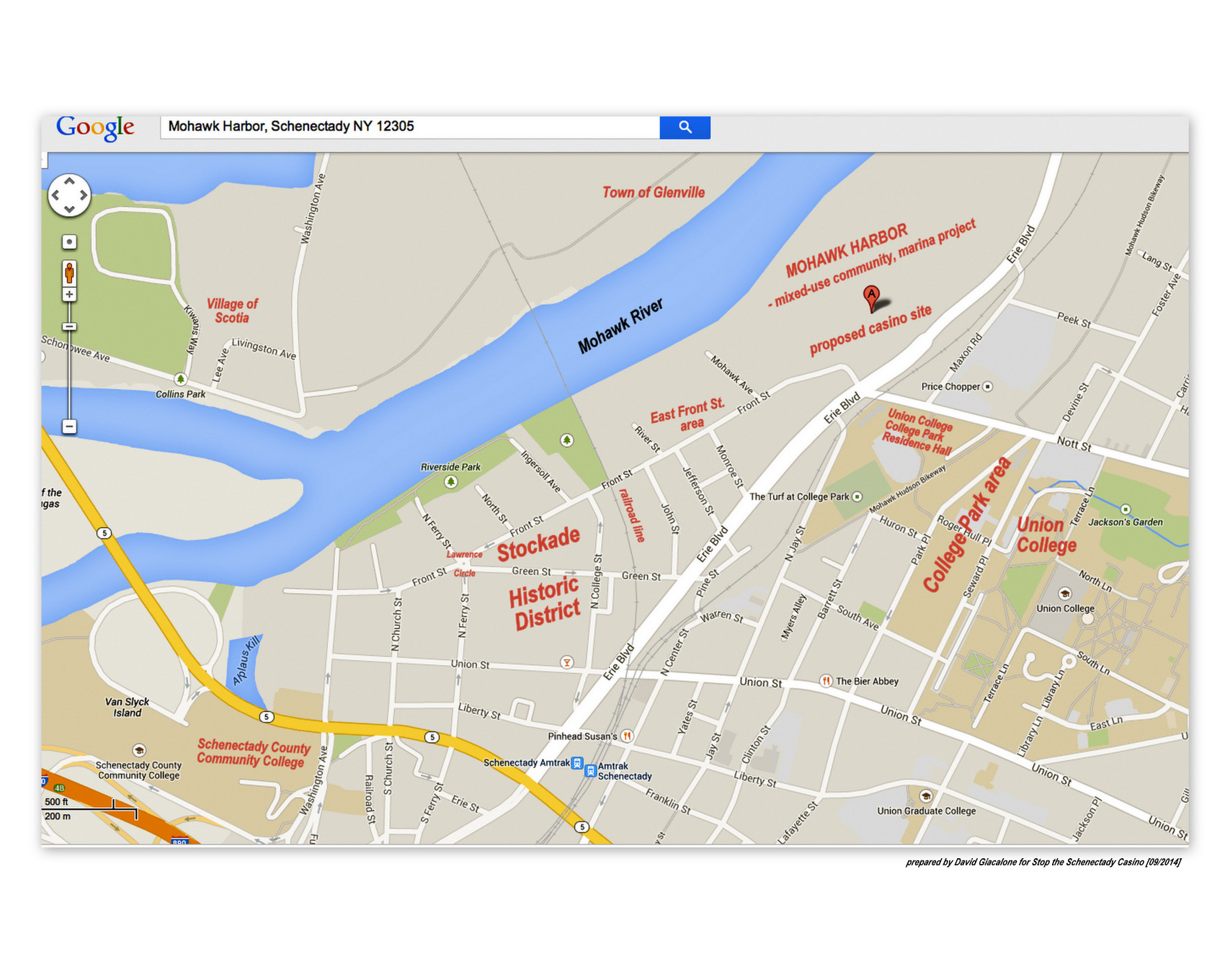
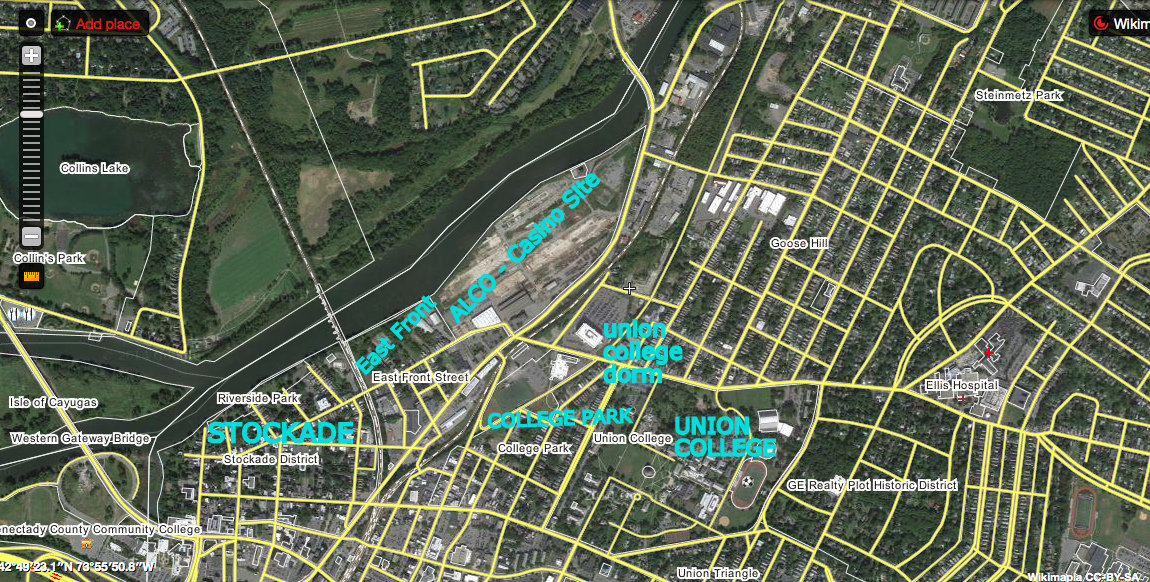
  •  #1: a Map of the Vicinity  . Casino-VicinityMapE
  •  #2: Jean Zegger’s one-page history of our Unique Stockade
  •  #3 & #4: two collages showing the beauty and community spirit of the Stockade Neighborhood:

StockadeFlagCollage . . . Casino-LawrenceCollage

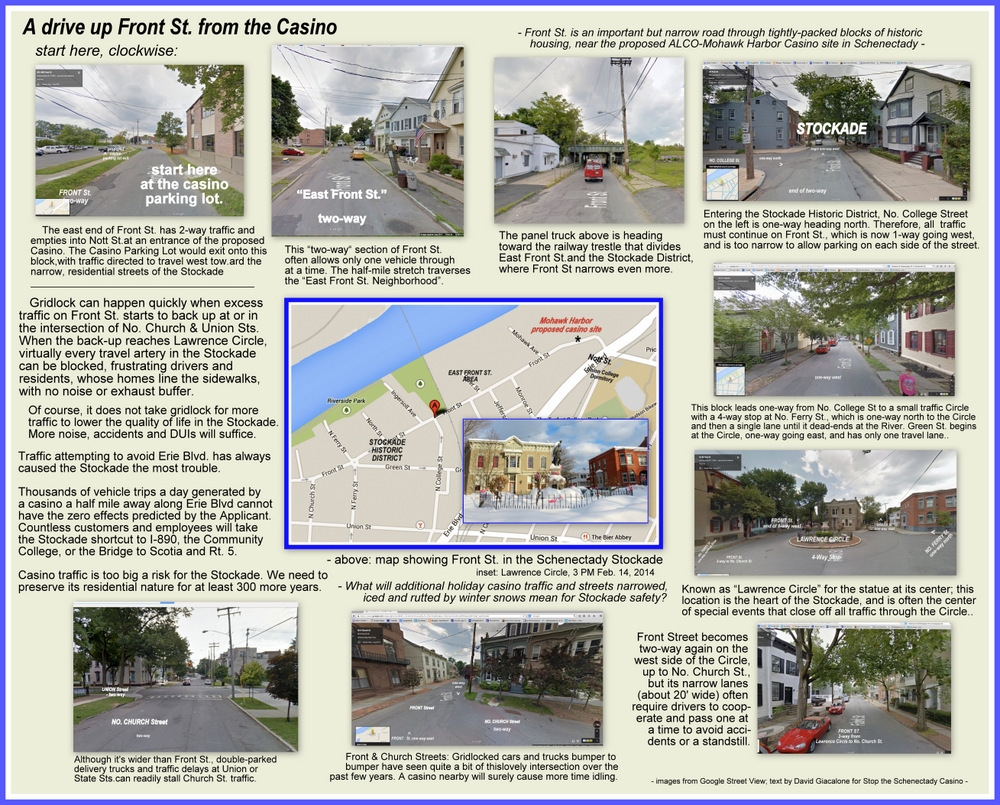
  • #5: the Applicant’s Traffic Access Plan targeting Front Street, in the heart of the Stockade ..
    • Casino-AccessDetail

.. #6:

casino-dormCollage . . . a collage showing just how close a Union College dorm is to the casino (i.e., about a block away)

  • #7: Rev. Baron’s Show of Hands . . . .
  • casino-SchdyCo.VoteNov2013BW  #8: a spread sheet showing the Schenectady County Election Results on Proposition One

. . #9 & #10: statements from our religious community condemning the process used by the Schenectady City Council and opposing the casino

  •  FrontStDriveCollage .  . . #11: a trip down Front Street showing the threat of traffic gridlock and other problems caused by casino traffic

. . #12: a sample of our Petition Opposing the Casino, which we are submitting today with 363 signatures, 125 of them by people living in the Stockade Historic District (more people than were members of the Stockade Association over the past year).


dontforgettack  Capital Region Casino public hearing – “Public Comment Event”
WHEN: 8 a.m. to 8 p.m. Monday
WHERE: Holiday Inn, Stonehenge Room A & D, 205 Wolf Road, Colonie
IN-PERSON: Seating is first-come, first-served. Pre-registered speakers should arrive 15 minutes before scheduled time to check-in. Walk-in speakers can register on-site on a first-come, first-served basis.

ONLINE: The full hearing will be streamed live and archived on the Gaming Commission’s website at www.gaming.ny.gov.

Written comments : May be submitted at the event or by email to CapitalRegion@gaming.ny.gov up to seven days after the hearing (September 29, 2014), to be part of the hearing record.  NOTE: Comments received after Sept. 29 will also be considered by the Board as part of its RFA review process.

it’s time to write to the Location Board

– click for a one-page handout with the information below –

updated October 1, 2014:

If you have not done so already, we urge you to let the NYS Gaming Facility Location Board know that you are opposed to having a casino in Schenectady. As part of its casino application review process, the Board will consider all comments, no matter when they are received. Because the Board may make its decision by the end of October, comments should be sent as soon as possible.

Email and Letters can be sent to Gail P. Thorpe: Email address: info@gaming.ny.gov

USPS address: NYS Gaming Commission, Contracts Office, One Broadway Center, Schenectady, NY 12301-7500.

   We believe that the promised benefits claimed for the casino are exaggerated and uncertain, and may be of short duration, as more and more casinos are constructed. Any benefits are clearly outweighed by the negative results that are likely to occur in our community. Moreover, basing the Government’s fiscal policy on casino revenues is inappropriate, as it will unfairly take money from the poor and most vulnerable, and their families.

In addition, Schenectady is not so desperate for development that it should gamble with a casino strategy for economic growth. For years, our leaders have taken credit for revitalizing the City, with many new jobs and businesses, and over $830 million in investment since 2004. Moreover, the Galesi Group says it will develop Mohawk Harbor, and remediate the brownfields, with or without a casino — an investment of $200 million, the biggest in the City’s history. Our proud reputation for manufacturing and technology should not be cashed in for the image of a small-time casino town.

Here are some of reasons that members of Stop the Schenectady Casino have for our opposition to having a casino operated at Mohawk Harbor (the old ALCO plant site) by Rush Street Gambling:

  • Injury to local businesses due to the casino taking a large portion of dollars consumers in this area would spend on leisure and entertainment, with most visitors coming from less than 50 miles, causing business bankruptcies, staff reductions, closings. The amenities at the casino will keep day-trippers on the casino lot, not out spreading their wealth across the community.
  • An increase in crime, such as drug sales, prostitution, purse-snatching, DUI, car theft and break-ins, especially near the casino, plus domestic violence; and embezzlement, fraud and financial crimes;
  • More problem gambling, and gambling by the elderly and the very poor, with a casino close-by and open 24/7, bringing much stress and injury to families as well as the entire community.
  • A serious threat to the Stockade Neighborhood’s residential nature, despite its legal protection as a historic district, with more crime and traffic, due to having a casino only a few blocks away.
  • Danger for Young Gamblers, with the Union College campus within half of a mile, and its biggest dorm one block away. Studies show that younger gamblers are more vulnerable to becoming problem gamblers, especially if they drink heavily, have easy access to a casino, and have friends who gamble. Rush Street Gambling’s experience marketing to potential young gamblers makes the location particularly worrisome.

For more information, discussion, photos, links to reference material, and more, browse this website.

TWC-Siena poll finds ambivalence

images-8 The Time Warner Cable News/Siena College poll that came out yesterday surveyed people from all three regions of the State where applicants are seeking casino licenses that are expected to be awarded this autumn.  See “Exclusive TWC News/Siena Poll Shows Ambivalent Attitude Toward Casinos” (July 28, 2014) Ambivalence is probably the right word, with the public showing an optimistic outlook on revenues and jobs that will be produced by casinos, but agreeing strongly with the statements:

  1. “We already have enough outlets for gambling in New York, we really don’t need new casinos.” [Capital Region results: 56% agree; 40% disagree] and,
  2. “New Casinos will only increase societal problems such as crime and compulsive gambling.” [Capital Region results: 60% agree; 38% disagree]

TWC’s coverage gives figures for the three areas combined, as well as tables showing the results for the various questions, broken down by regions, political parties, political leanings, religion, ages, and income.   At the Times Union, you can find a focus on the Capital Region results. “Poll: Voters divided on Capital Region casino development” (TU Capitol Confidential, by Matthew Hamilton, July 29, 2014)

newspaper update (July 30, 2014): In Part II of TWC-Siena casino poll, “19 percent of those surveyed would gamble more if they lived near a casino. A combined 64 percent said they would likely or very likely attend a concert. More than half said they would go out to dinner at a casino’s restaurant.”  In addition “26 percent overall said they expected either themselves or a member of their household to apply for a job at one of the resorts.”  In its coverage of the poll, the Times Union notes today that in the Capital Region 63 percent say they’re not likely to visit a regional casino.”

did crime go up near the SugarHouse Casino?

SugarHouseEntryway

Philadelphia’s SugarHouse Casino

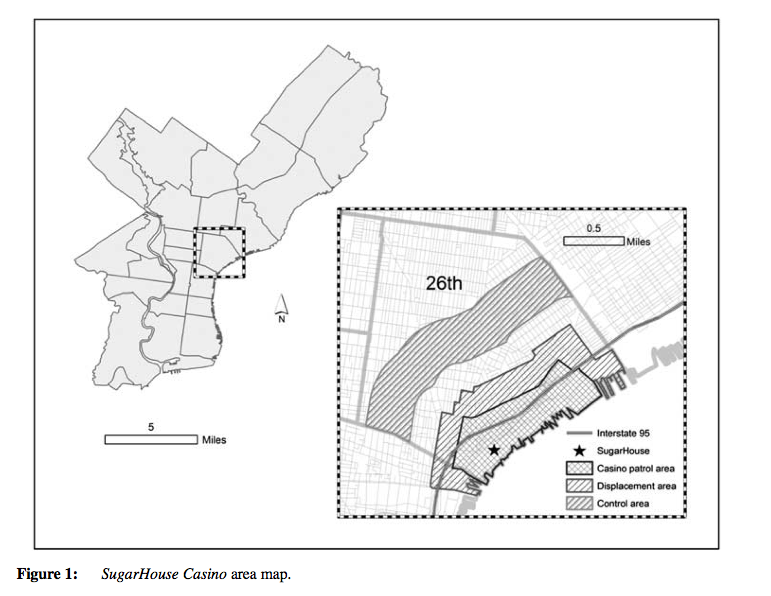
Prior to the 2010 opening of the SugarHouse Casino in Philadelphia, community groups warned that the casino would lead to an increase in neighborhood crime.  However, according to a news release posted on July 16th by Drexel University, a new study by two Philadelphia researchers “reveals that these concerns were unfounded.” Nonetheless, before you let down your guard or breathe a sigh of relief, please read on.

That claim is based on this conclusion in the study (emphases added):

In summary, there is no evidence that the opening and operation of the casino had a significantly detrimental effect on the immediate neighborhood in terms of vehicle crime, drug activity, residential burglary or violent street felonies.  

The SugarHouse crime study is entitled “A Partial Test of the Impact of a Casino on Neighborhood Crime;” it was conducted by by Lallen T. Johnson, PhD, an assistant professor of criminal justice in Drexel University’s College of Arts and Sciences, and Jerry H. Ratcliffe, PhD, a professor and chair of the Department of Criminal Justice at Temple University; and was published online on by Palgrave MacMillan’s Security Journal.  For coverage in the popular press, see “Study says crime has not risen around SugarHouse Casino” (Philadelphia Inquirer, by Vernon Clark, July 19, 2014); “No Crime Increase Around SugarHouse: Study (NBC10 Philadelphia, July 19, 2014). And see, “The Elusive link between casinos and crime(Pacific-Standard Magazine: The Science of Society, by Lauren Kirchner, July 29, 2014), which ignores the many weaknesses of the study.

 You can safely bet that we are going to hear about this study here in Schenectady, because SugarHouse is operated by Rush Street Gaming and owned by SugarHouse HSP Gaming, LP, which is primarily controlled by Neil Bluhm and his family. (see Pa. Gaming Board ownership listing, at 13-15).  Rush Street Gaming and Bluhm are, of course, the applicants seeking to build a casino in Schenectady.  We are, of course, opponents who have raised concerns over increased crime in the nearby neighborhood.

As indicated above, Johnson and Ratcliffe looked at four categories of crime: violent street felonies, vehicle crime (both theft of vehicles and break-ins), drug crime, and residential burglary in the surrounding community.  [They did not look at DUI or prostitution, two crimes on the short list of worries in the vicinity of an urban casino.]  Their data covered 80 months prior to the opening of the casino and 16 months after the opening.  The authors hoped their work would help answer a perennial question among crime scientists:

sleuth Has the casino’s presence led to increased crime in the immediate area and if not, has crime been simply displaced to nearby locations?

Prior studies have looked at crime statistics at a city or county level. Here, the authors used “geolocated crime data” to examine changes in crime volume in the immediate neighborhood of the casino since its opening; that “casino patrol area” covered an area one-half mile square.  They also looked at crime data for a “displacement area” just outside the “casino patrol area” to see whether the casino or related security and policing had positive or negative effects on that nearby area. (see Figure 1) The displacement area was about the same size as the casino patrol area.

Note: using the same distances as those in the study, one half-mile square, the Stockade District’s southeastern border would fall at the line between the casino patrol area and the displacement area, placing virtually the entire Stockade neighborhood within that potential displacement zone. See Map at the foot of this posting.  Union College’s campus and its College Park off-campus housing complex are also within the endangered areas.

– Figure 1 from SugarHouse Crime Study: map showing data areas –

SugarHouse Map- Figure 1 from  “A Partial Test of the Impact of a Casino on Neighborhood Crime.”

Ninety-six months of crime incident data were examined to determine the extent to which crime counts changed within the Philadelphia neighborhood of Fishtown after the opening of a new casino.  As stated in the Drexel U. Press Release below, key findings include (emphasis added):

  • Violent street felonies increased at a rate slightly greater than violence in the control area; however, this increase was not statistically significant when examined in the context of the longer trend since 2004.
  • Vehicle crime decreased in the casino area; however, there was substantial displacement and the reductions in vehicle crime were not statistically significant over the long term.
  • Both residential burglary and drug crime decreased in the casino area (again though, not significantly from a statistical perspective) and there were reductions in these crimes in the buffer areas.

Reading that set of Key Findings does not leave me quite as sure as the headlines suggest that we can stop being concerned about more neighborhood crime if Schenectady gets a casino.  Living in the Stockade District, which is in the “displacement zone” of the proposed Schenectady casino, it is difficult to ignore the large increase in vehicle-related crimes. The authors say the increase was not significant “over the long term,” which clearly suggests that it was significant in the short-term, where we actually reside, stroll the neighborhood, buy insurance, watch house price trends, etc.

The authors also say (at 14), regarding “displacement” to the nearby neighborhood:

“The displacement findings are interesting. In anticipation of the casino opening, the 26th Police District commander created the special patrol district, to which were assigned additional police officers. The increased police attention in the special patrol area may have led to the displacement of vehicle crime to the surrounding area. Officers that were re-assigned to the patrol area were not replaced in the rest of the district. It is possible that the relative reduction in personnel outside of the casino area reduced patrol deterrence in the displacement area, while suppressing crime in the target area.”

In their conclusion, Johnson and Ratcliffe modestly state the obvious:

“Findings here do not settle the debate on casino and crime linkages, but contribute to a growing body of knowledge and suggest a need for more neighborhood level research. At the least, findings demonstrate that oft-stated community concerns regarding local crime conditions with the addition of a casino to a neighborhood were not borne out by the SugarHouse Casino example.

Reason for Concern?  Yes. For one thing, some types of crime out of the four categories studied did go up.  The study states:

  • graphup “Violent street felonies increased in the target area compared with the control area.” [for examples, see “SugarHouse attacks concern casino neighbors” (CBS News10, David Change, Nov. 13, 2010); “Philadelphia casino winner robbed of $13,000“, New York Daily News, May 18, 2015); And,
  • “Vehicle crime decreased in the target area relative to the control area; however, there was substantial displacement indicating that the introduction of the casino made the vehicle crime problem in the combined treatment/buffer area worse than before the casino was opened.”

Beyond those worrisome increases, the failure to include DUI and prostitution is quite significant.  We expect a major increase in vehicles cutting through the Stockade, with drivers who have been drinking for hours, or weary employees and interns, using its narrow, dark streets as a way to avoid scrutiny on the well-lit Erie Boulevard, or simply to take the shorter route to SCCC or the bridge to Scotia and destinations heading west on Route 5.  And, we believe the Stockade’s shadowy streets and available apartments are ready-made for the expected increase in prostitution once the casino starts operation.

Furthermore, we need to ask whether the experience in a city 20 times larger than Schenectady can tell us much about what would happen here.  That issue, in all its facets, needs quite a bit of thought.

More important from a practical point of view, however, is the fact that Johnson and Ratcliffe admit their findings/conclusions are, “Net of unexamined police patrol changes and casino opening simultaneity effects.”  I have nothing useful to add on the issue of the “opening simultaneity effects,” but it appears that the “unexamined police patrol changes” may indeed be significant.  Thus, the very last sentence of the study states (emphasis added):

“Any potential significant crime increases either did not occur, or were effectively controlled by a reassignment of existing local police resources.”

That small word “or” raises big questions.   Here’s how the authors describe the police patrol changes that occurred in September 2010:

red check “When the casino opened in September 2010, the 26th Police District created a special casino patrol area. This area of slightly less than half a square mile (shown in Figure 1) is patrolled by one sergeant and 13 officers who provide coverage 24 hours a day, 7 days a week.”

It seems to this layperson, that 14 additional officers covering an area one-half mile square in shifts that take time of day and other conditions into account, might indeed have a significant deterrent effect.  In addition, the Casino itself is required by the Gaming Commission to have at least 3 uniformed security men at the door, and has as many as 7 more in the parking lot at  night. Furthermore, the State Police cover the floor of the casino.  As the authors might say, there are a lot of crime managers and guardians on hand in an effort to prevent crime.

Therefore, it appears that we at the very least need to add a big asterisk to those headlines about no increase in crime, and include a footnote with the caveat: “if you’re willing to spend a lot of money on a Police Casino Squad, or to leave other parts of town under-policed.”

GW dollar According to SalaryWiz.com, the medium total compensation package for a patrol officer in Schenectady is $71,965.  When we add the sergeant’s pay to that of his 13 underlings, a 14-officer squad would cost a little over $1 million to replicate in Schenectady.  Would our thrifty City Council pull some of the already scarce night-time patrols from other neighborhoods to keep the Casino Patrol Area adequately staffed?

 Such considerations turn this disclaimer by the authors into a major understatement:

“First, we should note that this is not a stand-alone quasi-experimental evaluation of the introduction of a casino to a neighborhood, due to the additional complication of the Philadelphia Police Department instigating a dedicated patrol to the neighborhood. The additional patrolling from 14 assigned officers may have acted to provide additional deterrence to any criminal activity.”

Johnson & Ratcliffe then say they cannot test in this study “Whether this is sufficient additional patrol for an area to have any impact.”   Most of us would hazard a guess that the patrol is indeed a significant deterrent with a meaningful impact on the crime rates.  And, in the Schenectady context, we would strongly disagree with the authors’ cavalier conclusion “that any additional resources were modest at best.”

So, we’ll be leaving our Crime Will Increase listing up on the Issues Page.  And, we’ll wonder, as we did all Spring, why only Councilman Vincent Riggi thought the City needed to do an analysis of the additional expenses it would be likely to incur if we had a casino operating at the old ALCO site.

CasinoFreePhila I’m going to let our readers answer the headline question at the top of this posting for themselves.

share this post with this short URL: http://tinyurl.com/PhillyCasinoCrime

.

WikiMap-SchdyCasinoNeighborhood

wikimapia map of the Casino-East Front-Stockade neighborhood; click on the image for a larger versioin –

the unpromising future of casino gambling

update: Cuomo on Declining Revenues (July 16, 2014)  Gov. Andrew Cuomo, when asked by reporters yesterday his reaction to predictions of reduced casino revenues due to oversaturation in the Northeast gaming market, responded (in “Cuomo: Size of NY casino play depends on investorsCapital New York, July 15, 2014) :

abacus “The private market, which reads Moody’s, which does this for a living, which is going to invest their money, will make a determination as to what scale and scope the market can support. And they will then build the buildings and employ people and run the business because they think it’s a good business to run.”

The Governor went on to say, “I’m sure they will propose what they believe will be successful.” Cuomo apparently was not concerned, as he told the reporters, “The state isn’t building any casinos. The state isn’t spending any money here, right? These are private companies which normally know what they’re doing.”

The questions for the Governor came at a conference in Niskayuna, where he was announcing the creation of a $500 million power electronics consortium led by General Electric in Albany that would give companies a a place to research and develop important new technologies. The State would pay $135 million to build the infrastructure for the consortium.  If he wasn’t asked at the press conference, we’d like to ask the Governor:

  1. checkedboxs Shouldn’t the Gaming Facility Location Board pause its review of casino applications and ask the applicants to reassess the “scale and scope the market can support” and to adjust their proposals, in light of the experts’ downward predictions? And,
  2. Why take a risk with the financial, fiscal and social problems caused by gaming, when Upstate development can be based on future-oriented, productive industries such as the technology represented by the Power Electronics Consortium?

[original posting]

plungegraphsmY There’s been a flood of recent articles and information pointing to the increasing unlikelihood of any casino fulfilling the glowing promises of revenues and resulting tax reductions and jobs made by its boosters.  For example, since we wrote “psst: the casino cash cow has too many calves” on June 21st, we’ve seen:

  • Moody’s downgrades U.S. gaming industry“, TU Capitol Confidential (July 1, 2014, by Benjamin Oreskes”)    Moody’s report notes a “strong indication that U.S. consumers will continue to limit their spending to items more essential than gaming, even as the U.S. economy continues to improve.”
  • Wait on casino licenses” (Albany Times Union editorial, July 6, 2014).  Here’s part of their discussion:

“These pessimistic prognostications merely underscore what is already known in New York. A lot of people will have to spend a lot of money at the new casinos if they are to deliver what those who pushed the state constitutional amendment had promised: job growth, increased school aid and lower property taxes. Developers of the proposed gaming resort for Schenectady, for example, predict attendance there would be around 7,500 on weekdays and 10,000 on weekend days. It’s hard not to be skeptical.

plungegraphsmBlack “The problems in other states suggest that the long-term success of New York’s planned casinos is dubious. And when casinos fail, all you have left is unemployment, empty buildings that can’t pay taxes and calls for a government bailout to rescue a struggling industry.”

  • Trump Plaza Casino In Atlantic City Expected To Close, Owners Say” (Huffington Post/AP, July 12, 2014):  “Atlantic City’s crumbling casino market disintegrated even further Saturday as the owners of the Trump Plaza casino said they expect to shut down in mid-September. . .  . If Trump Plaza closes, Atlantic City could lose a third of its casinos and a quarter of its casino workforce in less than nine months.”
  • Gambling on Casinos in New York” (New York Times editorial, July 13, 2014): “A five-member state board appointed by Gov. Andrew Cuomo is supposed to choose four sites and the companies that can build on them by this fall. This seems much too hurried. As Moody’s is warning, it is time to beware of all the promotional hoopla and realize that casino gambling does not always deliver on its promise.”
  • Fred LeBrun: “Minds once lost can be found again” (Albany Times Union, July 12, 2014): “We plunge ahead without so much as a nod from our leading politicians that wagering on casinos as an economic development tool may be a sucker’s bet and that just maybe we ought to take a harder look at ‘none of the above’ for the time being, whether there’s now a constitutional amendment in place allowing casinos or not.

    . . . “But not a peep. It’s a credit to how much can be bought in New York state for the $11 million the gaming industry spent in lobbying the same top pols.

    plungegraphsmMatte

    “It’s predictably annoying that our State Gaming Commission continues to take a strong stand in defense of the gambling crowd. It’s become the industry’s prime booster. . . .

    “What’s bothersome about the boosterism is that the Gaming Commission is also by statute the regulator of all gambling in New York. Its pronouncements show bias, which is at the very least inappropriate, unwise and not a confidence builder for the commission’s broader and thornier mandate to do what’s best, gambling-wise, for all New Yorkers even if that could ultimately mean saying no to everybody.”

    – each of the above articles is worth reading in full –

threemonkeys So, what are the unflinching boosters of the Schenectady casino thinking these days?  Mr. Mayor Gary McCarthy?  Madame Council President King? Stockade Association President Mary D’Alessandro?  The Trustees and Acting President of Schenectady County Community College?  The Me-too City Council members: Mootoveren, Kosiur, Perazzo? The Council’s self-appointed “financial analyst” Carl Erickson? Philip Morris, CEO of Proctors (and chief instigator and negotiator for what we like to call the FairGame Concert Cartel)?

How big of a gamble are the casino cheerleaders willing to take?  How do they weigh the self-interested promises of Galesi Group and Rush Street Gaming against the prospect of the probable increase in crime, problem gambling, and domestic violence, and a decrease in property values and the livability of the Stockade neighborhood?   Are they willing to accept the soul-deadening tradeoff of adopting a soak-the-poor fiscal policy, and the growth of problem gambling among our elderly and our college students, in the hope of obtaining increasingly uncertain future payments from the Casino, which they hope will appease the City’s taxpayers?  Does the shiny future they predict for Schenectady include the sight of a failing casino project along Schenectady’s riverfront and the inevitable request for tax breaks and financial assistance that we can expect once gaming revenues shrink along the Mohawk?

smallquestionmark Perhaps the most important question is: Do any of the so-called leaders mentioned above have the courage to stand up and ask the Gaming Facility Location Board to reject the Schenectady casino proposal, or at least to put off granting any license for the Capital Region, until it is much more certain that the jobs and revenue projections are realistic, given the tidal wave of negative predictions about the industry’s prospects?

Don’t forget: the Location Board has the power to reject all of the applications if none of them appears to meet the goals and requirements set up in the enabling statute and the Request for Applications.

As is stated in Section IV. A of the Request for Applications to Develop or Operate a Gaming Facility in New York State [Adobe pdf. version] [“RFA”] (at page 19):

In accordance with PML Section 1314.3, “Within any development region, if the commission is not convinced that there is an applicant that has met the eligibility criteria or the board finds that no applicant has provided substantial evidence that its proposal will provide value to the region in which the gaming facility is proposed to be located, no gaming facility license shall be awarded in that region.”

And, See RFA Sec. III  [at 17]

M. State’s Reserved Authority.

In addition to any authority set forth elsewhere in this RFA, the Board reserves the authority to:

3. Amend the RFA and direct Applicants to submit modifications to their Applications accordingly;

5. Reject any or all Applications received in response to this RGA, and reissue a modified version of this RFA;

6.  Withdraw the RFA at any time, at the sole discretion of the Board.

– share this post with this short URL: tinyurl.com/unpromisingCasinos

10 of 17 casino applicants accept FairGame’s terms

 The Albany Times Union reported this afternoon that: “The Upstate Theater Coalition for a Fairgame” said Tuesday that it has reached agreements with 10 of the 17 casino applicants seeking casino licenses in the three upstate regions eligible for commercial gambling halls.” (“Entertainment coalition nets majority of casino bidders“, Capitol Confidential Blog, by James M. Odato, July 1, 2014). The three Capital Region applicants that have partnered with “FairGame” are Schenectady’s Rush Street Gaming, the Hard Rock Café in Rensselaer, and the Howe Caverns Casino.

According to TU’s Capitol Confidential, Philip Morris, CEO of Proctors and chairman of Fairgame, said:

“While we were not able to come to accord with a number of other applicants, the agreements we have reached are significant. They clearly declare the size and scope of casino entertainment plans; they have joint booking agreements that will guarantee access for the casinos and for Fairgame members to touring performers; they support the Fairgame Fund for those same facilities; and they establish arts granting programs for smaller organizations in every region. Finally, should the plans the casinos propose be significantly changed, each applicant has agreed to mitigate those impacts with additional support.”

SlicingThePie By also reaching agreement with seven applicants in the two other Upstate regions that are eligible for casino licenses, the “FairGame” Coalition (a/k/a The Concert Cartel) may end up achieving joint booking and venue-size limitations, and a revenue-sharing agreement with each of the 3 or 4 winning casinos.  That could mean the equivalent of territorial exclusivity, and joint booking and ticket pricing, for all/each of FairGame members, across all of the eastern portion of Upstate New York, through midState locations such as Utica and Syracuse, and apparently stretching to their members in the Western end of the State.

Will the members of the FairGame Coalition be allowed to try to leverage the protection that the State meant to give local and regional entertainment venues from local casinos into a vast network of competition-killing promises among themselves and between each entertainment center and far-spread casinos covering several large regions, and perhaps all of Upstate New York?

NYg My “State Action” Analysis: To survive antitrust scrutiny, the FairGame group would need to justify such clearly anticompetitive joint action with a “state action” defense: the claim that their action is immunized from the antitrust laws because of the actions and policy of the State where the conduct takes place.  However, just last year, in its FTC v. Phoebe Putney Health Sys. Inc. (No. 11-1160, 2013) opinion, the U.S. Supreme Court reiterated that state-action immunity is a disfavored exception that will get careful examination before being accepted. The Phoebe Putney Court further stressed that to successfully invoke state-action immunity, state laws should be explicit in their intent to displace competition.  In addition, although the issue was not reached in Phoebe Putnam, prior cases have required that the state must “actively supervise” the conduct that would otherwise be deemed anticompetitive where — as here — the actors are private parties rather than governmental entities.

The FairGame Coalition may be able to show that New York State wanted to limit the competition that entertainment venues would normally face from a nearby casino, when it passed The Upstate New York Gaming Economic Development Act of 2013.  But they cannot show that the State wanted to greatly reduce competition among the major art and entertainment centers themselves, or even between the arts venues and casinos that would not normally be considered part of their local entertainment market.  The Act merely requires that the Siting Board evaluate whether the applicant has established:

“a fair and reasonable partnership with live entertainment venues that may be impacted by a gaming facility under which the gaming facility actively supports the mission and the operation of the impacted entertainment venues.” [§1320(3)(2)(D)]

As of COB today, I have not received any sort of reply from the State Attorney General’s office on the antitrust Complaint that I submitted last Friday. See our June 28th posting “arts venues want more than a fair game“.

– share this posting with this short URL: http://tinyurl.com/TenOfSeventeen

follow-up (March 8, 2017): An article in today’s Schenectady Daily Gazette, “Rivers Casino, Proctors team up for entertainment: ‘In no way, shape or form do I feel like we’re competitors” (by Brett Samuels, A1, March 8, 2017), suggests that my fears expressed above and in a prior post were warranted. See “a wicked concert cartel?” (March 8, 2017).

casinos bring property values down

  Common sense suggests that living close to a casino will drive down your property values. The tentative conclusions made by the National Association of Realtors Research arm in “Economic Impact of Casinos on Home Prices Literature Survey and Issue Analysis” strongly confirm that assumption.  The paper analyzed information from across the nation, but was done with a focus on the proposed downtown casino in Springfield, Massachusetts.   In addition to looking at the effects on residential realty prices, the Survey presents numerous other factors that could cause negative or positive externalities for a specific casino.

As for home prices, the Survey concludes that “The impact on home values appears to be unambiguously negative. ”  It continues [at 2-3]:

“We estimate that assessed home values will most likely be negatively impacted by $64 to $128 million from the introduction of a casino into Springfield, although there are many variables that could shift the price impact to be either more or less severe. In addition, pathological gambling could result in social costs of $8.4 million per year, possibly significantly higher. Additional foreclosures could produce costs of $5 million per year. Finally, there would probably be a negative impact on local retail businesses as local consumer expenditures were diverted to some degree to casino gaming, and a need for additional government expenditures to provide needed public services (police, fire, medical, etc.).”

SlicingThePie Another factor emphasized in the Survey is distances between casinos. “Casinos that are close to each other tend to split the available business, reducing profitability.”  Thus, “In the case of Springfield Massachusetts a significant level of sustained patronage as a destination casino appears unlikely given the saturation of gaming venues in the New England and New York region.”

A casino in Schenectady would, of course, also face the saturation problem, and would be in direct competition with one located in downtown Springfield, which is about 100 miles away.

will a casino bring more crime?

Crime statistics about casinos are tricky and it is difficult to make broad statements about casinos and crime, because casinos are located in such diverse places and there are relatively few casinos in cities.  Nonetheless, it seems rather clear that urban casinos can expect an increase in certain kinds of crime, especially near the casino and along major arterial roads leading to it.  The potential is too great, we believe, for any nearby neighborhood to merely accept the risk and “wait and see”.  Once a casino complex is built, any increase in crime or perception of increased jeopardy on its streets will mean a reduction in the quality of life (and property values) for those living in its immediate vicinity.

SugarHouseEntryway follow-up: SugarHouse in Philadelphia: see our posting “did crime go up near the SugarHouse Casino?“, which discusses a study that some say demonstrates there was no significant increase in crime in the neighborhood of the SugarHouse Casino in Philadelphia, which is operated by Rush Street Gaming.  Our analysis suggests, to the contrary, that those who live near a proposed urban casino should continue to be quite worried. And see, (Aug. 4, 2014).  .

.

The New York State Task Force on Casino Gambling – Report to the Governor (August 30, 1996), was thorough in its research, looking at existing studies and doing some of its own.  The Task Force Report was in favor of having upstate NY casinos, and found that “Casino gambling was accompanied by few significant or recurring crimes problems.” [217]  However, it distinguished between rural and urban locations, noting that the more rural a location, the less the probability of a significant increase in crime. “By contrast, the towns on the main routes to Atlantic City experienced spillover crime, which rose with proximity to the city.” [a t219] More generally, the Report continues:

  • “casinos in urban areas should be concerned with the potential for prostitution, panhandling, pick-pocketing and purse snatching. Urban casinos would be adversely affected by an unsafe urban environment, so that more resources would have to be devoted to maintain order and protect citizens from street crime.” [at 219]
  • “The frequency of theft, other property crime, and traffic-related offenses is likely to increase in and around a casino, with the extent of the increase largely dependent upon the opportunities presented by the location, historical crime patterns, and the daily visitor population.”

JailBird Furthermore, there were three notable exceptions to their finding that “Any growth in economically motivated crime is usually not accompanied by an upsurge in violent offenses in casino locales.” [at 218] Thus, “Researchers found greater increases in violent crime in localities most accessible to Atlantic City than in other communities in the region. Gulfport, Mississippi statistics show major increases in assaults (all levels), robberies and arson. And, while crime statistics are not available, Tunica County, Mississippi has experienced substantial increases in felony indictments and lower court filings since riverboat casinos began operating in 1992.”

Note: Atlantic City has a population of about 40,000 and Gulfport about 70,000, quite comparable in size to Schenectady’s 60,000.

The Report notes that the enormous increase in crime in Atlantic City from 1977-1980 (violent up 130%, non-violent up 176%), has been “misinterpreted”. The number of crimes may have gone up a lot, the Report says, but the increase in the number of persons in the City means “the risk of individualized victimization appears to have fallen slightly according to visitor-adjusted crime.”  I am not sure that is particularly re-assuring, especially to those who live or work near a casino, where the visitors are concentrated.

The Report adds that: “in sum, every factor that might affect opportunities for crime should be considered in casino planning.  The size of the facilities and overnight accommodations, hours of operation, types of games, age eligibility of patrons, availability of alcohol, and possible stake limits may affect the degree to which a casino causes crime in the community. The goal must be crime control.” [219]

NoloSharkS Problem Gambling and Crime: Another conclusion in the Task Force Report is: “With the advent of legalized casino gambling, pathological gamblers will likely commit additional income-generating crimes, though their prevalence and rate of criminal activity cannot be projected.” Thus, “Research indicates that there is a relationship between pathological gambling and economically motivated, non-violent offenses. Larceny, embezzlement, check forgery, loan fraud and tax evasion are thought to be the most common. . . . [I]f the number of compulsive gamblers grows with expanded availability and more convenient access to casino gambling, a corresponding increase in offending can be expected.”

Another study of interest is “The Effects of Casino Gambling on Crime”  (B. Stitt, D. Giacopassi, M. Nichols 1998), which was funded by a U.S. Justice Department grant and did a statistical analysis of 7 jurisdictions with fairly new casinos, comparing before and after crime stats.  It looked at both the official population of a city and the “at risk” population when visitors are added in.   Stitt et al concluded that there was a statistically significant increase in DUI, larceny/burglary, and family offenses in locations that established casinos in the 1990s. [at 16]  For me, the increase in family offenses is particularly telling, as it shows how the negative effects of gambling losses reach into the family of gamblers, as money for housing, food, clothing and children’s needs is spent at the casino.