
Lauren Stanforth has written a piece of investigatory journalism for the Albany Times Union, published yesterday at the top of the Sunday front page, on the dramatic shortfall of casino revenues from projections. See “State, local promises before casino vote a bust” (December 17, 2017). It points out that only the Schenectady City Council put actual projection numbers in a resolution, with a stated expectation of $5.7 million in annual tax gaming tax revenues for the City, and an 18% property tax reduction.
.
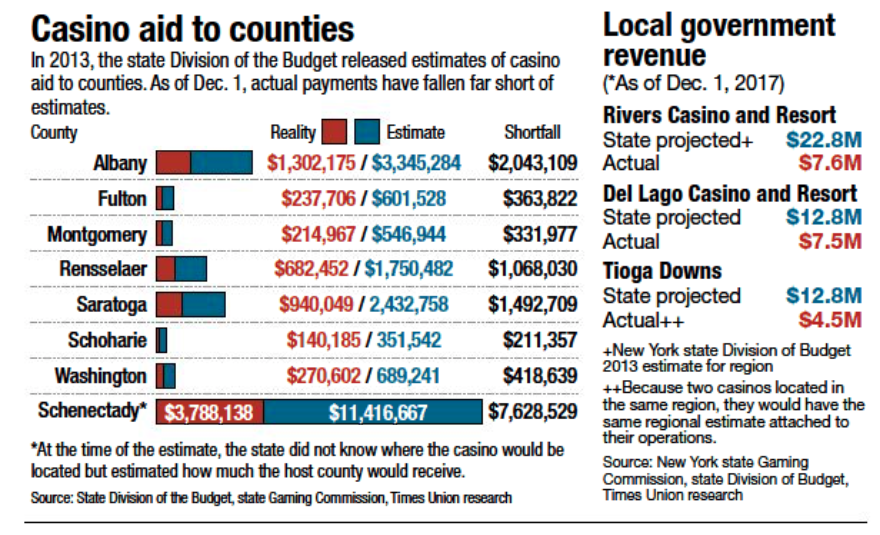 The City Council used NYS Dept. of Budget numbers for Regions, Counties, and Host Communities that were produced in 2013, announced in a press release (Oct. 2, 2013), to garner support for the Governor’s Constitutional Amendment Proposition, to permit non-Indian casinos. The numbers were, therefore, ginned up when the State did not know how many casinos there might actually be, nor where they would be located.
.
The Resolution stated, in part [emphases added]:
.
WHEREAS, as Host Municipality, the City of Schenectady is entitled to receive 5% of the gaming taxes paid by the Gaming Facility which is projected by the NYS Division of the Budget to be $5.7 million dollars annually; and.WHEREAS, a $5.7 million Host Municipality payment to the City of Schenectady would result in a reduction in real estate taxes of approximately 18%; . . ..NOW, THEREFORE, BE ITRESOLVED, that the Host Municipality payment received by the City of Schenectady will be used exclusively for the reduction of real property taxes in the City of Schenectady.
.
- At the time, we said at this website [in “Council ploy: all casino revenues will be used to reduce property taxes“, June 9, 2014] that “Th[e] Resolution is clearly meant to back the possible No Votes [on support for the Schenectady casino application] into a corner, by daring them to vote ‘no’ on a ‘tax reduction’.” In that context, using specific and huge numbers that appeared to come with the imprimatur of the State Budget office clearly strengthened the Mayor’s demand for Yes votes and the support in the very tax-conscious community for the casino. The Mayor was not able to convince Marion Porterfield and Vince Riggi to vote for the Casino application, but they did agree that any tax revenues from the casino should be used to bring down real property taxes in Schenectady.
 At no time did City Council or the Mayor explain the tenuous connection between the DOB projections and an actual casino located in Schenectady, as opposed to a municipality with a greater potential to attract the public.

.
The TU article notes that the State’s 2013 projections estimated that the Host County in the Capital Region would receive about $11.4 million dollars annually (with the Host City getting half of that amount), but that the actual numbers for this year appear to be about $3.7 million, a shortfall of $7.6 million. It also stresses, regarding the Schenectady Casino situation:
.
“A casino was expected to bring in so much revenue — and the local government share to go along with it — that Schenectady would reduce property taxes 18 percent in the first year. Now, 10 months after the opening of Rivers Casino and Resort, the city is reducing taxes 1 percent..“Schenectady County predicted a similar scenario, its legislature passing a resolution three years ago saying county taxes might be reduced 8 percent if a casino opened. County officials are now reducing taxes 1 percent.”.
Reporter Stanforth interviewed local politicians, and informed us:
.
Schenectady officials say their tax reduction promises were not disingenuous because they based their statements on the Budget Division’s numbers — and that property taxes are still being reduced..But those who argued against a casino say the disparity between what was promised and the current reality reinforces their concerns that local officials had no intention of looking critically at information provided by the state or casino operators themselves.
.“They did it in bad faith,” said Schenectady resident David Giacalone, who lives in the city’s historic Stockade neighborhood and was one of the most vocal critics opposing a casino. “They knew these numbers meant nothing.”.


Catskills casino coming in 2018
County Legislature Chair Gary Hughes pointed out that the NYS Gaming Commission believes casino revenues will grow in coming years, but he added, “Is it someday going to be $5.7 million? I have my doubts.” I wonder if Mr. Hughes has considered, as the TU stated, that “revenue from the Resorts World Catskills [casino in Monticello] will likely top Rivers, as it will have almost twice as many slot machines and an 18-story hotel when it opens in March, as well as a golf course opening in 2019″. Indeed, about a billion dollars will be invested in the Catskills casino project, yielding a location that will actually look like a tourist destination.
.
Perhaps City Council President Leeza Perazzo is giving up her hopes of being Mayor. She was remarkably frank with the reporter:
.
Schenectady City Council President Democrat Leesa Perazzo, who voted to support a casino, said the city included the revenue number in its June 2014 vote because the state provided it..The resolution also said that the host municipality payment, “will be used exclusively for the reduction of real property taxes.” However, city officials have already used casino revenue in settling fire and police contracts..Perazzo said a resolution is not a law, so city officials are not bound by the tax reduction promises made in it. [emphasis added]
Sadly, our City Hall has given us a Social Studies and Political Science lesson for the ages here in Schenectady. I wonder if this TU article has given the Gazette any ideas about doing a little casino-related investigation of its own. Perhaps a spotlight on the Applicants’ projection of 2.8 million visitors coming annually to Schenectady because of Rivers Casino needs a bit of investigation. More significantly, perhaps looking into the ways the Planning Commission and Board of Zoning Appeals have twisted (diminished? castrated?) our Zoning Code to please the Galesi Group and Rush Street Gaming might be more important in the long run.
.





 snowmen at the gates