render unto Caesars

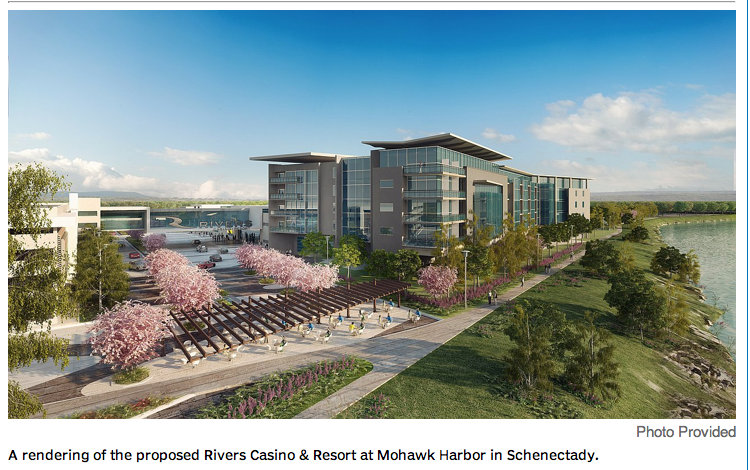
update/correction (July 12, 2014): The large building pictured in the “rendering” found in both the Gazette and Times Union yesterday, which they labelled at the time as the Rivers Casino & Resort at Mohawk Harbor (see below), is not the casino portion of the project.  It is, instead, the proposed hotel that will be built along with the casino. That’s good, in my opinion, as it looks more like a hospital or assisted living facility (which might have, at least, served one of the casino’s main target demographics).

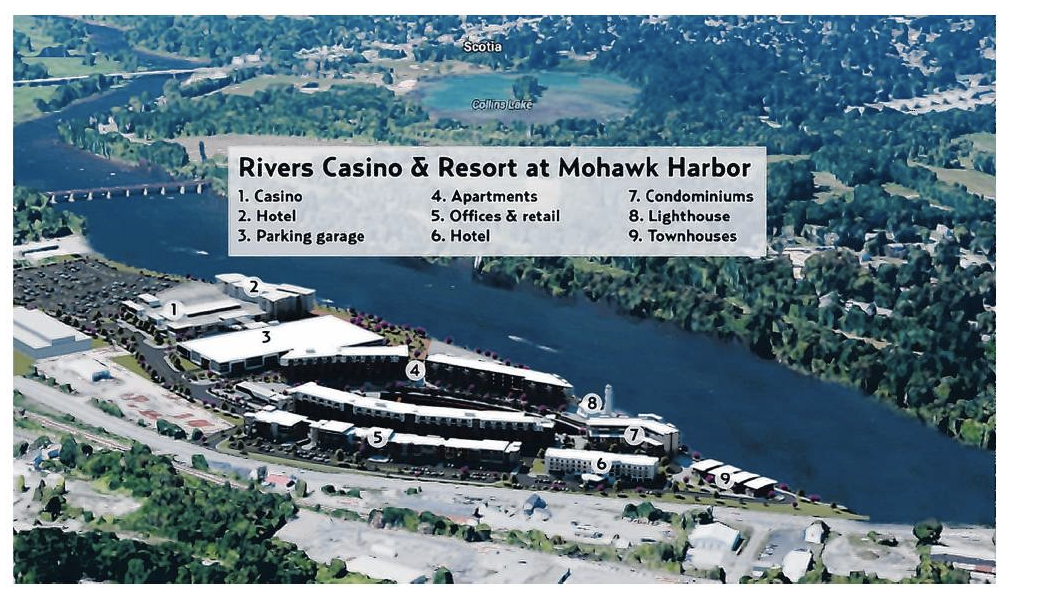
Here is a rendering showing a broader view of the entire project (click on it for a larger version):

Casino-ProjectRendering

Rendering of Casino proposed Schenectady Casino, Hotel, Parking Garage

– detail: #1 is the poorly-illustrated casino itself –

According to an article in Saturday’s Gazette (“Schenectady casino vision unveiled
Project’s hotel would overlook Mohawk“, by Haley Viccaro, C1, July 12, 2014):

“As shown in the rendering, the hotel would overlook the river, with the single-story casino behind it. An enclosed walkway would be built to connect an indoor parking garage to the hotel and casino.”

By the way, click Rivers Casino & Resort at Mohawk Harbor to see their remarkably uninformative website.  They do let you “stay in the loop” by signing up for email updates.  (You do have to give the your Full Name.)

[original posting, July 11, 2014:]

What does a world-class destination casino look like these days? With no editorial comment, I present a rendering of the Rivers Casino & Resort at Mohawk Harbor that was unveiled this afternoon:

SchdyCasinoRendering

Feel free to leave your (frank, but polite) impressions of the building design in a comment [Note: as discussed in the Update/Correction at the top of this posting, this image is actually the hotel portion of the casino project.]

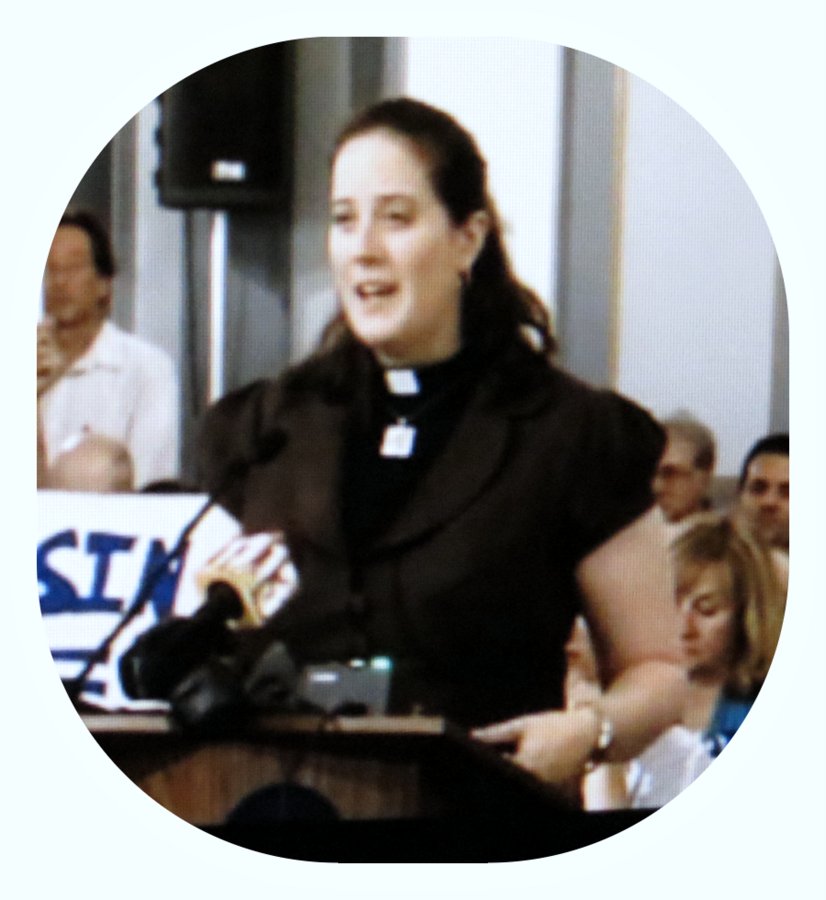
Rev. Baron’s excellent questions

SBaron9Jun2014

Rev. Sara Baron

Over the past weekend, I went to Open Stage Media’s Video on Demand page to find the video of the June 9th Meeting of the Schenectady City Council.  That was, of course, the meeting where over 80 people signed up to use the Privilege of the Floor for a chance to tell the Council (in three minutes or less) what they thought about Item #4 on its Legislative Agenda: the resolution to approve of the application for a casino in Schenectady.   I had heard so much about the presentation of  Rev. Sara Baron, pastor of The First United Methodist Church Schenectady, that I wanted to see it for myself. [Although present for the Council Meeting, I was out in the hallway getting quite a few anti-casino signatures, as well as some water and fresher air, at the time Rev. Baron was at the podium, so I missed her.]

https://i0.wp.com/blogs.law.harvard.edu/ethicalesq/files/2008/05/under07.jpg The new fans Sara Baron made that night were right. Her words — and especially a number of questions that she asked those in attendance — were important and telling.  You see, those of us against the casino were unpleasantly surprised to discover that long before the Meeting was to start at 7 P.M., folks with big “Yes!” stickers on their chests and toting coordinated blue signs had filled more than half the seats.  Given the brawny size of many of the men squeezed into the pews, it looked like the local construction unions and contractors had gotten out the rank and file.  And, the long, parade-like line of fresh young faces that also arrived early seemed to be SCCC and cosmetology students.

 Since it is no secret that the men representing the casino applicants were not Schenectadians, we naturally wondered just how many of those in the impressively large “Casino Yes” crowd actually came from Schenectady.

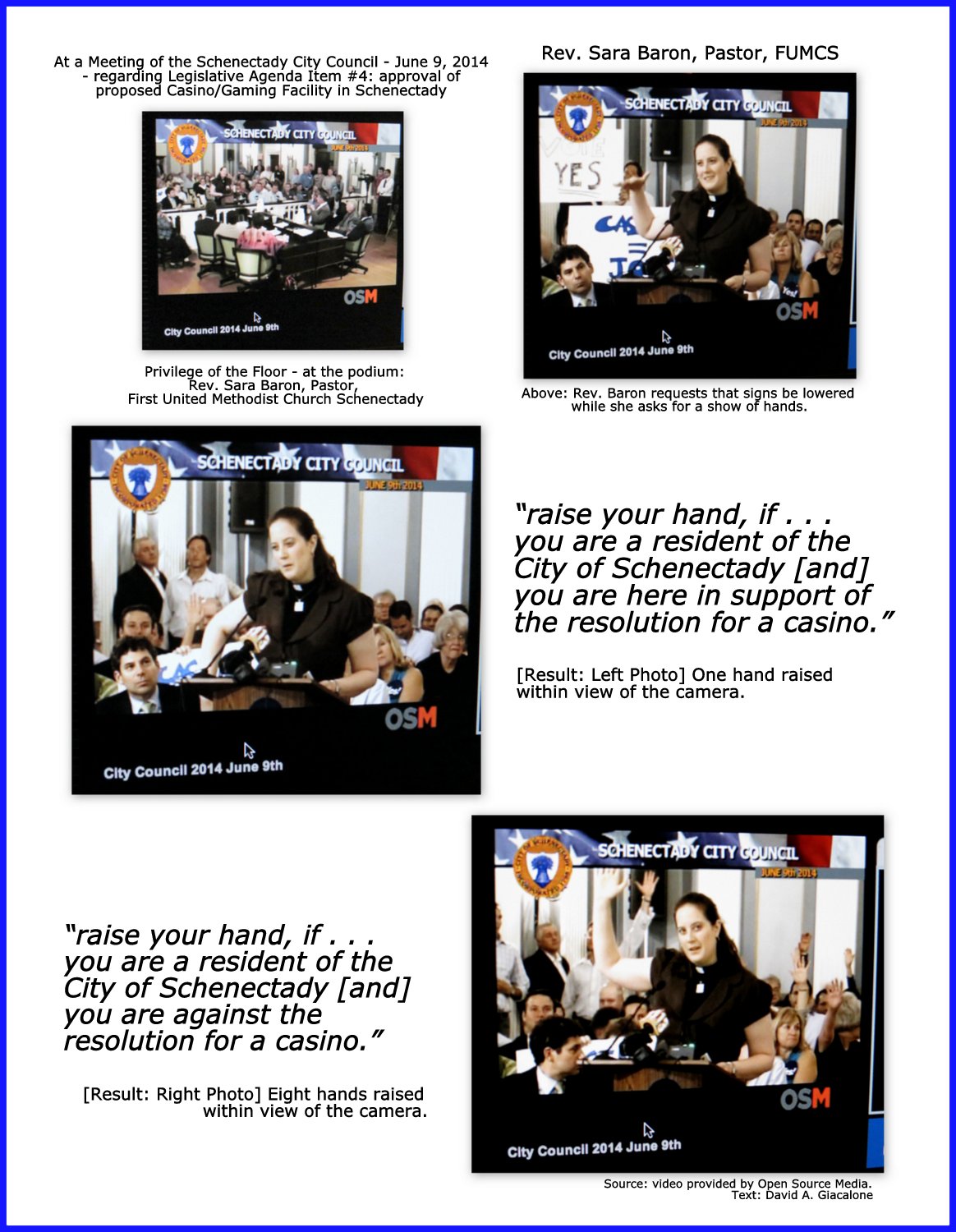
Rev. Baron’s questions helped give us the answer.  In the following collage you can see two of her “show of hands” questions and their answers (click on the image for a larger version), as she attempts to find out how many of those for and against the casino live in Schenectady:

above: within view of the Open State Media, 8 casino opponents indicate they live in Schenectady, but only one casino supporter – Rev. Baron’s 3-minute statement to the Council begins 104 minutes into the June 9, 2014 video –

As you can see from the top left photo of the collage, the Open Stage Media camera was not able to show the entire audience section of the Council Chambers when it focused on the podium.  I wish it had, because the video fails to show the sea of construction workers and other casino supporters whose hands stayed down when asked if they lived in Schenectady.  Nonetheless, the slice of the audience shown is, I believe, representative of the full assemblage.

  • images-5 Here’s how Mike Hendricks, Editor-in-chief of Albany Business Review, described Rev. Baron’s presentation, in a Viewpoint column called “Computer chips or poker chips” (June 16, 2014):

“The room was filled mostly with people waving blue “Yes” signs. But when Sara Baron, the pastor of the First Schenectady Methodist Church, had her turn to speak she asked everyone to put their signs down. With her back to the crowd she asked a series of questions of the audience. Were they here to discuss the casino? Did they support the casino? Her last question asked for those opposed to the casino, and who were residents of the city, to raise their hands. For all the people waving “Yes” signs and speaking in favor of the casino, the sentiment in the room among those who actually live in the city was anti-casino.

“The Rev. Baron then asked the council to table the motion to provide more time to get a sense for community sentiment. Then she laughed and said she was too realistic and knew they wouldn’t delay the vote.

“That moment highlighted some of the divisions the Cuomo’s casino issue creates.”

In the column, Hendricks also writes about a tour he had of the GlobalFoundries computer chip plant in Saratoga County, where he was amazed.  He then moves into the poker chip portion of the piece, where he notes that “While his father gave northern New York a prison economy, this Cuomo is pushing casinos as job creators upstate.” And, “While the chip plant was a local initiative, the casinos are coming from the top down. Cuomo decided”.

It is perhaps no surprise that a far larger portion of the people against the casino were Schenectady residents than were those supporting the casino.  Of course, it’s not  inappropriate for those hoping to receive jobs during either the construction stage or the operating stage of the casino, or those hoping to get rich(er) from the casino, to voice their support.  But, it is important to keep in mind that the appearance of a significant majority in Schenectady supporting the casino based on the audience at the Council Meeting is as misleading as the appearance of there being a true majority on the Council itself fully supporting the application based on their 5-2 vote that evening.  In both cases, individuals took the position their “boss” wanted them to take, or the position that seemed to be dictated by the promised gold to be found in future casino treasure chests.

threemonkeys NIMBY v. PITY.   As with many of the biggest and most powerful proponents of casinos in Massachusetts (see the NIMBY page at Repeal the Casino Deal), it is a lot easier to support a Schenectady casino when it is not in your own backyard.  With a project as socially toxic as a casino, NIMBYism is both natural and healthy.  Unfortunately, the hypocritical version of NIMBYism that I call PITYism — Put It in Their Yard — might be “natural” for those who hope to gain financially from a casino, but it is unhealthy for the community as a whole. I have to wonder how the construction workers and SCCC students would feel about having a casino in Schenectady, if they lived here and did not expect to get a casino-related job.

 After watching the portion of the Meeting video just prior to Rev. Baron’s presentation, I’d like to make two further points:

1. dice One gentleman casino supporter (from Rotterdam) voiced his amazement that the “nay-sayers” could oppose a project that would turn what has been a brownfield eyesore into a beautiful casino facility.   That is, of course, a false choice.  He could not possibly mean that anything is better than the ALCO brownfield.  More to the point, we know that the Galesi Group had planned to go forward with its $150 million Mohawk Harbor Marina project before there was any notion of a casino taking up the rest of the ALCO land.  See this Albany Business Review article from Nov. 6, 2013, and “Galesi Group unveils $150M-plus ‘Mohawk Harbor’ in Schenectady” (Albany Business Journal, April 3, 2014).  Savvy Mssrs. Galesi and Buicko would not spend $150 million on a hotel, condos, etc., and leave the rest of the ALCO eyesore next door.  Removing any old factory remnants and planting a nice lawn would be the least we’d expect for that brownfield.

In addition, the same gentleman had an ironic slip of the tongue.  He quoted our currency and Tony Danza for the phrase “e pluribus union.”, saying it meant “we are all one.” Given that crowd on June 9, “we are all union” might not have been far off.  (Of course, “e pluribus unum” means “from the many one”, referring to the many states becoming one nation.)  He stated the hope that, all being one, even the naysayers will come and gamble at the casino once it is built.  How open-minded.

2.  A young woman supporting the casino identified herself as an SCCC student, saying having the casino would fulfill her dream of working in the gaming industry without leaving Schenectady.  Whatever we might think of that dream, it seems that East Greenbush, or Rensselaer, or even Howe’s Cavern would make a comfortable commute from Schenectady, allowing her to work in her chosen field without bringing the problems of an urban casino to her beloved Schenectady.

She ended her comments to the Council by saying that we should not be concerned about people gambling too much, as every individual must take responsibility for his or her own choices.   Yes, we do have to take responsibility for our choices and actions, but we also should be concerned not merely for the effects of gambling addiction and debt on the gambler, but also on his or her children and family.  Furthermore, if problem gamblers with easy access to a Schenectady casino multiply in Schenectady or the County, our whole community will voluntarily or not end up being responsible for feeding and sheltering many families, and protecting many victims of domestic violence.

10 of 17 casino applicants accept FairGame’s terms

 The Albany Times Union reported this afternoon that: “The Upstate Theater Coalition for a Fairgame” said Tuesday that it has reached agreements with 10 of the 17 casino applicants seeking casino licenses in the three upstate regions eligible for commercial gambling halls.” (“Entertainment coalition nets majority of casino bidders“, Capitol Confidential Blog, by James M. Odato, July 1, 2014). The three Capital Region applicants that have partnered with “FairGame” are Schenectady’s Rush Street Gaming, the Hard Rock Café in Rensselaer, and the Howe Caverns Casino.

According to TU’s Capitol Confidential, Philip Morris, CEO of Proctors and chairman of Fairgame, said:

“While we were not able to come to accord with a number of other applicants, the agreements we have reached are significant. They clearly declare the size and scope of casino entertainment plans; they have joint booking agreements that will guarantee access for the casinos and for Fairgame members to touring performers; they support the Fairgame Fund for those same facilities; and they establish arts granting programs for smaller organizations in every region. Finally, should the plans the casinos propose be significantly changed, each applicant has agreed to mitigate those impacts with additional support.”

SlicingThePie By also reaching agreement with seven applicants in the two other Upstate regions that are eligible for casino licenses, the “FairGame” Coalition (a/k/a The Concert Cartel) may end up achieving joint booking and venue-size limitations, and a revenue-sharing agreement with each of the 3 or 4 winning casinos.  That could mean the equivalent of territorial exclusivity, and joint booking and ticket pricing, for all/each of FairGame members, across all of the eastern portion of Upstate New York, through midState locations such as Utica and Syracuse, and apparently stretching to their members in the Western end of the State.

Will the members of the FairGame Coalition be allowed to try to leverage the protection that the State meant to give local and regional entertainment venues from local casinos into a vast network of competition-killing promises among themselves and between each entertainment center and far-spread casinos covering several large regions, and perhaps all of Upstate New York?

NYg My “State Action” Analysis: To survive antitrust scrutiny, the FairGame group would need to justify such clearly anticompetitive joint action with a “state action” defense: the claim that their action is immunized from the antitrust laws because of the actions and policy of the State where the conduct takes place.  However, just last year, in its FTC v. Phoebe Putney Health Sys. Inc. (No. 11-1160, 2013) opinion, the U.S. Supreme Court reiterated that state-action immunity is a disfavored exception that will get careful examination before being accepted. The Phoebe Putney Court further stressed that to successfully invoke state-action immunity, state laws should be explicit in their intent to displace competition.  In addition, although the issue was not reached in Phoebe Putnam, prior cases have required that the state must “actively supervise” the conduct that would otherwise be deemed anticompetitive where — as here — the actors are private parties rather than governmental entities.

The FairGame Coalition may be able to show that New York State wanted to limit the competition that entertainment venues would normally face from a nearby casino, when it passed The Upstate New York Gaming Economic Development Act of 2013.  But they cannot show that the State wanted to greatly reduce competition among the major art and entertainment centers themselves, or even between the arts venues and casinos that would not normally be considered part of their local entertainment market.  The Act merely requires that the Siting Board evaluate whether the applicant has established:

“a fair and reasonable partnership with live entertainment venues that may be impacted by a gaming facility under which the gaming facility actively supports the mission and the operation of the impacted entertainment venues.” [§1320(3)(2)(D)]

As of COB today, I have not received any sort of reply from the State Attorney General’s office on the antitrust Complaint that I submitted last Friday. See our June 28th posting “arts venues want more than a fair game“.

– share this posting with this short URL: http://tinyurl.com/TenOfSeventeen

follow-up (March 8, 2017): An article in today’s Schenectady Daily Gazette, “Rivers Casino, Proctors team up for entertainment: ‘In no way, shape or form do I feel like we’re competitors” (by Brett Samuels, A1, March 8, 2017), suggests that my fears expressed above and in a prior post were warranted. See “a wicked concert cartel?” (March 8, 2017).

arts venues want more than a fair game

SlicingThePie It’s been twenty-five years since I practiced antitrust law at the Federal Trade Commission in Washington, D.C.  But, it’s still a good bet that when a bunch of major competitors get together and start throwing the word “fair” around, they are hoping to limit competitive pressure on themselves by placing restrictions on market forces that are helping to give consumers more choices and lower prices.  It seems to me that is what is happening with the Fair Game campaign that the UpState Theater Coalition for a Fair Game has turned into “joint negotiations” with casino owners.

follow-up (March 8, 2017): An article in today’s Schenectady Daily Gazette, “Rivers Casino, Proctors team up for entertainment: ‘In no way, shape or form do I feel like we’re competitors” (by Brett Samuels, A1, March 8, 2017), suggests that my fears expressed below and in a subsequent post were warranted. See “a wicked concert cartel?” (March 8, 2017).

It was one thing — and probably a useful thing — for the major arts venues across Upstate New York to lobby the legislature and the Gaming Commission last year. They were successful inserting into the casino application process the requirement that applicants take into account the needs of local arts and entertainment venues, and attempt to enter into partnerships that would help assure the casino does not take away so much business or garner so many big acts that they cause grievous injury to important local entertainment venues.  It is quite another for the Fair Game folks to morph into a joint negotiation team with a long litany of restrictions and financial obligations they hope to impose on all casino operators.  They are now using the tight deadlines of the application process as a club to strengthen their powers of “persuasion”.

trustbuster Teddy Roosevelt

trust-buster

Antitrust law frowns on the use of collective action or coercion by competitors to impose their will on others and to keep the group of competitors marching to a single beat.  That’s why I wrote yesterday to the N.Y. State Attorney General asking that the Antitrust Bureau look into the lawfulness of the activities of the Fair Game group, which includes 13 major arts venues located across Upstate New York, including the five major theaters and entertainment centers in the Capital Region (Proctor’s in Schenectady, whose CEO Philip Morris is chairing the group.; SPAC and Saratoga City Center; and the Palace and Times Union Center in Albany), plus organizations in nearby Bethel, Kingston, Binghampton and Utica.

If Schenectady is saddled with a casino and its operators have greatly limited their ability to compete with the biggest arts venues, the average resident of our City and County will lose (at least) twice: saddled both with the casino and with fewer choices and higher prices likely at Proctor’s and at the other large entertainment centers in Albany, Saratoga, the Region and beyond.  Here is the explanation that I wrote on June 27 in my Complaint to the Attorney General (slightly edited for clarity):

   Fair Game is taking advantage of the Casino Siting process, which includes criteria concerning the formation of partnerships with affected local entertainment venues.  Fair Game is using collective action among the largest theater venues in the State to pressure casino applicants — who are major potential competitors with such entertainment venues — into accepting a stringent, uniform set of restrictions and financial obligations in order to demonstrate Local Support in the Application process.  That pressure is greatly magnified by the very tight and imminent deadlines for all Applicants. 

    As seen in news articles such as the one that appeared in today’s Schenectady Gazette, Fair Game members not only seek to eliminate competition with casinos for top talent and productions, but also have agreed among themselves to a formula for dividing the revenues received from casinos. See Coalition asking for a piece of casinos’ actionby Haley Viccaro (June 27, 2014, at A6; see also “Coalition, casinos yet to sign deals”, at A1)

     This appears to go far beyond any possible State Action defense under legislation establishing the casino licensing process for restricting competition among themselves and with casinos.  The major entertainment venues are encouraged under the Act to enter into partnerships with “local casinos”, they are not given the freedom to eliminate competition among themselves, nor to prevent competition from all casinos within a large (seemingly unlimited) region.

    For example, in explaining the concept of Partnerships with Live Entertainment Venues, the Request for Applications for Gaming Facilities [RFA] seeks “copies of any and all contracts, agreements, MOUs or other understandings with live entertainment venues that may be impacted by the Gaming Facility.” (at 60). Also, in their applications, each applicant must include, in Ex. IX.B.2, copies of “agreements with impacted entertainment venues” and any declined agreements.  (RFA at 74-75)  One omnibus agreement with a coalition of venues is clearly not anticipated (nor, separate agreements which merely take collective terms and apply them in a separate contract with each venue).

    At its website, Fair Game brags about its “collective impact” in ticket receipts, jobs created, moneys invested, etc.  Major theaters such as Proctors and SPAC and the Times Union Center already have ticket prices for major acts and productions that are far out of reach of large percentages of residents of our region.   By acting jointly, they are likely to increase their ability to raise prices, not only by eliminating future competition from casinos, but also competition within the siting application process with eachother to form advantageous partnerships with local casinos.  (The ability of the East Greenbush applicant to achieve agreements separately with local venues shows that a joint bargaining team of theaters is not needed.)

    The partnerships envisioned under The Upstate New York Gaming Economic Development Act (Chapters 174 and 175 of the Laws of 2013), appear to favor the largest theaters, further disadvantaging the small and “mom-and-pop” venues and businesses that are likely to see the disposable income of many customers spent instead at a local casino.

    For the past couple of weeks, Philip Morris has gone public with his pressure for applicants to accept the collective terms of the Fair Game members.  Clearly, Fair Game hopes to use the looming June 30 application deadline to pressure-coerce casinos to sign onto their scheme.   I hope the Attorney General will make some sort of statement today cautioning Fair Game from attempting to wield such undue coercive power.

  Thank you for considering this last-minute appeal for action.

 Jim Odato covered my AG Complaint yesterday at the Times Union” at the Capital Confidential weblog, Anti-casino lawyer complains to AG about arts groups and antitrust(Capitol Confidential, June 27, 2014), and a related TU article.  The article ends:

“Morris said he would await word from Schneiderman before commenting, although he said he did not get legal advice before pursuing the agreements with casino teams on behalf of his coalition of entertainment entities.”

The Gazette carried an article by Haley Viccaro this morning, “Schenectady casino foe says Fair Game pact would be illegal” (June 28, 2014, C3).

NYg update: State Action: See our posting  “10 of 17 casino applicants accept Fair Game’s-terms“, reacting to “Entertainment coalition nets majority of casino bidders“, The Times Union Capitol Confidential Blog, by James M. Odato, July 1, 2014. The posting contains an analysis of the application of the State Action Doctrine to the actions of the FairGame coalition: that is, whether any action by the State or the Racing Commission has given the Coalition immunity from the charge that their collective negotiation violates the antitrust laws.

Even if Fair Game does not hammer out agreements with the casinos before submission of their complete applications on Monday, June 30, the groups may continue in July to pressure casinos who want to strengthen their demonstration of support by the local arts and entertainment venues.   An admonition or cautionary statement from the Attorney General might lessen that pressure.

Yesterday afternoon, I also sent the following email message to a Gaming Commission spokesman. It concerns a Statement made in October 2013 about Fair Game that some may suggest blesses the collective negotiations by the theater group:

Continue reading

psst: the casino cash cow has too many calves

toomanycalves

too many calves!

 An article in the Wall Street Journal this week revealed the Big Secret that everyone who’s done a little research, or just reads a newspaper regularly, already knows:  The great expansion of casinos in the Northeast over the past decade is “causing upheaval in the region.”  “Casino boom pinches northeastern states” (Wall Street Journal, June 19, 2014)  Indeed:

“States that adopted gambling earlier than their neighbors, such as Delaware, New Jersey and West Virginia, are watching dollars drain away, and new projects have some wondering how many facilities the area can support. Twenty-six casinos have opened since 2004, fueling a 39% increase in total annual gambling revenue in the mid-Atlantic and New England, according to a study by the University of Nevada, Las Vegas. Within 100 miles of Philadelphia, there now are 24 casinos, a big shift from the early 1990s, when Atlantic City, N.J., enjoyed an East Coast monopoly. At least a dozen more gambling spots are in the pipeline from Massachusetts to Maryland, raising fears in states such as Rhode Island that their casino tax windfall is at risk.

In reaction to the resulting dwindling of revenues:

  • Delaware casinos are asking the State for a $20 million tax break. “Delaware’s proposed tax relief for casinos, which needs legislative approval, would lower the table-game tax rate, eliminate fees and shift vendor costs to the state.”
  • “Delaware officials say declining gambling money—down 29% since fiscal 2011—is one reason the state cut 538 public jobs over the past five years.”
  • Public services have been reduced, in places like Ocean County, N.J., “because of a dip in casino revenues that fund programs for the elderly and disabled.”
  • Connecticut has forecast a 5% decline in state revenue from casinos in fiscal 2016 and a 20% drop the following year, and “Rhode Island is projecting it will lose about $422 million in casino revenue over the next five years, contributing to budget struggles.”

threemonkeys Somehow, the Casino Cheerleaders that have steamrolled approval of the Schenectady casino through the City Council and County Legislature seem oblivious to these trends. Maybe Mayor Gary McCarthy or County Planner Ray Gillen have some secret plan that will make Schenectady immune from the forces that have greatly reduced projections of casino revenues and put overly-reliant government budgets at risk.  As the casino cash cow is sucked dry by all those hungry calves, maybe the ALCO pig can fly and Galesi’s Goose really does lay golden eggs.

update (July 1, 2014):  Yesterday, the same day that 16 applicants seeking licenses for 17 UpState casino licenses dropped boxes and flashdrives with their final Applications to the Siting Board, with all their rosy predictions, Moody’s downgraded the outlook for the U.S. gaming industry from “stable” to “negative”.  See “Moody’s downgrades U.S. gaming industry“, TU Capitol Confidential (July 1, 2014, by Benjamin Oreskes”)    Moody’s report notes a “strong indication that U.S. consumers will continue to limit their spending to items more essential than gaming, even as the U.S. economy continues to improve.”

follow-up (July 8, 2014): Noting Atlantic City casinos that have recently declared bankruptcy or closed, along with the Moody’s report discussed above, and the Comptroller’s words of caution (in “DiNapoli: Gaming Revenue Plays Increasing Role In State Budget”  (NYS Comptroller Report, May 2014), the Albany Times Union‘s editorial board said on Sunday that the Siting Board should “Wait on casino licenses” (July 6, 2014).  Here’s part of their discussion:

“These pessimistic prognostications merely underscore what is already known in New York. A lot of people will have to spend a lot of money at the new casinos if they are to deliver what those who pushed the state constitutional amendment had promised: job growth, increased school aid and lower property taxes. Developers of the proposed gaming resort for Schenectady, for example, predict attendance there would be around 7,500 on weekdays and 10,000 on weekend days. It’s hard not to be skeptical.

“The problems in other states suggest that the long-term success of New York’s planned casinos is dubious. And when casinos fail, all you have left is unemployment, empty buildings that can’t pay taxes and calls for a government bailout to rescue a struggling industry.”

For more on this topic, see and our compilation posting, “the unpromising future of casino gambling” (July 14, 2014).


why are Mass. voters saying No to casinos?

 update (June 24, 2014): The highest court of Massachusetts decided today to allow a question seeking repeal of the state’s casino gambling law to go on the November state ballot.  See “Voters to decide fate of Massachusetts casino law“, AP/Boston Herald, June 24, 2014). Observers expect the gaming industry to wage an enormous advertising campaign, probably aided by labor unions, and other corporate groups who benefit from the operation of casinos. The article states: “John Ribeiro, chairman of the group Repeal The Casino Deal, said opponents were prepared for a ‘David versus Goliath’ fight in which they’ll likely be outspent ‘100 to 1,’ as they were in many communities that held local votes on casino proposals.”

 When the Massachusetts Gaming Commission met last week to select a licensee for the first resort-casino in the state, to be located in Western Massachusetts, there was only one casino proposal in contention, and the license granted was “tentative”?

 Do you suppose the casino cheerleaders in Schenectady City Hall and the County Building know why?

  • The MGM-Springfield application was the only remaining proposal in Western Massachusetts, because voters went to the ballot box and rejected all the other applicants.  Only Springfield would gamble on a casino.
  • And, the license can only be tentative, because over 90,000 people signed an initiative petition they hope will be on the statewide ballot on November 5, 2014, which would make the existing 2011 law allowing casinos void.. The courts are deciding whether to allow the initiative on the ballot.  If the Initiative is not allowed on the ballot or is defeated on Nov. 5, MGM’s Springfield license would go into effect.  Observers believe the Repeal the Casino Deal Initiative has a pretty good chance of succeeding, if it is on the ballot. See this Boston.com article.

In town after town, the people of Massachusetts or their elected officials have rejected specific proposed casinos.  And, across the State, tens of thousands of adults want the Casino Deal overturned, because they believe it is a very bad bargain for the people of their Commonwealth.

SmallShark Go to the lively Repeal the Casino Deal website for answers to my questions, and many more, with voluminous Resources, and a NIMBY page of Massachusetts leaders who are pro-casino, but have admitted they would not want to live near one.

casinos bring property values down

  Common sense suggests that living close to a casino will drive down your property values. The tentative conclusions made by the National Association of Realtors Research arm in “Economic Impact of Casinos on Home Prices Literature Survey and Issue Analysis” strongly confirm that assumption.  The paper analyzed information from across the nation, but was done with a focus on the proposed downtown casino in Springfield, Massachusetts.   In addition to looking at the effects on residential realty prices, the Survey presents numerous other factors that could cause negative or positive externalities for a specific casino.

As for home prices, the Survey concludes that “The impact on home values appears to be unambiguously negative. ”  It continues [at 2-3]:

“We estimate that assessed home values will most likely be negatively impacted by $64 to $128 million from the introduction of a casino into Springfield, although there are many variables that could shift the price impact to be either more or less severe. In addition, pathological gambling could result in social costs of $8.4 million per year, possibly significantly higher. Additional foreclosures could produce costs of $5 million per year. Finally, there would probably be a negative impact on local retail businesses as local consumer expenditures were diverted to some degree to casino gaming, and a need for additional government expenditures to provide needed public services (police, fire, medical, etc.).”

SlicingThePie Another factor emphasized in the Survey is distances between casinos. “Casinos that are close to each other tend to split the available business, reducing profitability.”  Thus, “In the case of Springfield Massachusetts a significant level of sustained patronage as a destination casino appears unlikely given the saturation of gaming venues in the New England and New York region.”

A casino in Schenectady would, of course, also face the saturation problem, and would be in direct competition with one located in downtown Springfield, which is about 100 miles away.

the fight is NOT over

   The approval, in a 5 – 2 vote by City Council last Monday, of the proposed casino in Schenectady does not end the fight of those who believe the future of Schenectady would be brighter and healthier without a casino. The NYS Gaming Facility Siting Board must still decide which of the 4 or 5 Applicants left after the June 30 final application filing deadline has the “best” proposal.  In choosing the casino licensee, the Siting Board will give 20% weight to the Local Support or Opposition for the application in the Host municipality and nearby communities.  Opponents now have the opportunity to show and explain their opposition to siting a casino at a particular location.  [update: See my letter to the editor in the Schenectady Gazette (Jun 19, 2014, C7) with a similar theme, “Still time to voice our opposition to casino” pdf.).] We opponents need to show the weakness in support for the Schenectady Casino Application and the solid bases behind their opposition.

follow-up (Aug. 9, 2014):  Despite majorities in their Towns and villages voting No to Proposition One in Nov. 2013, neither the Gazette Letter to the Editor mentioned above, nor email sent to the various town leaders, resulted in local legislative officials coming out in opposition to the casino. Instead, the Applicant’s list of local supporters includes:

  • Christopher Koetzle, Supervisor, Town of Glenville
  • Kris Kastberg, Mayor, Village of Scotia
  • Joe Landry, Supervisor, Town of Niskayuna

Similarly, Rep. Angelo Santabarbara and Rep. Phil Steck sent letters of support.  As did Rev. Bill Levering, Senior Pastor of 1st Reformed Church, in Stockade.

To our knowledge, each letter was sent without any chance for the relevant public (other than the often-interested local businessmen) to voice their opinion on the Schenectady proposal.

checkedboxs In the near future, the Siting Board will issue a statement outlining the procedures for the public to use in submitting materials to the Board. This webpage will supply that information as soon as it is available. Update: see our posting “Location Board schedules presentations and hearings” (Aug. 7, 2014)

   The Request for Applications to Develop or Operate a Gaming Facility in New York State [Adobe pdf. version] [“RFA”] sets out the criteria and procedures used in the selection process.  The following are sections of the RFA relevant to making the case for or against a casino:

[at 7] Initial Requirement of Local Support

“In weighing local support and opposition under this criteria, the Board will consider public statements and declarations, letters or resolutions from the Host Municipality, local governments, private organizations, community, religious and civic groups, charitable organizations entertainment venues, chambers of commerce, local businesses, labor organizations, etc.” (emphases added)

[at 22] Public Hearing

“The Board expects to convene public hearing in each Region to provide the Board with the opportunity to address question and concerns relative to the proposal of an applicant to build a Gaming Facility, including the scope and quality of the gaming area and amenities, the integration of the Gaming Facility into the Host Municipality and nearby municipalities and the extent of required mitigation plans and receive input from members of the public from an impacted community.

 “The Applicants for each Region and their agents and representatives are required to attend the public hearing(s) for that Region, may make a presentation and respond to questions of the Board or public comments as directed by the Board or the Board’s designee. Each Applicant must have at least one individual available who, bed on actual knowledge, is prepared to respond on behalf of the Applicant to such questions or public comments that can reasonably be anticipated in regard to the contents of its Application, including the scope and quality of the proposed gaming area and amenities, the integration of the proposed Gaming Facility into the Host Municipality and nearby municipalities and the extent or  required mitigation plans.”

[at 23] “Representatives of the Host Municipalities, representatives of nearby municipalities and representatives of any impacted live entertainment venue may attend the public hearing, may make presentations and may respond to questions as directed by the Board or the Board’s designee.  Others may attend the public hearing and may make a presentation at the discretion of the Board. Before the hearing, the Board will prescribe the manner in which it will receive comments from members of the public, and may take the opportunity during the hearing to read into the record any letters of support, opposition or concern from members of the public in the vicinity of the proposed Gaming Facility.”

On Friday, June 13, 2013, a staffer at the Racing Commission told me that the Siting Board should be beginning its Public Hearings “within the next couple of weeks.”  If that is true, groups and organization, and especially legislative bodies in nearby Towns and Villages, need to be organizing and preparing their statements.

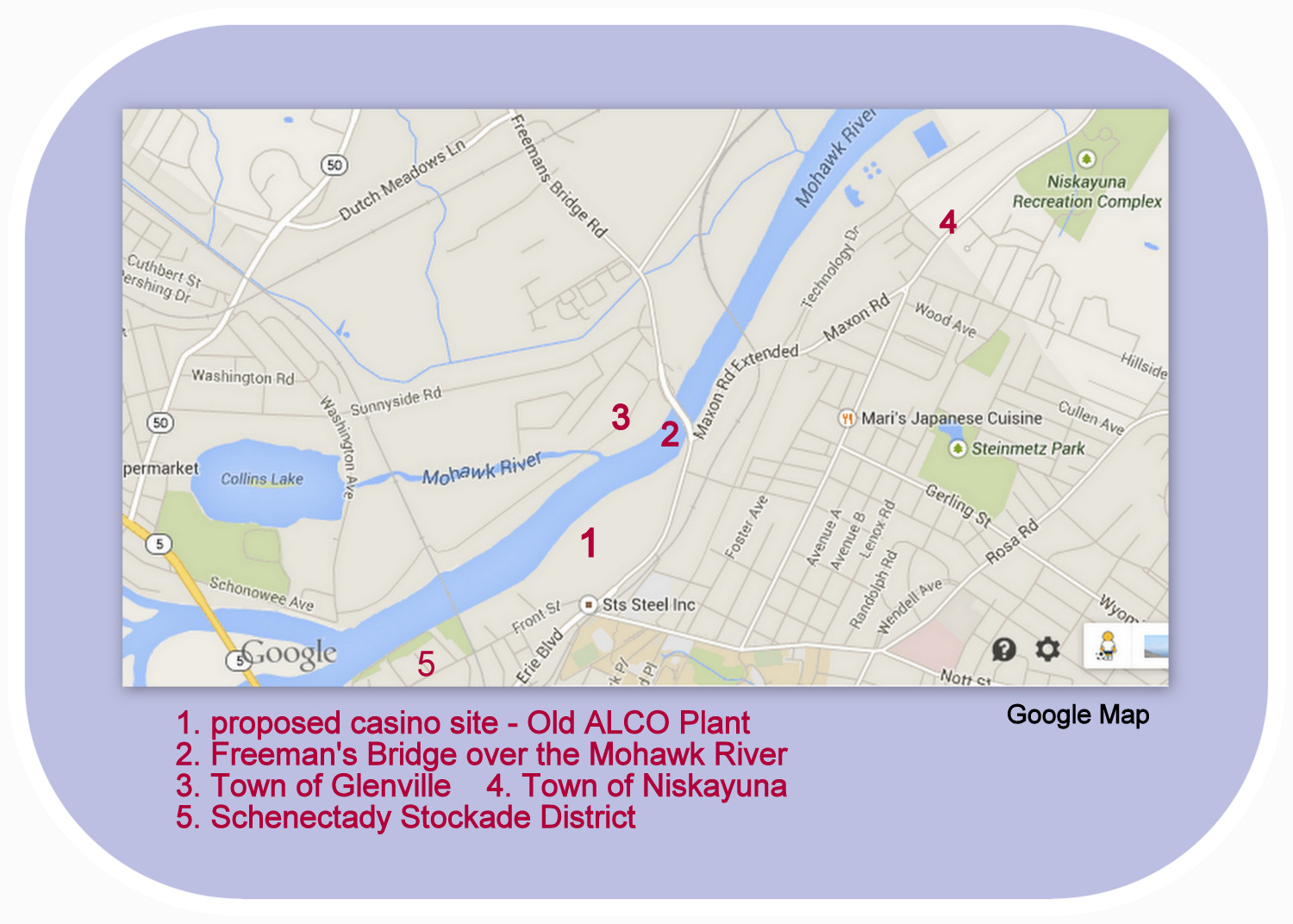
Casino-Map-Feeman'sBridge

– above: Google Map showing site of the proposed Schenectady Casino at the old ALCO  plant at Freeman’s Bridge, with Glenville to the northwest and Niskayuna south and east; click on it to enlarge –

     I believe the opinion of nearby communities will be especially important to the Siting Board, and that leaders in Niskayuna and Glenville, which lie so close to the old ALCO site, must be prepared to act quickly to consider and pass resolutions.  As is shown elsewhere on the website. strong majorities in those two towns, as well as Duanesburg and Princetown voted No on the November 2013 ballot Proposal One, which authorized the placement of up to 5 casinos in the eastern part of Upstate New York, with another four due at the western end of the state in the near future.  Other than the Applicant, only representatives of the Host Municipality, “nearby municipalities”, and impacted live entertainment venues, have the right to make presentations to the Board’s public hearings.  All others are at the discretion of the Board.

Bethlehem Resolution: At the end of May, the Town Board of Bethlehem voted unanimously to oppose the then-proposed Exit 23 casino in Albany.  As reported in the Times Union on  on May 29, 2014:

“It is the sense of the Town Board of the town of Bethlehem that our community is opposed to the E-23 Casino Proposal, as well as to other casino proposals within the Capital Region,” the resolution passed by the board read. “We are concerned with the welfare of the entire community, the impact on citizens, and we question the long-term economic and fiscal benefit of such ventures. And we intend to reach out to other municipalities, including the city of Albany, and neighboring towns and cities, to see if they too would become involved in this public debate.”

Similar resolutions from Glenville, Niskayuna and other towns in the County might help convince the Siting Board that there are better choices than Schenectady for locating a casino.

logoclip_0

– we can prevail, as the citizens of Hamilton. Ontario did, in our fight to stop a proposed downtown casino –

Please leave a comment or email message, if you would like to help Stop the Schenectady Casino –


will a casino bring more crime?

Crime statistics about casinos are tricky and it is difficult to make broad statements about casinos and crime, because casinos are located in such diverse places and there are relatively few casinos in cities.  Nonetheless, it seems rather clear that urban casinos can expect an increase in certain kinds of crime, especially near the casino and along major arterial roads leading to it.  The potential is too great, we believe, for any nearby neighborhood to merely accept the risk and “wait and see”.  Once a casino complex is built, any increase in crime or perception of increased jeopardy on its streets will mean a reduction in the quality of life (and property values) for those living in its immediate vicinity.

SugarHouseEntryway follow-up: SugarHouse in Philadelphia: see our posting “did crime go up near the SugarHouse Casino?“, which discusses a study that some say demonstrates there was no significant increase in crime in the neighborhood of the SugarHouse Casino in Philadelphia, which is operated by Rush Street Gaming.  Our analysis suggests, to the contrary, that those who live near a proposed urban casino should continue to be quite worried. And see, (Aug. 4, 2014).  .

.

The New York State Task Force on Casino Gambling – Report to the Governor (August 30, 1996), was thorough in its research, looking at existing studies and doing some of its own.  The Task Force Report was in favor of having upstate NY casinos, and found that “Casino gambling was accompanied by few significant or recurring crimes problems.” [217]  However, it distinguished between rural and urban locations, noting that the more rural a location, the less the probability of a significant increase in crime. “By contrast, the towns on the main routes to Atlantic City experienced spillover crime, which rose with proximity to the city.” [a t219] More generally, the Report continues:

  • “casinos in urban areas should be concerned with the potential for prostitution, panhandling, pick-pocketing and purse snatching. Urban casinos would be adversely affected by an unsafe urban environment, so that more resources would have to be devoted to maintain order and protect citizens from street crime.” [at 219]
  • “The frequency of theft, other property crime, and traffic-related offenses is likely to increase in and around a casino, with the extent of the increase largely dependent upon the opportunities presented by the location, historical crime patterns, and the daily visitor population.”

JailBird Furthermore, there were three notable exceptions to their finding that “Any growth in economically motivated crime is usually not accompanied by an upsurge in violent offenses in casino locales.” [at 218] Thus, “Researchers found greater increases in violent crime in localities most accessible to Atlantic City than in other communities in the region. Gulfport, Mississippi statistics show major increases in assaults (all levels), robberies and arson. And, while crime statistics are not available, Tunica County, Mississippi has experienced substantial increases in felony indictments and lower court filings since riverboat casinos began operating in 1992.”

Note: Atlantic City has a population of about 40,000 and Gulfport about 70,000, quite comparable in size to Schenectady’s 60,000.

The Report notes that the enormous increase in crime in Atlantic City from 1977-1980 (violent up 130%, non-violent up 176%), has been “misinterpreted”. The number of crimes may have gone up a lot, the Report says, but the increase in the number of persons in the City means “the risk of individualized victimization appears to have fallen slightly according to visitor-adjusted crime.”  I am not sure that is particularly re-assuring, especially to those who live or work near a casino, where the visitors are concentrated.

The Report adds that: “in sum, every factor that might affect opportunities for crime should be considered in casino planning.  The size of the facilities and overnight accommodations, hours of operation, types of games, age eligibility of patrons, availability of alcohol, and possible stake limits may affect the degree to which a casino causes crime in the community. The goal must be crime control.” [219]

NoloSharkS Problem Gambling and Crime: Another conclusion in the Task Force Report is: “With the advent of legalized casino gambling, pathological gamblers will likely commit additional income-generating crimes, though their prevalence and rate of criminal activity cannot be projected.” Thus, “Research indicates that there is a relationship between pathological gambling and economically motivated, non-violent offenses. Larceny, embezzlement, check forgery, loan fraud and tax evasion are thought to be the most common. . . . [I]f the number of compulsive gamblers grows with expanded availability and more convenient access to casino gambling, a corresponding increase in offending can be expected.”

Another study of interest is “The Effects of Casino Gambling on Crime”  (B. Stitt, D. Giacopassi, M. Nichols 1998), which was funded by a U.S. Justice Department grant and did a statistical analysis of 7 jurisdictions with fairly new casinos, comparing before and after crime stats.  It looked at both the official population of a city and the “at risk” population when visitors are added in.   Stitt et al concluded that there was a statistically significant increase in DUI, larceny/burglary, and family offenses in locations that established casinos in the 1990s. [at 16]  For me, the increase in family offenses is particularly telling, as it shows how the negative effects of gambling losses reach into the family of gamblers, as money for housing, food, clothing and children’s needs is spent at the casino.

Schenectady Council approves casino 5 to 2

SlicingThePie Democrat Marion Porterfield and Independent Vince Riggi were the only Schenectady City Council members to vote against the Rivers at Mohawk Harbor casino proposed by  the Galesi-RSG partnership.  It took a strong backbone for Ms. Porterfield to resist the heavy pressure for unity among the Democrats, and she deserves thanks.

The same goes for Vince Riggi, who surely found it easier to resist the Mayor and Peggy King, but also felt that a significant part of his base wanted the casino.  Vince ended by saying that they simply did not have enough information to make a decision that could affect Schenectady significantly for decades to come.  He opened with words he said were by a man we all respected.  It was Rep. Paul Tonko, who had this to say about the competition for casino licenses (Rep. Tonko, With Several Possible Locations In District, Lukewarm On Casinos,” by Alan Chartok):

Rep. Tonko: “You know, I’ve seen these dividing communities along almost a 50-50 threshold. If there is going to be an issue that people decide, if there is going to be a casino in the area, I hope it’s going to be a situation where it’s not in a poor neighborhood because of the disproportional impact on the poor,” he said. “But in general, I’m concerned about us hinging our hopes for a better economy on casinos. I think there has got to be a better way, a more straightforward way. What we have is a dependency on perhaps someone to lose their retirement check or their week’s salary so that we can invest in children and their future through education. Somehow that doesn’t make sense to me.”

treasurehunter

 “I know people have been saying that it equals jobs and it provides for economic recovery. I don’t know if the soundness of that recovery is as great as we would like to think; you look at the economy in Las Vegas and Nevada, it has not been that great, the property values have dipped precipitously,” he added. “I talked to my colleagues from Nevada, they have had tough, tough times and you see this growing number of states in the Northeast that are delving into this concept of casinos. I have to believe there is a finite amount of money that people are able, not necessarily willing, but able to give.

 emptyPockets“After you have drained some of those paychecks and retirement accounts, what’s left?

“And of course the impact on the cultural industry in these towns: Proctors, SPAC, the track itself in Saratoga. This has to be done in a way that puts together a plan that can avoid however possible, the negative impact on some of the standing cultural entities or entertainment entities as they exist today and also just being conscious of just where we provide for the setting so that it is not going to make it so convenient for some of the poorest amongst us.”

Ed Kosiur, perhaps heeding Lincoln’s advice on remaining silent, merely said “Yes” when it came time for his vote [note: I learned much later that Mr. Kosiur had to leave due to a medical issue].  All the others gave several reasons for their decisions.  John Mooterveren, who was at one time thought to be leaning toward a No, said that Schenectady needs the jobs.  Carl Erikson no longer seemed like a likely No vote for the past few weeks, but he struggled to come up with convincing reasons for his Yes.  One weak notion was the attraction a casino would be for sought-after skilled workers looking for a place with diverse entertainment options.

sbaron9jun2014 The crowd was probably 65% Yes supporters, but we discovered that very few of them were Schenectady residents.  Rev. Sara Baron asked a telling question to each camp: How many of you are from Schenectady?  A much larger percentage of the casino opponents than of the supporters were Schenectady residents. Follow-up: See our posting, “Rev. Baron’s excellent questions” (April 7, 204).

checkedboxs We opponents plan to reflect a bit, continue to collect signatures on our Petitions, and give some thought on how to best bring our cause before the State Gaming Facility Siting Board. Making our presence and our concerns known was and will be an important part of the campaign to keep a casino out of Schenectady.

StopCasPet

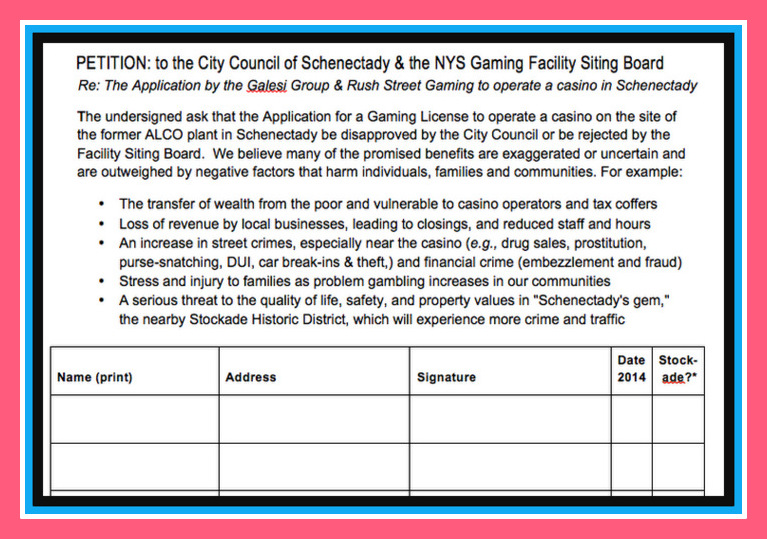
PETITION UPDATE:  We brought a packet with 187 signatures on 26 Petition forms to the City Council meeting, which were presented to the Council, saying it was just a downpayment on the signatures we would be submitting from people the Council has been ignoring. [click on the image at the head of this paragraph for a copy of the petition, and go here for instructions.]

While at City Hall, one avid worker handed me 30 additional signatures, and another 30 were obtained outside the meeting room during the session.  Many people sought out the opportunity to sign.

At this point, 77 Stockadians have signed the Petition.

 DSCF3061

Council ploy: all casino revenues will be used to reduce property taxes


Contrary to its custom, there are no materials attached to the Agenda for tonight’s Council Meeting, to allow the public to see the “exclusive use for tax reduction” proposal that the Council has been planning to vote on tonight.  That Resolution is clearly meant to back the possible No Votes into a corner, by daring them to vote “no” on a “tax reduction”.

The Exclusive Use resolution is officially named “RESOLUTION OF THE CITY OF SCHENECTADY IN SUPPORT OF USING HOST MUNICIPALITY REVENUES FROM A PROPOSED GAMING FACILITY FOR PROPERTY TAX RELIEF.”  Click here for a pdf. file of the Resolution.

 It states that the Schenectady Casino is the best site of all in the Capital Region, says that the Council expects to receive $5.7 annually as its 5% share of the casino tax revenues, and that a $5.7 million Host Municipality payment to the City of Schenectady would result in a reduction in real estate taxes of approximately 18%.”. The proposal then states that:

RESOLVED, that the Host Municipality payment received by the City of Schenectady will be used exclusively for the reduction of real property taxes in the City of Schenectady.

Of course, the Council cannot bind other Councils, dollars are interchangeable in a budget, and there will surely be normal increases in the budget, along with many casino-related expenses, that make a 18% cut in real property taxes an unlikely event.  To my knowledge, neither the Mayor nor the City Council has released any estimates of the additional expenses the City will incur “hosting”  construction process or operation of the Casino.

Petition update

StopCasPet

As of Saturday afternoon (June 7), we have collected at least 146 signatures on our “NO Casino in Schenectady” Petition.  That’s a good start, as the petitions were first available for signing on Tuesday, June 3rd, and we’ve done only a small amount of door-to-door canvassing.

You can still find and sign a Petition:

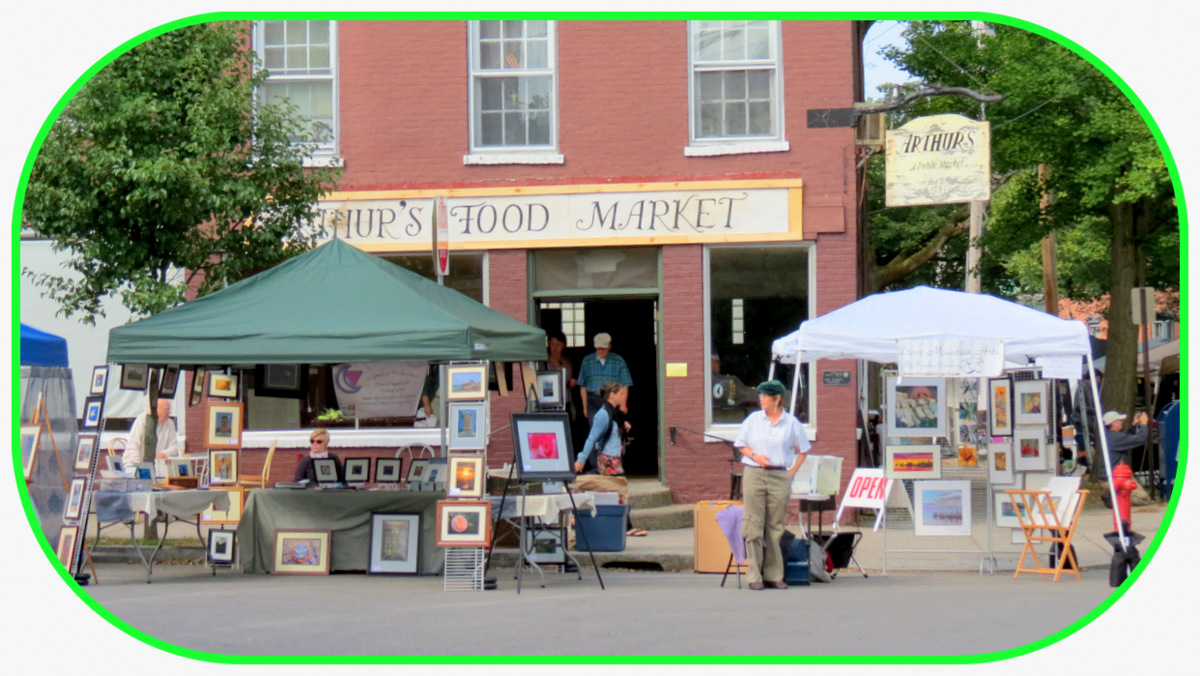
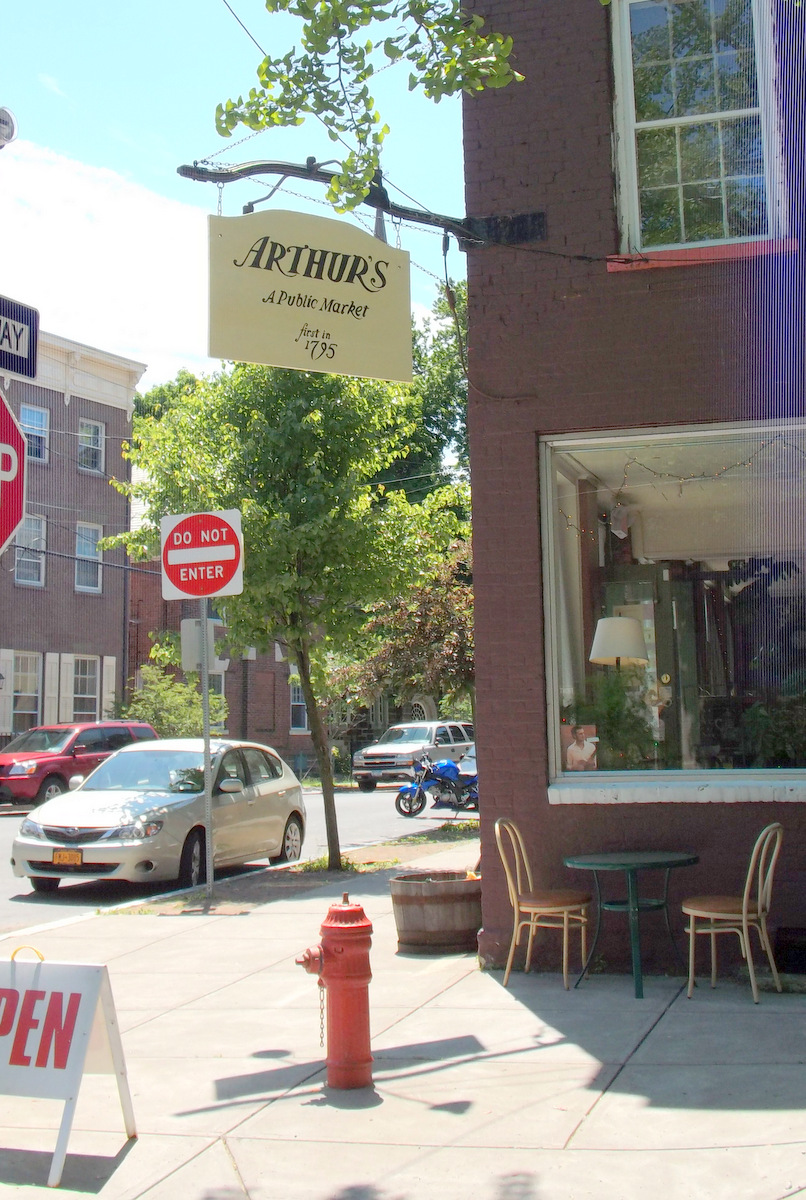
  • at Arthur’s Market & Historic Coffee House (35 N. Ferry St.) and Moon and River Cafe (115 S. Ferry St.).
  • Monday, at City Hall during the 6 PM Rally on the front steps and the City Council meeting.
  • by downloading and printing a Petition from this site  ( Click this Petition link), and then dropping them off at Arthur’s Market or bringing them to us at City Hall on Monday
  • by looking for someone in Riverside Park with a clipboard and a No Casino in Schenectady sign this afternoon, Sunday, June 8.

You can help even more by taking a blank Petition and circulating it at home, in the neighborhood, near schools and churches, etc.

Stockade Petition Report

As of Saturday afternoon, at least 66 “Stockadians” (persons who currently live in the Stockade or own property or a business there), signed our Petition — in stark contrast to the “neutrality” of the Stockade Association Board, with its unfathomable assumption that a nearby casino is not a topic worthy of a meeting of the Association’s membership.

It should not be surprising that there are scores of Stockadians against the proposed casino at the old ALCO site.  At November 2013 general election, 138 voters, 55.8% of those who voted on the Casino Proposal in election District 2, said No to any casinos in upstate New York. (District 2 is comprised solely of the Stockade and East Stockade; see map image below; click on it for a larger version)

. SchdyElectionDist2

– If you need convincing, or want to remind yourself, about how special the Stockade neighborhood is:

  • read about it at Wikipedia
  • see my own attempts to capture its beauty and community spirit, with thousands of photographs, at “suns along the Mohawk
  • peruse Jean Zegger’s brief description of the uniqueness and importance of the Stockade Historic District

PLEASE SIGN the NO-CASINO PETITION, and help circulate it, if you can.

.

our June 7 Opposition Meeting

 DSCF3041  . . .  DSCF3036

An article in the Sunday Times Union article captured the tone of our June 7th Meeting for Casino Opponents at Arthur’s Market:

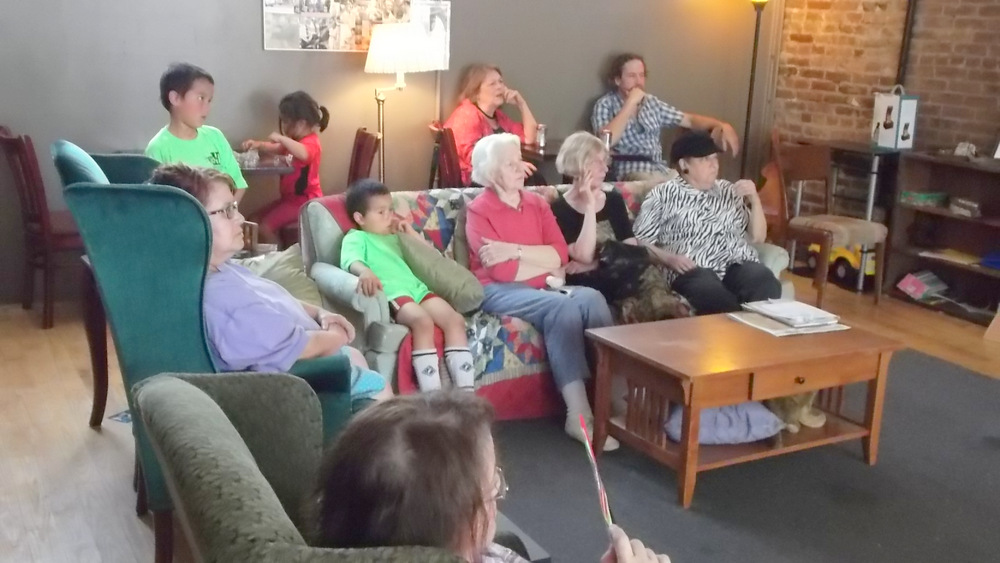
“Some 30 residents were willing to bypass Saturday’s glorious sunshine to gather on couches and around tables at the corner meeting place to join him. They shared concerns about the proposed casino and urged each other to speak against it at a City Council meeting Monday, when a resolution to support the project is on the agenda.” Stockade residents rally against Schenectady casino plan (by Claire Hughes, June 8, 2014)

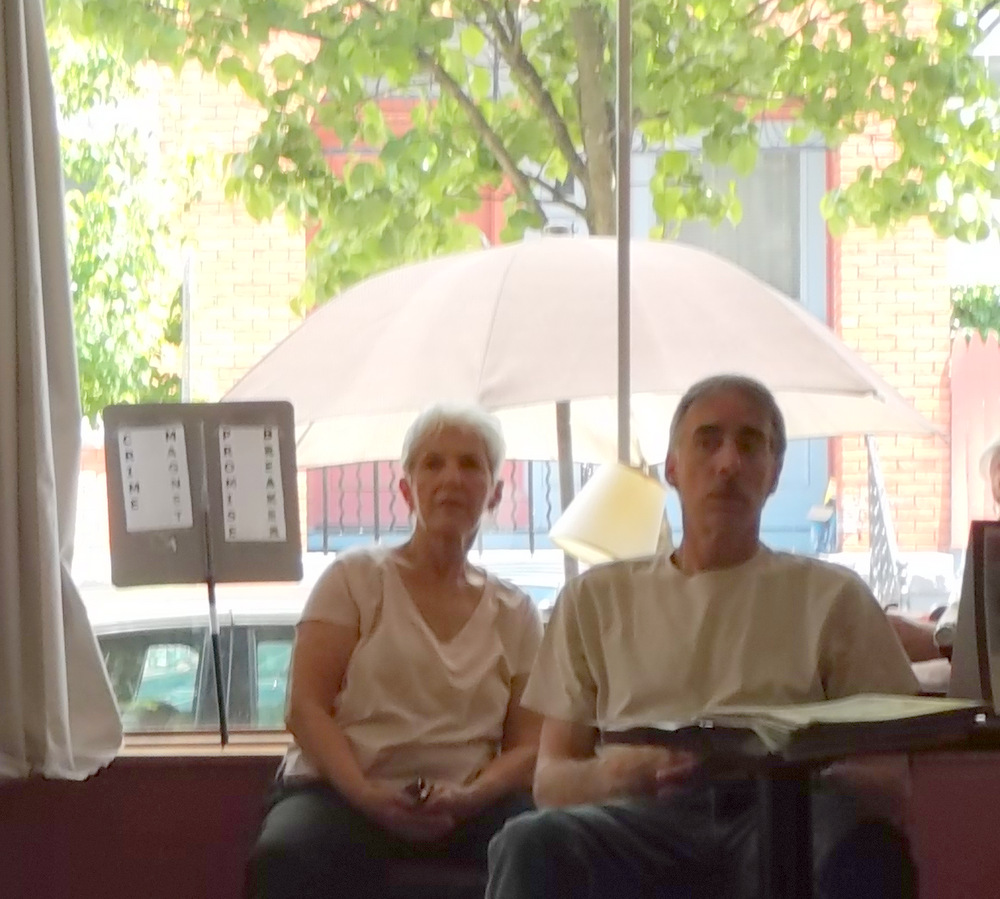
   DSCF3061    About three dozen Casino Opponents  created an atmosphere of urgency and caring, in the comfortable surroundings of the redesigned Arthur’s Market.  The subtitle of the TU article is “Stockade-area residents stress ‘people’ as council vote on gaming site nears” .  And, although “people” were/are our first priority, the Meeting stressed the many ways a casino would harm our people, community, businesses and future — using studies, literature, experience elsewhere and common sense. Many also stressed how the sneaky and cliquey process used by the applicant and by City Hall (Mayor and Council leadership) to push this proposal through tars the project and the Administration, insults the public and democratic principles, and creates suspicion and anger.

 DSCF3050-001 . . . OppoMtg07Jun2014MHafez

– Donna Lagone [L] and Mohamed Hafez –

Organizers Richard Genest, Mohamed Hafez, Tom Hodgkins and myself (David Giacalone), each told why we felt the need to show that a serious opposition existed.  We then asked those present (our opposition partners) to come up and tell us their most important reasons for opposing the casino.  Many did, including Lydia Eis, Jean Zegger, Vince Riggi, Joe Kelleher, Mary McClain, Donna Lagone, and Gloria Kishton.  I apologize for not recalling, or knowing the names of, others who contributed with their thoughts and emotions.  Mr. Riggi was the only elected official at the event.

   DSCF3058 Grade-schoolers Tianning and Hainuo Hodgkins, plus little Concetta, added energy inside Arthur’s, and made their beliefs known with chalk on the sidewalk, proclaiming “no casino.”

The front page of the Regional section of today’s Sunday Gazette, C1, has a lengthy article with a summary of the casino approval situation in Schenectady, as well as good coverage of yesterday’s Meeting of Opponents, and a description of the Statement of Schenectady Clergy calling for a public hearing (discussed here). “Neighbors rally against Schenectady casino plan” (by Ned Campbell, June 8, 2014; available online only by subscription)  On the lack of a public hearing, the Gazette writes:

 While the Schenectady County Legislature hosted a public hearing on the issue Monday, [Councilman Vince] Riggi criticized the City Council for not setting its own public hearing before the vote on what he considers “the most important issue” since he started attending council meetings 28 years ago.

“If I want to make it illegal to spit on the sidewalk, that requires a public hearing. By law, according to our corporation counsel, this doesn’t require a public hearing. Maybe legally, but morally?” he said to applause.

Vince Riggi (in yellow shirt) listens to opponents of the Schenectady Casino - 07Jun2014

 Two tv news reporters also covered the Meeting. Channel 13, WNYT, has a short, informative piece on the Meeting, with Dan Basile reporting after spending quite a bit of time with us at Arthur’s Market.  Take a look: Protestors in Schenectady speak out against casino proposal.  (WNYT News, June 8, 2014). YNN/TWC’s Madeleine Rivera was also at the Meeting with camera. The Time-Warner News website states “They held a rally Saturday, which several opposers attended.”  There may have been three opposers, but there also were another 30 or more opponents.  See Residents Voice Opposition Toward Schenectady Casino.

StopCasPet

WANT TO HELP STOP THE CASINO? You can demonstrate to City Council and (if needed) the Gaming Facility Siting Board the strength and sense of the casino’s opponents, by attending Monday night’s City Hall Rally (June 9, 6 PM on the entry steps), and the Council Meeting thereafter.  And, by signing our Petition. See “petition update” to learn its status and how to find it.

DSCF3037

checkedboxs Many thanks to all who came to show their support of the No Casino campaign, and to those helped organizing and putting on the Meeting: Richard Genest, our host at Arthur’s Market; Donna Lagone and Jessie Malecki, who did most of the work of circulating the petition in the Stockade; Mohamed Hafez, who physically got the petition to churches and businesses on his side of town, and spurred on the No Casino campaign with his energy and writing skills; and Tom Hodgkins, who made signs and decorations, but also crunched numbers to show us the strength of the opposition in Schenectady County, and brought along his best reasons for wanting to preserve and improve Schenectady, his three great kids.

DSCF3043

Thanks also to Vince Riggi, for his advice, and for having the spunk to resist the pressures at City Hall, and the courage to stand his ground and state his reasons for opposing a casino.

p.s.  Preparing for this meeting kept me from my hobby of photographing Stockade events and its beauty.  So, I missed Friday’s Garden Tour, and I was bouncing around too much during the Meeting yesterday to “focus” on photos.  Nonetheless, here’s a brief Slideshow with images from the event.  Sun and shadows created beauty and photographic challenges.  Please forgive the caffeine-busy-shaky fuzziness of the images.

.

This slideshow requires JavaScript.


what will the casino mean for Union College students?

– SmallShark click this link for our Statement to the Location Board on the problem with having a casino so close to Union College

.

– original posting with updates [more updates have been placed at the end of the posting] –

Letter to the Editor in Schenectadt Daily Gazette on June 7, 2014 by Carol Hyde of Niskayuna regarding the effect of a casino on nearby college students  A Niskayuna mother (and managing partner of an Albany-Poughkeepsie law firm), Carol A. Hyde, asks some very important questions in a Letter to the Editor printed in today’s Schenectady Daily Gazette (“Union, SCCC will be affected by casino,” June 7, 2014, C7; available by subscription).  Her main question is how the casino will affect already-poker-crazy students living practically right across the street?  Will they study less and spend their money becoming gambling addicts? Click on the image at the front of this paragraph to read the Letter.  Thank you Ms. Hyde for your letter, and thank you, Gazette, for printing it.

Note: Union College has a policy requiring all undergraduate students to reside in College housing.  From the perspective of the casino operators, the policy conveniently places the vast majority of the student body just an easy stroll away from the proposed casino.

We should, of course, also ask how safe students, perhaps especially female students, would be or feel at night walking in the adjacent “College Park” neighborhood or on Campus, given the expected increase in street crime when the casino opens. [see the section on Crime below.] What other problems might we expect when a casino open 24 hours a day is located near a campus already known as a major party school (e.g., with the highest ranking among all small colleges; also see here), with an abundance of “keggers” and poker parties?

  • Studies. There is a significant amount of literature and scholarship on college students and gambling, including the increased susceptibility of younger gamblers, alcohol’s connection to problem gambling, and the connection between proximity and increased gambling. For example: 1) College Student Booklet (Illinois DHS)  “Festering Beneath the Surface: Gambling and College Students“; 2) Problem and Pathological Gambling Among College Students, Randy Stinchfield, William E. Hanson, Douglas H. Olson; 3) California Council of Problem Gambling, College Student Web pages;  and, see our Issues Page re Young Gamblers for a fuller list.
    • “Colleges and universities located near gambling facilities had higher rates of student problem gambling behavior for their students”, See “College Problem Gambling Literature Review“, Jim Emshoff, Ph.D., Georgia State University (Jan. 2008), and citations to other resources.
    • The Handout on Problem Gambling from Union College’s Wicker Wellness Center, notes:”Gambling is in some ways a ‘norm’ among college students.  The most popular games are casino activities such as cards and gambling machines.”
  • casino-PropsHopsRules Targeting the Young Gambler: (Aug. 1, 2014): Rush Street Gaming is experienced in marketing to the Young Gambler.  For example, Rush Street Gaming’s SugarHouse Casino in Philadelphia has introduced a “simplified craps game” called Props & Hops (purportedly alluding to craps terminology), which was developed because “A lot of people, especially the younger kids, are intimidated about craps.” (See SugarHouse Press Release, April 30, 2014; and “Sugarhouse Develops a New, Simplified Craps Game For Younger Players“, CBS6 Philadelphia, May 1, 2014; SugarHouse Props & Hops Brochure.) They also greatly increased the number of poker tables at SugarHouse, a game particularly popular with college students. Their Schenectady Application shows that the Schenectady casino will have a dozen poker tables in a 3000 sq. ft. hall.
    • We can also expect a Schenectady casino to organize or facilitate groups of students coming from neighboring states where you must be 21 to gamble.
    • Gambling at a Casino appears to be more addictive than gambling online, according to work done at the Harvard Medical School Division on Addiction. See “Gambling Online, Gambling in Casinos: What’s More Addictive?” (The Atlantic, July 2014).
  • Gambling Age? We apologize for our earlier error in stating that the permitted gambling age will be 18 at the “destination gaming facilities” that will be licensed under the Upstate New Gaming and Economic Development Act of 2013 (click for the text of the Act).  You must be 21 to gamble at any new facility licensed under the Act. Although the general age to gamble in New York State is 18, the Act added an exception for the casinos, stating:

§1332.  Age for gaming participation   1. No person under the age at which a person is authorized to purchase and consume alcoholic beverages shall enter, or wager in, a licensed casino; provided, however, that such a person may enter a casino facility by way of passage to another room . . . “

Any winnings by a person prohibited under the above section must be forfeited and put into the State’s gaming revenues fund. Those under 21 are still allowed in other parts of the casino facility (restaurants, entertainment events, etc.), but not the actual “casino” rooms where the gambling is allowed.

“Racino” locations and Indian reservations may continue to allow 18 year-olds to gamble.  Such facilities either send them into special under-21 areas or give them wristbands indicating they are under 21, so they won’t be served alcohol.  Attempts by lawmakers and others to raise the gambling age at the racinos have gone nowhere in the State Legislature. See, e.g., “Bill to raise gambling age to 21 reintroduced: Addabbo, Goldfeder sponsor proposal” (Queens Chronicle, by Dominic Rafter, Feb. 7, 2013); and the ChangeTo20 campaign.

  •  “Quicksand Credit“: As Casino-Free Philadelphia explains: “SugarHouse casino [owned by Rush Street Gaming], as well as most other casinos in the country, offer their customers unlimited lines of credit, which can only be used to gamble at the casino. There is no interest on the line of credit, and it must be paid back in 30 days.The casinos call this a “convenience” so you don’t have to carry large amounts of cash to the casino — but they’ll happily give you more cash than you have. Having access to a line of credit makes a person more likely to keep playing — making SugarHouse’s billionaire investors richer.
    • Gambling and Budgets: At the Union College website, I found a Student Guide for studying abroad in Australia.  In the section How Much Money Will You Need?, there is a subsection titled Spending Money, which contains this guidance:
A word about gambling
During the last three or four years we have occasionally received calls from parents concerned about the amount of charges appearing on bank cards or credit cards. They felt that our recommendations and estimates here about money were too low and not realistic. Thus far, in each case where our estimates have been far off, it has turned out that students were attracted to a very rich and active life at a local casino in Brisbane. BE FOREWARNED! Gambling can be addictive and is very, very expensive. In the long run, one seldom ‘wins’. If you think you will give the casino a try, set a maximum budget IN ADVANCE and do not deviate from that sum.

.

– how close would the casino be to Union College’s 2200 undergraduate students?

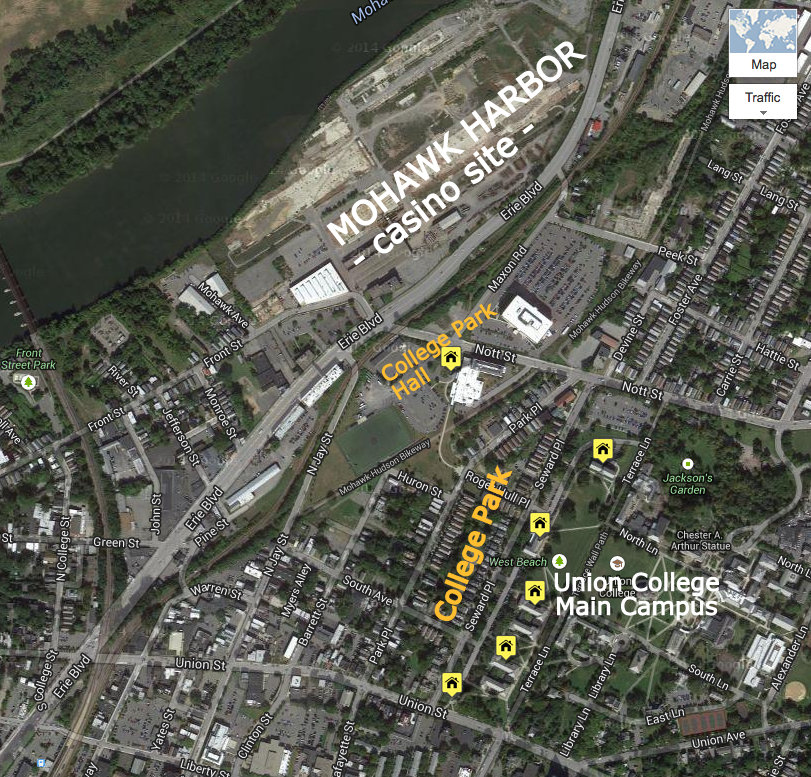
Google Map of Union College Residences

Google map with Union College Residence Halls –

  • 257 students at College Park Hall (former Ramada Inn) – about a block away. Indeed, the casino appears to be closer than any other restaurant or bar.
  • 130 upperclass students in the renovated homes, and fraternity houses, comprising the College Park Neighborhood Apartments on Seward Pl. and Huron St. – 3 blocks away.  update: A large new housing complex for upperclassman was announced at the end of July that would also be in the tiny College Park neighborhood.
  • residence halls on main campus – 4 blocks away.
  • update (July 12, 2014): the new rendering of the casino project shows the casino itself located right at Nott Street and Erie Boulevard, so that all the young prospective gamblers (or the elderly from East Front Street) won’t need to trek a long distance into the 60-acre site.

– share this post with this short URL: http://tinyurl.com/schdycasino-colleges
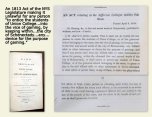
UnionCollegeGamingLaw Note: What a difference two hundred years makes.  As a religious school, Union College naturally prohibited all sorts of vices (from drinking spirits and engaging in “carnival entertainment,” to using gaming devices) in the early 19th Century.  However, if you click on the image at the head of this paragraph you will see legislation passed in 1813 by the New York State Legislature concerning Union College students and gaming.  In two hundred years, the State went from criminalizing to enabling gaming by the students of Union College:

“[I]t shall not be lawful for any person to entice the students of Union College . . . into the vice of gaming, by keeping within the first and second wards of the city of Schenectady, any billiard-table or other instrument or device for the purpose of gaming” [with a fine of $25.00 “for every such offense”]. See The Laws of Union College (1915), at 46.

[Note: Look at the size of that fine: $25 per incident was real money back then, the equivalent today of over $300.]

 CRIME: The entire Union College complex, including the Main Campus, the College Park off-campus housing area and College Park Residence Hall, are clearly within the radius of surrounding neighborhoods likely to experience increased crime after the opening of a casino. See our posting will a casino bring more crime?, and materials referenced there.  As explained in our post “did crime go up around the SugarHouse casino?”  a study that Rush Street Gaming uses to claim that crime went down in the area surroundings its SugarHouse Casino in Philadelphia has many caveats (e.g., it did not cover DUI or prostitution), and states, for example (emphases added):

  • graphup “Violent street felonies increased in the target area compared with the control area.” And,
  • “Vehicle crime decreased in the target area relative to the control area; however, there was substantial displacement indicating that the introduction of the casino made the vehicle crime problem in the combined treatment/buffer area worse than before the casino was opened.”
  • Philadelphia PD created a 14-man dedicated police unit whose sole task was to patrol a one-half-mile square around the casino.

What About the Parents?  It would seem sensible for Union College parents to protest having a casino a short stroll from where their young adult children will be living and pursuing an education.  My question to the UC office for parent relations have, like all other correspondence to the school staff, gone unanswered.  This is what Mike Hendricks, Editor-in-chief of Albany Business Review, had to say on the topic, in a Viewpoint column called “Computer chips or poker chips” (June 16, 2014):

The casino would be less than a five-minute walk from the relatively new dorm off the Union College campus. One of the premier institutions in Schenectady, Union College is one of those high-tuition private colleges. Whatever I might think about the economic viability of a casino, if I was the parent of a high school senior picking a college and I had to pay that kind of tuition, I might find a casino across the street from the dorm to be concerning.

Hendricks is concerned. I’m concerned. So, why isn’t Pres. Ainlay concerned enough to say something?  At the very least, shouldn’t the School press the Schenectady applicant to prevent gambling by those under 21, as was done at two of the four Indian casinos in the State?  Union College might also ask the Location Board to impose such a restriction as a term in any gaming license that it grants in Upstate New York. Update (March 6, 2016): A major Q&A article with President Ainlay in the Gazette about the relationship of Union College and the City fails to mention the casino.  “Q & A with Stepen AInlay: City, School ‘Tied at Hip’,” by Zachary Matson (online March 5, 2016)

threemonkeys Donation Deafness? Buddy Blindness? We don’t pretend to know why Union College has been so silent and evasive on the topic of the casino. It is difficult to avoid speculation on the institutional silence.  Historians consider Union College to be the Mother of the American fraternity movement and system, and believe that the establishment of the first fraternities at Union College, in off-campus residences, in the 19th Century, was the beginning of the end of the in loco parentis concept (schools acting “in the place of parents”) at American colleges. But, UC’s apparent casino indifference can’t merely be because the Administration doesn’t want to sound like a worry-wort nanny or a substitute for Helicopter Parents.  The School’s comprehensive Wellness Center and its Honor Code show that Union College does feel obligated to help its students to develop into healthy and socially-responsible adults.
images-3 Is the President’s role as Fundraiser-in-Chief at the core of the School’s failure to voice concern over the proximity of the proposed casino? The pool of actual and potential big donors is not that large in a City as small as Schenectady, and its academic, business-development, and political “elites” can’t help rubbing elbows on boards of directors, at awards, cultural, and fundraising events, and private parties among friends.

Is the Administration reluctant to ruffle the feathers or create bad will with business leaders as prominent as the heads of the Galesi Group, or with County, City and Metroplex officials whose cooperation might be important in the future? Is it afraid that it will tarnish its image as a main element in the “revitalization” of Schenectady and development of the region?

Stephen Ainlay also wears the hat of the Chancellor of Union University, which includes Union College and Union Graduate College, along with several other units.  The units of the University have been structured to be self-governing, with fiscal independence, but they surely pay attention to the opinions and needs of the heads of each part of the Union Family. Is Chancellor Ainlay reluctant to rain on the parade of David Buicko, the COO of the Galesi Group, which owns the ALCO site and is the developer of the Mohawk Harbor complex?  I suspect that it might be difficult — consciously or not — to openly oppose a casino that is being sought by David Buicko, when he is considered a Community Partner and major fund-raiser by Union Graduate College. Its President recently nominated Buicko for a Community Hero award, saying:

yinyang “I can think of no other single individual who has had the broad and positive effect on Schenectady that Dave Buicko has had. . . .

“Nothing that has been done to date in Schenectady will be quite as transformational as the innovative and break-through project planned for the Alco site on the Mohawk River that Dave initiated in the last year. “ [see “Union Graduate College Community Partner Dave Buicko Receives ‘Hero Award’” (Union Graduate College News, May 27, 2014)

Mr. Buicko also had some very kind words about the incoming Dean of the Graduate College, in 2011.  Here’s an excerpt from Union Graduate College News, September 4, 2011, “Bela Musits Named Dean”:

“Bela Musits is an innovator, well-respected and admired throughout the business community,” said David Buicko, President, Galesi Management and Chair, Center for Economic Growth Board of Directors.  “Naming him Dean of the School of Management is a coup not just for Union Graduate College but for all of us invested in economic development. I look forward to helping him succeed in his new role.”

Buicko is chairing Union Graduate College 2011 Scholarship Scramble golf tournament at Eagle Crest Golf Club in Clifton Park on September 16, 2011.

How connections with community and business leaders mesh with Union College’s promise to “work with city leaders to ensure that any and all revitalization efforts dovetail with our responsibility to our students,” is an important question I hope will soon be clarified.

NoloSharkS  Young people are “the  future of casino gambling”: This is what the report Why Casinos Matter, from the Institute for American Values (2013) has to say about young people and casino gambling:

 Young people are viewed as the future of casino gambling. SharkGF

A recent American Gaming Association survey of casino visitors ages 21- 35 found that young people had the highest rate of casino visitation and the greatest level of acceptance of casino gambling among all casino visitors. Nearly 4 out of 10 (39 percent) had gone to a casino in the past year, and 9 out of 10 agreed that casino gambling was acceptable for themselves and others. Machine gambling was ranked as the most popular game among young adults. Frank Fahrenkopf of the American Gaming Association highlighted this news in a 2013 industry report, stating that young people are “the very people with whom the future of our business lies.”

  That future is not far off. More than any earlier generation, today’s young people are technologically primed for gambling. From an early age, kids learn to play games by tapping buttons and tracking images on screens. They spend money with a swipe of a debit card. They play video games. They live on social media. For these reasons, young people are a soft target for Internet gambling—the next frontier for legalized gambling.

The first national U.S. survey of gambling among adolescents and young adults found that gambling among youth is widespread. It estimates that three-quarters of a million young people ages 14-21 are already problem gamblers.

See the article, Mining Millenials (Global Gambling Magazine, by Marjorie Preston, July 29, 2014,
Vol. 13, No. 8), for an example of how the gaming industry perceives young gamblers and the challenge of appealing to them.

 The Teenage Protection Alliance has started the ChangeTo20 campaign, to make 20 the age of majority at which individuals may gamble.  They are focusing first on New York, because of the rapid expansion of Casinos that is expected in the next year or two. We hope their work will help raise consciousness of the many problems caused by allowing teenagers to gamble.

.

IMG_4692 Schenectady County Community College. Yes, we are also worried about the effects of a close-by casino on the students at Schenectady County Community College.  SCCC has about 2700 full-time and 1700 part-time students and now has a large residence hall.  Anticipating the expansion of gaming in the State, SCCC started a Casino & Gaming Management A.A.S. Program, which will have close ties to the proposed casino. The main campus is less than one mile (by foot or car) from the proposed casino site (and I imagine many SCCC students will be cutting through the Stockade for a shortcut to the casino).

According to the Albany Business Review (by Megan Rogers, June 16, 2014):

“Schenectady County Community College board of trustees will vote tonight to support the $450 million Rivers Casino and Resort at Mohawk Harbor, about a mile from its campus.

“The Schenectady, New York casino project would provide an “invaluable and close-at-hand” resource to students in the two-year school’s casino gaming management, culinary, tourism and hospitality programs, according to the resolution.”

Is the SCCC Board of Trustees aware that casino employees make up a very large percentage of the troubled people calling Problem Gambling Help Lines?  Young employees and interns might, of course, be even more at risk than their older colleagues.

Followup: See “Students all in on casino future: Many see SCCC program as ‘head start’ to local jobs’,” (Sunday Gazette, at C 1, by Zachary Matson, March 13, 2016).

CONCLUSION (for now): As was stated in the Sunday Gazette OpEd piece linked above:

There are many good reasons for a socially-responsible university to oppose its City or State basing economic development and revenue raising on the operation of casinos.  Moreover, there seems to be no justification for Union College to remain silent when the location of a proposed casino so directly threatens its community, including the psychological, physical, social, academic and vocational welfare of its students.

MISCELLANEOUS UPDATES and FOLLOW-UP COMMENTS:

Looming Pylon: Note: in addition to the many issues discussed above, the Casino will have a giant pylon sign structure at the corner of Front and Nott Streets, just a little over a block from the College Park Residence Hall. it will be 80′ tall, with a very large, inner-illuminated white sign declaring the name of the casino on top, and 32′-tall LCD screens on each of its v-wings, with nothing taller than a railroad underpass between the sign and the dormitory. See, e.g., “bait and switch along the Mohawk“.

ha collage showing proximity of college dorm to proposed Schenectady casino. .

– click on the collage above to see The Casino & the Dorm –


[prior] follow-up (Sept. 19, 2014): An article in today’s Schenectady Gazette finally has a response from Union College President Stephen Ainlay on the issue of the nearby casino. (“Area colleges betting on Schenectady Casino,” by Haley Viccaro, Sept. 19, 2014).  The article states:

Union College President Stephen Ainlay said he has some concerns about a casino being built around the corner from the 120-acre campus off Nott Street.

“Are there anxieties? Yes, there are,” he said last week after Union’s annual business campaign breakfast. “There are things we are worried about, so we’re watchful, I guess you would say.” . . .

Ainlay declined to comment on his specific concerns or a potential rise in problem gambling among Union’s undergraduates, but students at the college say they would visit a casino that’s only about a 10-minute walk from campus. Casino patrons must be 21 or older to gamble under terms of the Upstate NY Gaming and Economic Development Act. In June, Union had 500 graduating seniors, most of whom were 21 or older.

just say no

[prior] update (Aug. 8, 2014): This is the only statement we have been able to obtain from the Union College Administration in response to questions about the casino:

podiumflip “President Ainlay stands by his statement that we are supportive of Schenectady’s ongoing revitalization efforts and understand the interest in bringing revenues and jobs to the city. We stand ready to work with city leaders to ensure that any and all revitalization efforts dovetail with our responsibility to our students. I hope this helps in your conversations with the community.”

The statement was sent to Schenectady Councilman Vince Riggi on July 1, 2014, by the Chief of Staff in the Office of the President on behalf of Pres. Stephen C. Ainlay.  Riggi was promised a reply from Pres. Ainlay upon his return from vacation in mid-August, but he has not received one. The same response, verbatim, was sent to a Schenectady Gazette reporter. Our requests for amplification or clarification have gone unanswered.

TooTempting-headline31Aug2014 (September 1, 2014): Perhaps yesterday’s Viewpoints column in the Sunday Gazette, “Too tempting?: Casino could create young gamblers, but college remains silent” (D1, August 31, 2014, by David Giacalone) will finally merit a response from the President’s Office, a professor, or some other responsible member of the staff. Click here for the text of the “Too tempting?” OpEd piece in a pdf file.

update (March 29, 2015): see our posting Taj casino doesn’t want a college next-door” (March 29, 2015).



the 4 PM June 30 deadline at the Siting Board

The folks at City Hall, along with the media, and even Schenectady’s Ministers, seem to believe that the Council can give timely approval to the Schenectady casino by voting as late as June 30.  However, as virtually every interested person knows, the Gaming Facility Siting Board’s Request for Applications says (at 7), “As a condition of filing an Application, each Applicant must submit to the Board a resolution passed by the local legislative body of its Host Municipality supporting the Application.” (emphasis added)

smallquestionmark What does not, however, seem to be public knowledge is that the Request for Applications for Gaming Facilities [RFA] states (at 19) :

“To apply for a License, a completed Application must be received by the Board by June 30, 2014 at 4 p.m. Eastern Daylight Time.  The Board shall have no obligation to accept or review an Application submitted after the established deadline.”  (emphasis added)

If the completed Application must include the Council’s Resolution Supporting the Application, and the gigantic Application packet (with 20 hard copies, including attachments, electronic copies, USB flash drives, etc.) must be received by 4 PM on June 30th, there’s no way the City Council can wait until June 30th to vote.

You might ask how our leaders and their staffs have missed this simple point. Well, these are the same folk who would have us believe they only very recently realized the application deadline was June 30, and are using the crunch of time as an excuse to skip having a public hearing.  Perhaps the slow readers at City Hall will finally reach page 19 of the RFA this weekend, and they will use the 4 PM deadline on June 30th as yet another reason to act without a public hearing.

SlicingThePie

We’ll hear, possibly at the June 9th Meeting, that June 23rd, rather than June 30th, is the last regular Council Meeting for their vote on the Support Resolution, given the 4 PM reception requirement of the Siting Board.  They will argue, then, that a public hearing can’t possibly be squeezed in before June 23rd, confessing that they are as surprised as anybody about this terribly imminent deadline, over which they have no control and had no prior knowledge.

I can’t wait to see how this plays out.  Parents are advised not to let their children watch.

ministers request a public hearing

 Saying they are “appalled as religious and community leaders by what is clearly a ‘rush to judgment’ with minimal community input,” a group of clergy and other community leaders called on the Schenectady City Council yesterday to table the Gaming resolution scheduled for this Monday’s City Council Meeting (June 9), and take no formal action until  Council members “have taken the time for a public forum to receive public input at the city level.” (click for the Statement and list of signatories)

The “Statement on Casino Gambling in Schenectady: Why no Public Hearing?”, which was released on Friday, June 5, 2014, concludes:

“We ask that the Council give careful consideration of the economic, social and human impacts to the community as a whole and provide such a report to the community prior to action on any resolution.”

Many thanks to those who worked on the Ministers’ Statement!

It is, indeed, appalling to have an important issue like bringing a casino to Schenectady decided without a public hearing. It is an insult to democratic principles. Nonetheless, no observer of the Schenectady City Council can realistically expect that a public hearing would in any way change the minds of Council members (much less write a report after considering the public’s input).  In a way, it is refreshingly honest of the Mayor and Council to show how little regard they give to public hearings and opinion.

In addition, a June 5 editorial in the Gazette makes the valid point that the show of local support is diminished by the lack of a public hearing.  The strong-arm tactics of the Mayor and Council President King might just backfire and help convince the Siting Board that support in other locales is more robust than in Schenectady.  Having no public hearing is, as the preachers said, appalling.  However, given the futility of public hearings under the current City Hall Administration, and the possibility that failing to hold a public hearing might hurt the chances of the Schenectady application in the license competition, I’m not going to make too much of a fuss about the process.  It’s the substance of City Hall’s decision on casinos that deserves most of our ire.

reprise: wise words from Mr. Hafez

I’ve heard, over and over, that the Letter to the Editor published in the Gazette by Mohamed Hafez on June 1st is the best short summary yet of the problems we fear are likely to come with a casino in Schenectady.  So, I was pleased this morning to find an email from Mr. Hafez submitting his letter, with a few new thoughts, to “stop the schenectady casino.”  It’s a reprise definitely worth republshing and rereading.

Letter to the Editor and the Schenectady Community:

June 6, 2014

Our anti-casino fight is too important to give up simply because some think a Yes vote by the Schenectady City Council is inevitable. I have not given up hope that good sense and good leadership will bring Mr. Erikson, Mr. Mootooveren and Ms. Porterfield to join with Councilmen Vince Riggi and create a majority against the proposed casino.

A year ago, the Toronto City Council voted 40 to 4 against the downtown riverfront mega casino proposal. It wasn’t a difficult vote for the councilors because they debated the issue for a year, engaged local economists at the University of Toronto that provided several studies on the impacts of a local casino on their city and the health and wellbeing of individuals.

Closedsm They all concluded that a local Casino makes a poor economic sense, is a poor use of precious downtown land, with no evidence that it will attract tourist dollars. In addition, a casino would have a devastating impact on local restaurants, bars, hotels and theater. A casino would have serious negative social impacts including problem gambling, bankruptcies, crime, traffic gridlock and parking problems. Furthermore, gambling is morally wrong and preys on the poor, the unsophisticated and the addict.

Residents signed 22,000 petitions opposing the casino proposal, enlisted business owners and faith leaders, discussed the issue on social media, collected donations and placed 3000 lawn signs throughout the city.

A local economist stated that gambling is one of the least productive economic activities imaginable — removing money from one set of pockets and putting it in another, without producing anything concrete as part of the exchange.  He also said that statistics concerning casinos throughout the United States show that after three to five years, almost two jobs are lost for every one that’s created. Most places that introduce gambling see a quick upward spike, followed by a steep decline.

Unlike Las Vegas, most casino-goers are locals, and their gambling money would otherwise be spent on other options in the city. No serious tourist dollars will be generated, it would be the locals who spend their hard eared money and social security checks.

abacus There is no evidence that our “leaders” have done their homework or looked behind the promises and puffery of the casino developers. Nor is there evidence that a riverfront casino would make good economic sense, promote tourism in Schenectady, or result in an assured stream of new tax revenue. Without such evidence, the Schenectady City Council should not be taking the risk that a casino will bring with it the predictable downsides, destroying local businesses and the social fabric of our city.

Tell the Schenectady City Council to Vote No on the proposed Casino.  Then, if we need to go further, let’s prepare to show the Gaming Facility Siting Board that there is significant opposition in Schenectady and surrounding communities and, if there must be a Capital Region casino, that other locations are better choices or, at the least, likely to cause less damage.

Mohamed Hafez,

Schenectady

City Hall Rally Monday – June 9 at 6pm

There will be a “Say No to the Casino” Rally this Monday, June 9, at 6 PM on the steps of the main entrance to City Hall (Jay Street side).  Please come to show the City Council and Mayor, the media, and proponents of the casino your opposition to a casino in Schenectady.

CITY HALL RALLY TO

STOP THE CASINO!

Monday, June 9th, 6 PM

On the steps of City Hall, before the Council Meeting

TELL OUR CITY COUNCIL TO SAY NO TO THE CASINO

Use this link to download the flier.

.

 she'

– click on the image for a larger version –

– you can share this posting with this shorter URL:

http://tinyurl.com/CityHallCasinoRally

a flier for publicizing the June 7th meeting

A flier is now available to download and print that publicizes the Meeting at Arthur’s Market this Saturday.  Click for the Rally Flier. The following is the content of the flier, which includes a listing of our major concerns about approving and living with a casino.

cropped-nocasinoschdy.jpg

flierheadlines

Our Schenectady is not a casino town. We are not willing to:

  • trade Schenectady’s proud history of productive enterprise and innovation for the non-productive transfer of dollars from individuals to the favored “house”
  • desperately believe the easy-money promises of developers and casino operators out of undue pessimism about our development potential
  • base Schenectady’s fiscal policy on taking money from hard-workers, problem-gamblers & the vulnerable, for the sake of uncertain amounts of added tax revenue
  • risk the health of small businesses, which have stayed here and created jobs, by draining revenue away to the casino and a few lucky partners, who will be drawing most of their business from gamblers living less than 25 miles away, not from distant high-rollers
  • create a crime magnet that will bring more drugs, prostitution, DUI, and car break-ins, as well as all-day traffic problems, to nearby neighborhoods, threatening the residential nature of the Historic Stockade District

go to tinyurl.com/NoSchdyCasino for more information & materials –

– get the No Casino Petition online or at Arthur’s Market –

PROTECT OUR COMMUNITY BY SAYING “NO!” TO A CASINO

..


ArthursMarketo5June2014a . . ArthursMarket05June2014b

– Arthur’s Market in the Schenectady Stockade –