how big is 80′ x 38′?

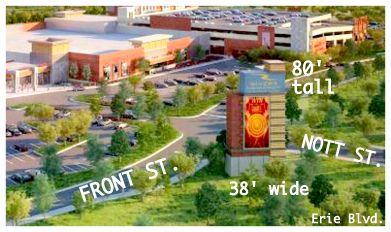
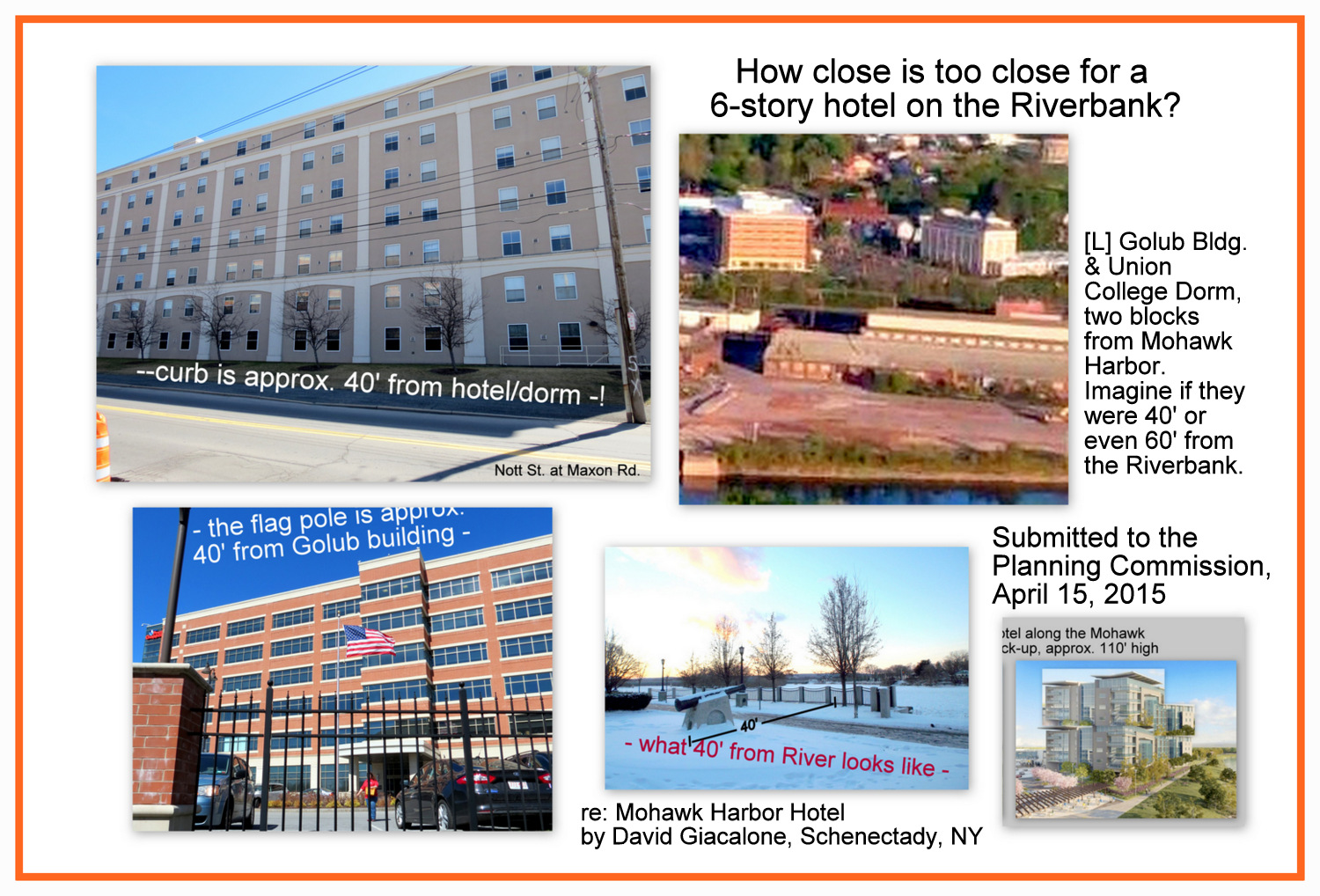
 The short answer is “too damn big”, but many people have no idea just what those dimensions look and feel like in the actual world, and we want to offer more than a conclusion about the size of the proposed Schenectady Casino pylon signage.  Luckily, here in Schenectady, we have a well-known structure right on State Street at Erie Boulevard that helps put the monster pylon into perspective. It is the former Masonic Temple, at 302 State Street, which is now the home of the Alcohol and Substance Abuse Council. To sum up the comparison: the proposed pylon sign is both taller and wider than the Masonic Temple.

The following collage shows and tells the tale (click on it for a larger image), including showing how huge the electronic display will be:

Around this website, we’ve been tired of the Pylon Tall Tale told by Dave Buicko and Rush Street to try to justify an outsized casino sign with no precedent that they can point to or that we have found. However, the ever-credulous Gazette news room repeats Rush Street’s STS-Pylon-Excuse in today’s Sunday newspaper, “Casino builders tout river views, huge revenues“, by Haley Vicarro, A1, July 13, 2015), repeats the STS excuse without qualification and makes the pylon sound like another Done Deal:

But unlike Pittsburgh, Schenectady’s casino will include an 80-foot-tall entrance sign, one developers say is needed because of how the casino is tucked into the old Alco property.

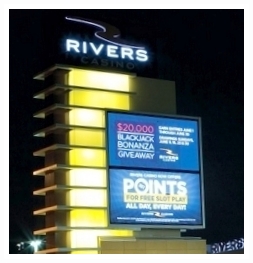
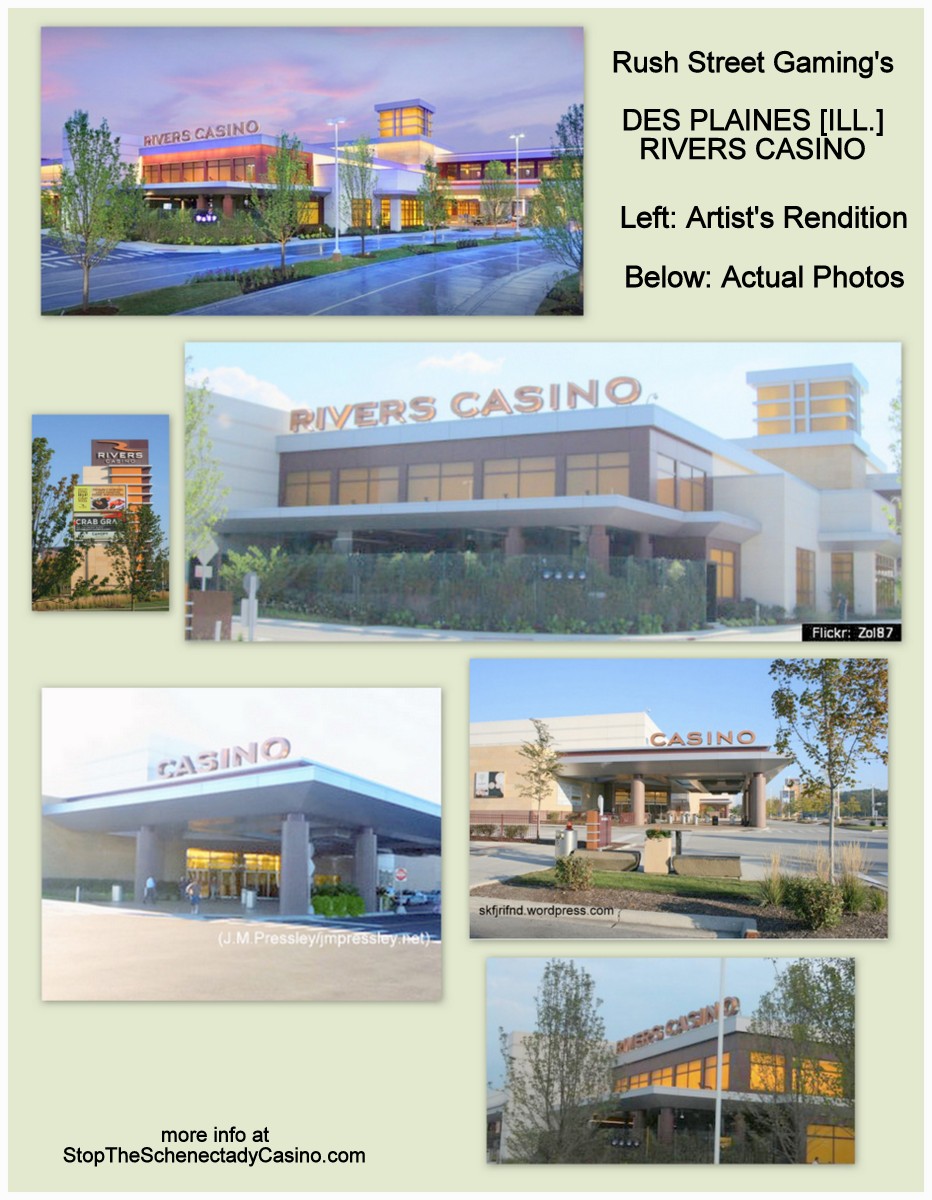
DesPlaines68 Rush Street’s Rivers Casino in Des Plaines has the only similarly wide-and-tall casino signage that we have been able to find online.  It is another reason we feel certain that the proposed Schenectady pylon is too big. The Des Plaines pylon is “only” 68′ by 25 ‘, and yet by any reasonable standard, it is objectionably large and looming and luminescent. See our posting “shrink that casino pylon“.

third time is a bore

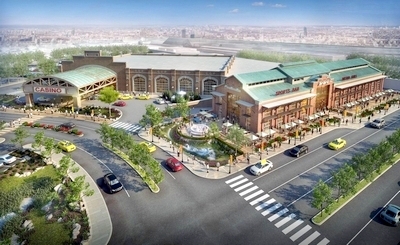
AOA-rivers_casino_schenectady_rendering_v3_back Rush Street Gaming released its third design proposal for the Rivers Casino at Mohawk Harbor this morning and it is, frankly, a bore. (Image at the left is a view of the riverside patio and the Casino hotel). The Gazette and the Times Union’s Business Buzz Blog only have two images to show us. The TU post pairs the peek at the 3rd version with similar images from the 2nd version. (click for our post on the 2nd Design) There is apparently no broad rendition of the entire casino facility or compound available, which seems to be one more slight for the public. Here is the front entrance to the Casino as released today:

AOA-rivers_casino_schenectady_rendering_v3_front

 And, here’s an Open Letter to the Gasino Gang from a disgruntled resident of Schenectady and its Stockade District [me]:

Dear Mr. Galesi and Mr. Bluhm:

We want Mohawk Harbor to be pedestrian-friendly, but we don’t want the design to be pedestrian.

“Schenectady” does not mean “doormat” or “dustpan” in the Mohawk Language. Treat us with a lot more respect, please.

s/ Man on the Street and on the Web

Haley Vicarro at the Gazette referred to the above design as “the third and presumable final draft of the Rivers Casino.” (Schenectady Daily Gazette, “New look for Schenectady casino revealed“, July 9, 2015)  Rush Street has consistently believed and acted as if the public’s input is irrelevant; sadly, so has City Hall. I hope there will be another groundswell of opinion, keeping in mind that:

More commentary is surely to follow. Please leave a (polite) comment with your opinion or suggestion.  update: Michael DeMasi at Albany Biz Journal uses his headline to tell the story; see “New Schenectady casino design: how “brick” became a four-letter-word” (July 9, 2015). And, thanks once again to All Over Albany for providing high-resolution versions of the new renderings, plus encoring the earlier versions.

– additional media reaction well worth a look: (1) Sara Foss in the Sunday Gazette, “casino drawings speak volumes“, July 12, 2015; (2) a Sunday Gazette editorial, Casino design is better, but public needs to see more” D2, July 12, 2015; (3) Chris Churchill’s frankly insightful Sunday column in the Times Union, “Let’s be honest about the (redesigned) Schenectady casino” (July 12, 2015);

p.s. VegasCompareCollage2 The Casino Pylon: Wrong Size/Wrong Place. Please don’t forget to check out our campaign to topple (before it gets built) the 80′ x 38′ eyesore and safety hazard Rush Street wants to erect, looming over Erie Blvd. from the corner of Front & Nott Streets. Links to relevant posting can be found at the top of “pylon envy?“.

follow-up (Thursday eve., July 9,  6:30): Could Rush Street have done any less work re-designing this facility (or spent less time and money)? Actually, they were honest, they just “tweaked” it.

detail2ndDesignEntrance . . . casino3rdDesignEntrance

– – the fake second story wall and support for the sign were removed from the 2nd design and colors were changed.

 – Casino2ndDesignRearPatio – – The tweaking in the rear patio was even less significant.

more follow-up (July 10, 2015): Demographics: Commentors at various sites and others chatting about the new renditions have noted that all of the Casino customers are thin, young, hip, white. How does Rush Street plan to make a profit without the Granny Buses rolling in and poor folk spending rent and food money?  Carl Strock (we miss him here in Schenectady!), after pointing out his opposition to casinos as an economic development tool, opines at his TU Blog, “Fantasy customers for Sch’dy casino(July 10, 2015):

Look at them. Look how trim they are. Look how well dressed, the men in dark suits, the women in skirts and heels. All of them looking like they just stepped out of a Fifth Avenue shop window. I would say to the project developers, if you can guarantee us a crowd like this, I don’t care how you design your casino.

PYLON DIRECTORY/Envy

 
Casino#3Pylon

July 2015 version

 Pylon Directory:  Here is a list of our posts and Comments discussing the proposed 80′ x 38′ Schenectady casino pylon and its digital display:

 .
Mayor McCarthy defends the casino pylon” at the League of Conservation Voters forum (September 22, 2015)
.
bait and switch along the Mohawk” (July 31, 2015) suddenly we have a v-shaped pylon with an LCD screen on each wing.
.
– “casino site plan approved: pylon, too” (July 22, 2015). And, the pylon will be bulkier, brighter and wider than expected.
 .
– click here for a pdf version of Comments to the Commission regarding the Casino Pylon, dated July 22, 2015
 .
– “the Commission should require a better pylon” (July 20, 2015) The Planning Comn has the power to insist on a safer and better-looking pylon.
.
– “a Pylon Precis: too big, too bright, too  much” (July 16, 2015): a pithy summary.
 .
– This posting “pylon envy?“ (see below): compares the Sch’dy pylon to classic Las Vegas signs and a massive new sign in Cincinnati; it also compares the signage rules that apply to all other businesses in Schenectady but not to the Casino
.

– “phony pylon excuse“: uses photos, maps, and other images to explain why the excuse that  the STS Steel Building blocks the view of the casino is simply untrue

– “shrink that Casino pylon“: explains why the proposed pylon is the wrong size at the wrong location; looks at the Des Plaines Rivers Casino, which is too large and too bright at night although “only” 68 ft. tall; worries the Schenectady pylon would become an inappropriate symbol of Schenectady

– “how big is 80 feet by 38 feet?” (July 12, 2015), which points out that the proposed pylon sign is both taller and wider than Schenectady’s former Masonic Temple, at 302 State Street.

– other pylon-related materials: (1) Comments submitted to the Planning Commission June 17, 2015, which stresses the inappropriate height and width and the serious traffic hazard from the huge digital display. (2) a discussion of variables for evaluating the safety of roadside CEVMS (digital variable message displays). (3) The Casino’s Visual Resources Assessment submitted by the Mohawk Harbor applicants as part of its environmental impact assessment, concluding that the project would have no negative visual impact on the City or any historically sensitive areas.
.
original posting:
PYLON ENVY?
GlitterGultch Right after giving the Planning Commission the easily-refuted excuse (see our posting “phony pylon excuse“) that they needed an 80′ pylon because the STS Steel building blocked the view of the Mohawk Harbor’s 71-foot tall casino, Galesi Group COO Dave Buicko assured them it would be “classy”, not gaudy. Sitting in the small Commission meeting room that evening, I remember smirking over what Mr. Galesi, Rush Street’s Neil Bluhm, or Gaming Industry folk in general might think of as “classy”.

Fremont+Stthe+Nugget+Apache+Pioneer+MUST

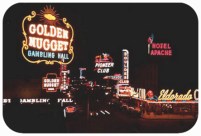
above & Right: photos of the 1960’s “Glitter Gulch” from the Classic Las Vegas website. For more images and history see InOldLasVegas.com.

If you are an East Coast Baby Boomer like myself, it was classic images of the Las Vegas Freemont Street district and The Strip from the 1960s, ’70s, and ’80s that created the vision of what a casino “should” look like. Many Americans back then apparently did consider Las Vegas to be classy. One thing for sure (especially for inhabitants of relatively low-rise Upstate New York cities), we thought of all those casino signs, competing for attention among the many gaming and recreation options, as very big and very bright. That’s why I was surprised to discover this past week how relatively modest in size iconic Las Vegas casino signs were compared to the monumental pylon proposed by Rush Street for Schenectady. For example, see the tale told by this Schenectady-Sands comparison:

Compare-Schdy-Sands-Pylons

 By the way, as explained at the Classic Las Vegas website, “The Sands Hotel, probably more than any other, came to symbolize the Las Vegas of our collective memory. It was here that the color line was finally broken, . . . It was where glamour and glitz met in the Desert and it helped propel tourism in the small desert mecca like no other. . . The result according to author Alan Hess was the ‘most elegant piece of architecture the Strip had ever seen’.”

In fact, the Classic Las Vegas piece continues:

SandsNightDetail The crowning glory though was the roadside sign. It was a departure from the usual sheet metal and neon displays that beckoned road-weary travelers to stop and stay. [Architect Wayne] McAllister designed a 56-foot (the S alone was 36-feet) tall sign, by far the tallest on the highway at that time. With its elegant modern script, the sign blended with the building to create a mid-century modern paradise. The sign and the building had motifs common to both. The sign was fabricated by YESCO. With its egg crate grill, cantilevered from a solid pylon, it played with desert light and shadow. In bold free script, it proclaimed “Sands” in neon across the face. At night, it glowed red when the neon spelled out the name.

The sign Mssrs. Bluhm and Buicko want to plop down in Schenectady will never be mistaken for elegance. There will be no playing with light and reflections off our lovely Mohawk River.  Instead, a solid wall 38′ wide will call to mind supersized versions of monument signs straddling huge shopping center parking lots, or maybe a gaudy mausoleum.

The proposed Schenectady pylon casino sign also dwarfs other iconic Las Vegas signage, from the friendly 40′ cowboy Vegas Vic waving from atop the one-story Pioneer Club, to the imposing 35′ Sultan on the similarly one-story Dunes Casino, to the famous and much slimmer pylon sign of The Mint, which (without counting the star on top) was no taller than the Rush Street pylon proposal for Schenectady. The next two collages compare the classic Las Vegas signage to the aberration that our Mayor, City Council and Planning Commission so blithely told Galesi and Rush Street they were welcome to erect in Schenectady. [click on each comparison collage for a much larger version]

VegasCompareCollage1

. .  . .

VegasCompareCollage2

SchdyPylonSketch2-006 One particularly worrisome aspect of the comparisons above is that the 32-foot-tall electronic display screen on the Schenectady casino pylon monument, with its intense LCD lighting, is itself about the same size as the behemoth Dunes Sultan, giant Vegas Vic cowboy, and elegant Sands “S”, which were all created to be impressive giants.

What kind of corporate or personal narcissism seeks to impose a massive, obtrusive and uninteresting monument on the City of Schenectady that is so much larger than the classic giants of Las Vegas’ classic era? What kind of civic insecurity would allow such a structure to mar a city’s streetscape and skyline?

CinciHorseShoeSignageComparedA Modern Comparison. A contemporary casino sign of massive size in Cincinnati should also give our Planning Commissioners a lot to contemplate as they decide on the appropriateness of the proposed Rivers Casino pylon for Schenectady and consider the kind of design that might fit in with and enhance the Schenectady scene. Richard Unger, a city planner who recently moved to the Stockade from Florida, set out to find large casino signs in existence that might offer Schenectady some useful ideas on the design and dimensions of the main freestanding sign for Rivers Casino at Mohawk Harbor. In his search, he located only one casino sign that was a large as 80′ tall. It is the massive marquee sign for the Horseshoe Casino in Cincinnati, Ohio, which is also 80′ tall.

The 80′ Horseshoe sign was endorsed by community groups in Cincinnati. (e.g., see “Cincinnati casino goes all-in with giant sign“, Cincinnati.com/Gannett, Oct. 26, 2012). It should not be surprising that prior to persuading community leaders to embrace its massive marquee, the casino developer engaged in a dialogue with the community. Even less surprising, the casino-community dialog was nurtured because City Government commissioned a large study and set up a nonprofit organization, Bridging Broadway, “whose mission is to maximize the new casino’s positive effect on Greater Cincinnati . . . as a catalyst for improving the quality of life for downtown Cincinnati, its businesses, and neighborhoods.”  As a result, the 150-page “Broadway Commons District Plan” was created. Click here for a half-dozen select pages from the Executive Summary and Introduction to the Study, and from the Plan’s Primary Implementation Recommendation: A Community Benefit Agreement.

A brief Aside: The Broadway Commons Plan has this to say about local official and CBAs (at 69):

  As stewards of the community trust in accountable development, local officials play a critical role in developing these agreements. . . . When a local authority has leverage to approve requests from the developer, these officials should represent the community’s interest. In recent years, many local officials have used this leverage to require that the developer negotiate and sign a CBA.

Beyond the process for achieving community backing for a large casino sign, here are practical reasons why the 80′ Horseshoe Marquee was far more appropriate than the huge pylon proposed for Schenectady:

  • Cincinnati is a “high-rise” City. Its highest building is 660 feet, and it has 25 buildings taller than 250 feet.  (See Wikipedia) In contrast, Schenectady’s tallest building is Summit Towers, at 148′, which architects would call “low-rise” residential. The next two tallest are The Lottery Building at One Broadway Center [111′] and the Parker Building next to Proctors at 99′).
    • Three other building that Schenectadians consider to be quite tall are in the same ballpark as the proposed Mohawk Harbor Casino pylon: Both Golub Headquarters and MVP Health Headquarters are 86′ tall, and the Wedgeway at Erie Blvd. and State Street is 76 feet tall. Because they are not quite as tarted up as the Schenectady Pylon will be, they all would seem quite demure in comparison. [follow-up: the sign is taller and wider than the old Masonic Temple at 302 State St., corner of Erie Blvd.]
  • No Digital Message Board. The Horseshoe Marquee has no digital message board with text and images to distract drivers. It merely has a 3D animated horseshoe rotating on its top, far above street level. [For a discussion of the safety hazards and factors to be considered when digital signs are displayed near roadways, see our commentary at http://tinyurl.com/electronicdisplayfactors]
  • A slender shape. The Cincinnati Horseshoe sign is not at all shaped like the proposed giant hulk at Mohawk Harbor, which is 38′ wide for the first 60 feet above the ground, and 30′ wide for the next 14.5 feet.   The Horseshoe marquee is about 33′ wide in a narrow strip near the top that names the casino. At the base, it is about 12 feet wide and stays that size for more than a dozen feet up the column. This slender silhouette greatly reduces the bulkiness of the Horseshoe sign.
  • Lower Profile.  According to Cincinnati.com, “The sign would be placed on Gilbert Avenue, away from the sprawling casino’s front door along Reading Road. Although the sign is tall – nearly twice the height of the Genius of Water sculpture at Fountain Square – its placement will be on the lowest point of the casino site, about 55 feet below the street level of Reading Road.”
  • The Cincinnati sign looks like a casino sign, not a wall with a big LCD screen.

In case our local officials are afraid to say no to the Rush Street pylon request because they fear the casino really does need the colossal sign to succeed, we note that Rush Street claims to be doing just fine in both Pittsburgh and in Philadelphia, and have no giant pylon at either location.

Exempted from the “normal” Signage Rules. Another way to look at the appropriateness of the proposed Schenectady Casino pylon is to compare it with the rules that govern every other location and business in the City of Schenectady.

Continue reading

phony pylon excuse: STS Steel is simply not in the way

STSSteel5Jul2015a

STS Steel Building – 49′ tall

 The only “justification” that Galesi Group COO Dave Buicko and Rush Street representatives have given for needing a monster 80′ pylon — beyond their always implicit and winning argument “because we want it” — is that the STS Steel building blocks the view of the Mohawk Harbor Rivers Casino, so that the pylon is needed to let people know Schenectady has a casino and where it is.  Despite the fact that the STS Excuse is very easy to refute, no one on the Planning Commission or in the Mayor’s Office, or among the majority of Yes-Persons on City Council, have pointed out that the assertion is simply not true, much less asked obvious follow-up questions such as:

  • How does a 49′ tall building block the view of a 71′ tall Casino that is sitting on land raised a few additional feet above the floodplain, which could also have a roof sign?
  • Why did you choose to place the casino partially behind the STS Steel building, if that is a big concern, when you have over 20 acres to choose from?
  • Casino-STS-PieChart When the entire project, river-side and street-side. is taken into account, wouldn’t a Pie Chart show that STS Steel makes up a tiny sliver of the sightline into the Casino, and one could not get to the “blocked” area without passing by an area from which the casino compound is visible? [click on image at the head of this bullet point]  Also, will Rush Street put in a much smaller sign if it succeeds in pushing STS Steel off the old ALCO site?
  • Who is going to be in or near Schenectady when the Casino has opened who won’t know there is a casino here?
  • How will a giant pylon guide drivers (front- or back-seat) off exits and through the streets of Schenectady? And, won’t there be plenty of signs along the way on our streets?
  • How do we balance the aesthetic damage and traffic hazard of such a large and bright pylon sign, and its intrusion on the skyline of our low-rise City (becoming the new Symbol of Schenectady), against its minimal actual usefulness?

SchdyPylonSketch2 . . . STSSteel5Jul2015b

above: rendering of 80′ pylon [L] and 49′-tall STS Steel Building seen from Erie Blvd. 

To put it charitably, the STS Excuse is silly and the acceptance by City Hall and the Media irresponsible and embarrassing. This posting will use images, photos and words to rebut head-on the STS Steel Excuse for a monster pylon. There is no need to balance the benefits and disadvantages of the monster pylon, because the STS Steel Building is simply not in the way of viewing the casino.

For other factors causing us to oppose the Monster Pylon, see Shrink that Pylon, which looks at the safety issues and the lessons taught by the Rivers Casino pylon in Des Plaines, and our “pylon envy?” piece, which compares the proposed pylon to signage at other casinos and to the rules that every other business must obey in Schenectady. And, see “how big is 80 feet by 38 feet?” (July 12, 2015), which reveals that the proposed pylon sign is both taller and wider than Schenectady’s former Masonic Temple, at 302 State Street.

– share this posting with the short URL http://tinyurl.com/PylonExcuse

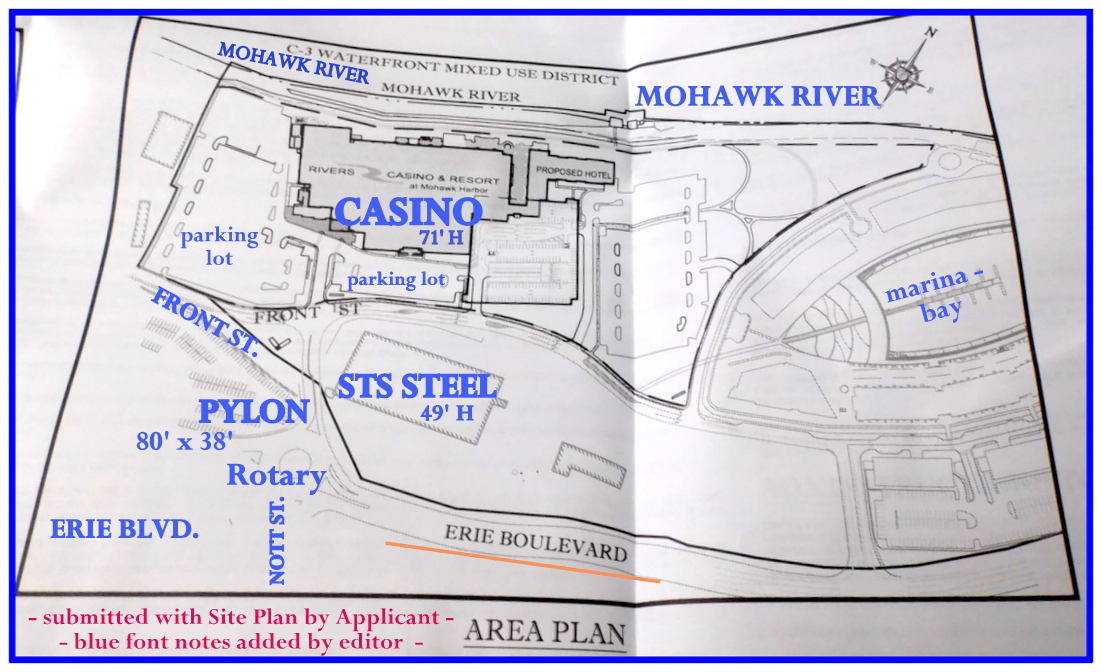
CasinoAreaPlan-001

  • As can be seen on the Area Plan submitted in the Applicant’s Site Plan materials (above), even if the Casino building were not 20+ feet taller than the STS Steel Building (plus, on land raised a few feet to be above the floodplain), the locations and orientation of the two buildings means that STS Steel is not blocking the view of the Casino for traffic heading NE on Erie Blvd. (from I-90, State St. or Union St.), nor for traffic heading SW on Erie Blvd (from the Freedom Bridge or Maxon Rd. Extension) until a vehicle is actually alongside STS Steel.
    • Click here to see the Pie Chart above combined with the Casino Area Plan.

CASINOvSTSvPYLON2

  • Ironically (see mock-up above), the giant pylon would surely block the view of the Casino itself for those coming NE on Erie Blvd., or entering Erie Blvd. from Jay Street, to a far greater degree than the STS Steel Building does. With the removal of the Automated Dynamics Building along Front Street, the view from the block of Erie at Jay Street should be a large open parking lot that permits viewing of the Casino until the point where the pylon blocks the view.
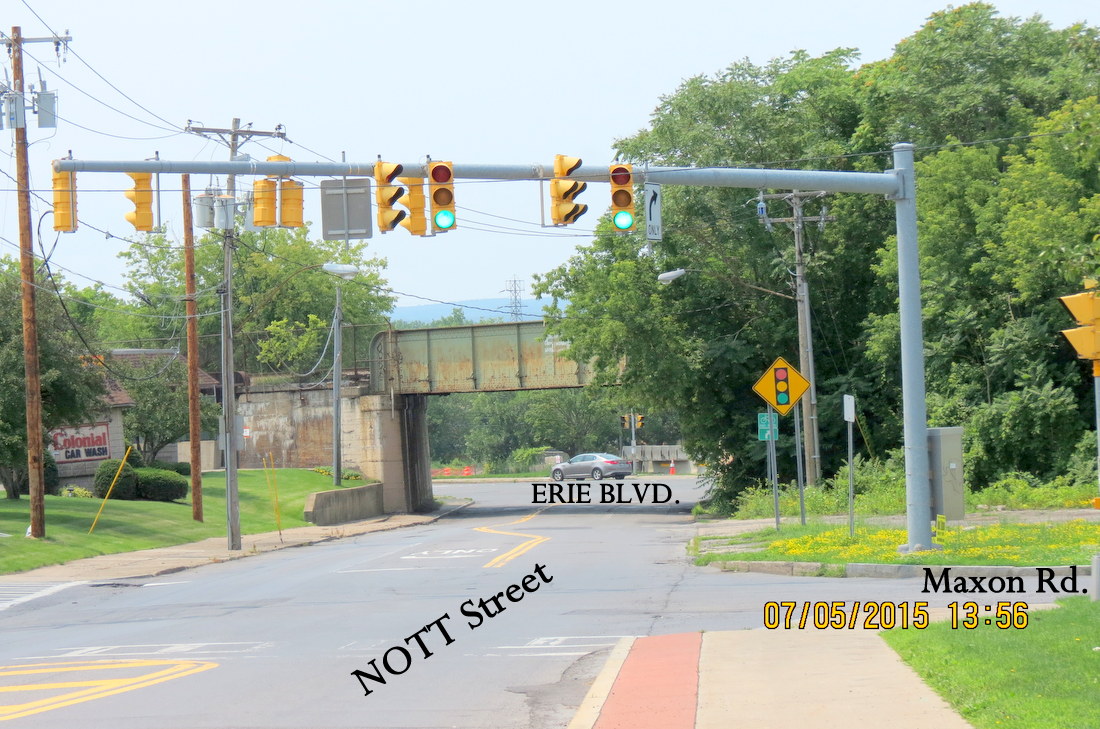
  • viewfromNottStTrestleAnd, even directly across the street from STS Steel and Mohawk Harbor, at the SE corner of Nott St. and Erie Blvd. (under the railroad trestle), a driver should be able to see the top of the Rivers Casino and any rooftop signage over the roofline of the STS Steel Building. The constructed image to the right illustrates the likely view, which should signal even the most oblivious driver there is a Casino neaby.
SatelliteViewMohawkHarbor2

Google satellite view

There’s No View Even Without STS Steel. Finally, and perhaps most telling, due to the terrain, the orientation of the roads, and the existing obstacles, traffic coming northward on Erie Boulevard (from State St. or I-890), or toward Erie Blvd. from Jay Street or Nott St. could not, and should not expect to, see the Casino facility until within a short block of the Mohawk Harbor entrances, even if there were no STS Steel Building.  Click on the Google satellite screenshot to the left of this paragraph, and explore the corresponding Google Map page. Thus: Even with no STS Steel Building, you could not see the Rivers Casino at Mohawk Harbor when driving north up Erie Boulevard (click on photos for larger versions):

. . from Union St.: ErieBlvdAtUnion

. . Erie@Green nor from Green Street, or Jefferson or Monroe:

 . . IMG_8302 . . IMG_8307 . . The Casino/Gaming Building is not in the line of sight up Erie Blvd. If no other structures are in the way, it will be the Galesi-Marina-Mixed-Use portion of Mohawk Harbor coming into view, not the Casino.  This shot looking south from the corner of Nott St. up Erie Blvd. shows that the street layout does not permit a view of the casino when driving north on Erie Blvd.:

IMG_8362-001

Similarly, vehicles coming toward Erie Boulevard on Jay Street could not see the Casino until reaching the RR underpass at Erie Blvd.:

JayStNearErieBlvd

. . Nor could drivers and passengers in vehicles traveling “west”on Nott Street toward Erie Boulevard see the Casino building if there were no STS Steel Building, as the line of sight takes you to the future location of a Casino Parking Lot, not to the actual casino facility:

NottSt-MaxonRd

Given the reality of the Casino “viewshed”, the only reasonable conclusion of those observing the zoning amendment and site plan process to date, is that there are but two reasons giant pylons were permitted in the C-3 Waterfront zoning district: (1) The Gasino Gang wanted them, and (2) no one at City Hall had the courage to do his or her duty and speak truth to power: that the proposed pylon was “the wrong size and wrong location, and the STS Steel Building is simply not a valid excuse”.

MakeBobble-poker

from MakeBobble.com

Like the majority party members of the Schenectady City Council, and the staff at the City’s Planning and Zoning Offices, Members of the Planning Commission are apparently so accustomed to simply nodding their heads in agreement and turning off their B.S. Meters whenever Dave Buicko, Rush Street representatives, Mayor McCarthy, or his Legal Department make an assertion, they failed to notice how silly the claim is that the location of the 49′ tall STS Steel Building justifies an 80-foot pylon monster looming over the intersections of Nott and Front Streets and Erie Boulevard. Of course, given the basic intelligence of the Commissioners and the rest of the City Hall Casino Cheerleaders, it seems far more likely that they simply feel compelled to nod “yes” and to hide behind phony deadline pressures for their Rush to judgment. Perhaps the firm MakeBobble.com (see sample of card player bobblehead at the left of this paragraph), could customize their dolls a bit further for us so that the heads only nod up and down and never shake a “no” reply. When reviewing the proposed amendments to the C-3 Zoning ordinance in early January, we wrote in “the House is already winning” that:

“By merely suggesting the possibility of an 80-foot pylon, Rush Street and Galesi Group demonstrate a brutish lack of sensitivity to aesthetics, safety, neighborhood traditions, and the image and reputation of the City of Schenectady — not to  mention the truth.”

Those strong words have not loss their significance, but it is tempting to be more antagonistic toward the Casino Gang half a year later, given the many half-truths and deceptive arguments they have made in their bamboozling and steamrolling of City Council and the Planning Commission and the public. 316-vector-no-evil-monkeysRNonetheless, it seems clear that the words are even more apt when applied to City Hall — the decision-makers in the Mayor’s Office, the Planning and Law Departments, and those whose votes on the Council and Planning Commission should and could have protected the City and its residents. (Perhaps, I’d substitute the more damning word “irresponsible” for the adjective “brutish” when targeting City Hall.)  Although deceptive business practices are unlawful in our legal system, we expect businesses to use sharp practices when hundreds of millions of dollars are at stake and often wink at them. However, if our system of government is to work effectively, and ever hope to gain the confidence of the people, we cannot permit those who purport to be acting on our behalf and enforcing the letter and spirit of our laws to passively accept arguments and statements that have no basis in fact or law.

the Lago casino HCA and the Mayor

GMcCarthyMug In his June 19th Guest Column in the Schenectady Gazette, Schenectady Mayor Gary McCarthy attempts to answer critics who have asked why he never tried to negotiate a “host community agreement” [“HCA”] or similar benefits package with Rush Street Gaming [“Rush Street”]. (Guest Column, “Mayor: Schenectady casino deal better than Seneca host package“, June 12, 2015, C8, pdf. file) The issue was first raised at this website in late April, in the posting “Mayor McCarthy left millions on the casino table“, with follow-up postings on May 18th, “Money on the Table, Part 2“, and May 27th, “Rush Street’s Giveaways“. Schenectady resident and business owner Mohamed Hafez, asked the Mayor directly about host community agreements at a City Council meeting on May 11th, and at subsequent meetings.

. . share this posting with this short URL: http://tinyurl.com/LagoPayments

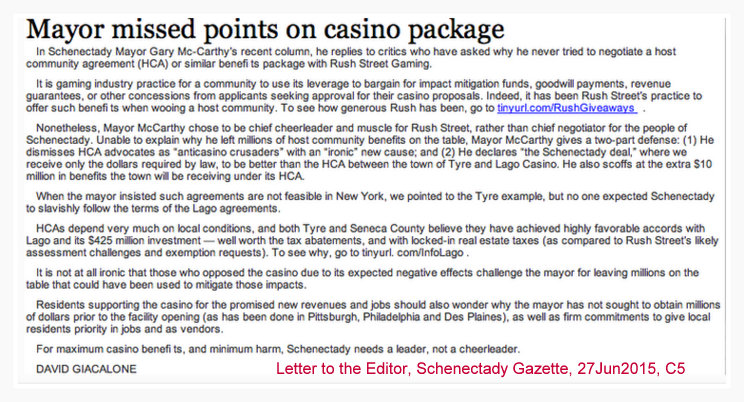
 Mayor McCarthy replied to Mr. Hafez that such agreements are not required here, as they are in Massachusetts, and are not feasible in New York, because gaming tax revenues are paid directly to the State which redistributes a portion to the Host County and City.  That attempt by the Mayor to excuse his failure to seek a community benefits package from Schenectady’s casino applicant led both this website and Mr. Hafez to refer the Mayor to the Host Community Agreement [“HCA”] signed last year by the Town of Tyre with Wilmorite, the developer of the Lago Resort and Casino, in the Fingerlakes County of Seneca New York (which is described in detail at the bottom of this posting).  On June 5, 2015, the Gazette published a Guest Column by Mr. Hafez explaining the need for a host community agreement in Schenectady, and describing aspects of the Lago HCA. “Schenectady in need of host deal for casino” (reprinted here). That column led the Mayor to ask the Gazette for an opportunity to reply. [To see David Giacalone’s Letter to the Gazette Editor in response to Mayor McCarthy, click this link: “Mayor missed point on casino package“, June 27, 2015, C5.]

Mayor McCarthy wrote in the resulting Gazette Guest Column that the casino deal Schenectady has with Rush Street Gaming is superior to the Lago-Tyre Host Community Agreement. The Mayor compares select figures from the Lago HCA and the Tax Accord between Lago and the Seneca County Industrial Development Agency (IDA) and declares the “Schenectady deal” (there is no agreement) to be better. That is apparently because Lago received tax incentives/abatements not granted by Schenectady or Schenectady County to Rush Street, and the projected annual share of gaming tax revenue for the City of Schenectady, $4.1 million, is larger than the estimate of $3.9 million for Tyre/Lago.

TyreLogo Comparing individual, selected pairs of numbers from Seneca County and Schenectady proves little when Schenectady, with a population of 66,000, has nearly 70 times more residents than Tyre, and Seneca County, at 35,000 residents, has less than a quarter of the population of our County. The important point is that both the Town and the County IDA decided to do their homework (i.e., learn what potential host communities have done elsewhere and what the Town’s legal rights are, while commissioning a study to identify likely impacts, and quantify costs and benefits), and then to actively negotiate with their suitors. As a result, they each believe they have negotiated very favorable terms with Lago.

For example, Wilmorite is investing $425M at Tyre (40% more than Rush’s plans at Mohawk Harbor); the jobs it brings will cut the County’s unemployment rate significantly more than similar numbers of employees could do here; and the sales taxes generated due to Lago’s construction and operation will be significantly more than the annual sales tax abatement it has been offered. Seneca County will also receive payments during the period of its IDA accord with Lago that will offset the mortgage tax abatement granted to Wilmorite.

ida-lago-cost-benefit-analysis-table11 The IDA’s Lago Cost/Benefit Analysis concluded that the benefits from Lago for the County will be 51 times greater than its costs (including tax abatements), without counting the enormous benefits of the largest construction project in the County’s history. [summary chart at left; click on image to enlarge] And, Tyre, by the way, is expecting about $4000 in annual gaming revenues per resident, whereas Schenectady’s share of gaming revenues will be about $62 per resident. Moreover, the millions in extra mitigation payments by Lago that are scoffed at by Mayor McCarthy will be about $500 per Tyre resident per year, while Schenectady won’t be getting one cent.

According to the Seneca County IDA (Q & A on the Lago Resort & Casino Tax Accord, Feb. 12, 2015; empasis added):

A study commissioned by the IDA estimates the project will have a $1.8 billion economic impact in Seneca County. The project would also generate $45.3 million in payments to Seneca County; the Waterloo Central School District; infrastructure improvements; and more over 20 years.

As part of the proposed agreement, Seneca County would receive $3.83 million more than it would have expected to receive thanks to efforts by the joint IDA and County project advisory committee. This level of payment would exceed the level that would be projected to be paid under the already available New York State statutory 485-b property tax exemption program that this project would qualify for. For nearly 40 years, New York State has offered this 50 percent property tax exemption to businesses that invest $10,000 or more per year on building enhancements.

All of this is in addition to the Host Community Agreement with the Town of Tyre that will generate a projected $10.5 million in payments over 20 years to provide additional services such as fire, ambulance, and sheriff.

This said, Wilmorite has applied for a tax agreement covering sales, mortgage and property taxes. These include $16 million in New York State, regional and local sales tax exemptions, and $3.35 million in New York State and Seneca County mortgage tax exemptions.

As part of the accord, the developer has committed to purchasing construction materials and supplies from Seneca County vendors whenever possible, offsetting the local sales tax exemption.

In addition, as part of the accord, Seneca County would receive payments in future years, offsetting the mortgage tax exemption.

. . . .

For the reader’s convenience, we are repeating below our lengthy discussion, from the earlier posting “Money on the Table, Part 2“, of the Host Community Agreement between the Lago Casino and the Town of Tyre.

.

 Lago at Tyre. More telling than Albany’s efforts to obtain a community host agreement is what happened with the Lago Casino & Resort in the Town of Tyre, a tiny agricultural community in Seneca County, NY, which was the eventual “winner” in the Finger Lakes Region. Although Tyre has a population below one thousand, its leaders had a thoughtful and thorough response when they learned that the Wilmorite Corp. [also known as Wilmot] wanted to put a casino on a parcel within the Town. Beyond getting itself good legal advice and keeping its residents fully informed and involved, the Town commissioned the study “Impacts of Wilmot Casino on the Primary Impact Area: Emphasis on Socioeconomic & Public Safety” (June 2014, 44-pages), which was prepared by the Center for  Governmental Research, in Rochester, NY. Tyre also requested Cornell University to review and summarize a compilation of Canadian studies on the impact of casinos, especially problem gambling.

The well-informed leaders of the Town of Tyre Board of Supervisors were, therefore, prepared to negotiate a Host Community Agreement [“Tyre HCA”, June 2014, ] with the Applicant. (The HCA notes on its title page that the Agreement constitutes a “Community Mitigation Plan, as Contemplated by the Upstate New York Gaming Economic Development Act of 2013.”) The lengthy list of responsibilities accepted and covenants made by Wilmorite, the Tyre-Lago Applicant, is a testament to the thoroughness of preparation of the parties, and also to the strong desire of Wilmorite to secure the approval of the Town Board and be a good neighbor if it were selected for the Finger Lakes Region gaming license.  (For a good summary of the terms of the Tyre HCA, see “Details of casino host community agreement unveiled“, Finger Lakes Times, by David L. Shaw, June 13, 2014.)

 The Lago Casino owner-devloper agreed that, among other things, it would:

• Pay all costs and expenses incurred by the town for attorneys, accountants, engineers, consultants and others in connection with the casino review process.

• Pay the town $100,000 annually from 2016-21 for the purchase of development rights or other action related to the preservation of agricultural land in the town, to mitigate the loss of farmland.

• Preserve the graves in six known burial sites on the land.

• Pay for the training of a security force acceptable to the Seneca County Sheriff’s Office; for special training of deputies, as needed; and up to $100,000 a year for the anticipated hiring of an additional deputy because of the casino.

• Pay the cost of a new high-rise firefighting equipment for six Magee Fire Department firefighters and will pay the cost of a ladder truck for the department.

• Pay for any medical training required by North Seneca Ambulance personnel who respond to the casino for emergencies. If North Seneca handles a casino patient whose insurance does not cover the entire cost, the company will make up the difference.

• To fulfill a previous agreement with Seneca County Mental Health Department, pay for hiring one additional problem gambling treatment and one additional problem gambling prevention specialist. [Note: the protocol for setting up a Problem Gambling Prevention, Outreach and Education Program looks like a good place for Schenectady County to start to construct its own program.]

• Pay all on-site employees wages no less than 75 percent of the national average for each occupation.

•  To mitigate impacts on town services, pay the town $750,000 in 2015, $2 million on Jan. 15, 2016 (prior to operation), and $2 million on Jan. 15, 2017. For 2018 and beyond, the impact fee will be at least $2 million and be adjusted by formula. Once it begins operation, the Casino will receive credit for Gaming Tax Revenues received by the Town. That is, the Casino must make a prepayment of the annual minimum Impact Fee each January 15, with the Town refunding to the Casino the amount that it receives as Gaming Tax Revenues each year.

• Construct, install, operate and maintain, a six-inch private-force sanitary sewer main from the casino to the existing Petro orRoute 414 pump station.  And, construct and install a new water-line connection to the existing 12-inch water line located on the east side of Route 414, and work to create or extend a water district that includes the casino site. [Note: as anticipated by the Location Board’s application form, the Schenectady casino applicant has stated it will make analogous necessary utility improvements.]

• Design a telecommunications infrastructure for the casino, with at least one strand of fiber-optic cable dedicated to the town and its residents.

  • Implement, at its sole cost and expense, all actions described in the Engineer’s Report prepared for the SEQRA review, and perform all other traffic improvements recommended or required by the New York State Department of Transportation. [Lago estimates that the traffic mitigation measures will cost $4,152,500.]

• Apply to the Seneca County Industrial Development Agency for a payment-in-lieu-of-taxes on property and other taxes. [In the resulting accord with the County IDA, Lago agreed to pay $45.3 million over a 20-year period. That amount, according to the Agency’s estimates, is $3.83 million more than Lago Resort would pay if the project were fully taxed under the New York State statutory 485-b exemptions (which have long been available to businesses that invest $10,000 or more per year on building enhancements). See IDA Press Release, Feb. 12, 2015.]

  • Recognize the right of property owners near the Project to continue farming consistent with past practice using good agricultural practices.
  • Limit its lodging facilities to no more than 220 rooms, unless the Company provides the Town with independent forecasts that demand exists in the area for additional rooms, in order to limit the impact on other lodging establishments in the region, during the first ten years after gaming operations open to the public.

• Take out a $4 million mortgage on the project to secure the company’s obligations to the Town and County. The town will be given first priority lien on the mortgage.

  • Engage in Periodic Review and good-faith negotiation to deal with additional payments for unanticipated or miscalculated impacts, up to $1 million per year.

In accepting the Tyre HCA, the Lago Casino developer acknowledged that construction and operation of Lago would have both direct and indirect impacts on the community. Unlike the Mohawk Harbor Applicants in Schenectady, who denied or trivialized any impact on Schenectady or nearby communities, Wilmorite signed an Agreement stating:

Direct Impacts. The Company acknowledges that the construction and operation of the Project will cause direct impacts on the Town and its residents, including but not limited to impacts on Town infrastructure, environment, public safety, emergency services, social and other impacts (“Direct Impacts”). The Company shall mitigate the Direct Impacts in the manner described in this Article III.

. . . [And]  Indirect Impacts. (a) The Company acknowledges that, in addition to the Direct Impacts described above, the Project will also have known and unknown indirect impacts on the Town and its residents, related to or indirectly resulting from the construction and operation of the Project from time to time (“Indirect Impacts”). Indirect Impacts include, but are not limited to:

(1) increased use of Town services;

(2) increased use of Town infrastructure;

(3) the need for additional Town infrastructure, facilities, equipment and employees;

(4) increased traffic and traffic congestion;

(5) issues related to public health, safety, welfare and addictive behavior;

(6) issues relating to quality of life; and

7) costs related to mitigating other indirect impacts to the Town and its residents.

Schenectady’s City Hall never demanded a benefits or mitigation agreement with Rush Street and Galesi.  Indeed, the Mayor and his Administration, Metroplex, County officials, the Chamber of Commerce, and hopeful casino vendors, have never admitted to any likely negative effects. As a consequence, the City never did or commissioned any independent research or investigation that could be used to rebut the glib and facetious claims of the Schenectady Applicant that its casino would have no significant added costs or negative impact on the City, nearby neighborhoods or towns, or the County. This lack of vital information caused the only non-Democrat on City Council, Vince Riggi, to refuse to vote in favor of the proposed casino.

answering Mayor McCarthy on HCAs

mayorgarymccarthy2013bwWe’re pleased that the Schenectady Gazette Editorial Page allowed us to respond yesterday (Letter to the Editor,“Mayor missed point on casino package“, June 27, 2015, C5) to the Guest Column by Schenectady Mayor Gary McCarthy panning the Host Community Agreement notion. (see “Mayor: Schenectady casino deal better than Seneca host package“, June 12, 2015, C8, pdf. file) Due to space limitations, our Letter to the Editor was limited to 400 words. The longer 1st Draft follows. [Also see, “the Lago casino HCA and the Mayor”]

Lago Lessons the Mayor Missed

In Schenectady Mayor Gary McCarthy’s June 19th Gazette Guest Column, he answers critics who have asked why he never tried to negotiate a “host community agreement” [“HCA”] or similar benefits package with Rush Street Gaming [“Rush Street”]. (Schenectady Gazette, “Mayor: Schenectady casino deal better than Seneca host package“, June 12, 2015, C8, pdf. file) It is gaming industry practice, and common sense, for a potential host community to use its inherent leverage to bargain for impact mitigation funds, goodwill payments, revenue guarantees, or other concessions. But, Mayor McCarthy has chosen to be chief cheerleader and backroom muscle for Rush Street, rather than chief negotiator for the people of Schenectady.

We pointed the Mayor to the Lago-Tyre Host Community Agreement to rebut his excuse that such agreements were not feasible in New York State, not to recommend slavish adherence to its particular terms. Rather than learn from the Lago example, McCarthy made a two-pronged attack on the HCA: (1) Dismiss the messengers as foes of the casino with an “ironic” new cause, and (2) stress cherry-picked and unexplained numbers. It is, of course, not at all ironic that those who opposed the casino due to its expected negative effects are taking the Mayor to task for leaving millions of dollars on the table that could have been used to mitigate those impacts and improve Schenectady. Casino supporters also expect the Mayor to maximize casino revenues, jobs, and community benefits.

HCAs are not cookie-cutter affairs, but are tailored to each community’s situation. Comparing selected pairs of numbers from Seneca County and Schenectady proves little when our situations are so different. Schenectady has almost 70 times more residents than tiny Tyre, and Seneca County has less than a quarter of the population of our County, and far less development momentum. Unlike Schenectady, both Tyre and Seneca County did their homework: They learned what host communities have done elsewhere, they commissioned studies to understand the impact of a casino and to quantify its costs and benefits, and they actively and successfully negotiated with their casino applicant.

TyreLogoB&W As a result, Tyre and Seneca County believe they have negotiated very favorable terms with Lago. For example, an extensive study by the County Industrial Development Agency claims that the benefits from Lago for the County will be 51 times greater than its costs. Wilmorite is spending 40% more developing Lago ($425M) than Rush is at Mohawk Harbor. And, the property tax accord will bring in $3.83 million more over the next 20 years than the County would have otherwise expected.

For a detailed discussion of the Lago agreements, see tinyurl.com/InfoLago .

In contrast, the Mayor’s approach has earned Schenectady not one penny more than the law will demand from Rush Street once its Mohawk Harbor casino is in operation, and nothing prior to opening. Moreover, Schenectady has no reason to believe Galesi will freely give up its scandalously low PILOT payments, nor that Rush Street is likely to give up its practice of challenging tax assessments and seeking every available exemption. More important, with no pressure from the Mayor and no cost analysis undertaken by the City, Rush Street has never stepped up, as Lago did, to acknowledge both the reality of negative impacts and its obligation to mitigate them with payments in addition to the gaming revenue taxes it must pay.

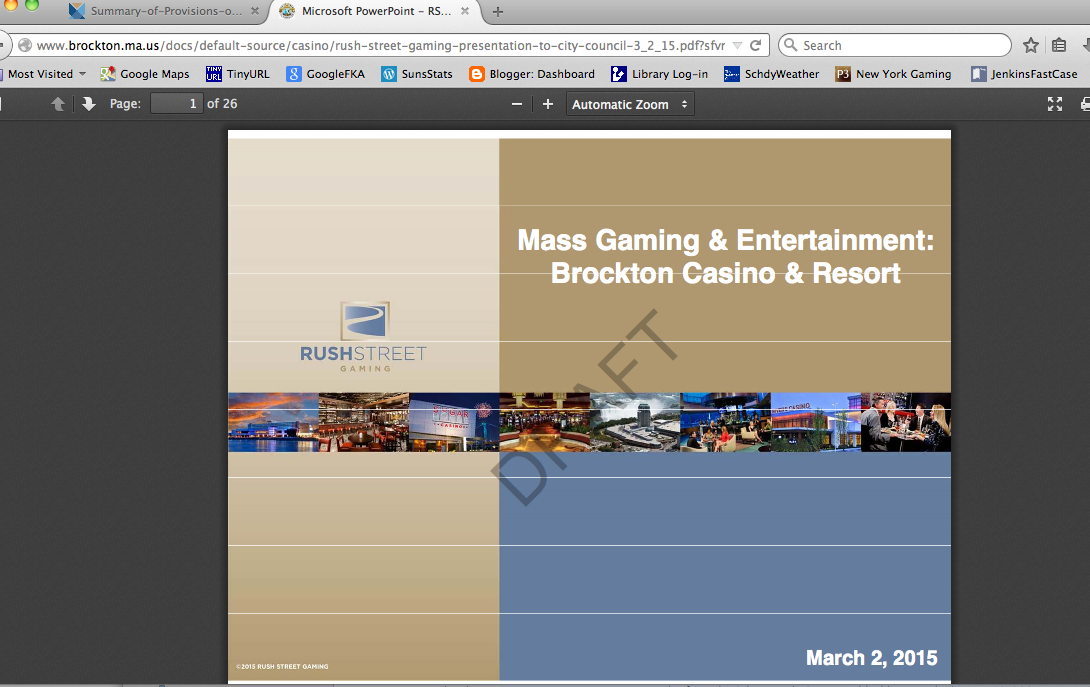
Schenectady could have done much better. Rush Street has offered each of its other existing and proposed casino locations various payments and community benefits beyond what the law requires, including millions prior to opening, millions in guaranteed annual revenues, large ongoing community benefit and mitigation payments, local job and vendor preferences, and more. It even agreed to guarantee waterfront access and build a Green Roof in Philadelphia, and to give Brockton a guaranteed $10 million a year in benefits, along with its beautiful casino design.

To see how generous Rush Street has been outside Schenectady, and what Mayor McCarthy might have achieved, go to tinyurl.com/RushGiveaways .

David Giacalone

Editor, StopTheSchenectadyCasino.com

Schenectady, New York

why does Schenectady get Rush Street’s scraps?


MinorLeagueSchdy  
I
t seems obvious that a “destination resort casino” should be designed to look and feel exciting and extraordinary.  The Gazette editorial board thinks so, and so does our Planning Commission.  Why, then, has Rush Street Gaming handed us two minor league designs, just boxes on boxes, and a casino complex easily relegated to the realm of humdrum regional facilities? It is not because Rush Street does not know how to put a little sparkle or class in a casino design. Click on the collage to the right of this paragraph to compare the two Schenectady designs with three others recently proposed by Rush Street. (You can also click the following links to see separate images of the gaming facilities in Worcester (also here and there), and Hudson Valley, as well as Brockton 1 and Brockton 2, and Millbury; also, see our posting “Schenectady casino redesigned“, June 4, 2015).

  • FallsView

    Fallsview

    A flashy digital brochure submitted to the New York State Gaming Commission, “The Companies of Neil Bluhm,” touts his having “developed and acquired over $50 billion in world class destinations,” his “Establishing international beacons to successfully attract the tourism market,” and “placing an emphasis on superior design” for his casinos. Unfortunately, instead of an “international beacon” like Fallsview Casino in Ontario, Canada, we get a design that reminds us Neil Bluhm “pioneered . . . the creation of urban shopping centers.”

  • According to the Worcester Business Journal (April 25, 2013), when Rush Street Chairman Neil Bluhm was unveiling their concept design for the 120,000-square-foot Worcester facility, he “called it beautiful and said it ‘will fit well with the surrounding area and enhance the neighborhood’.”
    • Bluhm was right to call the Worcester design beautiful, and we have to give him credit for not trying to tell us the same thing about either Schenectady design.
  • By the way, I wonder how much the architect bill was on each of the projects shown in the above collage. Considering they cloned the Des Plaines model for the 1st Schenectady design, and Rush Street CEO Jeff Carlin said the 2nd Schenectady design is just prefab modular that makes it easy to change, I bet the other projects were a bit more dear.
  • Share this posting with this short URL: http://tinyurl.com/RushScraps

Our first guess as to why Rush Street does not try very hard for Schenectady is that it has had our “leaders” fawning over it ever since the first rumor of a casino was in the air early last year.  This morning’s Schenectady Gazette suggests another reason: As with the earlier zoning amendments, the normal Planning Commission process has been aborted (hijacked?), with the skids greased by the Mayor to make sure Galesi and Rush Street never have to wait very long to get their wish list fulfilled, and with public input stifled whenever possible.

Thus, the Gazette reported that “Schenectady Planning Commission held closed meetings on casino plans – State official: Sessions legal but ‘evasive’” (by Haley Viccaro, A1, June 19, 2015). Observers of Schenectady’s government in action are “seldom surprised, but often shocked” and disappointed. The revelation that our Planning Commissioners met in 4-person “subcommittees” with Rush Street Gaming and the Mayor to discuss the important issue of casino-design is not surprising.  By meeting short of a 5-person quorum, the Commission did not legally have to give notice or have the meeting open to the public.

Bob Freeman, executive director of the state Committee on Open Government, was probably correct that it does not violate the Open Meetings Law to hold a single non-quorum session on a topic, but that “it demonstrates a lack of transparency,” and might not pass judicial muster “If there is an attempt to evade the Open Meetings Law by ensuring that a series of gatherings will include less than a quorum.” Freemen bemoaned the fact, as do we, that the Planning Commission left the public in the dark about a major development.

A major problem with Planning Commission Chair Sharran Coppola having held the pre-Meeting sessions with Rush Street, is that she thinks those chats justify not discussing the design issues during the Public Meeting this week.  If you care about the design issue (much less good government), you are very likely to want to know what the Commissioners are thinking and suggesting about the need to re-do the redesign. Left in the dark, the public has to comment about their design wishes in a vacuum, mostly complaining about its overall reaction to the Factory-Retro second design, rather than saying what it likes and does not like about the new suggestions, and giving alternatives.  In other words, we will probably be facing a fait accompli on July 15, and be (sadly, as always) wasting our time addressing the Commissioners.

The following is an online comment left by myself (David Giacalone) at the webpage of this morning Gazette‘s article. It suggests that Rush Street be required to submit its redesign by Independence Day weekend, and it reminds the Gazette readership and the Commissioners that no one was excited about the first Schenectady design, and it should not become the fallback outcome by default.

Comment to the Gazette:

DesPlainesCasinoCollage

real photo from Des Plaines

By depriving the public of a discussion among the Commissioners, its staff, and the Casino, concerning the design of the Casino, the Commission has made it impossible for the public to make meaningful comments over the next couple of weeks about the design “retooling” and to have any significant impact on the final design. Saying what we don’t like about the 2nd design is not an adequate way to work toward a much-improved 3rd design.

Schenectady surely does deserve a spectacular design for its casino. From the start, many of us pointed out that Rush Street’s competitors understood that a destination casino must look special, while our applicant seemed to be willing to settle for a very modest “regional” casino look, and the City Hall yes-persons failed to ask for something better.

Prior to the release of the Factory-Retro red brick 2nd design, I saw and heard no praise of the first design. At best, when anyone pointed out how much it looked like a gaudy version of a 1970’s mall cineplex, and was a retread of the underwhelming, mid-West-snazzy Des Plaines Rivers casino, the reply would be, “gee, it’s not that bad.” It is my hope that the Planning Commission, Mayor and Rush Street do not simply return to the mediocre first design, adding some redbrick coloration here and there. We also should not fool ourselves that the constructed casino will look like the rendition. To see how reality differs from the Rush Street drawings in Des Plaines, go to http://tinyurl.com/DPClessons .

The Applicant should be required to submit its next design proposal before the Independence Day weekend, so that the public can give meaningful input prior to the Commission’s July 15 meeting. We deserve more than a Done Deal sprung on us at the last minute. And, because the deadline for opening the new casino is at least 26 months away (and Rush Street insists they only need 16 to 18 months for construction), the Commissioners should be willing to have a 3rd public meeting on the Site Plan in order to give it adequate review.

I’ve seen this Commission force “little guys” to come back two and three times over things as insignificant to the public as the color and shape of their tiny storefront sign. Mohawk Harbor deserves closer scrutiny than a two-meeting rush on something so complex and important. And, of course, the public needs to be in the loop, not out in the hallway due to some 4-person loophole.

shrink that casino pylon! (with updates)

 How Big? See “how big is 80 feet by 38 feet?“, and click on the collage to the left. Yep, it’s bigger than the façade of Schenectady’s former Masonic Temple.

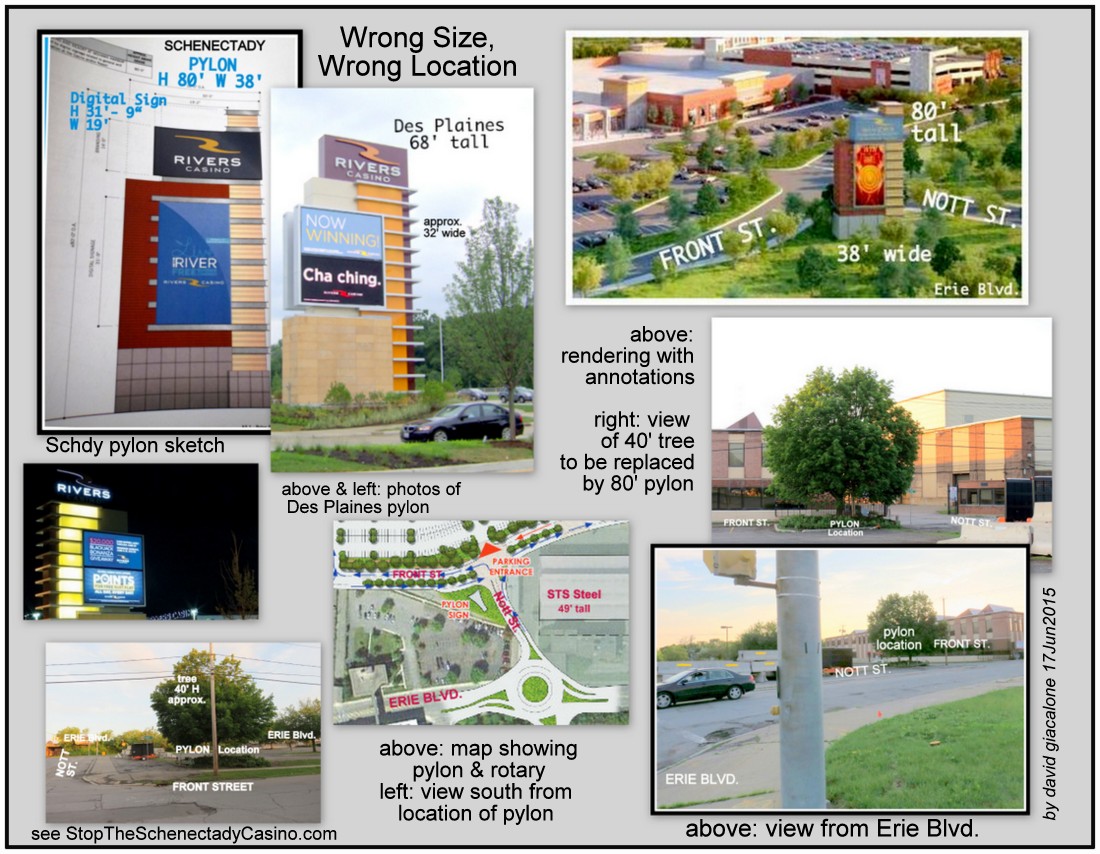
 casinopylonTree . . . update (June 17, 2015): Click for Comments to the Planning Commission regarding the proposed Casino Pylon (9-page pdf.). The submission collects, organizes, and amplifies points made below, arguing that the Pylon is the Wrong Size and in the Wrong Place. Rush Street’s argument that the pylon is needed because the STS Steel Building blocks the view of the Casino is rejected, and elements making this location highly hazardous for traffic are detailed. [a Wrong Size/Wrong Place collage, which is part of the submitted Comments, can be found at the bottom of this posting.]  Incidentally, the proposed location would require removing a large, healthy tree — probably the loveliest tree on the overwhelmingly barren Mohawk Harbor property (see photo at the left). Site Plan review factors include “the maximum retention of existing vegetation” [§264-89(G)]. We need a tree-hugger or two on the Planning Commission.

Haley Viccaro at the Gazette covered the Commission meeting in an article you will find here; the Times Union‘s Paul Nelson blogged about it here. The Gazette reported that East Front Street Neighborhood Association’s Mary Ann Ruscitto opposed the pylon, saying “We don’t want the giant big sign at the entrance to our neighborhood.”

– share this post with the short URL: http://tinyurl.com/RushPylon

.

original posting:

Which sign would you prefer as the symbol of Schenectady?

GESign2

General Electric’s famous sign, atop historic Bldg. 37 

 . . . or

DPCpylon4border  . . .  DesPlaines68

. . . an even larger version of the Rivers Casino pylon in Des Plaines IL, which is shown above and to the right of this caption.

Imposing as it is, the Des Plaines pylon would be the shorter little brother of its Schenectady sibling. If the enormous “pylon edifice” proposed by Rivers Casino at Mohawk Harbor is erected at the size and the location (close to Nott & Front Streets, and Erie Boulevard) requested by Rush Street Gaming and developer Galesi, it will almost certainly become the new symbol of Schenectady for all outsiders and newcomers, and soon local residents, too.  A few facts:

  • The Des Plaines pylon above is a mere 68′ tall, with a digital display about 25′ tall, plus an additional light-box taller than its digital sign.  When presenting their requested Schenectady zoning amendments earlier this year, David Buicko of Galesi Group said the Des Plaines pylon was similar to the one he was proposing for Schenectady. The slide showed to the Commissioners was a daytime photo of the Des Plaines pylon, in which the lightbox did not appear to be illuminated.
  • CasinoPylon-4Jun2015

    proposed pylon

    The proposed Schenectady pylon is significantly larger: It would be 80′ tall, 38′ wide, with a digital display 32′ high and 19′ wide, and it would have an edge design the entire height of the pylon that we presume is also a light-box.  The only explanation given for the increased size by Galesi Group COO David Buicko was that they needed it to be visible above the STS Steel Building so that the Casino could easily be found. The STS Building is, in fact, only 49′ tall. More important, it blocks only a fraction of the view from the street to the Casino, and none of the riverside view. Ironically, the tall and broad pylon will block the view of the casino for traffic heading east on Erie Boulevard far more than does the STS Building.

    • It was finally announced at the July 22 Planning Commission meeting that the “multisided” pylon will not simply have a message on the front and back. It will by “v” shaped, with wing of the vee facing toward Nott and Erie, and the other facing westward toward Erie and Jay St.
  • The GE sign’s giant letters are only 10′ tall, and its circular logo is 36′ in diameter, only 4 feet taller than the Casino pylon’s digital sign, and with a simple “message” considerably less distracting and less visually intense, due to the “dead space” between the illuminated portions of the logo. The GE signs sits upon historic Building 37 (site of the first corporate research facility in the nation), which is 73.89 feet tall, and sits far back from the street and from any residential or commercial neighborhoods.
  • The new Waterfront Zoning amendments allow the casino to have more than one 80′ pylon, with no stated limit.
  • Philadelphia has a lot of tall buildings that could block the view of a pylon or other freestanding sign. Nevertheless, in its Casino Zoning District, where Rush Street has its SugarHouse Casino, no freestanding sign may be taller than 40′. [Philadelphia Code, §14-405(8)] In addition, and also for safety reasons, the City of Philadelphia allows no digital displays within 200′ of an intersection. [Philadelphia Code, §14-904 (1) (b) Digital Display]

pylonrenderlocation

– above: location and size of proposed Schenectady Casino pylon –

pylontree2 . . . pyloncorner

– above (click on image to enlarge): corner where 40′ tree would be replaced with 80′ casino pylon, with Erie Blvd. a short block to the south; and see Pylon Collage 2, below –

ParkerBldg

How wide is 38 feet? It is the length of two large SUVs parked nose to nose. The Parker Building, next to Proctors, is only 24 feet wide. (For many decades the tallest building in Schenectady, it is 99 feet tall.) As mentioned above, the giant GE Logo is only 36′ in diameter.

  • For safety reasons, the NYS Department of Transportation cautions that off-site variable electronic signs should not be located so as to distract from nearby traffic control devices, nor be closer than 300 feet apart if more than one variable sign is visible to a driver at the same time. In addition, DOT requires that such digital signs appear no brighter at night than during the day, and no brighter than other signage such as billboards. See Criteria for Regulating Off-Premises Commercial Electronic Variable Message Signs (CEVMS) in New York State (2014).

casino-accessplan-frontst update (June 15, 2015, 5 PM): A visit to review the site plan this afternoon at the Schenectady Planning Office confirmed that the proposed pylon would not be located within the Casino Compound, nor merely close to Nott St. and Erie Blvd. It would be at the SW corner of the intersection of Front St. and Nott St., a few yards down from Erie Blvd., on what must be the shortest block in Schenectady. That short, narrow block will also be the point where vehicles will be exiting the planned traffic rotary, with drivers craning their necks to read the messages on the giant digital display. The plat detail to the left of this paragraph shows the pylon’s location and proximity to Erie Boulevard and the Rotary. (And, see this annotated detail from the Site Plan.)

Moreover, Front Street will be extended across Nott St. into the casino compound, rather than dead-end at that point, as it does now.  The intersection of Nott and Front Streets will be busy, and particularly confusing to first-time visitors to the Casino, or to customers leaving under the influence of alcohol.

SchdyPylonSketch2

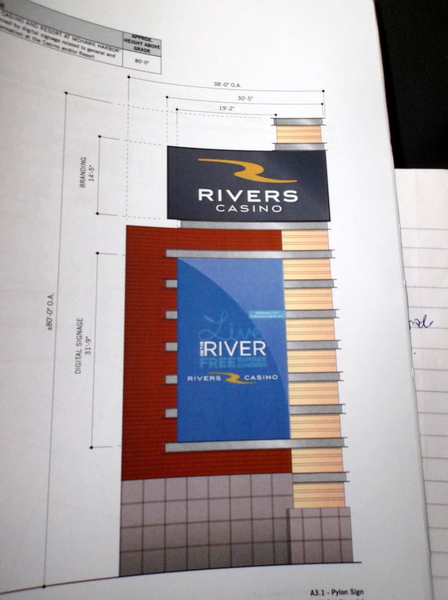
To the right is a sketch of the proposed Schenectady pylon from the Site Plan submission. (Click on it to enlarge.) It shows the color scheme and gives the dimensions of various portions of the sign.

Thanks to All Over Albany for linking to this posting and covering the re-design issue.

It is worrisome that our City’s planning and development staff are now in the position of supporting signage of this nature along such a busy and important stretch of roadway. In 2008, the proposed City of Schenectady Comprehensive Plan would have inadvertently required the GE Sign to be removed within two years, because rooftop signs are no longer allowed, and the Plan called for all illegal signs to be removed by 2010. They wisely ended up declaring that only illegal freestanding signs must be removed by 2010. Ironically, Schenectady chief zoning officer Steve Strichman stated back in 2008 that their goal was to remove “oversized signs that have been more recently installed in front of other businesses.” As the Gazette put it (in “Rule nearly brings down GE icon“, by Kathleen Moore, February 2, 2008):

Strichman aims to rid Schenectady’s streets of highway-oriented signs that are “out of pedestrian scale.”

If there were ever to be a freestanding, roadway-oriented sign in front of a business in Schenectady that is “out of pedestrian scale”, it would be the pylon monstrosity proposed for our Rivers Casino. casinotownlogo I’m hoping that Steve Strichman is as chagrined about the Rush Street/Galesi pylon proposal as we are. And, that Steve is pressing hard in the Planning Office to shrink that pylon to a manageable size. Of course, we cannot know what size is truly manageable without line-of-sight studies that have yet to be done. For additional discussion of issues raised by erection of the proposed pylon, see our recent post “lessons learned from the Des Plaines casino“; and, see our Pylon Collage at the bottom of this posting.

Symbol of Schenectady? In addition to the GE Logo Sign, Schenectady residents might prefer the Stockade’s statue of Lawrence the Indian (a mere 13 feet high, including base), the new, human-size memorial to Edison and Steinmetz, or Union College’s splendid Nott Memorial (103′) as Schenectady’s symbol.  Casino Town is, however, the wrong image for Schenectady, whether done in futuristic, shopping mall retro, or faux-factory style. We are a proud City preparing for a casino, not a desperate one willing to be branded a Casino Town. No matter what the Mayor, Metroplex or the Chamber of Commerce want us to believe about the Casino honoring our past and symbolizing our future, that pylon needs to be cut down to size and put in its proper place.

PylonCollage

-click on the collages above and below to enlarge the image –

PylonCollage2a

a must-read Letter by Jessie Malecki

Jessie Malecki has a Letter to the Editor in today’s Schenectady Gazette that deserves wide distribution and much consideration at City Hall. (June 12, 2015, C6):

what was the rush for casino approvals?

I hope everyone in the city of Schenectady had the opportunity to read Mohamed Hafez’s June 5 guest column, “Schenectady in need of host deal for casino.” That surely is an eye opener showing us what our city administration has neglected to do in dealing with Rush Street Gaming and the Galesi Group.

It is one thing that a casino will be coming to our city, but it is another that this administration did not even give the slightest thought that we should have a Host Community Agreement (HCA). This was completely left out of any dealings with Rush Street Gaming or the Galesi Group. [see our posting “Mayor McCarthy left millions on the casino table.“]

In other words, the administration of our fair city not only gave whatever was necessary for these two groups, but just about gave them the keys to our fair city — do what you want. No business is run like that — if it was, it wouldn’t last two days.

Even back in January, The Gazette had a great editorial (Jan. 29), “Public needs to see impact of zoning,” which is an important issue and should not have been taken lightly. Here again, most of the City Council members (except Vince Riggi), including the president, always had the inevitable “excuse” that there is a time deadline and a vote must be made as soon as possible.

There was and is always time to make sure things are done correctly and this was definitely one of them. This project will be here for a long time. By hurriedly voting on this important issue, they gave unlimited heights to buildings, signs, etc. to Rush Gaming and the Galesi Group.

hourglassAlmostFull What was all the hurry because we have a deadline all about? Rush Street Gaming has yet to receive a casino license from the state Gaming Commission, but it is said it will by the end of the year. Ms. King, among many other items needing immediate attention, what was the so-called deadline that you refered to back in January when you had to vote for the Alco site zoning change, which was something that should really have been thought about long and seriously?

The public needed to see the impact of the zoning change, which it did not because the “excuse” of a deadline in everything that was done.

Jessie Malecki

Jessie lives in the Stockade, in the North Street home she was born in during WWI. We are very lucky to have her among the founders of Stop the Schenectady Casino. She has been prolific telling the truth about the coming casino.

You can share this posting with this short url — http://tinyurl.com/LTEjm:

Bonus: Here’s the Guest Column by Mohamed Hafez mentioned above by Jessie:

Continue reading

lessons from the Des Plaines casino

DesPlainesCasinoCollage

Des Plaines Casino Collage

  The release of the new design for Schenectady’s Rivers Casino at Mohawk Harbor (see our June 6th posting) has started a robust debate that we hope will stir the City’s Planning Commission to actively evaluate and appropriately modify the casino Site Plan, which they will first treat in public on June 17, 2015.  Press coverage has included: Schenectady Gazette (subscription needed): “Reaction mixed on new casino design” (by Haley Viccaro, June 6, 2015); “Rethink the new casino design” (Editorial, June 7, 2015); “History shouldn’t repeat itself at casino” (column by Sara Foss, June 7, 2015); and Letters to the Editor: “Casino design could use historic charm” by Virginia Newton, and “New design of casino screams out ‘cheap’” by Suzanne Miller (June 10, 2015, scroll to 3rd Letter). And, Albany Times Union (subscription needed): “Redesign of Schenectady casino is a dud” (column by Chris Churchill, June 9, 2015).

TU‘s Chris Churchill rightly points out that:

[T]he city should demand better. The casino is a once-in-a-lifetime project and opportunity.

It’s too important to get wrong. It should be a knockout. 

photos taken by visitor at DPCR

photos taken by visitor at DPCR

Churchill also noted that the Planning Commission “would probably approve the casino if it looked like a giant Taco Bell.” Indeed, so far (e.g., with the C-3 zoning amendments), the Commissioners and Planning-Development Staff have acted like sleepy, toothless watchdogs, deaf to the requests and opinions of anyone other than the Casino Applicant (operator Rush Street Gaming, and The Galesi Group, site owner and developer), our Mayor Gary McCarthy, and County Planning satrap Ray Gillen. We hope the photos and images in this posting from Rush Street Gaming’s Rivers Casino at Des Plaines (Illinois) [“DPRC”] will prove more persuasive than the previous arguments and suggestions of many well-intentioned Schenectady residents.

The Des Plaines casino images in the Slideshow below teach us at least three important lessons:

  • As Rush Street has indicated over the past year, the first Schenectady Casino Design, from June 2014, is like a fraternal twin to the Des Plaines casino, with minor cosmetic changes and element slightly re-arranged. We got hand-me-downs from our Midwest sibling, not a Schenectady-specific design.*/

DPCrender2  . . .  Casino-RenderResort

– renderings: [L] Des Plaines Rivers Casino and [R] Schenectady’s Rivers Casino –

  •  The “reality” of the Des Plaines casino’s exterior is significantly less sparkling, futuristic, or inspiring than its artist renderings.  (That might be why DPRC’s Facebook page still has a 5-year-old rendering, rather than a recent photo, in its masthead.) The reality of the Des Plaines design might lessen the grief of many who, after seeing the Second Schenectady Design, are praising the First Schenectady Design for the first time and bemoan its demise. They should perhaps not urge the Planning Commission to revert to the First Design, but instead ask how the Second Design might be improved so that it is worthy to represent the best of Schenectady’s past accomplishments and future prospects.
  • real DPRC pylon at dusk A proposed pylon can be far more imposing once built than suggested in artistic “daytime” renderings. The brightness of the digital display at night and the size and intensity of the lightbox built into the pylon structure must be taken into consideration.  The shorter height of the Des Plaines pylon (68′ as compared to 80′ in Schenectady) and of its digital signage area (25′ tall approx. compared to 32′ in Schenectady), as well as its apparently narrower width, should give pause to Schenectady’s Planning Commission as it evaluates the proposed Schenectady design and its proximity to a vital and complicated intersection. It should ask whether the non-sign portion of the pylon “cabinet” will be lighted; and, demand a line-of-sight study of the proposed pylon edifice, in daylight and at night. For safety’s sake, it should also keep in mind the reasons behind the Philadelphia ban on digital signs within 200 feet of an intersection (§ 14-904 (1) (b) Digital Display), and the insistence of the NYS Department of Transportation that digital signs appear no brighter at night than during the day, and no brighter than permitted roadside billboards.
    • The Gazette June 7th editorial noted that “Judging from the new renderings, [the electronic signs are] as big and clunky and awful as some had feared. Interesting how those were the only things missing from the original design.”
    • Rush Street’s primary justification for its giant Schenectady pylon was that it had to be tall enough to be visible despite the STS factory building on the site.  The renderings show no connection between the pylon and the STS building, which is in fact 49′ high and not being raised up above the 100-year flood plain like the casino compound.

PylonCollage Click to see our Pylon Collage.

follow-up (July 17, 2015): In deciding whether the Big Brother of the Des Plaines pylon should be located near Erie Boulevard, the planned traffic rotary, and narrow Front and Nott Streets, they should take note that the Des Plaines pylon has a lot more “breathing room” than the Schenectady pylon would have.  Here’s a collage showing it is in a much different kind of location (click on it for a larger version):

DesPlainesVicinityE

This Slideshow shows a lot.

This slideshow requires JavaScript.

.

We’ll let readers decide if we have drawn the correct lessons from the Des Plaines Rivers Casino. As we did in the posting “tips for the Planning Commission,” we urge members of the public to let the Planning Commission know their feelings on the overall casino design, the pylon issues, the proximity of the big, bulky hotel to the riverbank, the need to secure public access to the riverbank, and all the other issues that must be part of a Site Plan Review.

update (June 19, 2015): See “Why does Schenectady get Rush Street’s scraps.”

CasinoJune2015  *It is surprising that the Gazette editorial on June 7, and then the June 9 Churchill Column in the Times Union, concluded that the new Schenectady Design looks like the Des Plaines casino. Compare the renderings of the Second Schenectady Design in the collage at the beginning of this paragraph with the Des Plaines images in the above Slideshow.

TIPS for the Planning Commission

 The Planning Commission of the City of Schenectady will begin, but hopefully not end, its Site Plan review of the Rush Street Gaming casino compound in Schenectady, on Wednesday, June 17, at 6:30 pm, in Room 101 the City Hall. (See our recent posting “Schenectady Casino redesigned“.)  We did not hide our disappointment over the Planning Commission’s “review” of the C-3 Waterfront Zoning Amendments, nor of the related actions of our City Council. But, despite recent history, we refuse to believe that the Planning Commission will shirk its duties in performing its review of what is surely the most important site plan to come before it so far this century (and millennium). See Zoning Law, §264-89 et seq. for relevant factors.

CasinoPylon-4Jun2015

80′ “pylon edifice”

There’s No Rush. There really is no excuse for a less than thorough review. The Commission justified its lightweight review of the Zoning Amendments by saying it would take a much closer look at the details when presented in the casino site plan review. It also has the final say here, and should not allow the City Council, the Mayor, or Corporation Counsel to cajole them to produce a particular result.  Equally important, it is now clear that Rush Street is under no looming construction deadline as they insisted last January when the Amendments were pushed through. Before the gaming license is issued, the Gaming Commission plans to release its proposed set of regulations for casino operation in three areas: problem gambling, disability access, and workplace diversity. There will then be a 45-day public comment period on the Regulations, with no license being issued during that period. It is highly unlikely the gaming licenses will be issued, therefore, prior to September, and the Commission said in May that it hoped to issue them before the end of 2015.

For well over a year, Rush Street has bragged that it could complete construction and open the casino for business within 18 months of getting needed permits and licenses.  Recently, Rush Street Gaming CEO Greg Carlin gave a 16-month completion estimate once it has its gaming facility license.  The Gaming Commission wants each casino operating within 24 months of receiving its license.  At the earliest, that 24-month deadline appears to be 26 months away. With Rush Street and Galesi promising completion much sooner than that, and their facing merely fines, and not loss of the license, should the deadline be missed by a modest amount, the Planning Commission has no need, and no excuse, to give less than a thorough review, including asking for all additional information needed to evaluate the proposal, and allowing time for meaningful public review of the final Site Plan proposal.

Given the importance of this matter, we want to urge all interested persons to submit comments to the Planning Commission, either in writing or in person at their Meeting.  At this website, there will be a series of suggestions to the Commission over the next couple of weeks, on questions the Planning Commission needs to ask and homework it should do in its Casino Compound Site Plan Review.

Topics will include: In addition to the lack of urgent time limits that prevent full evaluation, 1) the Giant 80′ Pylon and 32′-tall digital sign, including finally doing a Line of Sight profile, and evaluating its closeness to the intersection of Erie Boulevard and Nott Street; 2) ways to improve the newest Casino Design;  3) the overall need for signage, especially the bright, moving, changing kind; 4) the design, bulk and appropriate proximity to the riverbank of the very large hotel being proposed for along the Mohawk (see this photo-collage); 5) indications that the Casino and property owner is serious about allowing meaningful public access to the riverbank.

 Tip #1: The 80′ pylon “sign”, with 32′ digital display. We hope the Planning Commission will think hard about having such a giant pylon so close to Erie Blvd. and Nott Street. Below: Comparison of pylon signs at Rush Street’s Des Plaines [IL] Rivers Casino and at Mohawk Harbor in Schenectady (click to enlarge). See our post “shrink that pylon!” for additional factors to be considered and photos. update:  Click for my Comments to the Planning Commission regarding the proposed Casino Pylon (9-page pdf., June 17, 2015). 

PylonCollage

  • In general, you can get a good feel for our dissent to the Planning Commission’s treatment of the important Zoning Amendments in this post, which discusses public rights and protections loss in the new amendments.
  • Readers are invited to leave comments in response to ideas presented here and also to report their own tips for the Planning Commission.

Schenectady casino redesigned

casinoFacilityRend-June2014  It took a year, but the Schenectady Casino Gods & Gremlins have finally answered one of my prayers concerning the Rivers Casino at Mohawk Harbor: The rather tacky design (to the left of this paragraph) submitted to the public and Gaming Commission in June 2014, which mimicked Rush Street Gaming’s Des Plaines, Illinois, Casino, has been discarded for a design that is an improvement (in my personal view), even if disappointing. Below is a collage of the four images released today (and posted in a Sneak Peek by the Albany Times Union; the blog All Over Albany has high-resolution versions of the renderings, with comparisons to the 1st designs). They were submitted, along with many other documents, to the Schenectady Planning Commission for site plan review at its June 17th meeting, in 101 City Hall, at 6:30 PM. (Click on the collage for a larger version offering better detail.)

CasinoJune2015

– collage: renderings submitted June 2015 to Planning Commission –

According to Gazette reporter Haley Viccaro (“Schenectady casino seeks site plan approval“, online June 4, 2015)

The operator decided to make the two-story building less modern and instead play into Schenectady’s industrial history.

Instead of a white-colored building, the casino will be mostly brown with a large red sign mounted on its structure that says “Rivers Casino.” The casino will have metal panels, canopy ceilings and large windows.

CasinoPylon-4Jun2015The casino will be 71 feet tall and 72 feet from the River.  It will also have a pylon sign by the entrance to the site — at Erie Boulevard and Nott Street — that will be 80 feet tall with a 32-foot digital display.  I wonder if anyone considered, for aesthetic purposes, how wide the pylon should be. More important, I wonder if the Commission will insist on a line-of-sight study, and also take into consideration that an electronic sign at that location, so close to a major intersection that will have a new traffic rotary confusing people, changing every 8 seconds, is likely to be a significant safety hazard. (see our posting on the CEVMS at Proctors) By the way, under Philadelphia’s § 14-904 (1) (b), Digital Signs are prohibited within 200 ft. of any intersection of two or more streets.

CasinoSign-4Jun2015 It appears that the faux factory wall that would face the street and contain a large sign will be a portion of the casino gaming building that is around 70′ high. It is difficult to gauge its visual impact. Viscerally, it may remind us all that real things (many of them very important) used to be produced in Schenectady. It is somewhat ironic that Galesi Group CEO David Buicko told the Planning Commission the casino needed a tall pylon and lots of signage to overcome the effect of the STS Building, which is only 49′ tall, and does not appear to block the view of the casino from the street or the River.

The Gazette article also states there will be 14,929 square feet of signage.  It looks as if there will be no large, garish electronic display on the building as was shown in last year’s casino design.  It will be interesting to see how the pylon display is used, as to motion and brightness and frequency of changing. Rush Street said in its Environmental Impact statement that it would use up 15,000 square feet of signage. Nonetheless, our very generous Corporation Counsel, Carl Falotico, interrupted a Planning Commission member who questioned the 20,000 sq. ft. figure originally called for in the City zoning C-3 Waterfront amendment, and the City’s chief lawyer insisted he had looked closely at Rush Street’s needs and 20,000 was the very least they would need. That put an end to discussion and questions about the amount of signage. (Because Rush Street’s staff had mistakenly counted both sides of the pylon and our staff did not notice that mistake during its close review, the figure was reduced to 19,000 sq. ft. in the final amendment.)

CasinoHotel-4Jun2105

– above: the casino hotel: large and looming too close to the riverbank –

There are many facets the Planning Commission must consider in doing its casino site plan review (see our Zoning Law, §264-89 et seq.). I very much hope the Commission Chair remembers that she rushed through consideration of the zoning amendments because the members planned to look very closely at the details of the actual site plan. Another single review session would be a very bad sign.

BrocktonCasino

– proposed Brockton MA casino –

  .p.s. The first online Comment at the Gazette article described above states “Wow. The new one looks like a humdrum, suburban mall that you can find in Anytown, USA. Just what we always wanted in Schenectady. Uggh.” That was my instant reaction also, despite being pleased that the first design was being junked. In a way, we have replaced a tacky design like a 1970’s suburban mall with a more upscale 21st Century shopping mall design. The casino proposed by Rush Street’s Massachusetts division for Brockton (image above this paragraph), with its New England college aura, is clearly superior to the new Schenectady design.  As was the design Rush Street proposed in 2013 for a slots parlor in Worcester, Mass. (See Worcester Business Journal, April 25, 2013), and in 2014 in its joint venture with Saratoga Raceway for the Hudson Valley Casino & Resort:

– below: Hudson Valley Casino & Resort site rendition –

HudsonValleyCasino-Rush-Saratoga

RushStreet-Worchester2013

– above: proposed Rush Street slots parlor for Worcester MA (2013) –

RUSH STREET’s GIVEAWAYS (a letter to City Council)

. . This post is again relevant in October 2019, with Mayor McCarthy seeking a giant increase in pay and touting the Casino as an achievement justifying the increase.

rushstreetgiveaways5 Following up on the first two postings in our Money on the Table series (Part 1, and Part 2), the following email message was sent to City Council Members this afternoon (May 27), via City Clerk Chuck Thorne, along with a chart labeled Rush Street’s Giveaways. (click the image to the right for an updated jpg. version). The Chart shows the many benefits Rush Street Gaming [RSG] has bestowed on each of its other casino communities, in commitments made prior to opening, while offering none to Schenectady. We believe Mayor McCarthy has left Money and More on the Table in its dealings with RSG and the Galesi Group concerning Rivers Casino at Mohawk Harbor.

To: City Council Members

Re: Chart: Rush Street’s Giveaways

The attached chart shows that Rush Street Gaming has given or promised significant voluntary (non-mandated) payments and other benefits to every one of its casinos, and in every casino application, while offering no such giveaways to Schenectady. Many of these giveaway payments have been made in the years prior to the opening of a Rush Street Casino. I am hoping that these documented facts will start a conversation among City leaders and perhaps the public and media about:

  • why the City has been so generous to Rush Street, and not the other way around (Rush Street wants a casino at Mohawk Harbor and Mr. Galesi is not able to move the location)
    • Every other potential casino city demands such concessions, it is industry practice, and Rush Street negotiates everywhere
  • which neighborhood and community projects could have been funded with an extra $1 million, or even $100K, payment this year and next year?
  • the Mayor did not use his leverage when he let Rush Street and Galesi totally rewrite the City’s existing Harbor District Zoning provisions (including giving away the public’s right to use and enjoyment of the riverbank); has the City lost all leverage with Rush Street Gaming, or are there still things the Casino needs from the City or its residents that might inspire RSG to offer “goodwill” payments?

The Mayor referred to the Stop the Schenectady Casino website as “that blog” at the last Council meeting, and suggested the website has misinformation. I assure you that we’ve always done our best to present the facts and objective reading of laws concerning this Casino, and have often been the only source in this City for any stories, research, facts, etc., that show the casino or RSG in a bad light, or that even ask that the City Council and Mayor do some homework and stop to fully consider issues. We will correct any factual mistakes, if they are pointed out.

At this link, you will find documents and articles supporting our assertions, and find discussion countering the excuses that have been made to date by the Administration. You can use this short URL: http://tinyurl.com/casinoMOTT2

Please feel free to contact me with any questions and comments.

respectfully,

David Giacalone

Schenectady, NY

Share this posting with the short URL: tinyurl.com/RushGiveaways

MONEY ON THE TABLE, part 2

emptyPockets Summary: Mayor Gary McCarthy of Schenectady failed to obtain a host community agreement or impact mitigation plan from Rush Street Gaming and the Galesi Group, either prior to approving their Mohawk Harbor casino proposal, or later when granting major zoning and planning concessions to the casino.  In contrast, as in Massachusetts and across the nation, several of the other potential host municipalities in Upstate New York did successfully enter into such agreements with their local casino applicant.

Those Host-Casino agreements included benefits such as: Substantial payments to the Host prior to the opening of the casino, guaranteed amounts of annual revenues, lump and annual payments to mitigate direct and indirect negative impacts from operation of the casino, funding for community and neighborhood projects, real estate tax commitments, local hiring preferences, and more. [For example, see the Host Community Agreement, of the Town of Tyre, which will soon be the home of the Lago Casino, and which is discussed in detail below.]

Mayor McCarthy owes us a full, honest explanation for the failure of his Administration to protect and promote the interests of our City and community by insisting on a host community or mitigation plan agreement, when the leaders of so many other cities and towns undertook that crucial task. Why did Mr. McCarthy leave so much Money On The Table (“MOTT”) and ask so little of his “partners” Rush Street and Galesi?

– share this post with the short URL: http://tinyurl.com/casinoMOTT2

mayorgarymccarthy2013

Mayor Gary McCarthy

 In our prior posting, “Mayor McCarthy left millions on the casino table (April 26, 2015),” we asked our Mayor how it could be that Rush Street Gaming was willing to give so much to the cities of Philadelphia PA and Brockton MA, but has been able to achieve its entire wish list in Schenectady without making firm revenue guarantees to our City, offering pre-opening payments, or granting funds for the benefit of the community and neighborhoods. On May 11th, two weeks after that posting, a Schenectady resident raised that question at a City Council meeting, and a red-faced Gary McCarthy accused the speaker of getting misinformation from “that blog” [that is, us], and offered two excuses: (1) Massachusetts law requires such agreements and (2) in New York, the casino pays gaming taxes to the State, which distributes them to Host counties and municipalities, so applicants can’t promise payments to the host community.

We anticipated and explained the fallacy of the Mayor’s 1st Excuse in the earlier post. Massachusetts law mandates only that mitigation payments be addressed and responsibilities of host and casino be stated in a Host Community Agreement. It otherwise neither requires that any particular topics be addressed nor specifies the types of outcomes that must be achieved.

We note here that the 2nd Excuse completely overlooks at least two important facts: (1) Nothing in New York law prohibits a municipality from asking for, or a casino from giving, firm guarantees and additional payments to the Host government and community, and (2) New York’s gaming laws and regulations do in fact obligate a casino applicant to document the plans and commitments it has made to mitigate the impact of their proposed casino.  Moreover, the Gaming Commission has stated that “The Applicant is encouraged to work with a Host Municipality to reach what each considers appropriate mitigation”. It also answered a direct inquiry as to whether tax and fee payments made by the gaming facility may be “considered as part of the mitigation measures for the host municipality and nearby municipalities” with a very clear, one-word answer: “No”. (See Round 1 – Q&A, Location Board Report and Findings, at 489) That is contrary to Rush Street’s repeated refrain in Schenectady that revenues paid to the City from casino operations would cover any potential impacts, thereby requiring no additional payments to mitigate expected negative impacts.

smallquestionmark In this posting, we ask what may be an even more important question: Why is it that so many potential host municipalities in upstate New York not only asked their Casino Applicant for specific promises and additional payments but succeeded in entering into generous agreements with casino developers and operators long before the NYS Gaming Facility Location Board made its selections on December 17, 2014? Whether they called them Community Benefit Agreements, Host Community Agreements, or Impact Mitigation Plans, other New York State towns and cities got significant promises from applicants hoping to making scores of millions of dollars from operating a gaming facility, but who first needed the approval of the proposed host municipality. Indeed, at times it was the applicant who opened the discussion of benefit agreements and mitigation plans.

For example, click on the Casino Benefits Chart compiled by the Times-Herald Record last July, showing nine applicants in the Catskills/Hudson Valley Region. The accompanying article “Casino developers offering towns pot of gold” (July 28, 2014), notes: “As casino developers vie to get a piece of New York’s gambling pie, they have offered the moon and more to communities where they hope to build. And municipalities aren’t shy about driving a hard bargain, as consultants paid for by the developers tell them it’s an industry practice.” (As discussed near the end of this posting, Rush Street Gaming was one of the applicants bestowing largesse in the Hudson Valley, and in fact giving it out to nearby governmental entities, rather than to the Host Municipality.)

red check To protect the interests of their residents, other potential Host towns (as well as nearby municipalities) did what any good businessman or politician would do: They negotiated from strength with casino hopefuls who needed local approval before they could even submit an application to the Board. They leveraged the requirement stated in the authorizing statute [Upstate New York Gaming Economic Development Act of 2013§1316(5-7)], the resultant Gaming Commission Regulations [§5300.1(f)], and the Location Board’s Request for Applications, that each developer submit a description of its commitments to mitigate impacts of the proposed casino on each host municipality and nearby areas. As one news report stated, casino applicants “must provide studies completed by independent experts showing the impacts and submit copies of all agreements demonstrating mitigation commitments.” See “Casinos prepare applications for final review”, pressconnects.com, June 21, 2014.

Just a dozen miles down Route 5, Kathleen Sheehan, the Mayor of Albany, was in the same position as Mayor McCarthy and local leaders across the State: This was the first time her City and Administration ever faced the prospect of a gaming facility coming to town, with any potential casino applicant needing the approval of the local legislative body before it could apply for the casino license. Sheehan had the expected and appropriate response of the head of a municipal government to the challenge: She wanted to learn the City’s rights and options, and to know what cities had done elsewhere, as preparation for discussions with any Applicant. In the words of columnist Michael DeMasi at the Albany Business Review (March 26, 2014):

Mayor Kathy Sheehan wants to hire a law firm with expertise in casino gambling, land use and community benefit agreements as Albany, NY considers a developer’s proposal to build a $300 million-plus resort casino on the outskirts of the city.

“We think it’s very important that the city’s interests be well represented as we consider this opportunity,” Sheehan told me today. “We need to understand what our legal rights are and what we need to be advocating for in the context of the size and scope of this project.”

She added, “We have not had a $300 million, private-sector project ever [in the city] to my knowledge.”

The city on Monday issued a Request for Proposals for legal services, just a week after Sheehan first learned of the project being pursued by Flaum Management Co. Inc., a large commercial real estate developer based in Rochester.

. . . Sheehan does not know how much the legal services will cost, but said it’s possible the city would seek to have the fees paid for by the developer as part of the review process.

As a result, Mayor Sheehan hired attorney, Jonathan Silverstein of Kopelman and Paige P.C. in Boston, who had negotiated more than a dozen Host Community Agreements on behalf of cities and towns in Massachusetts. And, potential applicant Flaum Management paid lawyer Silverstein’s fees on behalf of the City. (See Albany Business Review, May 15, 2014). Meanwhile, Mayor McCarthy apparently decided to go with the minimal in-house expertise of his own Law and Planning Departments, and to look to the Applicant for good faith actions and advice.

In addition, whereas Albany council members wanted to be actively involved in the negotiation process and “want[ed] a host benefits agreement to include an upfront payment to the city (Id.),” McCarthy’s majority on the Schenectady City Council were satisfied with being cheerleaders and adopting a passive legislative and policy role predicated on implicitly trusting the casino partners and their Mayor.

 TyreLogo Lago at Tyre. More telling than Albany’s efforts to obtain a community host agreement is what happened with the Lago Casino in the Town of Tyre, a tiny agricultural community, which was the eventual “winner” in the Finger Lakes Region. Although Tyre has a population below one thousand, its leaders had a thoughtful and thorough response when they learned that the Wilmorite Corp. [also known as Wilmot] wanted to put a casino on a parcel within the Town. Beyond getting itself good legal advice and keeping its residents fully informed and involved, the Town commissioned the study “Impacts of Wilmot Casino on the Primary Impact Area: Emphasis on Socioeconomic & Public Safety” (June 2014, 44-pages), which was prepared by the Center for  Governmental Research, in Rochester, NY. Tyre also requested Cornell University to review and summarize a compilation of Canadian studies on the impact of casinos, especially problem gambling. 

The well-informed leaders of the Town of Tyre Board of Supervisors were, therefore, prepared to negotiate a Host Community Agreement [“Tyre HCA”, June 2014, ] with the Applicant. (The HCA notes on its title page that the Agreement constitutes a “Community Mitigation Plan, as Contemplated by the Upstate New York Gaming Economic Development Act of 2013.”) The lengthy list of responsibilities accepted and covenants made by Wilmorite, the Tyre-Lago Applicant, is a testament to the thoroughness of preparation of the parties, and also to the strong desire of Wilmorite to secure the approval of the Town Board and be a good neighbor if it were selected for the Finger Lakes Region gaming license.  (For a good summary of the terms of the Tyre HCA, see “Details of casino host community agreement unveiled“, Finger Lakes Times, by David L. Shaw, June 13, 2014.)

LagoLogo The Lago Casino owner-devloper agreed that, among other things, it would:

• Pay all costs and expenses incurred by the town for attorneys, accountants, engineers, consultants and others in connection with the casino review process.

• Pay the town $100,000 annually from 2016-21 for the purchase of development rights or other action related to the preservation of agricultural land in the town, to mitigate the loss of farmland.

• Preserve the graves in six known burial sites on the land.

• Pay for the training of a security force acceptable to the Seneca County Sheriff’s Office; for special training of deputies, as needed; and up to $100,000 a year for the anticipated hiring of an additional deputy because of the casino.

• Pay the cost of a new high-rise firefighting equipment for six Magee Fire Department firefighters and will pay the cost of a ladder truck for the department.

• Pay for any medical training required by North Seneca Ambulance personnel who respond to the casino for emergencies. If North Seneca handles a casino patient whose insurance does not cover the entire cost, the company will make up the difference.

• To fulfill a previous agreement with Seneca County Mental Health Department, pay for hiring one additional problem gambling treatment and one additional problem gambling prevention specialist. [Note: the protocol for setting up a Problem Gamblin g Prevention, Outreach and Education Program looks like a good place for Schenectady County to start to construct its own program.]

• Pay all on-site employees wages no less than 75 percent of the national average for each occupation.

MoneyBag neg To mitigate impacts on town services, pay the town $750,000 in 2015, $2 million on Jan. 15, 2016 (prior to operation), and $2 million on Jan. 15, 2017. For 2018 and beyond, the impact fee will be at least $2 million and be adjusted by formula. Once it begins operation, the Casino will receive credit for Gaming Tax Revenues received by the Town. That is, the Casino must make a prepayment of the annual minimum Impact Fee each January 15, with the Town refunding to the Casino the amount that it receives as Gaming Tax Revenues each year.

• Construct, install, operate and maintain, a six-inch private-force sanitary sewer main from the casino to the existing Petro orRoute 414 pump station.  And, construct and install a new water-line connection to the existing 12-inch water line located on the east side of Route 414, and work to create or extend a water district that includes the casino site. [Note: as anticipated by the Location Board’s application form, the Schenectady casino applicant has stated it will make analogous necessary utility improvements.]

• Design a telecommunications infrastructure for the casino, with at least one strand of fiber-optic cable dedicated to the town and its residents.

  • Implement, at its sole cost and expense, all actions described in the Engineer’s Report prepared for the SEQRA review, and perform all other traffic improvements recommended or required by the New York State Department of Transportation. [Lago estimates that the traffic mitigation measures will cost $4,152,500.]

• Apply to the Seneca County Industrial Development Agency for a payment-in-lieu-of-taxes on property and other taxes. [In the resulting accord with the County IDA, Lago agreed to pay $45.3 million over a 20-year period. That amount, according to the Agency’s estimates, is $3.83 million more than Lago Resort would pay if the project were fully taxed under the New York State statutory 485-b exemptions, which are available to businesses that invest $10,000 or more per year on building enhancements. See IDA Press Release, Feb. 12, 2015.]

  • Recognize the right of property owners near the Project to continue farming consistent with past practice using good agricultural practices.
  • Limit its lodging facilities to no more than 220 rooms, unless the Company provides the Town with independent forecasts that demand exists in the area for additional rooms, in order to limit the impact on other lodging establishments in the region, during the first ten years after gaming operations open to the public.

• Take out a $4 million mortgage on the project to secure the company’s obligations to the Town and County. The town will be given first priority lien on the mortgage.

  • Engage in Periodic Review and good-faith negotiation to deal with additional payments for unanticipated or miscalculated impacts, up to $1 million per year.

In accepting the Tyre HCA, the Lago Casino developer acknowledged that construction and operation of Lago would have both direct and indirect impacts on the community. Unlike the Mohawk Harbor Applicants in Schenectady, who denied or trivialized any impact on Schenectady or nearby communities, Wilmorite signed an Agreement stating:

Direct Impacts. The Company acknowledges that the construction and operation of the Project will cause direct impacts on the Town and its residents, including but not limited to impacts on Town infrastructure, environment, public safety, emergency services, social and other impacts (“Direct Impacts”). The Company shall mitigate the Direct Impacts in the manner described in this Article III.

. . . [And]  Indirect Impacts. (a) The Company acknowledges that, in addition to the Direct Impacts described above, the Project will also have known and unknown indirect impacts on the Town and its residents, related to or indirectly resulting from the construction and operation of the Project from time to time (“Indirect Impacts”). Indirect Impacts include, but are not limited to:

(1) increased use of Town services;

(2) increased use of Town infrastructure;

(3) the need for additional Town infrastructure, facilities, equipment and employees;

(4) increased traffic and traffic congestion;

(5) issues related to public health, safety, welfare and addictive behavior;

(6) issues relating to quality of life; and

7) costs related to mitigating other indirect impacts to the Town and its residents.

Schenectady’s City Hall never demanded a benefits or mitigation agreement with Rush Street and Galesi.  Indeed, the Mayor and his Administration, Metroplex, County officials, the Chamber of Commerce, and hopeful casino vendors, have never admitted to any likely negative effects. As a consequence, the City never did or commissioned any independent research or investigation that could be used to rebut the glib and facetious claims of the Schenectady Applicant that its casino would have no significant added costs or negative impact on the City, nearby neighborhoods or towns, or the County. This lack of vital information caused the only non-Democrat on City Council, Vince Riggi, to refuse to vote in favor of the proposed casino.

TuxedoMasthead Sterling Forest at Tuxedo. Like the Town Supervisor and Board in Tyre, the leadership in the Town of Tuxedo, NY, negotiated with its casino Applicant, Genting, and achieved a comprehensive and generous Host Community Agreement related to the Sterling Forest Resort proposal.  In his Supervisor’s Update to the residents of Tuxedoon July 21, 2014 Town Supervisor Michael Rost summarized:

Continue reading

Mayor McCarthy left millions on the casino table

Hisstationand4aces-coolidge

.. . . . . . . . . . . . . . . . . . . . . *_/

  At Schenectady City Council meetings, Mayor Gary McCarthy is pretty good at maintaining his poker face, while raking and calling in political chips. But, it’s apparently a different story when the Mayor sits down to gamble on our City’s future with the Casino Gang from Mohawk Harbor (Rush Street Gaming and the Galesi Group).  Despite holding numerous trump cards, the McCarthy Administration has left a lot of casino cash, public benefits, and basic zoning protections on the table, to the future enrichment and probable amusement of the savvy businessmen who are planning to make millions of dollars at the Old ALCO site.

*/ above image: “His Station and Four Aces” (1903), by C.M. Coolidge

So far, all that Schenectady has received from Galesi Group’s Dave Buicko and Rush Street’s Neil Bluhm are unenforceable promises of big dollars and jobs down the road, with lots of disclaimers, footnotes, and revenue projections adjusted downward. We should have expected and demanded much more of Mayor McCarthy, and his Legal and Planning Departments. As explained below, at the very least, we should ask how the Mayors of cities as different as Philadelphia (PA) and Brockton (MA) got so much from Rush Street Gaming, while Schenectady ended up with only smiles and praise for their cooperation from the so-called Partners.

. . . BROCKTON, MA

About ten weeks ago, in February 2015, Mohawk Harbor’s Casino Gang gave Schenectady City Hall its litany of zoning “needs”, and Mayor McCarthy gave them everything they asked for, and more, with no tit for tat. That same month, Rush Street Gaming, through its Massachusetts affiliate Mass. Gaming and Entertainment (“MGE”), entered into an agreement with the City of Brockton as part of its application process for a Massachusetts gaming facility license. As the Boston Globe reported (emphasis added):

“The six-page agreement, negotiated by Mayor Bill Carpenter, would require the casino’s developer to provide the city $3 million in upfront payments  and then $10 million a year, or 2.5 percent of gross gambling revenues, whichever is greater, if a casino is built.”  (“Brockton would receive $10 million a year under casino agreement,” Boston Globe, Feb. 20, 2015)

That’s right, Rush Street recently entered into a contract, called a Host Community Agreement, to make three million-dollar payments to Brockton for Community Enhancement during construction of its casino, and at least $10,000,000 a year in combined payments guaranteed once the resort is open to the public. (See the Yes for Brockton website’s description of the benefits promised to Brockton by Rush Street.) In addition, along with other benefits for the City and its residents, the Host Community Agreement (summary) obligated Rush Street to:

  1. commission and fund comprehensive Impact Studies to be performed by independent, mutually-acceptable experts, to assess the impacts of the Project on the City’s traffic and transportation infrastructure, utility infrastructure, public safety, and other impacts such as education and housing.
  2. enter a Mitigation Agreement, after receiving its gaming license, to fund the mitigation of all identified impacts.
  3. pay property taxes during construction based on the arms-length acquisition price of the land
  4. grant a hiring preference for both construction and permanent jobs, first to qualified Brockton residents and then to qualified residents of Surrounding Communities.
  5. pay for or reimburse the City for customary expenses incurred in the permitting and impact-review process
  6. issue at least $50,000 per year in gift cards or rewards vouchers to be used at local businesses located off site.
RSppMGCcover . . RSppMGC

– above screen-shots: Cover & Brockton Benefits page from Rush Street Power Point presentation to Massachusetts Gaming Commission, March 2, 2015 –

In addition to the very significant factor of allowing each municipality’s voters, rather than merely the local Council, to approve an applicant’s casino proposal, Massachusetts Gaming Law [G.L. Chapter 23K, §15(8)] differs from New York’s in that it requires the applicant to enter into a Host Community Agreement that sets out the responsibilities of both parties. But, the only specifically-required element is an Impact Fee of an unspecified size.  Everything else — i.e., payments prior to opening the casino; guaranteed minimum payments for real estate taxes and community enhancement, preference in hiring to local residents for jobs and vendors, etc. —  is a matter for negotiation and bargaining between the casino developer and the City.

checkedboxs  The most important aspect of the Agreement made by Rush Street with Brockton (as well as the agreements with Philadelphia) is that Rush Street clearly believes it can give such significant, firm prior commitments to the City and the Community and, nonetheless, make a profit sufficient to warrant submitting the application, waging a vigorous campaign, and making the immense investment necessary to develop and operate a casino. The apparent but understandable irony, of course, is that Rush Street offers its pre-operation payments, generous goodies, and binding revenue promises to the cities where the fight against Rush Street is the strongest (or where it faces a vote by the residents), and offers virtually nothing to places like Schenectady where “leaders” eagerly support their proposal.  That makes Mr. Bluhm a good businessman and poker player, but not necessarily a good neighbor. The question now is whether the City (as well as the County and Metroplex) can make up for those lost opportunities and take the City back from the New Bosses at the Old ALCO site. 

update (May 11, 2015): When confronted, by Mohamed Hafez at tonight’s City Council Meeting, with the many promises made by Rush Street to Brockton, Mayor Gary McCarthy made the expected excuse that Massachusetts requires the Host Community Agreements. As stated above, that response is incomplete, and cannot justify McCarthy not demanding similar agreements be made by Rush Street with Schenectady.

In addition, the Mayor pointed out that all New York gaming revenues go to the State, which distributes the funds to counties and municipalities.  That argument ignores the fact that the casino operator has the ability to guarantee that the city will receive a minimum amount each year in total revenues, and to reimburse the City for any shortfall from the revenue redistributed by the State and County.  In addition, the casino pays real property taxes directly to the County, City and School District, and those funds can be the subject of an agreement with the City, as can the other promises made by Rush Street with Brockton and Philadelphia, and the many other items that appear in typical Community Benefit Agreements.
RushStreetGiveaways For a detailed response to the Mayor, see “Money on the Table, part 2” (May 18, 2015), which describes the many Host Community Agreements and Impact Mitigation Plans entered into by other potential Upstate New York host municipalities last year, and their implications when judging the job the McCarthy Administration has done in Schenectady. Follow-up (May 27, 2015): See our post and related chart on Rush Street’s Giveaways (to everyone but Schenectady).

Additional points about casino location in Massachusetts:

  • See the Mass. Gaming Commission HCA webpage, for an explanation of Host Community Agreements, along with both full texts and summaries of existing agreements with 5 communities awaiting casino location. Also, click here, for 9 excerpted pages we’ve scanned from the 5 summary documents.
  • Payments prior to Opening. While it will be years before Schenectady tax payers will be seeing casino revenues to help reduce property taxes, Massachusetts localities, thanks to Agreements like the one made in Brockton, are already seeing pre-opening payments. Indeed, according to an article this week in the Attleboro Sun-Chronicle, several years before any casino dollars will be generated in Massachusetts:

Fifteen communities . . . have received roughly $5 million from the state’s three licensed casino operators as part of compensation agreements negotiated with the companies.

The payments range from more than $1 million to Springfield to $50,000 apiece to nearby Ludlow, Wilbraham, East Longmeadow and Holyoke. [“Early spend spree” (AP, The Sun-Chronicle, Attleboro MA, April 19, 2015)

  •  Helping Surrounding Communities. As the above Sun-Chronicle article suggests, another difference in the Massachusetts Gaming Law is that Massachusetts specifically attempts to help Surrounding Communities receive mitigation funds from a casino applicant/operator. (That is another way in which our State law fails to protect the public, making strong advocacy by a Host city for its residents and neighbors even more important.) Therefore, under G.L. Chapter 23K, §15(9), an applicant for a license must “provide to the commission signed agreements between the surrounding communities and the applicant setting forth the conditions to have a gaming establishment located in proximity to the surrounding communities and documentation of public outreach to those surrounding communities.” In Massachusetts, therefore, Rush Street says it will start approaching neighboring communities for mitigation agreements as soon as the people of Brockton vote “Yes” on the Brockton Agreement. See, “Neighboring towns keep close watch as Brockton prepares casino vote“, Boston Globe, April 26, 2015.

images-7 In Schenectady, by contrast to Brockton, neither City Hall nor the Casino (nor Big Brother Ray Gillen at Metroplex) has acknowledged publicly that there will be added expenses or other negative impact on the people, neighborhoods, and businesses of Schenectady and nearby towns. Instead, when asked about increased costs for police, fire, and emergency services, or the added need for public assistance and school district expenses, the “Casino Partners” glibly and dismissively tell us that more than enough extra revenue will come to the City and County from operation of the casino to easily pay for any such impacts, with lots left over to reduce property taxes. Similarly, when Council Member Vince Riggi (the only non-Democrat on the City Council) has asked his colleagues to study and report on added costs to the City caused by operation of the Casino, he has been rejected out of hand. images-3 . Likewise, calls by residents, and Mr. Riggi, at Council meetings, for a commitment by Rush Street for minimum payments to the City have been scoffed at by The Partners.  Imploring the Mayor and City Council to bargain from strength while they still have leverage has been met with Mayor McCarthy’s poker face and Council President King’s averted eyes. The goal proclaimed by Rush Street in the Brockton Agreement, “To achieve certainty for both parties”, cannot be heard along the Mohawk. . . . . .

.BrocktonCasino  . . . Casino-RenderResort – Rush Street Casino Renderings: [L] Brockton; [R] Schenectady (click on image for larger view) –

Architectural Comparison: There is at least one more significant way in which Rush Street has treated Brockton better then Schenectady: Neil Bluhm is planning a project at the Brockton fairgrounds that actually looks like it could be both a “destination resort” and part of a New England community, rather than a retread of his Midwest Des Plaines Casino, which has the charisma of a 1970s shopping mall or branch bank (see images above this paragraph). The Boston Globe said the Brockton proposal was a sprawling plan reminiscent of a New England college campus. I have wondered since last summer why no one at City Hall, the County Building, or Metroplex sent Rush Street back to the drawing board to come up with a design worthy of our City, perhaps in sync with the look and feel of our Historic Stockade District. I wonder if Brockton’s Mayor did just that, or if Rush Street decided from the start to go show Brockton more design respect than Schenectady has received.

StockadeFlagCollage

Stockade images


By the way, in its environmental remarks to the Location Board, concerning impacting nearby neighborhoods or historic sites, Rush Street the Applicant said there are design elements of the project that reflect the Stockade influence. Perhaps they mean the cherry blossoms that will apparently bloom all year long at Mohawk Harbor’s Casino, but only about a week in the real Stockade District.

.

PHILADELPHIA, PA . . .

We have in Philadelphia’s SugarHouse Casino additional, strong evidence that Mayor McCarthy and his Legal and Planning Departments have underperformed immensely in dealing with Rush Street and Galesi on behalf of the people of Schenectady.  The Philadelphia casino is operated by Rush Street Gaming and owned by SugarHouse HSP Gaming, LP, which are both controlled by Neil Bluhm and his family.  SugarHouse gives us a telling demonstration of just what happens when a City and community actually bargain with Rush Street, rather than grovel like desperate and helpless supplicants.

  • Schenectady residents focused on lowering property taxes, as well as those interested in funding projects to combat expected social and neighborhood issues, should pay particular attention to the Philadelphia story.

SugarHouseEntryway Two major Agreements, made prior to its Selection to receive a gaming license in December 2006 and its Opening in September 2010, have had a significant impact on the SugarHouse situation, including the size, shape and timing of its benefits.  First, the City of Philadelphia entered into a Development and Tax and Claim Settlement Agreement (“The Development Agreement”) with HSP Gaming on December 17, 2007, three days before its application was selected for a gaming license.  Second, persons and entities representing four nearby neighborhoods entered into a Community Benefits Agreement with HSP Gaming relating to the SugarHouse Casino in November 2008, almost two years before its opening. [You can learn about Community Benefits Agreements, including the SugarHouse CBA, at the CBA weblog.] . . . . . In 2006, in another significant prior action, the Philadelphia City Council passed §14-400 of its Zoning Code, establishing the Commercial Entertainment District (CED) to permit licensed gaming facilities. That was a year before HSP Gaming was selected by the Gaming Commission. Similar to Schenectady’s original C-3 Waterfront Multi-use Zoning ordinance, Philadelphia’s 2006 casino zoning included a very strong public access requirement at riverfront locations (§14-406(5)(b), details below). Unlike Schenectady’s amended casino zoning provision, Philadelphia continues to specify the requirement of guaranteed public access to the riverbank. [By the way, there is no waterfront on the Braxton casino property. If there were, I’m sure its citizens would have achieved a firm promise of permanent waterfront access, as the folks in Everett and New Bradford, MA, recently did.]

Note: In December 2011, the Philadelphia Zoning Code was revamped and reorganized, but its casino district provisions were only renumbered to §14-405, and renamed, without changing their substance. The district is now called SP-ENT (Special Purpose-Entertainment). For those interested in making a comparison, the Repealed Casino District provisions can be found here.  Click on this link for the current SP-ENT provisions.

PENNTreatySSD Logo Not only did Rush Street Gaming enter into a comprehensive Community Benefits Agreement with Philadelphia for its SugarHouse casino, it went beyond the elements customarily found across the nation in development CBAs by agreeing to the creation of a Special Services District (“SSD”), controlled by four neighboring communities, to administer the CBA on behalf of the Community. The resulting SSD is called the PENN Treaty Special Services District (“PENN Treaty SSD” or “PTSSD”). Click this link for the full text of the PENN Treaty SSD Articles of Incorporation and the SugarHouse CBA.

Why “PENN Treaty”? According to legend, Pennsylvania founder William Penn signed his treaty of peace with the local Lenape tribe under an elm tree just off the Delaware River in 1683, at a riverfront spot near SugarHouse. The tree fell down in a storm in 1810, but the site was dedicated in 1894 and named PENN Treaty Park.

PENNTreatySSD Logo Here are some of the most important provisions in the SugarHouse Community Benefits Agreement:

1.Goals: The CBA says that SugarHouse wants to open on schedule, “with the minimum disruption practicable, during both development and operation to the Neighboring Community.” In addition, the Community Signatories are said to desire ongoing cooperation with SugarHouse, “in order to properly address the impacts of casino development and maximize the benefits of such development to the community.”

2.red check Special Services District: The Community Benefits Agreement includes setting up a Special Services District, called PENN Treaty SSD (“PTSSD”), which is a nonprofit organization formed and controlled by volunteers from the four Neighboring Communities that border on the Casino. As PTSSD states on its web homepage, it distributes grants and sponsorships to organizations that provide charitable benefits to the residents of the SSD. PTSSD started operations in January 2010, nine months before SugarHouse opened for business.

3.red check Funding:  It took two years of continued wrangling, but the Casino eventually began making the required payments under the CBA and the Special Services District has been sharing those funds since that time with the communities of Fishtown, Northern Liberties, South Kensington and Old Richmond.

1.PTSSD has already received $1,175,000 from SugarHouse under their CBA to fund projects for the benefit of the neighboring communities

2.SugarHouse agreed to pay $175,000 each year during the Pre-Opening period; $500,000 the first Post-Opening Year; and $1,000,000 in subsequent years, for 15 years, with upward adjustments up to $1.5 million.

3.SugarHouse also agreed to pay up to $35,000 for the legal fees incurred by the community representatives setting up the SSD, plus $1000 in startup expenses

4.red check Waterfront Access: SugarHouse agreed that “in no event shall such access be more limited than provided in the [Development Agreement it made with the City]”. As a result, as detailed at pp. 6-7 of the Development Agreement, once SugarHouse completed its Waterfront Promenade (during its first phase of construction), it must permit “substantial public access . . at all times along its waterfront pursuant to a mutually satisfactory agreement concerning such access,” with street entry from both north and south ends of the Casino complex, and with very limited partial restriction allowed for special events and safety reasons. SugarHouse must also consult with the SSD on a regular basis regarding access to the waterfront.

Note: This is of course, quite different from the situation in Schenectady, where Rush Street and City Hall collaborated to remove a public access guarantee from its C-3 Waterfront zoning provision: with Council Member Leesa Perazzo inanely explaining “we don’t need it because they’re going to do it anyway,” and Director of Development Jaclyn Mancini pointing out that “they’ll have access to the retail shops,” as if being able to shop at Mohawk Harbor retail establishments was in question and is equivalent to being able to freely enjoy the waterfront. When the topic of public access came up before the Planning Commission, Galesi Group’s CEO and representative Dave Buicko twice said “it’s private property”, and he admitted they want people to come as customers.

5. Promotion of Local Businesses.  SugarHouse must operate a Promotional Player Program with points redeemable at local businesses and must keep a list of businesses offering discounts to SugarHouse players’ club members.

6.Traffic. Miscellaneous obligations are undertaken by SugarHouse aimed at minimizing “disruption caused by increased or modified traffic” related to the development and operation of SugarHouse. For example, free parking must be provided for employees and casino guests to prevent spillover to neighboring streets. Also, a one-time $5000 payment was made to allow for free car washes for those nearby affected by construction dust.

In addition, the Development and Tax and Claim Settlement Agreement with the City of Philadelphia included many commitments, such as:

•Security, Safety, Medical Emergencies: SugarHouse will fund private security for its complex sufficient to maintain the peace; will pay for expenses related to 911 emergency calls from the Casino; and will provide or fund ambulance service for medical emergencies at the Casino.

•Traffic Report. In the first and third years of operation, SugarHouse must do a traffic count at specified intersections and provide a plan to remedy any failure to reach goals set forth in certain Traffic Letters.

red check Specified Settlement Payments and Use and Occupancy (property tax) Payments: Specific Dollar Amounts are pledged (see p. 10), with a minimum of $3.2 million in Settlement Payments, and $1 million in Use and Occupancy payments in each of the first 10 years, and $3.5 million in years 11 to 20, with CPI adjustments.

•LEED & Green Roof. SugarHouse will use an LEED Certified consultant, and promises to spend a minimum of One Million Dollars to construct a Green Roof on the facility covering at least 60,000 sq.ft. (Click here for the EPA webpage on Green Roofs) In Schenectady, the Casino Gang speaks more in terms of aspirations than promises, and they seem to be saying something like, “Gosh, we’ll do what we can to be energy efficient, as long as it doesn’t cost too much.”

•Waterfront Access. As discussed above in the CBA section, the Development Agreement (at 6-7) sets forth numerous public access requirements, and explains limited restrictions on access that might be imposed due to special events, construction, and safety concerns.

Zoning Code Differences. . . . The Schenectady City Council recently pushed through a set of C-3 Waterfront zoning amendments to meet the “needs” of the developer and operator, with the City’s incurious, almost-servile Planning Commission granting it major CYA protection (see our earlier posting). The resulting zoning code leaves the people of Schenectady with fewer rights and less protection. (See, e.g., our posting of Feb. 10, 2015, “zoning vote hands the Casino Gang a Blank Check“) In contrast, treatment of licensed gaming facilities in the Philadelphia zoning code was put in place prior to the selection of SugarHouse for a casino license and not tampered with at SugarHouse, as they had been in Schenectady under pressure to fulfill the pressures, whims and exaggerated deadlines of the Galesi Group and Rush Street. . Here are examples of the contrast between casino-related zoning provisions in Schenectady (its C-3 District provisions, §264-14, which are described, with a link to the final version, at tinyurl.com/C-3Changes) and in Philadelphia (its SP-ENT provisions):

Continue reading

Bloomberg on Cuomo’s casino policy

According to yesterday’s New York Daily News:

“Former Mayor Michael Bloomberg Wednesday broke his silence on New York politics Wednesday —ripping Gov. Cuomo’s decisions to expand casino gambling and reject hydrofracking.” Bloomberg said:

Our strategy in New York State seems to be to open gambling casinos so we can rip the lungs out of the poor to subsidize upstate real-estate developers. That doesn’t help anyone in the area.”

(see New York Daily News, April 8, 2015, by Kenneth Lovett, “Former Mayor Michael Bloomberg slams Andrew Cuomo’s decisions to expand casino gambling, reject hydrofracking“)

When will other New York political, business, academic and community “leaders”, who have been either casino cheerleaders or cowering mute in the shadows, finally come forward to admit that casinos are very likely to harm many of the disadvantaged members of our society? When will they take the next step and start planning how to avoid those problems to the extent possible?

Perhaps Michael Bloomberg can help to finance and organize attempts to find solutions. It seems certain that individuals and groups who care about the social and economic fabric of our communities, and the fate of individuals and families, will have to start demanding that our public servants in Government take action. Better yet, because we have learned that we cannot count on help from politicians (even those whose Party purports to care about social issues), we need to start brainstorming, researching, organizing and fund-raising on our own to help prevent and remedy casino-caused problems.

Those with ideas on how to start the Problem-Solving Process, should leave a comment or contact members of Stop the Schenectady Casino directly. And, even if it seems futile, start telling or local politicos they need to take heed and take up this cause.

Is PROCTORS jazzed-up MARQUEE a preview of Casino Town?

IMG_7488 Last Friday, upon seeing the new, hyperactive display on Proctors marquee for the first time at night, I had to wonder: “If this is what Schenectady’s culture mavens think is tasteful signage, what should we expect from the Casino Gang over at Mohawk Harbor?” Is this a glimpse of our gaudy, distraction-filled future as Schenectady the Casino Town?

For many images, and a video clip, of the marquee signage, and discussion of its threat to public safety and traffic conditions at State and Jay Streets, see our comprehensive posting: “Proctors accelerated marquee messages look unsafe and unlawful“, which is being released simultaneously with this post.

collage Speaking of Casino Town, the CEVMS “message board” on the front face of Proctors’ marquee is perhaps 50 sq. ft. of signage.  So, it would take almost 400 of them to equal the 19,000 sq. ft. of signs the City Council is allowing in just the casino portion of Mohawk Harbor.

Location Board gives us its “findings”

LocBdReprot27FEb2015 The NYS Gaming Facility Location Board released its Report and Findings on its casino selection process yesterday, February 27, 2015.  In four decades of reviewing reports by government agencies as an attorney and/or an interested citizen, I have never seen anything quite like this one:

  1. The Location Board tells us what was wrong with the other Applications, but
  2. Does not list any of the weaknesses of the selected Applicant, Rivers Casino at Mohawk Harbor, and instead
  3. Uses the assertions, projections, and promises — untested — of the Applicant as its Findings.

The Schenectady Gazette produced another of its cheer-leading articles today, in the piece “Report: Schenectady casino won on location, operator’s record,” by Haley Viccaro, Feb. 28, 2015.  This Comment at the Gazette website contains my response to both the Gazette article and the Location Board Report:

Comment by dgiacalone:

This is a most peculiar Report by a government Board. From its introductory “Disclaimer” page, we learn that:

  •  “In reaching its determinations, the Board has relied on the actual information or material submitted in [each] application.
  • “To the extent that this report contains any errors or omissions, the staff is solely responsible for such errors or omissions, and such errors and omissions are not findings adopted by the Board.” [note: This is a new one on me: “If we made a mistake, it is not our finding, and our staff is to blame” is an attitude that makes it hard to take these people seriously.]
  • “For the vast majority of Applicants, the results of the consultants’ estimates [of gaming revenues] were substantially lower than those of the Applicants.”

While the Board states the negatives of the other applications, it accepts all the Rivers Casino numbers, projections, promises at face value. The Report never mentions any of the opponents’ concerns over higher crime, proximity to Union College and the Stockade, traffic problems, impact on families, etc., much less explain why the concerns were not important. It also fails to explain how a site that already had a $200 million project, in a County that brags of its strong revitalization, meets the criteria of helping spur development.
.
The state traffic experts did not make “findings”, as reported by the Gazette above, but merely “suggest” that the Schenectady Casino’s traffic analysis is “highly detailed with specific analysis of intersections leading to the site,” without finding that the Casino’s analysis is competent or the details plausible.
.
Most telling, the Board simply counts comments pro and con, without considering the source or the strength of the arguments. It is hard to take the Location Board’s analysis any more seriously than we should take Rush Streets projections and its promises to protect the interests of the people of Schenectady. Like our City Council, the Location Board has, in its words, “relied on the actual information or material submitted” by the Applicant.

Click here to see excerpted pages of the Location Board’s Report and Findings, showing its Disclaimer page, the one-page discussing the Public Support demonstration for the Schenectady Casino, and two pages on that topic for the East Greenbush Casino proposal.

follow-up: Hey, we’re wondering how the Location Board could be so solicitous of bat colonies 5 miles from a rival casino site, but not even mention the treasured Stockade historic district, 0.5 miles away from Mohawk Harbor.  Maybe we also need to send spare eyeglasses to the Board members, who rejected other casino designs as “not inspiring”, but chose the extremely uninspiring Mohawk Harbor casino facility.

zoning vote hands Casino Gang a blank check. . .

. . . for a pig in a poke

(in a New York Minute, with a Rubber Stamp)

approved-CityCouncilWe need some new cliches and metaphors to describe the way Schenectady’s ever-grateful and gullible City Hall has again kowtowed to every wish and whim of the Casino Gang (The Galesi Group, which is the owner/developer of Mohawk Harbor & Rush Street Gaming, the erstwhile operator of Rivers Casino at Mohawk Harbor).  The links in our righthand margin will take you to posts describing the issues raised and the questions never asked (much less answered) by the set of amendments to our C-3 Waterfront Mixed Use District, which were passed into legislation last night (by a vote of 4 yes, 0 no and 1 Abstention (Vince Riggi [I]).  They are said to be what the Gang at Mohawk Harbor needs to make their/our dreams a reality. You can read news reports in the Times Union, “City Council approves new waterfront zoning: Rules let buildings be up to 10 stories tall” (by Paul Nelson, Feb. 9, 2015), and in the casino-smitten Schenectady Gazette, “Schenectady council OKs zone change for casino site” (by Haley Vicarro, Feb. 10, 2015).

Rather than use thousands of words to discuss the potential harmful effects of the needless rush to push through the C-3 amendments. I’ll remind you that:

  • “Trust”. Council members insist they didn’t need more facts or discussion before passing the C-3 amendments, because they trust the Galesi Group and Rush Gaming, especially their chief spokesman, David Buicko, and his promise that “it will be tasteful”; and,
  • “Minor Clarification”. Galesi COO David Buicko has said often that the C-3 amendments are minor, and mostly “clarification”, and not even really focused on the casino.

City Council is, therefore, putting its trust in the Casino Gang to protect the interests the zoning law is meant to serve, despite the fact they have pitched the following changes as just “minor clarification” of the existing ordinance:

  • deletion of the requirement of an easement to permanently guarantee “public access and enjoyment of the waterfront,” and of the provision granting a right to 10% of dock space reserved for public use
  • changing the maximum building height allowed to 110′ as of right; C-3 had required a special use permit for any building over 56′
    • By the way, Galesi told Metroplex the buildings around the embayment would be 3-4 floors, and that they wanted a 110′ gaming facility.  Buicko now says he wants the 110′ maximum to use around the bay-marina, if the market looks like there will be a lot of demand. How many buildings will be over 100 feet?
  • increasing the minimum setback from the river to 40′, from 50′
  • making Article IX-Signs of the Zoning Code, which contains the rules everyone else must follow when using signage of any kind, inapplicable to the casino and its related structures
  • permitting the casino and its hotel and parking structure, etc., to have 19,000 sq. ft. of signage, when under Art. IX it might need an area variance to have more than about 200 sq. ft.
  • allowing one or more multi-sided pylon signs, with a height not to exceed 90 feet, when under Article IX freestanding signs with a maximum height of 7′ are allowed

dice It might be better to put your trust on a pair of dice, because the only thing the amendments clarified is that the Casino Gang is in charge of this Company Town.

Finally, through ignorance, incompetence or cunning, the City Council did one more favor for the Casino Gang last night: At the request of Councilwoman Porterfield, they amended the proposal in order to remove from §264-61(I) mention of the new 8-second minimum between changes in electronic message boards.  Ms. Porterfield said that would make it easier to change the Zoning Code, by having all mention of the subject in one place, §264-61. [Sadly, only in Schenectady is changing a number in two places of a Code somehow considered to be difficult or risky.] What she may have forgotten, along with apparently everyone else in the room, is that §H of the amendments to C-3 states: “Article IX-Signs shall not be applicable to a casino facility and attached uses.” Therefore, because §264-61,the electronic message board provision in the Zoning Code, is part of Article IX, it is not applicable to the casino.  The casino’s use of electronic message boards is left totally unregulated under the Schenectady zoning code. At the public hearing last week, I had asked the Council to specifically make the protections in §264-61(2) applicable to the casino. Under§264-61(2), every other business in town must demonstrate, at a public hearing that the proposed sign

“shall not substantially impact upon the nature and character of the surrounding neighborhood, upon traffic conditions and any other matters affecting the health, safety and general welfare of the public.”

The one business most likely to fail that test, the Casino, does not have to take the test. At this point, I’d like to see the requirements of §264-61(2) applied to the Casino by a change in section H of the C-3 ordinance, or by drawing the Casino back into §264-61, even though it is part of Article IX.

Note: This reminds me that I have never heard the City Council or the Planning Commission mention why our signage regulations have been made inapplicable to the Casino, much less the potential ramifications. Was it so that no one would notice how much more generous Council has been to the Casino than to any other Schenectady business erecting a sign when they redid the Art. IX Signage Schedule?

Because the 8-second interval is the NYS Department of Transportation minimum for changes on electronic variable message signs, the casino will not be allowed to adopt a shorter interval, as long as DOT monitors and enforces its rule. Let’s hope that DOT also monitors and enforces its spacing requirement along the Mohawk Harbor stretch of Erie Boulevard. The spacing rules states that CEVMS signs must be spaced at least 300 feet apart, “if more than one CEVMS sign face is visible to the driver at the same time on either side of the highway.”

prayinghandsS If I were a praying man, I’d be asking St. Thomas (known for Doubting) and St. Nicholas (who is said to protect folks from Misunderstandings, Robberies, and Wolves) to take special care of Schenectady, especially along Mohawk Harbor.

– share this posting with the short link: http://tinyurl.com/BlankCheckZoning

the Planning Commission can’t tame the C-3 Amendments

As discussed below, my several hours of legal research this weekend reaffirm the conclusion in our earlier post,”City Hall is giving bad legal advice to get Council votes” (Jan. 24, 2015) that:

 diceOnce put into law in a new version of C-3 standards, the signage, height and setback numbers will be virtually untouchable by the Planning Commission (unless, perhaps, it does a new environmental impact statement under SEQRA that justifies the changes as necessary “mitigation” of environmental harm).

Mayor Gary McCarthy and Corporation Counsel Carl Falotico have continued to argue that the Planning Commission will be able to reduce the allowable square footage of aggregate signage and the maximum height of buildings in the C-3 district during the Site Plan review process.  A Site Plan submitted by the Mohawk Harbor Developer and Casino Operator would be a detailed depiction and description of their proposed Casino Compound (the location and design of the gaming facility, its ancillary uses, parking garage and lots, and the casino hotel, and its traffic circulation plans and full signage plans), with plats, architectural drawings and more.

approved-CityCouncil At the February 3, 2015 Committee Meeting of City Council, Councilman Vince Riggi, an independent and the only non-Democrat on City Council, asked that a provision be added to the C-3 Amendments specifying that the Planning Commission has the authority to make such modifications, before asking the Council to vote on extreme changes to the C-3 ordinance with no idea of what the results would be in the real world. Riggi was voted down, and the Amendments were place on the Council Meeting Agenda for Monday, February 9, 2015.  The City Council is, therefore, poised to vote to approve the C-3 Amendments, despite their many flaws, and without having a fraction of the information needed to make an intelligent and responsible decision. So, they are dragging out all those rubber stamps again to please their Casino Cronies.

Councilman Ed Kosiur was adamantly against such a provision and Councilman John Ferrari stated it would be redundant. See the Schenectady Gazette article “Schenectady City Council mulls zoning for Mohawk Harbor: Riggi wants city to reiterate Planning Commission’s authority,” by Haley Vicarro, Feb. 3, 2015.  According to the Gazette:

“Corporation Council Carl Falotico stressed that the commission has the ability to evaluate the aesthetic visual impact of the project even if the plans satisfy zoning requirements.”

While Falotico’s assertion is true, it is quite vague and seems to suggest more than he has actually stated. Planning Boards or Commissions, of course, very often do modify or set conditions for a Site Plan, usually after the applicant has agreed to the changes out of indifference or to avoid the Site Plan being disapproved.  Those conditions tend to state detailed landscaping or buffering requirements; specify allowed color schemes for buildings and signs; limit illumination, and similar “aesthetic” improvement or safety requirements.  Leaving such details to the Planning Commission not only makes sense, it is a necessity, since such details could not possibly be included in a zoning code for a district that has hundreds of parcels in many different settings (and some of the criteria may appear to be in conflict).  Of necessity, the criteria given to a planning board often speak in general terms, such as not having a “substantial impact” on the nature of the neighborhood; or ensuring the “adequacy” of landscaping or buffering between the project and adjacent lands, or of traffic or pedestrian access and circulation.

In the case Moriarity v. Planning Board of Village of Sloatsburg, 119 A.D.2d 188 (1986), the N.Y. appellate court for the 2nd Department pointed out that zoning codes establish specific standards that are applicable to all parcels in a zoning classification, but then have to be applied from lot to lot, by a planning board. The Moriarity court noted that: “there is no escape from the fact that most of the cases dealing with land use regulation indicate a fairly restrictive interpretation of delegated powers. Thus it has been consistently held that each local agency involved in the zoning and planning process [including planning boards], may not exceed the bounds of the power specifically delegated to it.”

The court went on to find that the Sloatsburg Planning Board could not, under its general power to protect the health, safety and general welfare of the community, deny site plan approval based on the lack of nearby public water for fire protection purposes.

Planning Commission conditions are said to be “more onerous” than the zoning code, because they take a code provision stated in general or broad terms and make particular demands of the applicant for fulfilling the code provisions (e.g., the number and height of evergreen trees, or the width and length of a landscaped buffer zone).

Continue reading